
CINE-301 · Lesson 4 of 12 · 25 min
Camera angle, height and point of view
Where the camera sits relative to the subject shapes how the audience perceives characters and their world. A camera at eye level invites equal engagement; a camera looking down can diminish, a camera looking up can elevate or threaten; a camera aligned with a character's eyes lets us see through them. Horizontal angle, from frontal to profile to behind, changes how open or closed a character feels. This lesson covers vertical camera angles and height, horizontal angles, canted or Dutch angles, point-of-view and subjective shots, over-the-shoulder shots, objective versus subjective camera, camera height as a stylistic signature, and how angle choices combine with other variables to create meaning.
Vertical angle and camera height
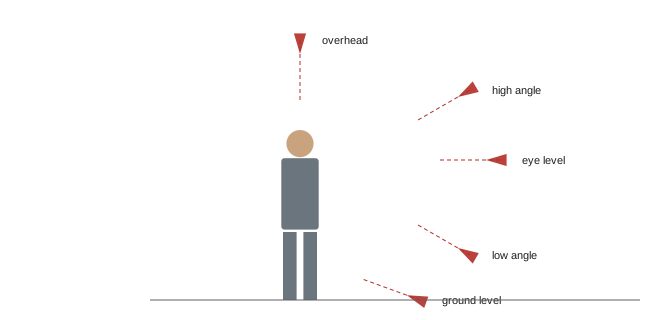
Vertical angle describes whether the camera looks down, up or level at the subject, and camera height describes how high the lens is. They are related but distinct: a camera at eye height can still tilt down or up, and a low camera can shoot level.
- Eye level: the camera at the subject's eye height, level. It is the neutral default, placing the audience on equal terms with the character.
- High angle: the camera above the subject, looking down. It can make subjects look smaller, weaker, vulnerable or observed, and reveals layout of floors, tables and crowds.
- Low angle: the camera below the subject, looking up. It can make subjects look larger, more powerful, heroic or menacing, and can show ceilings, skies and architecture.
- Overhead or top shot: the camera directly above, looking straight down. It creates a graphic, god's-eye view, emphasizing pattern and abstraction; Busby Berkeley musicals and many contemporary title sequences use it.
- Ground level or worm's-eye: the camera on or near the floor, looking up dramatically.
These meanings are tendencies, not rules. Orson Welles and Gregg Toland in Citizen Kane (1941) used low angles that showed ceilings, emphasizing Kane's power and later his entrapment; the same angle in a comedy can make a pompous character absurd.
Subtle height choices
Most coverage uses subtle variations rather than dramatic angles. A camera slightly below eye level, around chest height, is common in drama because it gives faces a little stature and avoids looking down on characters; a camera slightly above eye level can feel softer or more observational. Many DPs choose a consistent default height for a film, such as just below eye level, and deviate from it for specific effects. Height also affects background: lower cameras show more ceiling and sky, higher cameras more floor and ground, which influences set construction and lighting rigging. When characters of very different heights talk, the camera height for each single is chosen to reflect their eyelines and relationship, often shooting slightly up at the shorter character from the taller character's point of view and vice versa, or flattening the difference for equality.
Horizontal angle
Horizontal angle describes where the camera sits around the subject. A frontal view, the camera straight in front, is direct and confrontational, used for address to camera, interrogations and moments of confrontation. A three-quarter view, the most common in drama, shows both eyes and gives the face dimension. A profile view, from the side, is observational and cool, often used for contemplation or for two characters facing each other in a two-shot. A rear view or back angle hides the face, creating mystery or emphasizing what the character sees. In coverage, horizontal angle determines how open each character feels: a "wider" angle that sees more of the face draws the audience in; a "tighter" angle closer to the line between characters, seeing them nearly in profile, feels more distant.
| Angle | Typical effect | Common uses |
|---|---|---|
| Eye level | Neutral, equal | Most dialogue coverage |
| High angle | Vulnerable, diminished, observed | Defeat, surveillance, layout |
| Low angle | Powerful, imposing, heroic or threatening | Authority, menace, triumph |
| Overhead | Graphic, detached, fateful | Patterns, bodies, title sequences |
| Dutch angle | Unease, instability | Disorientation, madness, danger |
| Frontal | Direct, confrontational | Address to camera, confrontation |
| Profile | Observational, cool | Contemplation, two-shots |
Dutch angles
A Dutch angle, or canted angle, tilts the camera on its roll axis so that horizons and verticals are diagonal. The term derives from "Deutsch", referring to German Expressionist cinema of the 1920s, which used distorted, unbalanced compositions. Dutch angles create unease, instability, disorientation or madness, and are associated with thrillers, horror and films noir, such as The Third Man (1949). They can also add energy to action and comedy. Overused, they become a cliché; used precisely, such as tilting gradually as a character becomes unsettled, they can be effective. A small tilt of a few degrees can look like a mistake rather than a choice, so Dutch angles are usually committed to strongly or not at all.
Point-of-view shots
A point-of-view (POV) shot shows what a character sees, from their position. The standard pattern is a shot of the character looking, a POV shot of what they see, and often a return to the character's reaction. POV shots align the audience with the character's perception and are central to suspense: Alfred Hitchcock's Rear Window (1954) is built largely on the protagonist's point of view through his window. True POV shots match the character's eye height and the direction of their look, and may move with their head or body. Some films sustain subjective POV for long passages or entire films, a challenging technique because the audience cannot see the character's face; Lady in the Lake (1947) and Hardcore Henry (2015) are examples. Horror films often use POV shots from an unseen threat, creating dread.
Over-the-shoulder shots
The over-the-shoulder (OTS) shot frames one character from behind and slightly to the side of another, with the foreground character's shoulder and head partially in frame. It is the foundation of conversational coverage, keeping both characters present, establishing their spatial relationship, and providing depth. OTS shots sit between objective and subjective: we see one character's face from near the other's position, sharing their perspective without fully adopting it. The proportion of foreground shoulder in the frame, how close the camera is to the line between characters and the lens used all affect how intimate the OTS feels. Clean singles, with no foreground, feel more isolated; dirty singles and OTS shots feel more connected.
Objective and subjective camera
Shot designers often think about where the camera stands in relation to the story: as an objective observer outside the action, as a participant aligned with a character, or somewhere between. An objective approach uses wide, stable, eye-level shots and avoids POV, giving the audience freedom to judge; a subjective approach uses POV, close shots, handheld movement and eyelines close to the lens, immersing the audience in a character's experience. Many films shift between these modes: objective in establishing scenes, subjective as a character's crisis peaks. Deciding whose story each scene belongs to, whose point of view the camera adopts, is a key question in shot design. A useful practice is to ask, for each scene, "Whose scene is this?" and to favor that character in angle, size and eyeline.
Worked problem
Choosing whose point of view
In a scene, a teenager returns home late and is confronted by a parent. The director wants the audience to experience the scene from the teenager's perspective. How should angles and coverage support this?
Show solution
- Make the teenager the focus character: their coverage is slightly tighter and their eyeline closer to the lens.
- Shoot the parent from roughly the teenager's eye height, slightly low if the parent is taller, so the parent looms.
- Include a POV shot from the teenager of the parent's face or of the clock on the wall.
- Keep the parent's coverage a little wider and more observational, so the audience stays aligned with the teenager.
Answer: Favor the teenager with tighter, closer-to-lens coverage and shoot the parent from the teenager's eye height and POV.
Camera height as a signature
Some filmmakers adopt a distinctive camera height as part of their style. Yasujirō Ozu placed the camera low, often around the height of a person seated on a tatami mat, creating a calm, respectful view of domestic life. Steven Spielberg often uses low angles to give a sense of wonder, particularly in films with child protagonists. Wes Anderson favors eye-level, frontal frames that feel like dioramas. These signatures show that height is not only a scene-by-scene choice but can express a film's overall attitude toward its characters.
Combining angle with other variables
Angle never works alone. Its effect depends on shot size, lens, lighting, performance and editing. A low angle with a wide lens close to a character, lit from below, creates menace; the same angle with a long lens from a distance, in soft daylight, can feel heroic. A high angle on a happy character dancing can feel joyful rather than diminishing. When planning coverage, consider angle together with size, lens and light, and make sure angles across the coverage of a scene are consistent with its point of view and relationships.
Angle and the geometry of power in groups
In scenes with several characters, angles and heights express hierarchy. A boss standing over seated employees can be shot from a low angle from their eye level, while the employees are seen from above in the boss's point of view; a character who rises to challenge the group may be given a lower, more heroic angle at the moment they stand. Directors can also equalize heights deliberately, for example by having characters sit at the same level for a negotiation between equals. Planning angles for groups is closely tied to blocking (Lesson 6), since who stands and who sits, and where each character is placed in the room, determine the angles available.
Practical considerations of camera height
Camera height has practical consequences. Low angles may reveal ceilings, which must then be built or dressed on stage sets, and may show lighting rigs that would otherwise be hidden; high angles show floors, which must be dressed and kept free of cables and marks. Extremely low positions may need special mounts such as a high hat, a low-mode Steadicam or a slider on the floor; very high positions need ladders, cranes, scaffolding or drones, with safety implications (CINE-230). When planning angles in prep, directors and DPs consider these constraints with the production designer and key grip, so that sets and equipment support the shots.
Point of view in genre
Genres use point-of-view shots in distinctive ways. Thrillers and horror films use POV to withhold or reveal information, often from a hidden observer; romantic films use POV to show what a character finds beautiful or fascinating; comedies use POV for reveals and reaction gags. Some films use unreliable POV, showing a character's perception that later proves false, which works only if the audience has been aligned with that character. Planning which characters receive POV shots, and when, shapes the audience's identification across a film.
Overhead shots in storytelling
Overhead shots appear more often in contemporary film and television, partly because drones and remote heads have made them easier. They can show a character alone in a vast landscape, the pattern of a crowd, the geometry of a city or a body lying on a bed or floor, and they often suggest fate, surveillance or detachment. Because they remove the horizon and faces are rarely visible, they work best as punctuation, for transitions or for moments where the abstract shape of the situation matters more than individual expressions.
Angles also interact with lighting: a low angle reveals the undersides of faces and objects lit from above, and a high angle shows more of the floor, where pools of light and shadows define space. The gaffer needs to know planned angles in advance to hide lights and shape these areas.
Common mistakes
MistakeAssuming a low angle always means power.
InsteadConsider context, lens, light and performance.
MistakeSmall accidental tilts that look like mistakes.
InsteadKeep horizons level or commit clearly to a Dutch angle.
MistakePOV shots at the wrong height or direction.
InsteadMatch the character's eye height and eyeline.
MistakeOverusing Dutch angles.
InsteadReserve them for moments of real instability.
MistakeNot deciding whose scene it is.
InsteadFavor the point-of-view character in angle and coverage.
Summary and key terms
- Eye level is neutral; high angles diminish; low angles elevate or threaten.
- Subtle height choices, such as slightly below eye level, shape tone across a film.
- Horizontal angle from frontal to profile changes how open a character feels.
- Dutch angles express instability and should be used deliberately.
- POV shots align the audience with a character's perception.
- OTS shots keep both characters present and create depth.
- Decide whose scene it is and design angles accordingly.
- Eye level
- Camera at the subject's eye height.
- High angle
- Camera above the subject looking down.
- Low angle
- Camera below the subject looking up.
- Overhead shot
- Camera directly above looking down.
- Dutch angle
- Camera tilted on its roll axis.
- Three-quarter view
- Face angled between frontal and profile.
- Point-of-view shot
- Shot showing what a character sees.
- Over-the-shoulder shot
- Shot framed past one character toward another.
- Objective camera
- Camera as detached observer.
- Subjective camera
- Camera aligned with a character's experience.
Practice problems
Work each problem on paper first, then reveal the answer to check.
What does a high angle often suggest?
Show answer
Vulnerability or being observed.
What is the difference between angle and height?
Show answer
Height is lens position; angle is tilt direction.
Why is a slightly low height common in drama?
Show answer
It gives faces stature without looking down on them.
What does a profile view feel like?
Show answer
Observational and cool.
Where does the term Dutch angle come from?
Show answer
Deutsch, from German Expressionism.
What sequence forms a POV pattern?
Show answer
Character looks, POV shot, reaction.
Name a film built on POV.
Show answer
Rear Window (1954).
Why are OTS shots common?
Show answer
They keep both characters present and add depth.
What question decides subjective coverage?
Show answer
Whose scene is this?
What height did Ozu favor?
Show answer
Low, about seated tatami height.
Lesson quiz · 5 questions
Score 60% or more to complete this lesson.
Create a free account to save your progress, take quizzes and earn a certificate.