
CINE-301 · Lesson 5 of 12 · 27 min
Depth staging and composition in motion
A film frame is flat, but cinematographers create the illusion of depth, and depth is one of the richest tools for storytelling. Staging action in depth, with characters and objects arranged from foreground to background, allows several pieces of information to coexist in one shot, reveals relationships, and lets the audience's eye explore. And because the frame moves and its contents move, composition in film is dynamic: frames evolve, reframe and resolve over time. This lesson covers depth cues, layering foreground, middle ground and background, deep focus and selective focus, staging in depth, focus pulls as storytelling, dynamic composition and reframing, planimetric and lateral staging, and the relationship between depth staging and coverage.
Depth cues
The eye perceives depth in a two-dimensional image through several cues, which cinematographers can strengthen or weaken:
- Overlap: objects in front hide those behind.
- Relative size: similar objects appear smaller with distance.
- Linear perspective: parallel lines, such as roads and corridors, converge toward vanishing points.
- Atmospheric perspective: distant objects appear lighter, lower in contrast and bluer, an effect enhanced by haze and smoke.
- Focus: sharp areas read as closer to the plane of attention; blur suggests distance in front of or behind it.
- Light and shadow: separation of planes by brightness, such as a lit subject against a darker background, or backlight that outlines figures.
- Motion parallax: when the camera moves, near objects move faster across the frame than distant ones (CINE-230).
Flat, shallow images arise when these cues are absent: a subject against a plain wall, lit frontally, with no foreground. Deep images layer several cues together.
Foreground, middle ground and background
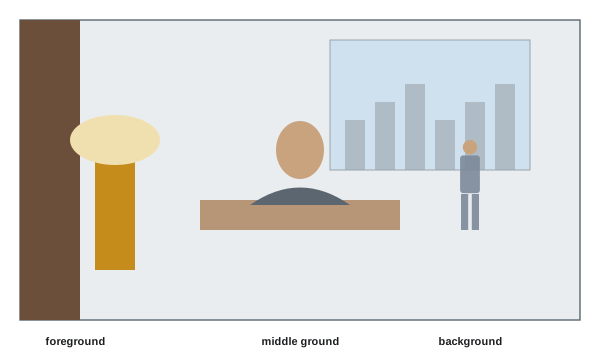
A common compositional strategy is to arrange the frame in three planes: a foreground element close to the camera, the subject in the middle ground, and a background that gives context. Foreground elements can be objects, such as a lamp, a plant or a door frame, or people, such as a shoulder in an over-the-shoulder shot. They add depth, frame the subject, and can convey meaning: bars or blinds in the foreground suggest confinement; a glass of whisky suggests a character's state. Backgrounds should be designed with as much care as subjects: they tell the audience about the world, and busy, bright or poorly placed background elements distract. Production design, lighting and lens choice all shape how the planes relate.
Deep focus and selective focus
Deep focus keeps foreground, middle ground and background sharp at once, allowing staging in depth with several centers of interest. Gregg Toland's cinematography for Citizen Kane (1941) is the classic example, using wide lenses, small apertures, strong light and fast film to keep near and far planes sharp; in one famous scene, Kane's mother signs away her son in the foreground while the boy plays in the snow, visible through a window in the background. Deep focus asks the audience to choose where to look and lets relationships play out in a single frame. Selective focus, by contrast, uses shallow depth of field to isolate a subject against a soft background, directing attention precisely and creating intimacy or separation. Contemporary large-format digital cinematography often favors shallow focus, but deep focus remains a powerful choice; the decision is creative, technical (it depends on light, lens and format) and logistical.
Staging in depth
Staging in depth places characters at different distances from the camera within the same shot, so that their relationships are visible and the scene can unfold without cutting. A character in the foreground can react while another speaks in the background; a character can walk from the background to a close-up in the foreground, changing the shot size without a cut. Staging in depth can carry entire scenes in a single take, creating a rich, theatrical flow while still guiding attention through blocking, focus and light. Directors such as Orson Welles, Kenji Mizoguchi and Steven Spielberg are known for complex depth staging. Spielberg's scenes often begin wide and evolve, through actor movement and subtle camera moves, into shots that function as close-ups and two-shots, giving the editor coverage within a single take.
Worked problem
Staging a scene in depth
A scene shows a mother receiving bad news on the telephone in the kitchen while her teenage son eats breakfast, unaware. The director wants both characters in one shot, with the audience noticing the mother's reaction before the son does. How could it be staged?
Show solution
- Place the son in the foreground at the table, in a medium close-up, eating and looking at his phone.
- Place the mother in the background at the counter, answering the phone, in a full or medium shot.
- Light the mother slightly brighter, or frame her in a doorway, so the eye is drawn to her when she reacts.
- Use deep enough focus to read her face, or rack focus to her at the moment of the news, then back to the son as he looks up.
Answer: Son in the foreground, mother in the background with attention guided by light and focus, possibly with a rack focus at the key moment.
Focus pulls as storytelling
A focus pull, or rack focus, shifts the plane of sharp focus from one subject to another during a shot. It redirects attention without cutting, links two elements, and can reveal information, such as shifting from a character in the foreground to someone appearing in the doorway behind them. Focus pulls should be motivated, by a look, a sound, a movement or a story beat, and timed with performance; the first assistant camera, the focus puller, plans and executes them with marks and rehearsals (CINE-210). Overused or unmotivated focus pulls draw attention to technique. Split diopters, which allow two planes to be sharp at once, are an alternative used notably in films by Brian De Palma.
Dynamic composition and reframing
Because actors and camera move, compositions are constantly changing. Operators reframe continuously to keep subjects well placed, adjusting pan and tilt as actors shift, maintaining lead room and headroom, and keeping key elements in frame. Good reframing is invisible, anticipating rather than chasing movement. Beyond maintenance, dynamic composition can be designed: a frame can begin with a character alone and reveal a second character as the camera moves; a door can open in the background to change the composition; actors can move into new positions that create a new two-shot. Designers think of shots as sequences of compositions, with key frames at important moments, and plan blocking and camera so that each key frame is strong.
Planimetric and lateral staging
Not all strong compositions use depth. Planimetric staging arranges figures parallel to the frame, often against a flat background, with the camera perpendicular to it, producing frontal, tableau-like images. It is associated with directors such as Wes Anderson, Aki Kaurismäki and, in a different way, Jean-Luc Godard, and creates a deadpan, formal or ironic tone. Lateral staging moves action across the frame, parallel to the image plane, often with lateral tracking shots, emphasizing horizontal movement and the flatness of the screen. These approaches show that depth is a choice, not a requirement: the decision to flatten or deepen the frame contributes to style.
| Staging approach | Description | Effect |
|---|---|---|
| Depth staging | Characters at different distances, often with deep focus | Rich relationships, scene in one take |
| Selective focus | Shallow depth isolating a subject | Intimacy, clear attention, separation |
| Planimetric | Figures parallel to a flat background, frontal camera | Formal, deadpan, tableau |
| Lateral | Movement across the frame, often with lateral tracking | Horizontal flow, flatness |
Depth, blocking and coverage
Depth staging changes how a scene is covered. A scene staged in depth with deep focus may need only one or two setups, because the composition shows both characters and their relationship; a scene staged flatly may need more cutting to show reactions. Conversely, scenes planned for extensive coverage are often staged more simply, with characters at similar distances, making it easier to shoot singles and overs that match. A useful approach in planning is to consider whether a scene's key relationships can be expressed in depth, reducing coverage and giving the scene a distinctive shape, or whether the editorial flexibility of traditional coverage is more valuable. Lesson 6 develops blocking further, and Lesson 7 covers coverage strategies.
Depth and lighting
Lighting reinforces depth. Separating planes with contrast, such as a brighter middle ground against a darker foreground and background, or a backlit background with haze, makes depth readable. Pools of light in a deep set guide the eye through planes; practical lights in the background add depth and interest. Atmosphere created with haze softens and lightens distant planes. When the background is too bright or too similar in tone to the subject, depth collapses. Coordination between the DP, gaffer and production designer ensures that depth staging is supported by light and design (CINE-221).
Lens choice and depth
Focal length strongly affects how depth is perceived. Wide-angle lenses exaggerate the distance between planes: a foreground object looks large and the background small and far away, so staging in depth with a wide lens feels expansive and dynamic. Long lenses compress the distance between planes, so that a background appears close behind the subject and objects at different distances seem stacked; this is useful for crowded city streets, isolating a subject in a busy environment, or making a threat in the background feel closer. Because depth of field also depends on focal length, distance and aperture, deep focus is easier with wide lenses and smaller apertures, and selective focus with long lenses and wide apertures (CINE-210).
Worked problem
Choosing a lens for depth staging
A director wants a shot in which a soldier in the foreground watches a convoy approaching along a road in the background, with both sharp, and the convoy feeling far away. Should the DP choose a wide or long lens, and what aperture approach?
Show solution
- A wide lens, such as 24 mm on Super 35, exaggerates the distance between the soldier and the convoy, making it feel far away.
- Wide lenses give more depth of field at a given aperture and distance, making deep focus easier.
- Stopping down to about T5.6 or T8, with enough daylight or light, keeps both the soldier and the convoy acceptably sharp.
- If the convoy should feel close and threatening instead, a long lens would compress the distance, but deep focus would be harder.
Answer: A wide lens stopped down to around T5.6–T8 keeps both planes sharp and makes the convoy feel distant.
Revealing and concealing within the frame
Composition in motion can reveal and conceal information. A character can step aside to reveal another person behind them; a door can open to reveal a room; a camera move can bring a hidden object into frame. Conversely, foreground elements can hide important actions, creating suspense or mystery. Designers plan these reveals as story beats: the moment the audience sees something should coincide with the moment it matters dramatically. Reveals within a shot often feel more natural and powerful than cuts, because the audience discovers information in real time.
Composing for visual effects and virtual production
Depth staging has particular importance when shots include visual effects or LED volume backgrounds. Foreground practical elements, such as real props and set pieces, help anchor actors in a digital environment, and the middle ground must transition convincingly into the virtual background. Depth of field, haze and lighting must match between real and virtual planes. Designers often plan these shots in previs, testing compositions with the virtual environment before building the practical foreground (CINE-302).
An exercise in depth staging is to take a scene usually covered in singles and redesign it as one or two shots in depth, using blocking, focus and light to guide attention. Comparing the results shows what depth staging gains in fluidity and what it loses in editorial flexibility.
Common mistakes
MistakePlacing subjects flat against walls.
InsteadCreate space and layers between subject and background.
MistakeIgnoring the background.
InsteadDesign backgrounds as carefully as subjects.
MistakeUnmotivated focus pulls.
InsteadPull focus on a look, sound, movement or story beat.
MistakeChasing actors when reframing.
InsteadAnticipate movement and design key frames.
MistakeAssuming shallow focus is always better.
InsteadChoose deep or shallow focus for the scene's needs.
Summary and key terms
- Depth cues include overlap, size, perspective, atmosphere, focus, light and parallax.
- Foreground, middle ground and background layers add depth and meaning.
- Deep focus allows multiple centers of interest; selective focus isolates.
- Staging in depth can carry scenes in fewer setups.
- Motivated focus pulls redirect attention without cutting.
- Dynamic composition designs key frames across a shot.
- Planimetric and lateral staging flatten the frame as a stylistic choice.
- Depth cue
- Visual signal that suggests distance.
- Atmospheric perspective
- Distant objects lighter, lower contrast and bluer.
- Foreground
- Plane nearest the camera.
- Deep focus
- Sharpness across near and far planes.
- Selective focus
- Shallow depth isolating a subject.
- Staging in depth
- Placing action at different distances in one shot.
- Rack focus
- Shifting focus between subjects during a shot.
- Reframing
- Adjusting the frame as subjects move.
- Planimetric staging
- Figures arranged parallel to a flat background.
- Key frame
- Important composition within a moving shot.
Practice problems
Work each problem on paper first, then reveal the answer to check.
Name four depth cues.
Show answer
Overlap, size, linear perspective, atmosphere, focus, light, parallax.
What do foreground elements add?
Show answer
Depth, framing and meaning.
Name the classic deep focus film and DP.
Show answer
Citizen Kane, Gregg Toland.
What does selective focus do?
Show answer
Isolates a subject against a soft background.
What can staging in depth reduce?
Show answer
The number of setups needed.
What should motivate a focus pull?
Show answer
A look, sound, movement or story beat.
What is good reframing?
Show answer
Invisible, anticipating movement.
What is planimetric staging?
Show answer
Figures parallel to a flat background with a frontal camera.
How does lighting support depth?
Show answer
Separating planes by contrast, backlight and haze.
What does a split diopter allow?
Show answer
Two planes sharp at once.
Lesson quiz · 5 questions
Score 60% or more to complete this lesson.
Create a free account to save your progress, take quizzes and earn a certificate.