
CINE-221 · Lesson 8 of 12 · 25 min
Night exteriors and moonlight
Night exteriors are among the most demanding scenes in cinematography. The real night offers very little light, the spaces to be lit can be enormous, and the audience must see enough to follow the action while still believing it is dark. Over the history of cinema, conventions have developed for representing night, from blue-tinted day-for-night to large, soft moonlight sources hung from cranes, and modern sensors and LEDs have opened new possibilities for lighting night with practical and existing sources. This lesson covers the conventions of night, moonlight and its representation, ambience and the night sky, streetlights and urban night, lighting large exterior areas from above and afar, wet-downs and reflections, using existing light, day-for-night, and planning and safety for night exteriors.
Conventions of night
Real moonlight is very dim, about 0.1 to 0.3 lux at full moon, roughly 18 to 20 stops below direct sun, and to the eye it appears cool and desaturated because human vision shifts toward the blue and loses color in low light (the Purkinje effect). Films have long represented night with cool, bluish light, deep shadows and selective highlights, a convention audiences accept as night even though real moonlight, photographed with long exposures, is the same color as sunlight, since it is reflected sunlight. Other conventions include strong backlight that outlines figures against darkness, pools of warm or sodium-orange light from streetlights, and visible practicals in windows and on buildings. Some cinematographers reject the blue convention in favor of more neutral or warm nights, especially in cities, where artificial light dominates. Choosing the convention for a film is a stylistic decision.
Moonlight and its representation
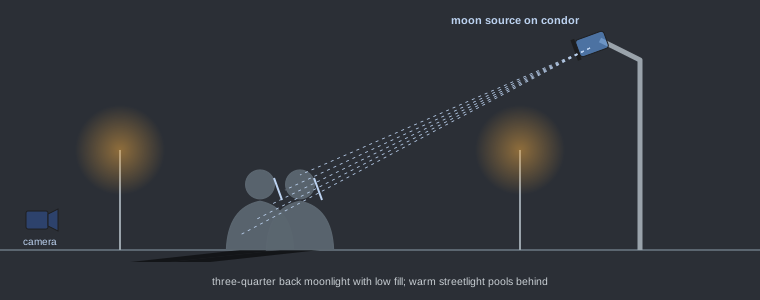
Moonlight on film is usually a large, high, soft or semi-soft source that bathes a scene in low-level cool light from one direction, creating long, soft shadows and backlight. The classic approach places a large HMI or LED, sometimes several, on a condor or crane 20 to 40 m high and some distance from the set, often through diffusion or bounced into a large frame, to create a broad, even, moon-like source. Placing it behind the action, as three-quarter backlight, gives rim light on actors and surfaces and keeps fronts in shadow, which reads strongly as night. A softer, lower-level fill can lift shadows slightly. Color is set by gels or LED settings to the film's chosen moon color, relative to the camera's white balance, from slightly cool to deep blue.
Worked problem
Estimating moonlight from a condor
A cinematographer plans an 18K HMI on a condor 40 m from the action as a backlight moon. At EI 1280, T2.8, 24 fps and 180°, the rim needs about 30 lux. If the fixture at full flood delivers about 3,000 lux at 10 m, will it suffice at 40 m, and how might the level be adjusted?
Show solution
- Inverse square: illuminance at 40 m ≈ 3,000 × (10/40)² = 3,000 × 1/16 ≈ 190 lux.
- That is far more than 30 lux, about 2.6 stops too bright (log₂(190/30) ≈ 2.7).
- Reduce with diffusion and scrims, or by spotting the light less, or use the extra level to cover a larger area with a softer, bounced source.
- Alternatively, a smaller fixture such as a 6K or a large LED may provide enough light for the area.
Answer: About 190 lux at 40 m, roughly 2.5–3 stops more than needed, so it can be diffused, scrimmed or bounced to cover a large area softly.
Ambience and the night sky
In real night scenes, a little ambient light comes from the sky glow, especially in cities where clouds reflect artificial light, and from surrounding surfaces. Without ambience, night scenes become pure black with isolated pools, which can be striking but hard to read. Cinematographers often add a very low, soft ambient level, for example from large overhead soft sources, bounced light or helium balloon lights, enough to suggest shapes in the shadows. The sky itself usually appears black or very dark in night scenes; at dusk or in cities it may retain color. Including the sky in frame, with silhouettes of buildings or trees, helps establish the space.
Streetlights and urban night
Urban nights are lit mainly by artificial light: streetlights, shop windows, signs, headlights, traffic signals and building lights. Their colors vary: older high-pressure sodium streetlights emit an orange light with poor color rendering; metal halide lamps are whiter; many cities have replaced older lamps with LED streetlights, often around 3,000 to 4,000 K, giving a whiter, cooler, more even look. Productions may use the existing street lighting, supplement it with fixtures matching its color, or replace it, by switching off streetlights with municipal permission and placing film lights on lifts or in the streetlight positions. Shop windows and signs can be enhanced with additional light. The mix of colors in a city night, warm windows, cool LEDs, colored signs, creates rich, layered images.
| Urban source | Typical color | Notes |
|---|---|---|
| High-pressure sodium streetlight | Orange (about 2,000 K, poor CRI) | Being replaced in many cities |
| LED streetlight | About 3,000–4,000 K | Whiter, more even, may flicker on camera |
| Metal halide | About 4,000 K | White with some green |
| Shop windows | Warm to cool depending on fixtures | Often enhanced with film lights |
| Neon and LED signs | Saturated colors | Test for flicker and clipping |
| Car headlights | Warm halogen or cool LED | Moving beams; often recreated |
Lighting large exterior areas
When a scene spans a street, a field or a car park, the challenge is to light a large area convincingly with as few fixtures as possible. Typical tools include large HMIs or LEDs on condors as moon or general sources; balloon lights, helium-filled diffused spheres containing HMI or LED sources, which float above the set and give soft, even, shadowless light over large areas without stands in frame, popular for night exteriors and roads; large soft boxes or frames hung from cranes; and many smaller fixtures placed to light key areas and create pools. The approach often combines a broad, low-level ambient or moon source with selective pools motivated by streetlights and windows, and backlight to separate figures. Power requirements are significant, with generators and long cable runs (CINE-220).
Wet-downs and reflections
Wetting streets and surfaces at night, called a wet-down, is a classic technique. Wet asphalt becomes reflective, catching streetlights, signs and backlight in long, shimmering reflections that add depth, sparkle and color to night images. Without water, dark streets absorb light and look dull. Wet-downs require water trucks or hoses, permissions, attention to drainage, ice in cold weather, and safety for actors and crew. Backlight is essential, since reflections appear only when light sources are behind the wet surface relative to the camera. Even small puddles placed in the foreground can add reflections for close-ups.
Using existing light
Modern cameras with high sensitivity and wide dynamic range allow night exteriors to be shot largely with existing light: streetlights, storefronts, signs and car lights, supplemented by small fixtures and LEDs. This approach suits documentaries, independent films and scenes requiring large areas or crowded public spaces where large rigs are impractical. Its success depends on choosing locations with good existing light, positioning actors in or near it, adding small sources to faces matched to the existing colors, controlling exposure so that bright signs do not clip excessively, and accepting that some areas will fall to black. Scouting at night, at the actual shooting time, is essential.
Day-for-night
Day-for-night, shooting night scenes in daylight and darkening them in grading, was common in the era of slow film stocks and remains useful for wide landscapes, deserts, oceans and other places that cannot be lit at night. Successful day-for-night requires shooting with the sun behind or to the side of the subject, so that shadows face the camera and backlit edges resemble moonlight; avoiding the sky in frame where possible, or using filters and grading to darken it; underexposing by 1.5 to 2.5 stops or grading down heavily; using cool color and reduced saturation; and avoiding visible light sources that would be on at night, such as switched-off car headlights. Modern grading tools and sky replacement make day-for-night more convincing than in the past, and some productions shoot dusk-for-night, at twilight, for a more natural sky. Mad Max: Fury Road (2015) used extensive day-for-night grading in its desert night sequences.
Planning and safety for night exteriors
Night exteriors involve long hours, large equipment, generators, lifts, public spaces and cold or wet weather. Planning includes permits for filming, lifts, street closures, streetlight switch-offs and wet-downs; notifying residents; scheduling around sunset and sunrise, since true night may last only a few hours in summer at northern latitudes; rehearsing with camera and lights; and ensuring safety for crew working at height and around traffic.
In the United States, aerial lifts such as condors and scissor lifts are governed by OSHA regulations, which reference the ANSI/SAIA A92 series of standards for design, operation and training, and require operators to be trained and to use fall protection where specified. Film offices and municipalities issue permits for street use.
Wind limits for lifts and balloon lights, cable protection across walkways, high-visibility clothing near traffic and warm shelter for crew are part of every night exterior plan.
Forests, fields and rural nights
Rural night scenes lack the practical sources of cities, so the cinematographer must decide what lights the scene: moonlight, a campfire, car headlights, flashlights or the glow of a distant farmhouse. Forests at night are particularly difficult, since trees block light and absorb it; a high moon source behind the action, rim-lighting trunks and figures, combined with low ambience, can suggest the depth of the forest. Haze adds volume to moonlight shafts through trees. Open fields can be lit by large overhead sources or balloons for broad ambience. Flashlights carried by actors provide motivated, moving light, often supplemented by small LEDs to brighten faces subtly.
Flashlights and handheld sources
Flashlights, phones and lanterns carried by actors create dynamic, motivated light, central to many thrillers and horror films. Real flashlights may be too bright, too narrow, too blue or flicker on camera; film productions often modify them with dimmable LEDs, warmer color, diffusion and wider beams. Because the light moves with the actor, exposure varies constantly; rehearsing movements with the camera and choosing settings that tolerate variation help. Faces of actors holding flashlights are usually lit by spill from the beam bouncing off surfaces, sometimes supplemented by small hidden LEDs on the flashlight body aimed back at the face.
Balancing the sky in night exteriors
In night exteriors where the sky is visible, its brightness affects the mood. A pitch-black sky emphasizes isolation; a dark blue sky with some detail suggests open space and moonlight; a glowing orange city sky indicates an urban setting. On real locations, the sky can be controlled by shooting at different times of night or during blue hour; in grading, the sky can be darkened or tinted with masks. On stages, backings and LED walls represent the night sky and can be adjusted directly. Stars are rarely visible on film without special techniques, so they are usually added in visual effects if needed.
Night exteriors and the camera
Camera choices matter at night. Fast lenses allow lower light levels, reducing the size of rigs, but their shallow depth of field makes focus difficult for moving actors; cinematographers often balance stop and light level carefully. High-sensitivity cameras and dual native ISO settings help, though noise must be tested. Wider lenses include more of the dark surroundings, so they need more of the space lit; longer lenses concentrate on actors and can make small lighting setups go further. Choosing lenses and camera positions with the lighting budget in mind is part of planning night exteriors.
Common mistakes
MistakeFrontal moonlight that flattens the scene.
InsteadPlace moon sources high and behind as backlight.
MistakeNo ambience, leaving shapes invisible.
InsteadAdd a very low soft ambient level.
MistakeDull dry streets.
InsteadWet down with backlight for reflections.
MistakeDay-for-night with sun behind the camera.
InsteadBacklight or side-light and darken in grading.
MistakeOperating lifts without training or permits.
InsteadFollow lift regulations and obtain permits.
Summary and key terms
- Night is conventionally represented with cool light, deep shadow and backlight.
- Real moonlight is extremely dim; film moonlight is a high, large, distant source.
- A low soft ambience keeps shapes readable in darkness.
- Urban nights mix streetlights, windows, signs and headlights of varied colors.
- Condors, balloon lights and large soft sources cover large areas.
- Wet-downs with backlight add reflections and depth.
- Existing light, day-for-night and careful planning and safety complete the toolkit.
- Purkinje effect
- Shift of vision toward blue in low light.
- Moonlight convention
- Representing night with cool backlight.
- Condor
- Boom lift used to raise lights high.
- Balloon light
- Helium-filled diffused light floating above a set.
- Wet-down
- Wetting surfaces to create reflections.
- Sodium vapor
- Orange streetlight with poor color rendering.
- Day-for-night
- Shooting in daylight and grading to night.
- Dusk-for-night
- Shooting at twilight to represent night.
- Ambience
- Low general light level.
- Street closure
- Permitted closure of a road for filming.
Practice problems
Work each problem on paper first, then reveal the answer to check.
Illuminance of full moonlight?
Show answer
About 0.1–0.3 lux.
Why does night look blue to the eye?
Show answer
The Purkinje effect.
Where is a moon source usually placed?
Show answer
High and behind the action.
Illuminance at 30 m if 3,000 lux at 10 m?
Show answer
About 333 lux.
Why add low ambience at night?
Show answer
To keep shapes readable.
Typical LED streetlight color?
Show answer
About 3,000–4,000 K.
What are balloon lights good for?
Show answer
Soft even light over large areas.
Why must wet-downs be backlit?
Show answer
Reflections appear from sources behind the surface.
Name two day-for-night techniques.
Show answer
Backlight, avoid sky, underexpose, cool and desaturate.
Which standards govern aerial lifts in your country?
Show answer
CSA B354 (Canada) or ANSI/SAIA A92 (US).
Lesson quiz · 5 questions
Score 60% or more to complete this lesson.
Create a free account to save your progress, take quizzes and earn a certificate.