
CINE-221 · Lesson 5 of 12 · 25 min
Day interiors and windows
In a day interior, the window is usually the main source, and the way it is handled defines the scene. Real windows bring beautiful, soft, directional light, but they also bring problems: the exterior is often several stops brighter than the room, the sun moves through the day and changes the light through the window, and clouds alter it from minute to minute. Productions therefore often light windows from outside with large fixtures, control the exterior with ND gel, and build the interior light around the window's logic. This lesson covers the window as a source, balancing exterior and interior, lighting through windows from outside, soft window light and hard sun shafts, bouncing and filling inside, ambient and room tone, blinds, curtains and patterns, color in daylight interiors, and stage windows and backings.
The window as a source
A window behaves like a large soft source when lit by skylight or overcast, and like a hard source with a soft fill component when the sun shines through it. Its size relative to the actor determines its softness: a large window close to an actor wraps light around the face; a small window or one far away gives more directional, contrasty light. Its direction relative to the camera is critical. Shooting an actor with the window behind the camera gives flat, frontal light; with the window to the side, strong modeling; with the window behind the actor, a backlit silhouette or rim unless fill is added. Many naturalistic interiors place the camera so that actors are side-lit or three-quarter back-lit by the window, keeping the shadow side toward the camera for depth, a technique often called "shooting into the shadow side".
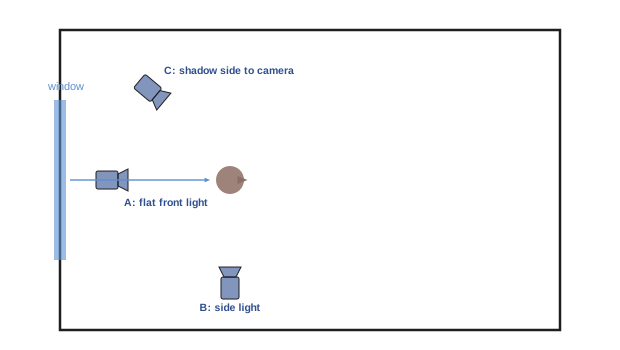
Balancing exterior and interior
On a sunny day, the scene outside a window may be 4 to 6 stops brighter than the faces inside. If exposure is set for the faces, the window clips to white; if set for the exterior, the room falls into darkness. Choices include:
- Accepting a blown-out window, which can feel natural and is common in drama, especially when the exterior is unimportant.
- Applying ND gel to the window glass, in grades from ND 0.3 (1 stop) to ND 1.2 (4 stops) or more, to bring the exterior closer to the interior. Combined ND and color correction gels are available for windows. Gel must be applied smoothly to avoid wrinkles and reflections, usually by experienced grips.
- Adding light to the interior to raise the faces toward the exterior level, which keeps the window natural but requires a lot of light.
- Shooting at times when the exterior is less bright, or when the sun is not hitting the facade.
Most productions combine several of these, for example ND gel on the window to reduce the exterior by 2 stops and extra light inside to lift faces by a stop, leaving the window about 1 to 2 stops brighter than faces, which feels natural.
Worked problem
Planning ND gel for a window
A living-room scene has a window showing a sunny garden. Faces read T2.8 with available light plus a little fill; the garden reads T16. The cinematographer wants the garden visible about 1.5 stops brighter than faces. How much ND is needed on the window if the interior is not raised?
Show solution
- Difference between garden and faces: T2.8 to T16 is 5 stops.
- Desired difference: 1.5 stops, so the window must be reduced by 3.5 stops.
- ND density needed ≈ 3.5 × 0.3 = 1.05; ND 0.9 plus a little extra (or ND 1.2 with interior lifted by half a stop).
- A practical choice is ND 1.2 on the window and half a stop of additional interior light.
Answer: About 3.5 stops of reduction: ND 1.2 on the glass with the interior lifted about half a stop, or ND 0.9 plus about two-thirds of a stop more interior light.
Lighting through windows from outside
Because real daylight through windows changes constantly, productions often create their own controlled daylight by placing large lights outside the windows. HMIs from 6K to 18K, or large LED fixtures, are placed on stands, scaffolds, condors (boom lifts) or rooftops, shining through the windows, often through diffusion frames to soften them. For hard sun shafts, a single large Fresnel or PAR at a distance gives crisp shadows and parallel rays; for soft daylight, lights are bounced off large white frames or pushed through heavy diffusion outside the window. The exterior lights can be kept consistent all day, and the real sky can be reduced with ND gel and blacked out entirely for day-for-night. On upper floors, lifts and scaffolds bring lights to the right height, requiring planning, permits and safety measures. In the studio, window light comes from lights placed behind the set walls.
Soft window light and hard sun shafts
Two characteristic daylight looks are soft window light, gentle and directional, as in a north-facing studio or on an overcast day; and hard sun shafts, beams of sunlight falling across floors, walls and actors, creating bright patches and strong shadows, often with haze in the air to make the beams visible. Soft window light is achieved with large diffusion frames or bounce surfaces outside the window, or with the window itself covered in diffusion. Hard sun is achieved with a single, powerful, distant source; the farther away, the more parallel the shadows, as with real sun. The angle of the sun shaft should match the time of day: low and long for morning and evening, steeper for midday. Combining a hard sun shaft on part of the set with soft skylight fill elsewhere reproduces a sunny day convincingly.
Bounce and fill inside
Light entering a real room bounces off floors, walls and ceilings, filling shadows. On set, this is reproduced and controlled with bounce boards, white frames and soft fixtures inside the room, often placed on the window side to extend the window's light deeper into the room, or near the camera for gentle fill. A book light, a light bounced into a white surface and then through diffusion, creates very soft, controllable fill that feels like light reflected from a sunlit floor. Sunlight striking a floor produces warm bounce upward onto faces, which can be reproduced with a low bounce board or a dim, warm soft light below eye level. Fill must remain subordinate to the window, otherwise the logic of the source is lost.
Ambience, depth and contrast
Real daylight interiors usually fall off from bright near the window to darker away from it. This gradient gives rooms depth and helps separate actors from backgrounds. Lighting too evenly across a room flattens it. Common techniques include letting the far side of the room fall a stop or two darker than the window side; using flags and negative fill to stop window light spilling evenly onto background walls; adding small accents, such as a sunlit patch on a wall or a practical lamp in a dark corner; and ensuring that background walls are not brighter than faces unless motivated. Deeper rooms or rooms with dark walls need more ambience to keep detail; small white rooms may need negative fill to avoid flatness.
Blinds, curtains and patterns
Window treatments shape light and add character. Sheer curtains diffuse light, acting as built-in diffusion; heavy curtains block light, with gaps creating slits of light; venetian blinds cast stripes, a classic noir look, whose angle depends on the light's angle and whose sharpness depends on the source's size and distance; shutters and lattices create patterns. For hard patterns, the light outside must be a small, distant, hard source; diffusing it softens the pattern. Production designers and set decorators choose treatments in collaboration with the cinematographer. Patterns can also be created with cookies (cucoloris) and gobos in front of lights to suggest foliage or architecture outside the window.
Color in daylight interiors
Daylight interiors often mix color temperatures: cool daylight through windows and warm tungsten-like practicals inside. Many cinematographers embrace this mix, setting the camera's white balance to a value between daylight and tungsten, such as 4,300 K, so that window light reads slightly cool and practicals warm, creating color contrast that feels natural. Others correct practicals to daylight with blue gels or daylight bulbs for a neutral look. Large interior fills should match the logic: window-side fill matched to the window's color, practical-side fill matched to the practicals. Bounce from colored walls tints the light, such as green from painted walls or warm from wood floors, which may need to be enhanced, reduced or corrected.
| Situation | Typical color approach |
|---|---|
| Window daylight plus warm practicals | White balance around 4,000–4,500 K; windows slightly cool, practicals warm |
| Neutral modern office | Match practicals and fills to window color |
| Warm nostalgic interior | Warm the window light with CTO or LED settings |
| Cold, bleak interior | Leave window cool; dim or remove warm practicals |
| Late afternoon sun | Warm hard sun shaft, cooler soft fill |
Stage windows and backings
On stage sets, windows look out onto backings: painted or photographic translights, LED walls displaying images or video, or green screens for later compositing. The backing must be lit or set to a level consistent with the daylight logic, typically a stop or two brighter than faces for a bright day, and its color must match the window light. Translights are lit from behind or in front; LED walls emit their own light and can also light the actors and set, adding realism. The perspective, focus and parallax of the backing must suit the camera; LED walls with camera tracking can display images whose perspective changes with camera movement, a technique covered in CINE-302.
Lighting through windows at different times of day
A day interior shot over a full day sees the sun move through windows, changing the light dramatically. Morning sun through an east window floods the room with warm, low light; by noon, the window may be in shade, giving soft skylight; in the afternoon, sun may enter from another side. To maintain continuity, productions often black out windows that receive changing sunlight and replace it with controlled exterior sources, or tent the windows with fabric to exclude the real sun while lighting through them. On upper floors where exterior rigging is impossible, interior sources placed near the windows, such as large soft boxes or bounced lights, can imitate window light convincingly, as long as they stay out of frame.
Reflections in windows and glass
Windows and glass in frame reflect the room, the crew and lights, especially when the exterior is dim. Polarizing filters can reduce reflections at certain angles, and dulling spray or angled glass can help, but the most reliable solutions are controlling what the glass reflects: dressing or blacking the areas reflected, moving lights out of the reflection angle and adjusting the camera position. Removing glass from window frames, where possible, eliminates reflections entirely and is common on sets. ND gel applied to glass also reflects some light and must be checked from the camera position.
Doors, hallways and secondary windows
Rooms rarely have a single opening. Doors to lit hallways, windows on other walls and skylights add secondary sources that provide back light, edge light and depth. A sunlit doorway behind an actor can provide a natural rim; a window on the far wall can light the background and give the room dimension. Planning these secondary sources, and controlling their levels relative to the main window, gives interiors a layered, realistic feel and offers motivation for back light that might otherwise seem arbitrary.
Common mistakes
MistakeShooting with the window behind the camera by default.
InsteadConsider side or back window light and shoot into the shadow side.
MistakeWrinkled or reflective ND gel on windows.
InsteadHave grips apply gel smoothly and check reflections.
MistakeLighting the whole room evenly.
InsteadKeep the natural fall-off away from the window.
MistakeFill brighter than the window.
InsteadKeep fill subordinate to the source.
MistakeHard blind patterns from a diffused source.
InsteadUse a small, distant, hard source for patterns.
Summary and key terms
- Windows act as large soft or hard sources depending on sky and sun.
- Camera position relative to the window shapes the look; shooting into the shadow side adds depth.
- Balance exterior and interior with ND gel, interior light or acceptance of blown windows.
- Lights outside windows create controllable, consistent daylight.
- Soft window light and hard sun shafts need different source sizes and distances.
- Bounce extends window light; fill stays subordinate.
- Window treatments, color mix and stage backings shape daylight interiors.
- Shooting into the shadow side
- Placing the camera so the shadow side of faces faces it.
- ND gel
- Neutral density film applied to windows.
- Condor
- Boom lift used to raise lights or crew.
- Sun shaft
- Beam of hard sunlight through a window.
- Book light
- Light bounced into a surface then through diffusion.
- Fall-off
- Decrease of light with distance into a room.
- Venetian blinds
- Slatted blinds that cast stripes.
- Cookie
- Patterned panel that breaks up light.
- Translight
- Large photographic backing for windows.
- Backing
- Scenery seen through a set window.
Practice problems
Work each problem on paper first, then reveal the answer to check.
What does shooting into the shadow side mean?
Show answer
Camera placed so the shadow side of faces faces it.
Typical exterior-to-interior difference on a sunny day?
Show answer
About 4–6 stops.
ND density for 2 stops?
Show answer
ND 0.6.
Name three options for bright windows.
Show answer
Accept clipping, ND gel, add interior light, change timing.
Why light through windows from outside?
Show answer
Consistent, controllable daylight.
How do you create a hard sun shaft?
Show answer
A single powerful distant hard source.
What is a book light?
Show answer
Light bounced into a surface and through diffusion.
Why keep fall-off across a room?
Show answer
It adds depth and realism.
What white balance mixes window and practicals pleasingly?
Show answer
About 4,000–4,500 K.
Name two kinds of stage window backing.
Show answer
Translights, LED walls, painted backings, green screen.
Lesson quiz · 5 questions
Score 60% or more to complete this lesson.
Create a free account to save your progress, take quizzes and earn a certificate.