
CINE-221 · Lesson 12 of 12 · 25 min
Designing a lighting style for a film, and capstone
Individual scenes may be lit beautifully, but a film needs a coherent lighting style: a set of choices about light that expresses the story, evolves with its characters and holds together from the first frame to the last. Designing that style is one of the cinematographer's central creative responsibilities, carried out in collaboration with the director, production designer, costume designer, gaffer and colorist. This final lesson covers the elements of a lighting style, deriving style from story, visual arcs and contrast between worlds, look books and lighting bibles, scouting and technical scouts, lighting plans and pre-rigs, budget and crew, communicating with the gaffer and team, case studies, and the capstone project.
Elements of a lighting style
A lighting style is defined by consistent decisions about:
- Key and contrast: high-key or low-key, overall contrast ratios, how deep shadows fall.
- Quality: hard or soft sources, or a mixture used with meaning.
- Direction: favored directions, such as side light, backlight, top light or frontal light.
- Color: palettes for day and night, warm and cool contrasts, saturated or muted.
- Motivation: strict naturalism, heightened naturalism or expressive departures.
- Practicals and visible sources: their prominence, color and density.
- Movement and change: static light or light that changes within scenes.
- Texture: haze, diffusion, flare and the overall feel of the image.
These choices interact with camera, lenses, composition and grading to form the film's visual language. A clear style helps the whole team make consistent decisions when the cinematographer is not present.
Deriving style from story
Style should grow from the story's themes, characters and world. Questions to ask include: what is this film about emotionally? Whose point of view do we share? How do the characters' situations change? What world do they live in, and how does it feel? A story of isolation might suggest single sources, darkness and cool color; a story of warmth and community, soft light, warm practicals and lower contrast; a thriller, hard light and deep shadows; a memory piece, soft, warm, diffused light. Period and place matter: the sources available in 1890 differ from those in 1970 or 2026, and the light of a northern Canadian winter differs from a Los Angeles summer. Style is not decoration; it should tell the audience something about the story, even if they do not consciously notice.
Visual arcs and contrasting worlds
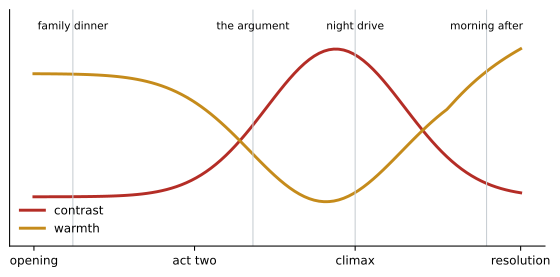
Lighting can change across a film to follow a character's journey or a shift in tone. A visual arc might move from warm, soft light in a happy opening to harder, cooler light as conflict grows, then to a new kind of light at the resolution. Films with contrasting worlds, such as past and present, reality and dream, home and away, or two families, often give each world its own lighting style, so that audiences instantly know where they are. These contrasts can involve color, contrast, quality and motivation. Planning the arc scene by scene, often in a chart or color script, ensures that changes are deliberate and well timed.
Look books and lighting bibles
A look book (Lesson 2) communicates the intended style with references and text. For complex productions, cinematographers and gaffers may develop a more detailed lighting bible, describing the approach for each set and situation: the sources and their colors, typical ratios, practical lists, rules for night and day, and examples from tests. Series television, where several directors and sometimes several cinematographers share a show, relies on such documents to maintain consistency across episodes and seasons. Look books and bibles should be concise, visual and specific, with references that show principles rather than random beautiful images.
Scouting and technical scouts
Location scouting lets the cinematographer evaluate the light of each place: window directions, sun paths at the planned shooting times, existing fixtures, ceiling heights, power availability, access for lifts and trucks, and neighbors and permits. Scouts at the actual time of day for each scene reveal how light will behave. The technical scout, or tech scout, brings together the director, cinematographer, gaffer, key grip, production designer, first assistant director, locations manager and others to walk each location or set, agree on camera positions and lighting plans, identify rigging and power needs, and anticipate problems. Photographs, measurements, sun app screenshots and notes from scouts feed directly into the lighting plan.
Lighting plans and pre-rigs
For each set or location, the cinematographer and gaffer develop a lighting plan: a diagram showing fixtures, positions, modifiers, gels, power and control, often with a list of equipment. Large or complex sets are pre-rigged days before shooting by a rigging crew, so that on the shooting day the lighting is already in place and needs only refinement. Pre-rigging is common on stages, large locations, night exteriors with lifts and sets with many practicals. Lighting control setups, with fixtures patched to consoles and presets programmed, allow quick changes between scenes and times of day. The plan also considers how lighting will change between setups, to minimize time spent relighting.
Worked problem
Planning a lighting plan for a diner
A film has three scenes in a roadside diner: a sunny afternoon, a dusk scene and a late-night scene. The production designer has installed pendant lamps, a neon sign and counter lights. How might the cinematographer and gaffer plan the lighting?
Show solution
- Fit all practicals with controllable film bulbs and LED tape under the counter, patched to a wireless console.
- Rig large sources outside the windows on stands or lifts: a hard HMI or LED as afternoon sun at a low angle and soft daylight frames for skylight.
- Hang soft overhead sources above the booths, skirted and on dimmers, for ambience matched to the pendants.
- Program presets: afternoon (sun shafts, practicals low), dusk (warm low sun fading, practicals rising, blue window fill), night (sun off, window exteriors dark blue or orange streetlight, practicals and neon as keys).
- Pre-rig the day before so that each scene changes with a console cue and minor adjustments.
Answer: Controllable practicals, exterior sun and sky sources, overhead ambience and programmed presets for each time of day, all pre-rigged.
Budget and crew
Lighting style must be achievable within the production's budget, schedule and crew. Large overheads, condors, balloon lights, long pre-rigs and big generators are expensive. Cinematographers prioritize: where the money and time should go to achieve the most important scenes, and where simpler approaches will do. An ambitious night exterior may justify a large rig, while other scenes rely on practicals and small LEDs. The size of the electric and grip crews determines how quickly setups can change. Discussing priorities early with the producer, line producer and gaffer avoids compromises on the day. Styles built on naturalism with practicals and existing light can be both beautiful and economical, which is one reason they are popular on independent productions.
Communicating with the gaffer and team
The gaffer, head of the electric department, translates the cinematographer's ideas into fixtures, power and control, and the key grip shapes and supports the light. Effective communication uses the shared vocabulary of light: describing sources, quality, direction, color and ratios rather than naming specific fixtures, which the gaffer may know how to achieve better. Sharing references, diagrams and the lighting bible, walking the set together and explaining the story intention of each scene help the team anticipate needs. On the day, clear, concise instructions and trust in the crew's expertise keep work efficient. Many cinematographers form long-term partnerships with gaffers and key grips who understand their style.
Case studies
Studying how cinematographers have built lighting styles for whole films is valuable. Examples worth analyzing include The Godfather (1972), with Gordon Willis's top-lit, low-key interiors contrasting with sunlit exteriors; Days of Heaven (1978), with Néstor Almendros's magic-hour naturalism; Barry Lyndon (1975), with John Alcott's candlelit interiors and painterly daylight; In the Mood for Love (2000), with Christopher Doyle and Mark Lee Ping-bing's saturated, practical-led nights; The Revenant (2015), with Emmanuel Lubezki's natural-light wilderness; Moonlight (2016), with James Laxton's color-rich, emotionally driven light; and Blade Runner 2049 (2017), with Roger Deakins's bold, designed light in large spaces. For each, ask how the lighting style serves the story, how it varies across the film, and what sources motivate it.
Capstone: lighting design for a short film
The capstone asks you to design the lighting for a short film or a sequence of scenes from a script, and to execute at least one scene. Your submission should include:
- A statement of the story and its emotional arc, and the lighting style you propose, with reasons.
- A look book with references for each major location and time of day, and notes on principles taken from them.
- Floor plans with source maps and lighting plans for three scenes: one day exterior or interior with windows, one night interior and one night exterior or dusk scene.
- Equipment lists, power estimates and a simple schedule that considers sun times and twilight.
- Execution of at least one scene, lit and filmed, with production stills of the setup, frame grabs, meter readings and a short analysis of what worked and what you would change.
- Notes on safety, permits and crew roles for your plan.
Present the design as you would to a director and gaffer in prep, clearly and visually.
Style and the colorist
The lighting style extends into the grade. The colorist can reinforce the style by refining contrast, color and texture, and can help unify scenes shot in different conditions. Cinematographers often share the look book, lighting bible and test grades with the colorist during prep, and some create show LUTs that encode part of the style for monitoring on set (CINE-202). Planning which aspects of the look will be created on set and which in the grade avoids conflict: lighting choices such as direction, quality and practicals cannot be changed in grading, while overall color and contrast can be refined.
Developing your own style
Over a career, cinematographers develop personal tendencies: preferred qualities of light, ways of handling darkness, favorite color relationships. These tendencies become a recognizable signature, but the best cinematographers adapt their style to each story rather than imposing it. Reflecting on your own work, noticing which choices you return to and why, and deliberately trying approaches outside your comfort zone, helps develop range. Studying the evolving work of cinematographers over many films shows how styles mature.
Evaluating the style during production
During shooting, reviewing dailies with the director and colorist shows whether the lighting style is working. Questions to ask include whether scenes feel consistent with the plan, whether the visual arc is visible, whether any scenes look out of place, and whether the practical realities of locations have forced compromises that need addressing. Adjusting the approach early, before many scenes have been shot, is far easier than trying to fix inconsistencies in the grade. Keeping a running log of decisions and changes helps maintain the style across a long shoot.
Lighting style in series television
In series television, a lighting style must last across many episodes, directors and sometimes cinematographers. The original cinematographer, often working on the pilot, establishes the style, which is then documented and maintained by successors. Standing sets are lit with pre-rigged, controllable systems that reproduce the style quickly. Flexibility is needed for new locations and story developments, but the core rules of the style give the show its identity.
Common mistakes
MistakeLighting each scene in isolation.
InsteadDesign a coherent style and arc for the whole film.
MistakeChoosing a style for its own sake.
InsteadDerive style from story, character and world.
MistakeScouting at the wrong time of day.
InsteadScout at planned shooting times with sun apps.
MistakeNaming fixtures instead of describing light.
InsteadDescribe sources, quality, direction, color and ratios.
MistakeIgnoring budget until the shoot.
InsteadPrioritize resources for key scenes in prep.
Summary and key terms
- A lighting style defines key, contrast, quality, direction, color, motivation and texture.
- Style should grow from story, character, period and place.
- Visual arcs and contrasting worlds give lighting narrative meaning.
- Look books and lighting bibles communicate the style.
- Scouts and tech scouts inform lighting plans and pre-rigs.
- Budget, crew and priorities shape what is achievable.
- Clear communication with gaffer and grips realizes the design.
- Lighting style
- Consistent set of lighting choices for a film.
- Visual arc
- Change in visual style across a story.
- Color script
- Chart of color and mood across scenes.
- Lighting bible
- Detailed document of lighting approaches for a show.
- Tech scout
- Location walk-through by department heads.
- Lighting plan
- Diagram and list of fixtures for a set.
- Pre-rig
- Installing lighting before the shooting day.
- Preset
- Stored lighting state on a console.
- Gaffer
- Head of the electric department.
- Key grip
- Head of the grip department.
Practice problems
Work each problem on paper first, then reveal the answer to check.
Name five elements of a lighting style.
Show answer
Key, contrast, quality, direction, color, motivation, practicals, movement, texture.
Where should style come from?
Show answer
Story, characters, period and world.
What is a visual arc?
Show answer
Change in visual style following the story.
Why give contrasting worlds different lighting?
Show answer
So audiences instantly know where they are.
What is a lighting bible?
Show answer
A detailed document of lighting approaches for a show.
Who attends a tech scout?
Show answer
Director, DP, gaffer, key grip, designer, 1st AD, locations and others.
Why pre-rig?
Show answer
Lighting is ready on the shoot day, saving time.
How should the DP communicate with the gaffer?
Show answer
Describe sources, quality, direction, color and ratios.
Name two films noted for lighting style.
Show answer
The Godfather, Days of Heaven, Barry Lyndon, Moonlight, Blade Runner 2049.
Name three capstone components.
Show answer
Style statement, look book, floor plans, equipment, executed scene, safety notes.
Lesson quiz · 5 questions
Score 60% or more to complete this lesson.
Create a free account to save your progress, take quizzes and earn a certificate.