
CHEM-271 · Lesson 9 of 12 · 22 min
Phase equilibria of pure substances: phase diagrams and the Clapeyron equation
▶ Video coming soon A video version of this lesson is on the way.
A pure substance can exist as a solid, a liquid or a gas, and many substances have several solid forms as well. Which phase is stable depends on temperature and pressure, and the boundaries between phases follow from the condition found in lesson 8: at equilibrium, the chemical potential of the substance is the same in every phase present. This lesson uses that condition to explain phase diagrams, derives the Gibbs phase rule, and obtains the Clapeyron and Clausius–Clapeyron equations, which give the slopes of the phase boundaries from enthalpies and volumes of transition. The examples are water and carbon dioxide, two substances whose phase diagrams matter to everyone from weather forecasters to food scientists.
Phases and phase diagrams
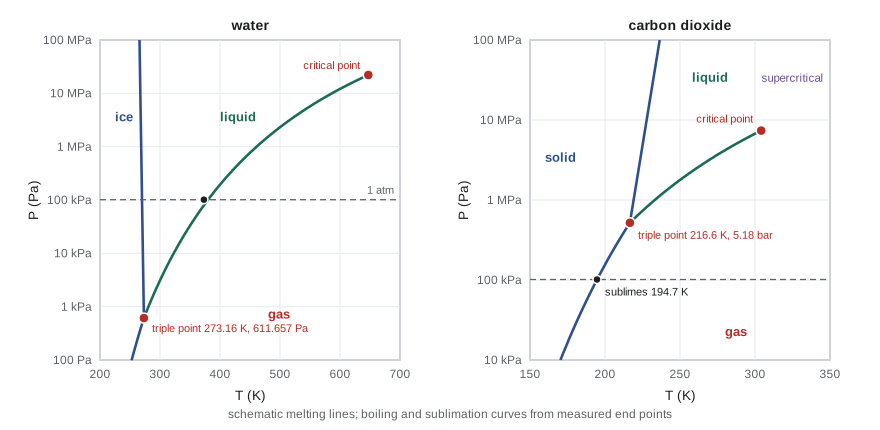
A phase is a form of matter that is uniform in chemical composition and physical state throughout. Ice, liquid water and water vapor are three phases of water; a mixture of ice and liquid is a two-phase system. A phase diagram maps the regions of temperature and pressure in which each phase is the stable one, that is, the phase with the lowest chemical potential. The lines separating the regions are phase boundaries, and along each one two phases have equal chemical potentials and coexist at equilibrium.
The boundary between liquid and vapor gives the vapor pressure of the liquid at each temperature, and the temperature at which the vapor pressure equals 1 atm is the normal boiling point; at 1 bar it is the standard boiling point, which for water is 99.6 °C. The boundary between solid and vapor gives the vapor pressure of the solid, and the boundary between solid and liquid gives the melting temperature as a function of pressure. The three boundaries meet at the triple point, the single temperature and pressure at which solid, liquid and vapor coexist. The liquid–vapor boundary ends at the critical point, beyond which there is a single fluid phase, as lesson 2 described for carbon dioxide.
The phase rule
How many variables can be changed independently while keeping a given set of phases in equilibrium? Gibbs answered this in 1876 with the phase rule. For a system with C components and P phases at equilibrium, the number of degrees of freedom is
\[F = C - P + 2.\]
The derivation is a count. Each phase has its own composition, described by C − 1 mole fractions, and the whole system shares one temperature and one pressure, giving P(C − 1) + 2 variables. Equality of the chemical potential of each component in all P phases imposes C(P − 1) equations. Subtracting gives F = C − P + 2. For a pure substance, C = 1, so F = 3 − P. A single phase has F = 2: temperature and pressure can both be varied, and the phase fills an area on the diagram. Two phases have F = 1: choosing the temperature fixes the pressure, and coexistence is confined to a line. Three phases have F = 0: they can coexist only at a point, the triple point. A pure substance can never have four phases in equilibrium.
Because the triple point of water is fixed by nature, it served from 1954 to 2019 as the defining point of the kelvin, assigned exactly 273.16 K. Its pressure is 611.657 Pa, only about 0.006 of an atmosphere. Since the 2019 redefinition the triple point temperature is a measured quantity, still equal to 273.16 K within the uncertainty of measurement.
Water and carbon dioxide
The phase diagram of water has one feature shared with very few substances: its solid–liquid boundary slopes slightly to the left. Ice is less dense than liquid water, by about one part in eleven, so raising the pressure favors the liquid and lowers the melting point. The effect is small, about 0.0074 K per bar, and it is not, as often claimed, what makes ice slippery for skaters: the pressure under a skate blade lowers the melting point by only a few kelvin at most, which cannot explain skating at −20 °C. A thin, mobile surface layer on ice, present even well below 0 °C, and frictional heating are the main reasons. At very high pressures, water has more than a dozen crystalline forms, many first mapped by Percy Bridgman at Harvard, who received the 1946 Nobel Prize in Physics for his work on high pressures; above about 2 kbar, the stable ices are denser than the liquid, and their melting curves slope to the right.
Carbon dioxide behaves like most substances: its solid is denser than its liquid, so its melting line slopes to the right. Its triple point lies at 216.6 K and 5.18 bar, well above atmospheric pressure. Liquid carbon dioxide therefore cannot exist at 1 atm at any temperature, and solid carbon dioxide, dry ice, sublimes directly to gas at 194.7 K (−78.5 °C). Liquid CO₂ exists only in pressurized cylinders, such as fire extinguishers and soda-fountain tanks. Its critical point, at 304.1 K and 73.8 bar, is easy to reach, and supercritical CO₂ is widely used as a solvent: it dissolves caffeine from green coffee beans, extracts hop oils and essential oils, and is easily removed afterwards by lowering the pressure.
The Clapeyron equation
Along a phase boundary between phases α and β, the chemical potentials are equal: \(\mu_\alpha(T, P) = \mu_\beta(T, P)\). If we move a small distance along the boundary, changing T by dT and P by dP, the chemical potentials must change by equal amounts to stay equal. For a pure substance \(\mathrm{d}\mu = -S_\mathrm{m}\,\mathrm{d}T + V_\mathrm{m}\,\mathrm{d}P\), so
\[-S_{\alpha}\,\mathrm{d}T + V_{\alpha}\,\mathrm{d}P = -S_{\beta}\,\mathrm{d}T + V_{\beta}\,\mathrm{d}P \quad\Rightarrow\quad \frac{\mathrm{d}P}{\mathrm{d}T} = \frac{\Delta_\mathrm{trs}S}{\Delta_\mathrm{trs}V} = \frac{\Delta_\mathrm{trs}H}{T\,\Delta_\mathrm{trs}V}.\]
This is the Clapeyron equation, found by Émile Clapeyron in 1834 and derived rigorously from the second law by Rudolf Clausius in 1850. It is exact. For melting, \(\Delta_\mathrm{fus}H\) is positive, and the slope of the melting line has the sign of \(\Delta_\mathrm{fus}V\). For water at 0 °C, \(\Delta_\mathrm{fus}V = -1.63\ \mathrm{cm^3\,mol^{-1}}\), so \(\mathrm{d}P/\mathrm{d}T = 6010/(273.15 \times -1.63 \times 10^{-6}) = -1.35 \times 10^{7}\ \mathrm{Pa\,K^{-1}}\), about −135 bar per kelvin. It takes 135 bar to lower the melting point of ice by one degree. The melting lines of other substances are equally steep but slope the other way.
The Clausius–Clapeyron equation
For equilibria involving a gas, two good approximations simplify the Clapeyron equation. The molar volume of the gas is so much larger than that of the liquid or solid that \(\Delta V \approx V_\mathrm{m}(\mathrm{g})\), and if the vapor behaves ideally, \(V_\mathrm{m}(\mathrm{g}) = RT/P\). Substituting gives the Clausius–Clapeyron equation,
\[\frac{\mathrm{d}\ln P}{\mathrm{d}T} = \frac{\Delta_\mathrm{vap}H}{RT^2}, \qquad \ln\frac{P_2}{P_1} = -\frac{\Delta_\mathrm{vap}H}{R}\Bigl(\frac{1}{T_2} - \frac{1}{T_1}\Bigr),\]
where the integrated form assumes that \(\Delta_\mathrm{vap}H\) is constant over the range. A plot of ln P against 1/T is then a straight line of slope \(-\Delta_\mathrm{vap}H/R\), which gives a simple way of measuring enthalpies of vaporization from vapor pressures. The same equation, with \(\Delta_\mathrm{sub}H\), describes sublimation. Because \(\Delta_\mathrm{sub}H = \Delta_\mathrm{fus}H + \Delta_\mathrm{vap}H\), the sublimation curve is steeper than the vaporization curve where they meet at the triple point.
Vapor pressure rises steeply with temperature. For water it roughly doubles for every 10 to 12 K near room temperature, which is why warm air can hold much more water vapor than cold air, why hot summer days feel humid, and why the amount of water vapor in the atmosphere is expected to rise by about one part in fifteen for each kelvin of warming. Climate scientists refer to this scaling simply as the Clausius–Clapeyron relation.
Boiling at altitude and under pressure
A liquid boils when its vapor pressure equals the pressure above it. At high altitude the atmospheric pressure is lower, so water boils at a lower temperature, and food takes longer to cook. In Denver, at about 1609 m, the average air pressure is near 83 kPa and water boils at about 94.5 °C; at the summit of Pikes Peak, at about 4300 m, it boils near 86 °C. A pressure cooker works the other way: it seals the pot and lets the pressure rise to about 2 bar absolute, so that water boils near 120 °C and food cooks several times faster. Hospital autoclaves sterilize instruments with steam at about 121 °C for the same reason.
The phase diagram also explains freeze-drying. Below the triple-point pressure, ice cannot melt; it can only sublime. Food or a pharmaceutical is frozen and then placed under a vacuum well below 611 Pa, and the ice sublimes away without passing through the liquid, leaving a porous dry solid that keeps its structure and rehydrates quickly. Instant coffee, field rations, many vaccines and the meals carried by astronauts are prepared this way.
A worked example: the slope of a phase boundary
Worked problem
Lowering the melting point of ice
At 273.15 K, ΔfusH = 6.01 kJ/mol, the density of ice is 0.9167 g/cm³ and that of water 0.9998 g/cm³. Find dP/dT for the melting line and the melting point at 500 bar.
Show solution
- Molar volumes: 18.015/0.9167 = 19.652 cm³/mol for ice and 18.015/0.9998 = 18.019 cm³/mol for water.
- ΔfusV = 18.019 − 19.652 = −1.633 cm³/mol = −1.633 × 10⁻⁶ m³/mol.
- dP/dT = 6010/(273.15 × −1.633 × 10⁻⁶) = −1.347 × 10⁷ Pa/K = −134.7 bar/K.
- Raising the pressure by 499 bar lowers the melting point by 499/134.7 = 3.7 K.
Answer: About −135 bar/K; the melting point at 500 bar is about −3.7 °C.
The measured melting point of ice at 500 bar is close to −4 °C, in good agreement; the small difference arises because ΔH and ΔV themselves change along the curve. The same calculation for a typical substance whose solid is denser than its liquid gives a slope of about +30 to +50 bar/K.
A program: a Clausius–Clapeyron fit
The program fits the integrated Clausius–Clapeyron equation to measured vapor pressures of water between 20 °C and 100 °C by least squares, finds the enthalpy of vaporization from the slope, and uses the fit to predict the boiling point at the average air pressure of a city at altitude, estimated from the standard atmosphere. It also evaluates the Clapeyron slope for melting ice.
import math

R = 8.314462618
data = [(20, 2.339), (30, 4.246), (40, 7.384), (50, 12.35), (60, 19.94),
        (70, 31.20), (80, 47.41), (90, 70.18), (100, 101.42)]   # t in C, P in kPa
x = [1 / (t + 273.15) for t, _ in data]
y = [math.log(p) for _, p in data]
n = len(x); mx, my = sum(x) / n, sum(y) / n
slope = sum((xi - mx) * (yi - my) for xi, yi in zip(x, y)) / sum((xi - mx) ** 2 for xi in x)
icept = my - slope * mx
ss_res = sum((yi - (icept + slope * xi)) ** 2 for xi, yi in zip(x, y))
ss_tot = sum((yi - my) ** 2 for yi in y)
print(f'slope = {slope:.1f} K, dvapH = {-slope * R / 1000:.2f} kJ/mol, r^2 = {1 - ss_res / ss_tot:.6f}')

def boil(P_kPa):
    return slope / (math.log(P_kPa) - icept) - 273.15

def p_alt(h):   # standard atmosphere, kPa
    return 101.325 * (1 - 2.25577e-5 * h) ** 5.25588

for name, h in ((('sea level', 0), ('Denver', 1609), ('Leadville', 3094), ('Pikes Peak', 4302))):
    P = p_alt(h)
    print(f'{name:16s} {h:5d} m  P = {P:6.1f} kPa  water boils at {boil(P):5.1f} C')
print(f'pressure cooker   P = 200.0 kPa  water boils at {boil(200.0):5.1f} C')

dV = (18.015 / 0.9998 - 18.015 / 0.9167) * 1e-6
print(f'ice melting line: dP/dT = {6010 / (273.15 * dV) / 1e5:.1f} bar/K')slope = -5153.2 K, dvapH = 42.85 kJ/mol, r^2 = 0.999905 sea level 0 m P = 101.3 kPa water boils at 99.5 C Denver 1609 m P = 83.4 kPa water boils at 94.3 C Leadville 3094 m P = 69.3 kPa water boils at 89.5 C Pikes Peak 4302 m P = 59.3 kPa water boils at 85.6 C pressure cooker P = 200.0 kPa water boils at 118.7 C ice melting line: dP/dT = -134.7 bar/K
The fit is excellent, and it gives an enthalpy of vaporization of about 42.9 kJ/mol, the average over the range, between the values of 44.0 kJ/mol at 25 °C and 40.7 kJ/mol at 100 °C. The predicted boiling points at altitude sit about half a degree below the figures quoted above, the same offset the fit shows at sea level, where it gives 99.5 °C instead of 100.0 °C. The fit slightly underestimates the boiling point in the pressure cooker, because ΔvapH continues to fall above 100 °C, beyond the range of the data.
Common mistakes
MistakeIce skating works because the blade's pressure melts the ice.
InsteadPressure lowers the melting point by only a few kelvin; a premelted surface layer and frictional heating matter far more.
MistakeA pure substance can have four phases in equilibrium.
InsteadF = 3 − P, so at most three phases coexist, at a triple point.
MistakeThe normal boiling point is the temperature at which a liquid starts to evaporate.
InsteadLiquids evaporate at every temperature; boiling occurs where the vapor pressure equals the external pressure, 1 atm for the normal boiling point.
MistakeThe Clausius–Clapeyron equation applies to melting.
InsteadIt assumes a gas phase; for melting use the full Clapeyron equation.
MistakeDry ice melts at −78.5 °C.
InsteadAt 1 atm it sublimes; liquid CO₂ needs at least 5.18 bar.
MistakeThe melting line of every substance slopes to the right.
InsteadWater, bismuth, gallium and silicon expand on freezing, so their melting lines slope to the left.
Summary and key terms
- A phase boundary is where two phases have equal chemical potential; the stable phase has the lowest μ.
- The phase rule F = C − P + 2 (Gibbs, 1876) gives areas, lines and triple points for a pure substance.
- Water's melting line slopes left because ice is less dense than liquid; CO₂'s triple point is above 1 atm, so dry ice sublimes.
- The Clapeyron equation dP/dT = ΔtrsH/(TΔtrsV) is exact; for ice it gives about −135 bar/K.
- The Clausius–Clapeyron equation d ln P/dT = ΔvapH/RT² applies when one phase is an ideal gas.
- Boiling points fall with altitude and rise in pressure cookers; freeze-drying uses sublimation below the triple point.
- Phase
- A form of matter uniform in composition and physical state throughout.
- Phase diagram
- A map of the stable phase as a function of temperature and pressure.
- Triple point
- The unique temperature and pressure at which three phases of a pure substance coexist.
- Phase rule
- F = C − P + 2, the number of intensive variables that can be varied independently.
- Clapeyron equation
- dP/dT = ΔtrsH/(TΔtrsV) along a phase boundary.
- Clausius–Clapeyron equation
- d ln P/dT = ΔvapH/RT², for equilibria with an ideal vapor.
- Sublimation
- The direct conversion of a solid to vapor.
Practice problems
Work each problem on paper first, then reveal the answer to check.
Benzene has a vapor pressure of 12.7 kPa at 25.0 °C and boils at 80.1 °C. Estimate ΔvapH.
Show answer
ln(101.3/12.7) = 2.077 = (ΔH/R)(1/298.15 − 1/353.25), giving ΔH ≈ 33 kJ/mol.
How many degrees of freedom does a pure substance have where liquid and vapor coexist?
Show answer
F = 1 − 2 + 2 = 1.
Ethanol boils at 78.4 °C with ΔvapH = 38.6 kJ/mol. Estimate its vapor pressure at 25 °C.
Show answer
ln(P/101.3) = −(38 600/8.314)(1/298.15 − 1/351.55) = −2.37, P ≈ 9.5 kPa (measured about 7.9 kPa).
Why does CO₂ have no liquid phase at 1 atm?
Show answer
Its triple-point pressure, 5.18 bar, is above 1 atm.
Benzene's solid is denser than its liquid. Which way does its melting line slope?
Show answer
To the right: ΔfusV > 0, so dP/dT > 0.
What pressure is needed for water to boil at 120 °C, using ΔvapH = 40.7 kJ/mol?
Show answer
ln(P/101.3) = (40 700/8.314)(1/373.15 − 1/393.15) = 0.667, P ≈ 198 kPa.
Lesson quiz · 5 questions
Score 60% or more to complete this lesson.
Create a free account to save your progress, take quizzes and earn a certificate.