
CHEM-271 · Lesson 1 of 12 · 27 min
What physical chemistry is: energy, change and equilibrium
▶ Video coming soon A video version of this lesson is on the way.
Physical chemistry is the part of chemistry that asks why and how far. Why does a gas cool when it expands through a valve? Why does salt melt ice on a winter road, and why does it stop working on the coldest nights? Why does a mixture of nitrogen and hydrogen give only a modest amount of ammonia even when it is left indefinitely over a catalyst, and why does the yield fall as the temperature rises? How much electrical work can a battery deliver, and why does its voltage change as it runs down? Each of these questions has a quantitative answer, and the answers all come from one body of theory: chemical thermodynamics. This course develops that theory from its foundations and applies it to gases, reactions, phase changes, solutions, equilibria and electrochemical cells.
Thermodynamics is unusual among scientific theories because it makes no assumption about what matter is made of. Its laws were established in the nineteenth century, when the existence of atoms was still debated, and they remain valid whatever the microscopic details turn out to be. That generality is its strength. A handful of measurable quantities, such as pressure, volume, temperature, heat and work, and a handful of laws relating them, are enough to predict the direction of any chemical or physical change, the position of equilibrium and the maximum work that can be extracted. The microscopic picture, in which energy is distributed over molecular states, is the subject of statistical mechanics; PHYS-361 develops it, and we will borrow its results where they explain a thermodynamic fact, such as why entropy is related to disorder or why heat capacities fall at low temperature.
Three questions: energy, direction and equilibrium
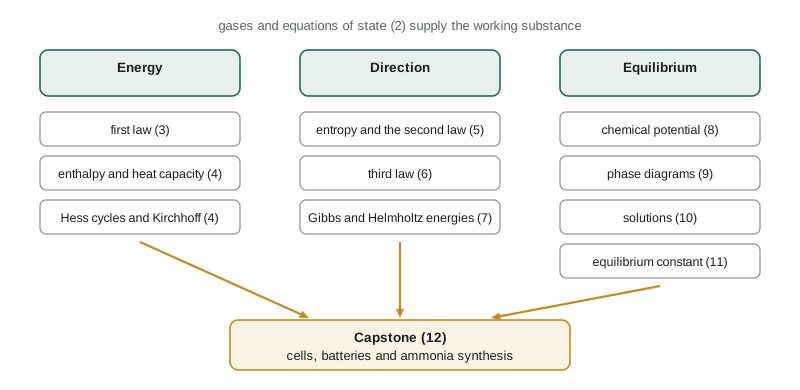
The whole course can be organized around three questions. The first is about energy: when a system changes, how much energy flows in or out as heat and as work? The first law of thermodynamics, which states that energy is conserved, answers it. Lessons 3 and 4 develop internal energy and enthalpy, measure them by calorimetry and combine them by Hess's law, so that the heat of a reaction that has never been run can be calculated from tables.
The second question is about direction: given a possible change, will it happen on its own? Energy alone cannot answer this. Ice melts spontaneously at 10 °C even though melting absorbs heat, and many exothermic reactions do not proceed at all. The second law introduces a new state function, entropy, and states that the entropy of an isolated system never decreases. Lessons 5 and 6 develop entropy and the third law, which gives entropies an absolute zero, and lesson 7 combines energy and entropy into the Gibbs energy, the quantity that decides direction at constant temperature and pressure.
The third question is about equilibrium: if a change does happen, where does it stop? A reaction mixture or a two-phase system reaches a state in which there is no further net change, and the Gibbs energy is then at a minimum. Lesson 8 introduces chemical potential, the tool for describing equilibrium in systems whose composition can change. Lessons 9 to 11 apply it to phase changes, to solutions and to chemical reactions, ending with the equilibrium constant and its dependence on temperature. The capstone, lesson 12, applies everything to electrochemical cells, batteries and the industrial synthesis of ammonia.
Systems, surroundings and boundaries
Thermodynamics begins by dividing the world in two. The system is the part we are interested in: the gas in a cylinder, the solution in a beaker, the reacting mixture in a furnace. Everything else is the surroundings. The boundary between them may be real, like the walls of a flask, or imaginary, like a surface drawn around a parcel of air. What matters is what the boundary allows to cross. An open system exchanges both matter and energy with its surroundings; an uncovered beaker of boiling water is an example. A closed system exchanges energy but not matter; a sealed flask that can be heated or cooled is closed. An isolated system exchanges neither; a well-insulated, sealed vessel of fixed volume approximates one, and the universe as a whole is the ultimate isolated system.
Boundaries are further described by what kinds of energy transfer they permit. A diathermic wall lets heat pass; an adiabatic wall does not. A rigid wall prevents the system from doing expansion work, while a movable piston allows it. Choosing the system and stating the nature of its boundary is the first step in every thermodynamic problem, and many apparent paradoxes disappear once that step is done carefully.
State functions and path functions
The state of a system at equilibrium is specified by a small number of variables. For a fixed amount of a pure gas, any two of pressure, volume and temperature fix the third, and they also fix every other property: the internal energy, the density, the refractive index. A property that depends only on the current state, and not on how the system got there, is a state function. Pressure, volume, temperature, internal energy, enthalpy, entropy and Gibbs energy are all state functions. The change in a state function between two states is the same for every path that connects them, so it can be calculated along whatever path is most convenient, even an imaginary one.
Heat and work are different. They are not properties of a state but descriptions of a process: energy in transit across the boundary. The heat absorbed and the work done when a gas goes from one state to another depend on the path. We write small amounts of them as δq and δw, to show that they are not exact differentials, while a small change in a state function such as U is written dU. The program later in this lesson takes a gas between the same two states by two different routes and shows that the heat and work differ while the change in internal energy does not.
Properties are also classified by how they scale. An extensive property is proportional to the amount of substance: volume, mass, internal energy, entropy. An intensive property does not depend on the amount: temperature, pressure, density, and any molar quantity such as the molar volume \(V_\mathrm{m} = V/n\). Dividing one extensive property by another gives an intensive one. Thermodynamic tables list molar or specific quantities so that they can be scaled to any amount.
Equilibrium and the zeroth law
A system is in thermodynamic equilibrium when its properties do not change with time and there are no net flows of matter or energy within it or across its boundary. Equilibrium has several parts. Mechanical equilibrium means no unbalanced forces, so the pressure is uniform. Thermal equilibrium means no heat flow, so the temperature is uniform. Chemical equilibrium means no net reaction or transfer of matter between phases. Classical thermodynamics deals with equilibrium states and with processes that connect them; how fast a system gets there is the separate subject of chemical kinetics, studied in CHEM-373.
Temperature itself rests on an observation so basic that it was named only after the first and second laws: the zeroth law. If system A is in thermal equilibrium with system C, and system B is also in thermal equilibrium with C, then A and B are in thermal equilibrium with each other. The law makes thermometers possible. A thermometer is a system C with some easily read property, such as the length of a mercury column or the pressure of a gas at constant volume, and the zeroth law guarantees that any two bodies that give the same reading would not exchange heat if they were brought into contact.
The thermodynamic temperature scale has its zero at absolute zero and is measured in kelvin. Since 2019 the kelvin has been defined by fixing the Boltzmann constant at exactly \(k_\mathrm{B} = 1.380649 \times 10^{-23}\ \mathrm{J\,K^{-1}}\), and the gas constant \(R = N_\mathrm{A} k_\mathrm{B} = 8.314462618\ \mathrm{J\,K^{-1}\,mol^{-1}}\) follows from the fixed Avogadro constant. The Celsius temperature is defined by \(\theta/^{\circ}\mathrm{C} = T/\mathrm{K} - 273.15\). In every equation of this course, T means the thermodynamic temperature in kelvin.
Standard states and units
Thermodynamic data are reported for substances in standard states, so that tables compiled in different laboratories can be combined. The standard state of a gas is the pure gas behaving ideally at the standard pressure \(p^{\circ} = 1\ \mathrm{bar} = 10^{5}\ \mathrm{Pa}\). The standard state of a liquid or solid is the pure substance at 1 bar, and the standard state of a solute is an ideal solution at a molality of 1 mol per kilogram. IUPAC replaced the older standard pressure of 1 atm (101.325 kPa) with 1 bar in 1982; the difference is small but matters for precise work, and some older tables still use 1 atm. The temperature is not part of the definition of a standard state. Tables are usually given at 298.15 K, but a standard state exists at every temperature, which is why we will write \(\Delta_\mathrm{r}G^{\circ}(T)\) when the temperature is not 298.15 K.
Energy is measured in joules. Older sources use the calorie, now defined as exactly 4.184 J; a food Calorie is a kilocalorie. Pressure is measured in pascals, with the bar, the atmosphere and the torr (1/760 atm, close to the millimeter of mercury) still common. Volumes appear in cubic meters, liters and cubic decimeters; one liter is exactly one cubic decimeter. Keeping units straight, especially when R is used with pressures in bar and volumes in liters, is half the battle in thermodynamic calculations. The useful values are R = 8.314 J/(K mol) = 0.08314 L bar/(K mol) = 0.08206 L atm/(K mol).
A short history
Thermodynamics grew from the study of gases and of steam engines. Robert Boyle reported in 1662 that the volume of a fixed amount of air is inversely proportional to its pressure. Jacques Charles found, in experiments around 1787 that he did not publish, that gases expand equally on heating, and Joseph Louis Gay-Lussac published careful measurements of the effect in 1802. Sadi Carnot's 1824 essay on the motive power of fire asked how much work a heat engine could produce, and his answer, that the maximum efficiency depends only on the temperatures of the hot and cold reservoirs, contained the seed of the second law.
The first law came in the 1840s. Julius Robert Mayer argued in 1842 that heat and work are interchangeable forms of one quantity, and James Prescott Joule measured the mechanical equivalent of heat in a series of experiments through that decade, most famously by stirring water with paddles driven by falling weights. Hermann von Helmholtz stated the general conservation of energy in 1847. On the chemical side, Germain Hess showed in 1840 that the heat of a reaction is the same whether it occurs in one step or several, and Gustav Kirchhoff showed in 1858 how reaction heats change with temperature.
Rudolf Clausius and William Thomson, later Lord Kelvin, formulated the second law around 1850. Clausius introduced the word entropy in 1865, and Ludwig Boltzmann connected it to the number of molecular arrangements in 1877. The application of thermodynamics to chemistry was largely the work of Josiah Willard Gibbs at Yale, whose long paper on the equilibrium of heterogeneous substances, published in two parts in 1876 and 1878, introduced chemical potential, the phase rule and the free energy that bears his name. Helmholtz introduced his own free energy in 1882. Jacobus Henricus van 't Hoff and Henry Le Chatelier worked out the effect of temperature and other changes on equilibrium in 1884, Walther Nernst proposed his heat theorem, the forerunner of the third law, in 1906, and Fritz Haber's ammonia synthesis of 1909 showed what the new science could do for industry. We will meet each of these people again at the point where their work enters the course.
How this course connects to others
Thermodynamics is shared territory between chemistry and physics. PHYS-261, Thermal Physics, covers the laws from a physicist's point of view, with heat engines, the Carnot cycle, Maxwell relations, blackbody radiation and the Earth's energy balance. This course covers the same laws from a chemist's point of view, with the emphasis on reactions, mixtures, phases and equilibrium constants. PHYS-361, Statistical Mechanics, derives thermodynamic quantities from partition functions; its treatment of chemical equilibrium and of the dissociation of hydrogen is the microscopic counterpart of lesson 11 here. CHEM-371, Physical Chemistry II, continues with quantum chemistry, which supplies the molecular energy levels that statistical mechanics needs, and CHEM-373 covers chemical kinetics. The mathematics needed is single-variable calculus from MATH-101 and a little partial differentiation, which lesson 8 explains as it goes.
A worked example: choosing the system
Worked problem
Classifying a system and its properties
A sealed, rigid steel cylinder holds 2.00 mol of argon at 300 K. It is left in a room at 295 K. (a) Classify the system. (b) Which of these are state functions and which are intensive: P, V, T, U, the heat that flows out overnight, the molar volume? (c) What is the initial pressure if argon behaves ideally and V = 10.0 L?
Show solution
- The cylinder is sealed, so no matter crosses the boundary; steel conducts heat, so energy can cross as heat. The system is closed, with a rigid diathermic wall.
- P, V, T and U are state functions. P and T are intensive; V and U are extensive.
- The heat that flows out overnight is not a state function: it describes a process, not a state.
- The molar volume V/n is a state function and intensive.
- P = nRT/V = (2.00 mol)(0.08314 L bar/(K mol))(300 K)/(10.0 L) = 4.99 bar.
- Overnight the gas cools to 295 K at constant volume, so its pressure falls to 4.99 × 295/300 = 4.91 bar; no work is done because the wall is rigid.
Answer: A closed system with rigid, heat-conducting walls; P, V, T, U and the molar volume are state functions, of which P, T and the molar volume are intensive; heat is a path quantity; the initial pressure is 4.99 bar.
A program: state functions do not depend on the path
The program takes one mole of a monatomic ideal gas from state A (300 K, 1 bar) to state B (600 K, 1 bar) by two routes. Route 1 heats the gas at constant pressure. Route 2 first heats it at constant volume, which doubles its pressure, and then lets it expand isothermally at 600 K back to 1 bar. For a monatomic ideal gas \(U = \tfrac{3}{2}nRT\), so the change in internal energy depends only on the temperature change. The program uses the sign convention of IUPAC and of most chemistry texts: q is the heat absorbed by the system and w is the work done on the system, so that \(\Delta U = q + w\). Lesson 3 derives the work formulas used here.
import math

R = 8.314462618     # J/(K mol)
n = 1.0
Cv = 1.5 * R        # monatomic ideal gas
Cp = Cv + R
TA, TB = 300.0, 600.0

# Route 1: heat at constant pressure from A to B
q1 = n * Cp * (TB - TA)
w1 = -n * R * (TB - TA)             # w = -P dV, and P dV = nR dT at constant P
# Route 2: heat at constant volume to 600 K (P doubles), then expand isothermally to 1 bar
q2a = n * Cv * (TB - TA); w2a = 0.0
w2b = -n * R * TB * math.log(2.0)   # reversible isothermal expansion, P from 2 bar to 1 bar
q2b = -w2b                          # dU = 0 for an isothermal ideal gas
q2, w2 = q2a + q2b, w2a + w2b

for name, q, w in (('route 1 (constant P)', q1, w1), ('route 2 (constant V, then T)', q2, w2)):
    print(f'{name:30s} q = {q:8.1f} J   w = {w:8.1f} J   dU = q + w = {q + w:7.1f} J')
print(f'{"from U = 3/2 nRT":30s} dU = {n * Cv * (TB - TA):.1f} J on every route')route 1 (constant P) q = 6235.8 J w = -2494.3 J dU = q + w = 3741.5 J route 2 (constant V, then T) q = 7199.4 J w = -3457.9 J dU = q + w = 3741.5 J from U = 3/2 nRT dU = 3741.5 J on every route
The two routes absorb different amounts of heat and do different amounts of work, yet the sum q + w is the same, 3741.5 J, because internal energy is a state function. This is the content of the first law, and it is why tables of internal energy and enthalpy are useful: a change in a state function can be computed along any convenient path.
Sign conventions
Physics and engineering texts often write the first law as ΔU = Q − W, where W is the work done by the system on its surroundings. Chemistry texts and IUPAC write ΔU = q + w, where w is the work done on the system. The two are the same law with opposite signs for work. In this course, positive q and positive w both mean energy entering the system. When you read PHYS-261 or an engineering source, check which convention is in use before comparing numbers.
Common mistakes
MistakeHeat and work are properties of a system, like its temperature.
InsteadHeat and work are energy in transit during a process; they depend on the path, while state functions depend only on the state.
MistakeTemperature and heat are the same thing.
InsteadTemperature is an intensive state function that decides the direction of heat flow; heat is a quantity of energy transferred because of a temperature difference.
MistakeA standard state means 298.15 K.
InsteadA standard state fixes the pressure (1 bar) and the form of the substance; it can be defined at any temperature.
MistakeAn exothermic change must be spontaneous.
InsteadDirection is decided by entropy as well as energy; ice melts spontaneously above 0 °C although melting absorbs heat.
MistakeA closed system cannot exchange energy.
InsteadA closed system exchanges energy but not matter; an isolated system exchanges neither.
MistakeΔU = q + w and ΔU = Q − W contradict each other.
InsteadThey use opposite sign conventions for work and describe the same law.
Summary and key terms
- Chemical thermodynamics answers three questions: how much energy a change involves, which direction it goes, and where it stops.
- A system is open, closed or isolated according to whether matter and energy can cross its boundary.
- State functions such as P, V, T, U, H, S and G depend only on the state; heat and work depend on the path.
- The zeroth law makes temperature and thermometers possible; T is measured in kelvin.
- Standard states refer to 1 bar; tables are usually at 298.15 K, but a standard state exists at any temperature.
- Chemists write ΔU = q + w, with q and w both positive when energy enters the system.
- System
- The part of the world under study, separated from the surroundings by a boundary.
- Isolated system
- A system that exchanges neither matter nor energy with its surroundings.
- State function
- A property whose value depends only on the current state of the system, not on its history.
- Extensive property
- A property proportional to the amount of substance, such as volume or internal energy.
- Intensive property
- A property independent of the amount of substance, such as temperature or pressure.
- Zeroth law
- Two systems each in thermal equilibrium with a third are in thermal equilibrium with each other.
- Standard state
- The reference form of a substance at the standard pressure of 1 bar.
Practice problems
Work each problem on paper first, then reveal the answer to check.
Classify each as open, closed or isolated: (a) a cup of hot coffee with no lid; (b) a sealed can of soda in a refrigerator; (c) a sealed vacuum flask, to a first approximation.
Show answer
(a) Open: vapor and heat leave. (b) Closed: heat flows, matter does not. (c) Approximately isolated.
Which of these are intensive: mass, density, molar enthalpy, entropy, temperature?
Show answer
Density, molar enthalpy and temperature.
A gas absorbs 500 J of heat and does 200 J of work on its surroundings. Find ΔU in the chemistry convention.
Show answer
q = +500 J, w = −200 J, ΔU = +300 J.
Convert 25.00 °C and −40.00 °C to kelvin.
Show answer
298.15 K and 233.15 K.
What is the pressure, in bar, of 0.500 mol of an ideal gas in 5.00 L at 350 K?
Show answer
P = nRT/V = 0.500 × 0.08314 × 350/5.00 = 2.91 bar.
Why can ΔU for route 2 of the program be computed from U = 3/2 nRT without knowing the path?
Show answer
U is a state function; for an ideal monatomic gas it depends only on T, so ΔU = 3/2 nR(TB − TA) on any route.
Lesson quiz · 5 questions
Score 60% or more to complete this lesson.
Create a free account to save your progress, take quizzes and earn a certificate.