
CHEM-271 · Lesson 6 of 12 · 25 min
The third law, absolute entropies and spontaneity
▶ Video coming soon A video version of this lesson is on the way.
The second law defines entropy changes, but it leaves the zero of entropy undefined: any constant could be added to every entropy without changing a single prediction about a physical change. For chemical reactions that freedom is awkward, because a reaction converts one set of substances into another, and to predict its entropy change from tables we need the entropies of all of them on a common scale. The third law of thermodynamics supplies that scale. It states that the entropy of a perfect crystal is zero at the absolute zero of temperature. This lesson traces the law from Nernst's heat theorem, shows how absolute entropies are measured by integrating heat capacities from near absolute zero, explains the residual entropy of some crystals, and uses tabulated entropies to decide whether reactions are spontaneous.
Nernst's heat theorem
At the start of the twentieth century chemists wanted to calculate equilibrium constants from thermal measurements alone, without measuring any equilibrium. The enthalpy of a reaction could be found by calorimetry, but its entropy change could not, because entropies were known only up to an unknown constant for each substance. Walther Nernst, then at Göttingen and later in Berlin, studied reactions between solids at lower and lower temperatures and proposed in 1906 that the entropy change of any reaction between pure crystalline solids tends to zero as the temperature approaches absolute zero. This was the Nernst heat theorem. With it, the entropy change of a reaction at any temperature could be calculated from heat capacities and enthalpies measured down to very low temperature. Nernst received the 1920 Nobel Prize in Chemistry for this work.
Max Planck strengthened the statement in 1911. If the entropy change of every reaction between perfect crystals vanishes at absolute zero, it is natural to set the entropy of every element in its perfect crystalline form to zero at T = 0, and then every perfect crystalline compound also has zero entropy there. In the form given by Gilbert Lewis and Merle Randall in their 1923 textbook, the third law reads: if the entropy of each element in some crystalline state is taken as zero at the absolute zero of temperature, every substance has a finite positive entropy, but at absolute zero the entropy may become zero, and does so in the case of perfect crystalline substances.
Boltzmann's formula makes the law intuitive. A perfect crystal at absolute zero is in its single lowest-energy state, with every atom in its place, so the number of microstates is W = 1 and \(S = k_\mathrm{B}\ln 1 = 0\). Any disorder that survives to absolute zero, such as random orientations of molecules, leaves W greater than one and the entropy greater than zero.
Measuring absolute entropies
Once the zero is fixed, the entropy of a substance at any temperature can be measured. Starting from a perfect crystal at T = 0, we heat it reversibly at constant pressure, adding \(\int C_P\,\mathrm{d}T/T\) for each phase and \(\Delta_\mathrm{trs}H/T_\mathrm{trs}\) for each phase transition on the way. For a substance that is a gas at temperature T,
\[S_\mathrm{m}(T) = \int_0^{T_\mathrm{f}} \frac{C_{P,\mathrm{m}}(\mathrm{s})}{T}\,\mathrm{d}T + \frac{\Delta_\mathrm{fus}H}{T_\mathrm{f}} + \int_{T_\mathrm{f}}^{T_\mathrm{b}} \frac{C_{P,\mathrm{m}}(\mathrm{l})}{T}\,\mathrm{d}T + \frac{\Delta_\mathrm{vap}H}{T_\mathrm{b}} + \int_{T_\mathrm{b}}^{T} \frac{C_{P,\mathrm{m}}(\mathrm{g})}{T}\,\mathrm{d}T.\]
In practice heat capacities can be measured down to a few kelvin, but not to absolute zero itself. Below the lowest measured temperature the heat capacity is extrapolated with the Debye T³ law. Peter Debye showed in 1912 that the lattice vibrations of a nonmetallic crystal give \(C_V = aT^3\) at low temperature, where a is a constant characteristic of the solid. If the lowest measurement is at \(T_\mathrm{low}\), the entropy below it is \(\int_0^{T_\mathrm{low}} aT^2\,\mathrm{d}T = aT_\mathrm{low}^3/3 = C_P(T_\mathrm{low})/3\), one third of the heat capacity measured there. Metals have an extra contribution from their conduction electrons, linear in T, which is handled the same way.
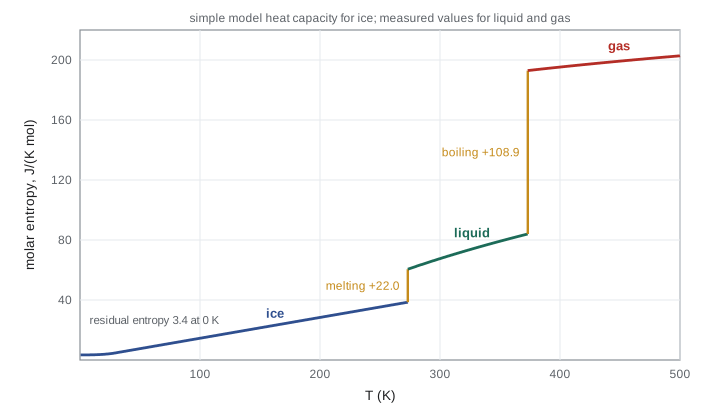
The figure shows the result for water. The entropy rises steadily while each phase is heated and jumps at each phase transition. The jump at boiling is about five times the jump at melting, because a gas has vastly more accessible arrangements than a liquid, while a liquid has only modestly more than a solid. The curve does not start at zero, for a reason explained below. William Giauque at Berkeley made many of the precise low-temperature measurements on which these tables rest; he also invented adiabatic demagnetization, which reached temperatures below 1 K in 1933, and received the 1949 Nobel Prize in Chemistry.
Standard molar entropies
The entropy of a substance in its standard state, measured in this way, is its standard molar entropy S°. Unlike enthalpies of formation, these are absolute values, not values relative to the elements, and the entropies of the elements themselves are not zero at 298 K. Some typical values follow.
| Substance | S° (J/(K mol)) | Substance | S° (J/(K mol)) |
|---|---|---|---|
| C (diamond) | 2.38 | H₂(g) | 130.7 |
| C (graphite) | 5.74 | He(g) | 126.2 |
| Cu(s) | 33.2 | Ar(g) | 154.8 |
| CaO(s) | 38.1 | N₂(g) | 191.6 |
| NaCl(s) | 72.1 | O₂(g) | 205.2 |
| CaCO₃(s) | 92.9 | NH₃(g) | 192.8 |
| H₂O(l) | 69.9 | CO₂(g) | 213.8 |
| C₂H₅OH(l) | 160.7 | CH₄(g) | 186.3 |
| H₂O(g) | 188.8 | C₃H₈(g) | 270.3 |
Several trends stand out. Gases have much larger entropies than liquids, and liquids larger than solids. Hard, rigid solids with strong bonds and light atoms, such as diamond, have very small entropies, because their vibrations are high in frequency and few vibrational states are excited at room temperature; graphite, with its weakly bound layers, has more. Among the noble gases, heavier atoms have larger entropies, because their translational energy levels are more closely spaced. Larger molecules have larger entropies than smaller ones of the same kind: methane, ethane and propane have 186, 230 and 270 J/(K mol). These trends follow from the molecular formulas that PHYS-361 derives, such as the Sackur–Tetrode equation for the entropy of a monatomic gas, which reproduces the measured entropies of the noble gases almost exactly.
Residual entropy
Some crystals keep disorder down to the lowest temperatures, and their calorimetric entropies come out smaller than the values calculated from spectroscopy and statistical mechanics. Carbon monoxide is the classic example. The CO molecule has only a tiny dipole, so in the crystal each molecule can point either way, CO or OC, with almost the same energy. As the crystal cools, the molecules lose the ability to turn before they can order, and the random arrangement is frozen in. If each of the \(N_\mathrm{A}\) molecules in a mole has two choices, \(W = 2^{N_\mathrm{A}}\) and the residual entropy is \(R\ln 2 = 5.76\ \mathrm{J\,K^{-1}\,mol^{-1}}\). The measured residual entropy is about 4.6 J/(K mol), a little less than the ideal value because the disorder is not perfectly random.
Ice has a residual entropy too. Each oxygen atom has two hydrogens close to it and two farther away, but which hydrogens are close is random, subject to the rules that every O–H···O bond has one hydrogen and every water molecule has two. Linus Pauling counted the arrangements in 1935 and found \(W = (3/2)^{N_\mathrm{A}}\), a residual entropy of \(R\ln 1.5 = 3.37\ \mathrm{J\,K^{-1}\,mol^{-1}}\). Giauque and Stout measured 3.4 J/(K mol) in 1936. The agreement was one of the first triumphs of statistical thinking applied to a real crystal, and it is why the curve in the figure starts above zero. Glasses, which are frozen liquids, have residual entropies for the same reason; they are not perfect crystals, and the third law in its strict form does not apply to them.
The unattainability of absolute zero
Nernst also argued, in 1912, that absolute zero cannot be reached in a finite number of steps. Every cooling method works by changing some variable, such as pressure or magnetic field, in a way that lowers the entropy, and then letting the system cool adiabatically. Because the entropy curves at different values of the variable converge to the same value at T = 0, each step achieves a smaller drop in temperature than the last. This is often taken as another statement of the third law. Laboratories now cool matter to well below a millionth of a kelvin, but never to absolute zero itself.
Reaction entropies and spontaneity
With absolute entropies in hand, the standard entropy of reaction is \(\Delta_\mathrm{r}S^{\circ} = \sum \nu S^{\circ}(\text{products}) - \sum \nu S^{\circ}(\text{reactants})\). A quick qualitative guide is the change in the number of moles of gas: reactions that produce gas usually have positive \(\Delta_\mathrm{r}S^{\circ}\), and those that consume it usually have negative values. For ammonia synthesis, \(\mathrm{N_2 + 3H_2 \to 2NH_3}\), four moles of gas become two and \(\Delta_\mathrm{r}S^{\circ} = -198\ \mathrm{J\,K^{-1}}\). For the decomposition of limestone, \(\mathrm{CaCO_3(s) \to CaO(s) + CO_2(g)}\), one mole of gas appears and \(\Delta_\mathrm{r}S^{\circ} = +159\ \mathrm{J\,K^{-1}}\).
The spontaneity criterion from lesson 5 now becomes a calculation. Under standard conditions at temperature T, \(\Delta S_\mathrm{tot} = \Delta_\mathrm{r}S^{\circ} - \Delta_\mathrm{r}H^{\circ}/T\). Four cases arise. If the reaction is exothermic and increases entropy, both terms are positive and the reaction is spontaneous at every temperature. If it is endothermic and decreases entropy, it is never spontaneous. If both are negative, as for ammonia synthesis, the surroundings term wins at low temperature and the system term at high temperature, so the reaction is spontaneous only below some temperature. If both are positive, as for limestone decomposition, it is spontaneous only above some temperature. Lesson 7 repackages this criterion as the Gibbs energy, \(\Delta G = \Delta H - T\Delta S = -T\Delta S_\mathrm{tot}\), which refers only to the system.
A worked example: the entropy of a reaction
Worked problem
Entropy and spontaneity of ammonia synthesis
Using S° values from the table and ΔrH° = −91.8 kJ for N₂(g) + 3H₂(g) → 2NH₃(g), find ΔrS°, ΔS_surr and ΔS_tot at 298.15 K under standard conditions.
Show solution
- ΔrS° = 2(192.8) − 191.6 − 3(130.7) = 385.6 − 191.6 − 392.1 = −198.1 J/K.
- ΔS_surr = −ΔrH°/T = 91 800/298.15 = +307.9 J/K.
- ΔS_tot = −198.1 + 307.9 = +109.8 J/K.
- The total is positive, so the reaction is spontaneous under standard conditions at 298 K.
- Setting ΔS_tot = 0 gives T = ΔrH°/ΔrS° = 91 800/198.1 ≈ 463 K, above which the standard reaction would not be spontaneous if ΔH and ΔS stayed constant.
Answer: ΔrS° = −198.1 J/K, ΔS_surr = +307.9 J/K, ΔS_tot = +109.8 J/K: spontaneous at 298 K, but only below about 460 K.
Spontaneous here does not mean fast: a mixture of nitrogen and hydrogen at room temperature does not react at any measurable rate, and industry works at 400 to 500 °C to make the reaction go quickly over a catalyst, accepting a less favorable equilibrium. Lesson 11 and the capstone take up that compromise.
A program: a third-law entropy with a Debye extrapolation
The first part of the program imitates a calorimetric measurement. It generates heat capacities of copper at the temperatures where they might be measured, from 15 K to 298.15 K, using Debye's model with a Debye temperature of 343 K, then integrates C/T by the trapezoidal rule, adding C(15 K)/3 for the region below 15 K. It compares the result with the exact Debye entropy. The second part computes reaction entropies from the table and the total entropy change at 298.15 K.
import math

R = 8.314462618

def simpson(f, a, b, n=2000):
    h = (b - a) / n
    return h / 3 * (f(a) + f(b) + sum((4 if k % 2 else 2) * f(a + k * h) for k in range(1, n)))

def debye_C(T, th=343.0):
    f = lambda x: x ** 4 * math.exp(x) / (math.exp(x) - 1) ** 2 if x > 0 else 0.0
    return 9 * R * (T / th) ** 3 * simpson(f, 0.0, th / T)

def debye_S(T, th=343.0):
    f = lambda x: x ** 3 / (math.exp(x) - 1) if x > 0 else 0.0
    return R * (12 * (T / th) ** 3 * simpson(f, 0.0, th / T) - 3 * math.log(1 - math.exp(-th / T)))

Ts = [15, 20, 25, 30, 40, 50, 60, 70, 80, 90, 100, 120, 140, 160, 180, 200, 220, 240, 260, 280, 298.15]
Cs = [debye_C(T) for T in Ts]
S_low = Cs[0] / 3                       # Debye T^3 extrapolation below 15 K
S = S_low + sum(0.5 * (Cs[i] / Ts[i] + Cs[i - 1] / Ts[i - 1]) * (Ts[i] - Ts[i - 1]) for i in range(1, len(Ts)))
print(f'C at 15 K = {Cs[0]:.3f} J/(K mol); entropy below 15 K = {S_low:.3f} J/(K mol)')
print(f'C at 298.15 K = {Cs[-1]:.2f} J/(K mol)  (3R = {3 * R:.2f})')
print(f'third-law entropy by trapezoid = {S:.2f} J/(K mol); exact Debye = {debye_S(298.15):.2f}; tabulated Cu = 33.15')

S0 = {'N2': 191.6, 'H2': 130.7, 'NH3': 192.8, 'CaCO3': 92.9, 'CaO': 38.1, 'CO2': 213.8,
      'CH4': 186.3, 'O2': 205.2, 'H2O(l)': 69.9}
rxns = [('N2 + 3 H2 -> 2 NH3', {'N2': 1, 'H2': 3}, {'NH3': 2}, -91.8),
        ('CaCO3 -> CaO + CO2', {'CaCO3': 1}, {'CaO': 1, 'CO2': 1}, 178.3),
        ('CH4 + 2 O2 -> CO2 + 2 H2O(l)', {'CH4': 1, 'O2': 2}, {'CO2': 1, 'H2O(l)': 2}, -890.3),
        ('H2 + 1/2 O2 -> H2O(l)', {'H2': 1, 'O2': 0.5}, {'H2O(l)': 1}, -285.8)]
print()
T = 298.15
for name, re, pr, dH in rxns:
    dS = sum(n * S0[s] for s, n in pr.items()) - sum(n * S0[s] for s, n in re.items())
    tot = dS - dH * 1000 / T
print(f'{name:30s} dS = {dS:7.1f} dS_surr = {-dH * 1000 / T:7.1f} dS_tot = {tot:7.1f} J/K {"spontaneous" if tot > 0 else "not spontaneous"}')C at 15 K = 0.163 J/(K mol); entropy below 15 K = 0.054 J/(K mol) C at 298.15 K = 23.37 J/(K mol) (3R = 24.94) third-law entropy by trapezoid = 30.54 J/(K mol); exact Debye = 30.57; tabulated Cu = 33.15 N2 + 3 H2 -> 2 NH3 dS = -198.1 dS_surr = 307.9 dS_tot = 109.8 J/K spontaneous CaCO3 -> CaO + CO2 dS = 159.0 dS_surr = -598.0 dS_tot = -439.0 J/K not spontaneous CH4 + 2 O2 -> CO2 + 2 H2O(l) dS = -243.1 dS_surr = 2986.1 dS_tot = 2743.0 J/K spontaneous H2 + 1/2 O2 -> H2O(l) dS = -163.4 dS_surr = 958.6 dS_tot = 795.2 J/K spontaneous
The trapezoidal integration with a T³ tail reproduces the exact Debye entropy to within a few hundredths of a joule per kelvin, which shows that the extrapolation below 15 K contributes very little. The Debye model itself falls about 2.6 J/(K mol) short of the tabulated entropy of copper, because it describes a perfectly harmonic solid at constant volume: the measured heat capacity is at constant pressure, and the real spectrum of lattice vibrations is not exactly Debye's. Three of the four reactions are spontaneous under standard conditions at 298 K. Limestone decomposition is not: its total entropy change is strongly negative at 298 K, and it becomes spontaneous only above about 1100 K, as lesson 7 shows.
Common mistakes
MistakeThe third law says every substance has zero entropy at absolute zero.
InsteadOnly perfect crystals do; CO, ice and glasses keep residual entropy.
MistakeStandard entropies of elements are zero, like their enthalpies of formation.
InsteadS° values are absolute; elements have positive entropies at 298 K, such as 130.7 J/(K mol) for H₂.
MistakeHeat capacities must be measured all the way to 0 K.
InsteadBelow the lowest measured temperature the Debye T³ law is used; the contribution is C(T_low)/3.
MistakeResidual entropy means the calorimetric measurement was wrong.
InsteadIt reflects real frozen-in disorder, such as random CO orientations or proton arrangements in ice.
MistakeA reaction with negative ΔrS° can never be spontaneous.
InsteadIt is spontaneous if −ΔH/T outweighs the entropy decrease, as for ammonia synthesis at 298 K.
MistakeWith enough cooling steps, absolute zero can be reached.
InsteadEach step lowers T by less than the one before; absolute zero is unattainable in a finite number of steps.
Summary and key terms
- Nernst's heat theorem (1906): reaction entropies between perfect crystals vanish as T → 0; Planck (1911) set the entropy of perfect crystals to zero.
- Absolute entropies are measured from ∫CP dT/T plus ΔtrsH/Ttrs, with the Debye T³ law below the lowest measurement.
- Gases have much more entropy than liquids and solids; heavier, larger and more flexible molecules have more entropy.
- CO (R ln 2 ideal, about 4.6 measured) and ice (R ln 1.5 = 3.4, Pauling 1935) have residual entropies.
- ΔrS° = ΣνS°(products) − ΣνS°(reactants); reactions that produce gas usually have positive ΔrS°.
- Spontaneity under standard conditions requires ΔrS° − ΔrH°/T > 0.
- Third law
- The entropy of a perfect crystal is zero at absolute zero.
- Nernst heat theorem
- The entropy change of a reaction between perfect crystalline solids approaches zero as T approaches 0.
- Debye T³ law
- At low temperature the heat capacity of a nonmetallic solid is proportional to T³.
- Standard molar entropy
- The absolute entropy of one mole of a substance in its standard state.
- Residual entropy
- Entropy remaining at absolute zero because of frozen-in disorder.
- Third-law entropy
- An entropy measured calorimetrically relative to zero for the perfect crystal at 0 K.
Practice problems
Work each problem on paper first, then reveal the answer to check.
The heat capacity of a crystal at 10 K is 0.42 J/(K mol). Estimate its entropy at 10 K.
Show answer
S = C/3 = 0.14 J/(K mol).
Calculate ΔrS° for 2H₂(g) + O₂(g) → 2H₂O(l).
Show answer
2(69.9) − 2(130.7) − 205.2 = −326.8 J/K.
Explain why S°(He) < S°(Ar).
Show answer
Argon atoms are heavier, so their translational energy levels are more closely spaced and more are accessible.
Predict the sign of ΔrS° for 2SO₂(g) + O₂(g) → 2SO₃(g).
Show answer
Negative: three moles of gas become two.
A solid has residual entropy 11.5 J/(K mol). How many orientations per molecule does this suggest?
Show answer
R ln W per mole = 11.5 gives ln W = 1.38, W ≈ 4.
Why is the entropy jump at boiling larger than at melting for water?
Show answer
The gas has vastly more accessible positions and arrangements than the liquid; the liquid has only modestly more than the solid.
Lesson quiz · 5 questions
Score 60% or more to complete this lesson.
Create a free account to save your progress, take quizzes and earn a certificate.