
CHE-499 · Lesson 6 of 12 · 23 min
The separation train
In most chemical plants the separations cost more than the reactors, in capital and in energy. The ATJ plant is no exception. Between the ethanol feed and the three products are a quench tower, a water stripper, a compressor train with caustic washing and drying, guard beds, high-pressure separators, a stabilizer and two product columns. Riya leads this part of the design, with the methods of CHE-350. This lesson walks through the train in process order, explains why each step is there and in that position, and sizes two of them in code: the stripper that cleans the process water, and the column that makes the jet cut.
Ordering the separations
The order of separations in a train is not arbitrary, and the heuristics CHE-350 taught apply directly. Remove the most plentiful component first: here, water, which is more than half the moles leaving the dehydration reactor. Remove corrosive or hazardous components early: carbon dioxide and acids, which would corrode the compressor, are washed out before compression. Do the easiest separations first and the hardest last, when the streams are smallest. Leave the product splits, which set product quality, until the end, where they can be controlled tightly. And favor separations that are needed anyway for recycle, because their cost is shared.
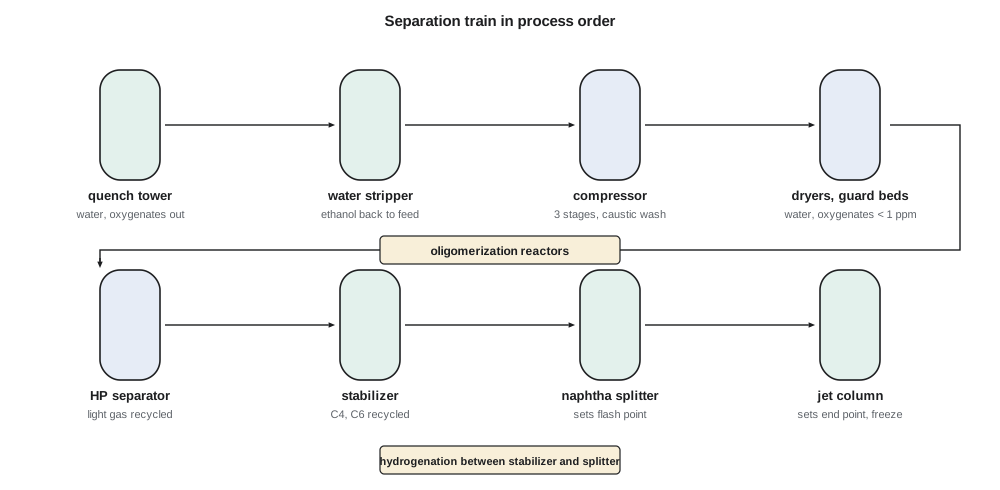
Quench and process water
The dehydration effluent leaves the last bed at about 350 °C, mostly steam and ethylene. A quench tower cools it in direct contact with circulating water, condensing the steam and washing out the polar by-products: unconverted ethanol, acetaldehyde and traces of acetic acid. Direct contact is chosen over a train of exchangers because the gas carries small amounts of heavy material that would foul exchanger tubes, and because the quench water circuit gives the heat recovery of Lesson 7 a clean, single stream to work with. The tower's bottom section, where water condenses at about 120 °C, is the warmest part of the circuit and the most valuable for heat recovery.
About 426 kmol/h of water leaves the quench, carrying about 1.1 kmol/h of ethanol and similar amounts of acetaldehyde. That water cannot be discharged or reused as it is: the organics are a chemical oxygen demand load for the site's treatment plant and a loss of feedstock. A steam stripper recovers them, returning the overhead vapor to the dehydration feed, where the ethanol is converted and the acetaldehyde passes through to be washed out again, with a small purge to the boilers.
Dilute ethanol in water strips easily, because its activity coefficient at infinite dilution is high. Near 105 °C and 1.2 bar(a), its vapor-liquid equilibrium ratio K is about 9. The Kremser equation, from CHE-350, gives the fraction of a dilute solute left in the liquid after N theoretical stages in terms of the stripping factor S = KV/L:
# Separation train: process water stripper (Kremser) and the jet/diesel column (Fenske-Underwood-Gilliland)
import math
# --- 1. Steam stripping of ethanol from the quench water
L = 426.0                      # kmol/h of water from the quench
x_in = 1.1 / L                 # mole fraction ethanol (plus a little acetaldehyde, which strips far more easily)
K = 9.4                        # ethanol in dilute water near 105 C and 1.2 bar(a): gamma-infinity 5 x Psat 2.26 / P 1.2
for VL in (0.10, 0.15, 0.20):
    S = K * VL
    for N in range(1, 60):
        frac = (S - 1) / (S**(N + 1) - 1)          # Kremser: fraction of solute left in the liquid
        if x_in * frac < 20e-6:
            print(f"steam/water {VL:.2f}: stripping factor {S:.2f}, {N} theoretical stages to 20 ppm(mol); steam {VL*L*18.02/1000:.2f} t/h")
            break
    else:
        print(f"steam/water {VL:.2f}: stripping factor {S:.2f}, cannot reach 20 ppm(mol); limit {x_in*(1-S)*1e6:.0f} ppm with infinite stages")
# --- 2. Jet/diesel split with four pseudo-components (relative volatility to the heavy key)
comp = ['C12 (jet)', 'C16 (LK)', 'C20 (HK)', 'C24 (heavy)']
alpha = [6.0, 2.5, 1.0, 0.45]
F = [20.0, 7.4, 1.6, 0.7]                         # kmol/h, from the oligomer distribution
z = [f / sum(F) for f in F]
rec_LK, rec_HK = 0.99, 0.98                       # LK to the top, HK to the bottom
d = [F[0], rec_LK * F[1], (1 - rec_HK) * F[2], 0.0]
b = [f - di for f, di in zip(F, d)]
D, B = sum(d), sum(b)
Nmin = math.log((d[1] / b[1]) * (b[2] / d[2])) / math.log(alpha[1] / alpha[2])
# Underwood: find theta between the key volatilities for a saturated liquid feed (q = 1)
def g(th): return sum(a * zi / (a - th) for a, zi in zip(alpha, z))
lo, hi = alpha[2] + 1e-6, alpha[1] - 1e-6
for _ in range(100):
    mid = (lo + hi) / 2
    if g(mid) > 0: hi = mid          # g rises from minus to plus infinity between the keys
    else: lo = mid
th = (lo + hi) / 2
Rmin = sum(a * di / D / (a - th) for a, di in zip(alpha, d)) - 1
print(f"distillate {D:.2f}, bottoms {B:.2f} kmol/h; Nmin {Nmin:.1f}; theta {th:.3f}; Rmin {Rmin:.2f}")
for f in (1.2, 1.3, 1.5):
    R = f * Rmin; Xg = (R - Rmin) / (R + 1)
    Yg = 0.75 * (1 - Xg**0.5668)                  # Eduljee fit of the Gilliland correlation
    N = (Nmin + Yg) / (1 - Yg)
    print(f"R = {f:.1f} Rmin = {R:.2f}: {N:.1f} theoretical stages including the reboiler")
# Kirkbride feed location, R = 1.3 Rmin
N = (Nmin + 0.75 * (1 - ((0.3 * Rmin) / (1.3 * Rmin + 1))**0.5668)) / (1 - 0.75 * (1 - ((0.3 * Rmin) / (1.3 * Rmin + 1))**0.5668))
ratio = ((z[2] / z[1]) * ((b[1] / B) / (d[2] / D))**2 * B / D)**0.206
Nr = N / (1 + ratio)
print(f"Kirkbride: {Nr:.0f} stages above the feed, {N - Nr:.0f} below")steam/water 0.10: stripping factor 0.94, cannot reach 20 ppm(mol); limit 155 ppm with infinite stages steam/water 0.15: stripping factor 1.41, 11 theoretical stages to 20 ppm(mol); steam 1.15 t/h steam/water 0.20: stripping factor 1.88, 7 theoretical stages to 20 ppm(mol); steam 1.54 t/h distillate 27.36, bottoms 2.34 kmol/h; Nmin 9.3; theta 1.044; Rmin 0.32 R = 1.2 Rmin = 0.38: 25.9 theoretical stages including the reboiler R = 1.3 Rmin = 0.41: 23.9 theoretical stages including the reboiler R = 1.5 Rmin = 0.48: 21.2 theoretical stages including the reboiler Kirkbride: 9 stages above the feed, 15 below
If the steam rate is too low, the stripping factor is below one and no number of stages can reach the target: at a steam-to-water ratio of 0.10, the ethanol cannot be reduced below about 155 ppm. At 0.15 the stripping factor is 1.4, and 11 theoretical stages reach 20 ppm. At 0.20, 7 stages do it with a third more steam. Riya chooses a ratio of 0.15 and a column with 15 valve trays, taking a tray efficiency of about 75 %. The stripped water goes partly to the dilution steam generator and partly to the site's wastewater system as the net water the reaction makes.
Ethylene purification
The quenched ethylene is close to saturated with water at about 2 bar(a), and it carries traces of carbon dioxide, acetaldehyde, ether and other oxygenates. The oligomerization catalyst is sensitive to all of them; Lesson 2's change note recorded the need for less than about 1 ppm of oxygenates. The purification steps follow the compressor stages. The gas is compressed in three stages with intercooling, condensing more water at each stage. Between the second and third stages, a caustic wash tower absorbs carbon dioxide and acids into dilute sodium hydroxide, as in a steam cracker. After the last stage, molecular sieve dryers take the water to a few ppm, and a guard bed of activated alumina or a specialized adsorbent removes the remaining oxygenates. Each adsorbent bed has a twin that is regenerated with hot nitrogen while the other works.
The spent caustic is a waste stream: a few hundred kilograms a day of sodium carbonate solution with traces of organics. Wren asks whether it can go to the site's treatment plant. Liam's answer, recorded for Lesson 11, is that it can after neutralization, at the flows expected, but the caustic consumption depends on how much carbon dioxide the dehydration reactor makes from side reactions, which is uncertain.
Recycle separations
After the oligomerization reactors, a high-pressure separator at about 30 bar and 40 °C splits the effluent into a gas phase, mainly unconverted ethylene, ethane and the light paraffin diluent, and a liquid phase of oligomers. The gas is recompressed slightly and returned to the reactors, with the 5 % purge to fuel gas that Lesson 4 sized. The liquid goes to a stabilizer column that takes the C4 and C6 olefins overhead and returns them to the reactors, where they grow into the jet range. This is the separation that makes the high jet yield of Lesson 5 possible, and its cost is part of the price of that yield.
The stabilizer is a column where the design specification is set by the downstream use. The C4 and C6 recycle must contain little C8 and heavier material, because heavy material recycled to the reactor tends to grow beyond the jet range. The bottoms must contain little C6, because what is not recycled ends up in the naphtha. Riya specifies the column with a shortcut model, then checks it in the simulator the team has from CHE-460.
Product fractionation
The hydrogenated paraffins go to two product columns. The first, a naphtha splitter, takes the C8 and lighter material overhead. Its cut point sets the jet's flash point: lighter components lower the flash point, and the Annex A5 minimum of 38 °C must be met with margin. The second, the jet column, takes the jet cut overhead and leaves the diesel-range material as bottoms. Its cut point sets the jet's final boiling point and freezing point, both limited by the annex.
Riya models the jet column with four pseudo-components, each standing for a group of isoparaffins: a C12 group typical of the jet cut, a C16 group that is the light key, a C20 group that is the heavy key, and a C24 group. Relative volatilities to the heavy key are estimated from boiling point differences at the column's average temperature. She specifies 99 % of the light key overhead and 98 % of the heavy key in the bottoms. The Fenske equation gives the minimum number of stages at total reflux, the Underwood equations the minimum reflux ratio, and the Gilliland correlation the stages at a chosen reflux:
The column needs at least 9.3 theoretical stages, a minimum reflux ratio of about 0.32, and, at 1.3 times minimum reflux, about 24 theoretical stages including the reboiler, with the feed about 9 stages from the top. The low reflux ratio reflects the small amount of diesel to be removed: the overhead is most of the feed. Riya chooses 1.3 times minimum, the usual economic optimum, and specifies 32 actual trays or the equivalent height of structured packing.
Worked problem
The cost of a low stripping factor
The water stripper has a stripping factor of 0.94. What is the lowest ethanol fraction it can reach, as a fraction of the feed concentration, however many stages it has?
Show solution
- As \(N \to \infty\) with \(S < 1\), \(S^{N+1} \to 0\).
- So \(x_N/x_0 \to (S - 1)/(0 - 1) = 1 - S = 0.06\).
- The stripper can remove at most 94 % of the ethanol.
Answer: Six percent of the feed concentration. A stripping factor below one is a pinch: adding stages cannot overcome too little steam.
Operating pressure of the jet column
The heaviest material in the jet column's bottoms boils above 340 °C at atmospheric pressure. A reboiler at that temperature would need a high-temperature hot oil system, and the paraffins would begin to crack. Riya sets the column pressure at about 0.3 bar(a) at the top, which lowers the bottoms temperature to under 300 °C and lets the reboiler use the plant's hot oil circuit. The cost is a vacuum system and a larger column diameter, because vapor at low pressure has a lower density. She compares this with steam stripping of the bottoms at atmospheric pressure, which lowers hydrocarbon partial pressure without vacuum but adds water to the product, and keeps vacuum operation in the design because the diesel cut must be dry.
Product quality and testing
The separation train is where product quality is made, so the team writes the sampling plan at the same time as the design. Each product tank is sampled and tested before release. For the SAF, the batch tests cover the Annex A5 properties: distillation curve, flash point, freezing point, density, thermal stability, and the trace limits. Dev confirms that the site laboratory can run the simpler tests and that the full certification tests would go to an accredited fuel laboratory. Because the product is a blending component, the certificate of analysis travels with each batch to the fuel supplier who blends it with conventional jet; once blended and recertified, the fuel is treated as conventional jet fuel.
Common mistakes
MistakeRunning a steam stripper with a stripping factor below one and adding stages to compensate.
InsteadRaise the steam rate until S exceeds one; stages cannot overcome a pinch.
MistakeCompressing wet, acidic ethylene and washing it afterwards.
InsteadRemove carbon dioxide and acids between stages so the compressor is protected.
MistakeTreating the stabilizer as a product column.
InsteadSpecify it for the recycle: limit heavy material overhead and light olefins in the bottoms.
MistakeChoosing the jet column cut points from the product name.
InsteadSet them from the flash, freezing and distillation limits of the annex, with margin.
MistakeRunning the jet column reboiler hotter than the paraffins tolerate.
InsteadLower the pressure or use stripping steam to keep bottoms below the cracking range.
Summary and key terms
- Separation heuristics order the train: plentiful and corrosive components first, product splits last.
- A quench tower condenses the steam and washes out oxygenates; a steam stripper recovers ethanol from the water.
- The Kremser equation sizes dilute strippers; the stripping factor must exceed one.
- Ethylene is compressed in stages with caustic washing, drying and guard beds to protect the oligomerization catalyst.
- High-pressure separators and a stabilizer recycle ethylene and light olefins, raising the jet yield.
- Fenske, Underwood and Gilliland give stages and reflux for the product columns, whose cut points set jet quality.
- Quench tower
- A column cooling a hot gas by direct contact with a circulating liquid.
- Stripping factor
- The ratio KV/L that measures how readily a solute is stripped.
- Caustic wash
- Absorption of acid gases into sodium hydroxide solution.
- Stabilizer
- A column removing light components from a liquid product.
- Pseudo-component
- A single component representing a group with similar boiling points.
- Light key, heavy key
- The two components whose split defines a column.
- Cut point
- The boiling temperature dividing two products of a column.
Practice problems
Work each problem on paper first, then reveal the answer to check.
What is the stripping factor with K = 8 and V/L = 0.20?
Show answer
1.6.
Why is caustic washing placed between compressor stages?
Show answer
To remove acid gases before the last stage and the catalysts, at a pressure where absorption works well.
What two properties of the jet are set mainly by the naphtha splitter and the jet column respectively?
Show answer
Flash point (naphtha splitter) and freezing point or final boiling point (jet column).
Why does the stabilizer's specification matter for the jet yield?
Show answer
Its overhead is recycled; heavy material in it grows past the jet range.
Why does the jet column run under vacuum?
Show answer
To keep the bottoms below the temperature at which paraffins crack and within the hot oil range.
In the Fenske equation, what happens to Nmin if the key relative volatility rises?
Show answer
It falls.
Lesson quiz · 5 questions
Score 60% or more to complete this lesson.
Create a free account to save your progress, take quizzes and earn a certificate.