
CHE-499 · Lesson 5 of 12 · 24 min
Reactor design
The ATJ plant has three reactor systems, and they could hardly be more different. Dehydration is endothermic, fast and runs hot; the design problem is supplying heat. Oligomerization is strongly exothermic and runs at moderate temperature; the design problem is removing heat fast enough to keep the reactor stable and the product in the jet range. Hydrogenation is exothermic but forgiving. Jonah leads this part of the design, drawing on CHE-345 for the reactor models and on the published literature for kinetics. This lesson covers the choices he makes, the models behind them, and the questions he could not answer without a licensor.
Dehydration: supplying the heat
Ethanol dehydration over an acid catalyst is fast at 350 to 450 °C, and at those temperatures the equilibrium lies far toward ethylene. The catalyst choice is between alumina-based catalysts, which are robust, tolerate water and need the higher end of the temperature range, and zeolites such as ZSM-5 or SAPO-34, which are active at lower temperatures but deactivate faster by coking and can make heavier hydrocarbons. Jonah chooses a modified alumina for its water tolerance, which the hydrous feed of Lesson 2 needs, and its selectivity, which published work places above 98 % to ethylene.
The reaction absorbs about 45 kJ per mole. Two reactor types can supply that heat. A multitubular reactor with catalyst in tubes inside a fired box or a molten-salt bath keeps the temperature nearly constant, but it is expensive and hard to maintain. A series of adiabatic fixed beds with reheaters between them is simpler: each bed lets the temperature fall as the reaction proceeds, then the gas is reheated before the next bed. The number of beds depends on how far the temperature may fall in each one.
The adiabatic temperature change for full conversion depends on how much heat capacity the stream carries for each mole of ethanol. The dilution steam helps here: it carries heat into each bed. The code compares three steam ratios. With one mole of water per mole of ethanol, full conversion in one bed would drop the temperature by about 330 K, which is impossible, so four beds are needed if each runs from 450 to 350 °C. With two or three moles of water, the drop is smaller and three beds suffice, but the plant must raise and later condense much more steam.
Jonah recommends four beds at a water ratio of one. The extra bed and reheater cost less than generating and condensing twice as much steam for twenty years. The lower limit of 350 °C protects selectivity: below it, diethyl ether forms and conversion per bed falls. The upper limit of 450 °C protects the catalyst and limits acetaldehyde and coke. Coke deposits slowly on the catalyst and reduces its activity; the beds are regenerated by controlled burning with diluted air every few months, so the design includes a spare bed that can be regenerated while the others run.
Oligomerization: removing the heat
Oligomerization joins ethylene molecules into longer olefins. Each mole of ethylene that joins a chain releases about 80 kJ when the chains reach the jet range, nearly twice the heat that dehydration absorbed. The catalysts used in published ATJ schemes include nickel on acidic supports such as silica-alumina or zeolites, which dimerize and oligomerize ethylene at roughly 120 to 250 °C, and solid acids that build longer chains from butenes and hexenes. Temperature matters in two ways. Higher temperature speeds the reaction but also cracking and the formation of heavy oligomers that foul the catalyst and leave the jet range. And, because the reaction is exothermic and its rate rises steeply with temperature, a reactor that removes heat too slowly can run away.
Jonah chooses a cooled multitubular reactor: catalyst in many narrow tubes, with boiling water on the shell side. The boiling water holds the tube walls at a nearly constant temperature, set by the pressure in the steam drum; at about 10 bar(g) it boils at about 180 °C. The steam raised is useful: Lesson 7 uses it as dilution steam for dehydration. The feed is diluted with recycled light paraffins and ethane, so ethylene is about 15 mol % of the reactor feed and the heat released per kilogram of gas is limited.
The model is a one-dimensional pseudo-homogeneous plug-flow reactor, as in CHE-345, with a first-order rate in ethylene concentration and wall cooling. Along the tube, the mole balance and the energy balance are
The first term on the right of the energy balance is heat generated, which rises exponentially with temperature; the second is heat removed, which rises linearly. Narrow tubes have more wall area per unit volume, through the 4/d term, and so remove heat better. The hot spot is the maximum temperature along the tube, a short way in from the inlet, where the rate is still high and the heat has not yet been removed.
# Reactor design: adiabatic dehydration beds, a cooled multitubular oligomerization reactor, chain-length distribution
import math
R = 8.314
# --- 1. Dehydration in adiabatic beds with reheating: how many beds keep the outlet above 350 C?
dH = 45.4e3                                   # J per mol ethanol converted
cp = {'EtOH': 100.0, 'H2O': 36.0, 'C2H4': 64.0}   # J/(mol K) near 650 K (illustrative)
for s in (1.0, 2.0, 3.0):                     # mol water per mol ethanol in the feed
    Tin, Tout_min = 450.0, 350.0
    X, beds = 0.0, 0
    while X < 0.995:
        beds += 1
        # heat capacity of the stream per mol of ethanol fed, at the current conversion
        Cp = (1 - X) * cp['EtOH'] + X * (cp['C2H4'] + cp['H2O']) + s * cp['H2O']
        dX = min(0.995 - X, (Tin - Tout_min) * Cp / dH)
        X += dX
    print(f"water:ethanol {s:.0f}: adiabatic rise for full conversion {dH/Cp:.0f} K; {beds} beds from 450 to 350 C")
# --- 2. Cooled multitubular oligomerization reactor, pseudo-homogeneous plug flow, first order in ethylene
def tube(d, Tc, L=6.0, G=8.0, yE=0.15, P=30e5, k0=9e-5, Ea=80e3, U=300.0, n=3000):
    Mmix = yE * 28.05 + (1 - yE) * 44.0       # g/mol; diluent of recycled light paraffins and ethane
    cpm, rho_b, dHo = 2400.0, 650.0, 80e3     # J/(kg K), kg catalyst per m3 of tube, J per mol ethylene
    FE0 = G * yE / Mmix * 1000; Ft0 = G / Mmix * 1000          # mol/(m2 s)
    X, T, h = 0.0, Tc, L / n; Tmax = T
    for _ in range(n):
        FE = FE0 * (1 - X); Ft = Ft0 - FE0 * X * 5 / 6         # moles shrink as ethylene joins chains
        C = P * FE / Ft / (R * T)                              # mol/m3
        r = k0 * math.exp(-Ea / R * (1 / T - 1 / 453.15)) * C  # mol/(kg s)
        X += r * rho_b / FE0 * h
        T += (dHo * r * rho_b - 4 * U / d * (T - Tc)) / (G * cpm) * h
        Tmax = max(Tmax, T)
        if T > 600: return min(X, 1.0), None
    return X, Tmax - 273.15
print('tube ID, coolant -> per-pass conversion, hot spot')
for d in (0.025, 0.032, 0.038, 0.050):
    row = []
    for Tc in (180, 185, 190):
        X, Tm = tube(d, Tc + 273.15)
        row.append(f"{Tc} C: X {X:.2f}, " + (f"{Tm:.0f} C" if Tm else "runaway"))
    print(f"{d*1000:.0f} mm  " + ' | '.join(row))
# tube count for the chosen design: 32 mm tubes, 6 m, mass flux 8 kg/(m2 s)
m_tot = (231.4 * 28.05 + 231.4 / 0.15 * 0.85 * 44.0) / 3600       # kg/s of reactor feed
A = m_tot / 8.0; nt = A / (math.pi * 0.032**2 / 4)
print(f"feed {m_tot:.1f} kg/s; flow area {A:.2f} m2; {nt:.0f} tubes of 32 mm; catalyst {A*6*650/1000:.1f} t")
# --- 3. Schulz-Flory distribution: mass fraction of chains with n ethylene units, w_n = n (1-a)^2 a^(n-1)
def cut(a, lo, hi, recycle_light=False):
    w = {n: n * (1 - a)**2 * a**(n - 1) for n in range(1, 200)}
    if recycle_light:                          # C4 and C6 (n = 2, 3) are recycled until they grow
        tot = sum(v for n, v in w.items() if n >= 4); w = {n: v / tot for n, v in w.items() if n >= 4}
    return sum(v for n, v in w.items() if lo <= n <= hi)
for a in (0.5, 0.6, 0.65, 0.7, 0.8):
    print(f"alpha {a}: jet C8-C16 {cut(a, 4, 8):.2f} once-through, {cut(a, 4, 8, True):.2f} with C4-C6 recycle; "
f"diesel C18+ {cut(a, 9, 199, True):.2f}")water:ethanol 1: adiabatic rise for full conversion 334 K; 4 beds from 450 to 350 C water:ethanol 2: adiabatic rise for full conversion 264 K; 3 beds from 450 to 350 C water:ethanol 3: adiabatic rise for full conversion 218 K; 3 beds from 450 to 350 C tube ID, coolant -> per-pass conversion, hot spot 25 mm 180 C: X 0.89, 195 C | 185 C: X 0.94, 204 C | 190 C: X 0.97, 215 C 32 mm 180 C: X 0.91, 200 C | 185 C: X 0.96, 212 C | 190 C: X 0.99, 225 C 38 mm 180 C: X 0.93, 206 C | 185 C: X 0.97, 219 C | 190 C: X 0.99, 234 C 50 mm 180 C: X 0.97, 218 C | 185 C: X 0.99, 234 C | 190 C: X 1.00, 250 C feed 17.8 kg/s; flow area 2.23 m2; 2771 tubes of 32 mm; catalyst 8.7 t alpha 0.5: jet C8-C16 0.29 once-through, 0.94 with C4-C6 recycle; diesel C18+ 0.06 alpha 0.6: jet C8-C16 0.40 once-through, 0.85 with C4-C6 recycle; diesel C18+ 0.15 alpha 0.65: jet C8-C16 0.44 once-through, 0.78 with C4-C6 recycle; diesel C18+ 0.22 alpha 0.7: jet C8-C16 0.46 once-through, 0.70 with C4-C6 recycle; diesel C18+ 0.30 alpha 0.8: jet C8-C16 0.38 once-through, 0.47 with C4-C6 recycle; diesel C18+ 0.53
The tube results are the core of the reactor design. With 32 mm tubes and coolant at 180 °C, the per-pass conversion is about 0.91 and the hot spot about 200 °C, 20 K above the coolant. Raising the coolant temperature by only 5 K raises the hot spot by 12 K; by 10 K, by 25 K, to about 225 °C. That disproportionate response, called parametric sensitivity, is the signature of a reactor near runaway. Wider tubes make it worse: at 50 mm and 190 °C coolant the hot spot reaches 250 °C. Jonah sets a hot-spot limit of 215 °C, above which literature reports faster deactivation and more heavy oligomer, and chooses 32 mm tubes at 180 °C. That leaves about 15 K of margin, and Lesson 9 makes steam drum pressure, which sets the coolant temperature, one of the most carefully controlled variables in the plant.
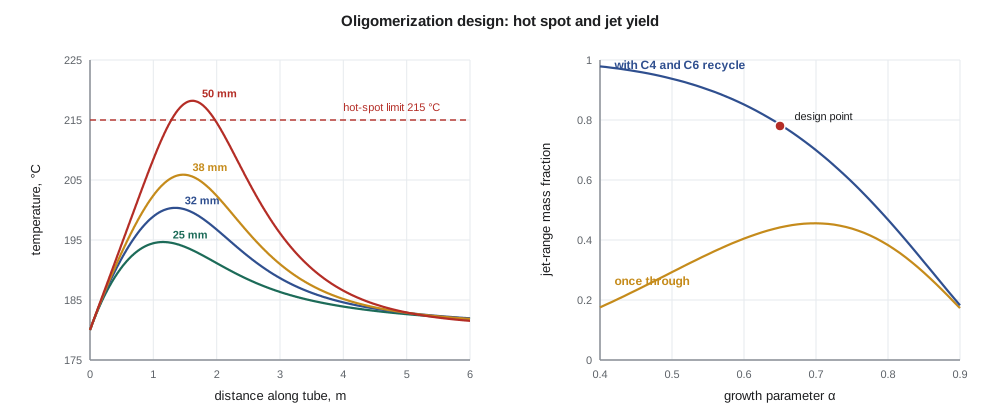
The tube count follows from the mass flux. The reactor feed, ethylene plus recycle and diluent, is about 17.8 kg/s. At a mass flux of 8 kg/(m²·s), which gives a good wall heat transfer coefficient without excessive pressure drop, the flow area is 2.2 m², about 2,800 tubes of 32 mm, holding about 8.7 metric tons of catalyst. Jonah splits the duty between two reactors of about 1,400 tubes each, so that one can be taken offline for catalyst change while the other runs at reduced rate.
Chain length and the jet yield
Oligomerization does not make one product. Chains grow by adding ethylene units, and at each step a chain can either grow again or terminate. If the probability of growth, α, is the same at every step, the mass fraction of chains with n ethylene units follows the Schulz-Flory distribution:
Jet fuel spans roughly C8 to C16, four to eight ethylene units. Once through, the best possible jet fraction is under 0.5, whatever the catalyst: a low α leaves most of the product as butenes and hexenes, a high α makes heavy waxes. The way out is recycle. The C4 and C6 olefins are separated and returned to the reactor, where they grow further, so the light end of the distribution disappears from the product. With full light recycle, an α of about 0.65 gives the base-case jet fraction of 0.78, with about 0.22 heavier than C16. Real systems are less ideal: recycle is not complete, some C6 to C8 material leaves as naphtha, and two-step schemes with different catalysts shape the distribution more than one α can. That is why the balance of Lesson 4 carries 12 % naphtha.
Worked problem
Adiabatic temperature drop in a dehydration bed
The feed to a bed contains one mole of water per mole of ethanol, with mean heat capacities of 100 and 36 J/(mol·K). If the bed may cool by 100 K, what fraction of the ethanol can it convert, at the start of the train?
Show solution
- Heat capacity per mole of ethanol \(\approx 100 + 36 = 136\) J/K.
- Heat available \(= 136 \times 100 = 13\,600\) J per mole of ethanol.
- Conversion \(= 13\,600 / 45\,400 = 0.30\).
Answer: About 30 % per bed. As conversion rises, the stream's heat capacity rises slightly, so later beds convert a little more each, and four beds reach 99.5 %.
Hydrogenation
The olefins are saturated in a trickle-bed reactor: liquid oligomer flows down over a fixed bed of supported nickel or palladium catalyst while hydrogen flows with it. The reaction is fast and releases about 125 kJ per mole of double bonds, about 1.25 MW in total. Because the liquid has a large heat capacity and the feed contains only one double bond per molecule, the adiabatic temperature rise is moderate if part of the hydrogenated product is recycled to dilute the feed. Jonah specifies a recycle ratio of about three parts product to one part fresh olefin, an inlet at about 200 °C and an outlet below 260 °C, at about 30 bar. Hydrogen is fed at 10 % above the stoichiometric amount, and the excess leaves with light gas to the fuel system. The jet specification requires essentially complete saturation, which the analysis of the product's bromine number or olefin content confirms.
Sulfur is the main threat to the hydrogenation catalyst, which is why the feed limits in the design basis matter. A sulfur guard bed of zinc oxide upstream of the oligomerization reactor protects both catalysts.
What the team could not determine
A capstone team works from published data, and the report lists honestly what that leaves open. Catalyst lifetimes, regeneration cycles and the response of the oligomerization catalyst to trace oxygenates are licensor information. The rate constants in the model are fitted to published conversions, not measured. The chain growth parameter is assumed, not predicted. Jonah's recommendation is that, at the next stage, Kingfisher obtain pilot or licensor data on the oligomerization step, where uncertainty most affects both safety and yield, and he quantifies that statement: a 20 % error in the rate constant changes the hot spot by about as much as a 5 K change in coolant temperature.
Common mistakes
MistakeDesigning an exothermic tubular reactor at nominal conditions only.
InsteadCheck parametric sensitivity: the response of the hot spot to small changes in coolant temperature and feed.
MistakeChoosing wide tubes to save on tube count.
InsteadWide tubes remove heat poorly; size tubes for a stable hot spot first.
MistakeTaking all the steam needed for dehydration as dilution.
InsteadCompare more beds against more steam; steam must be raised and condensed for the plant's life.
MistakeExpecting one catalyst pass to make mostly jet fuel.
InsteadSchulz-Flory limits once-through jet yield; recycle the light olefins.
MistakeForgetting regeneration and catalyst change in the layout.
InsteadProvide spare beds or parallel reactors so the plant runs during regeneration.
Summary and key terms
- Dehydration is endothermic; adiabatic beds with reheaters supply the heat, and steam dilution reduces the temperature drop per bed.
- The number of dehydration beds trades capital for steam; four beds at one mole of water per mole of ethanol are chosen.
- Oligomerization is strongly exothermic; cooled multitubular reactors with boiling water hold the wall temperature.
- Narrow tubes and dilution keep the hot spot below its limit; parametric sensitivity shows the margin to runaway.
- Chain lengths follow Schulz-Flory statistics; recycle of light olefins raises the jet fraction.
- Hydrogenation in a trickle bed with product recycle saturates the olefins; guard beds protect the catalysts.
- Adiabatic reactor
- A reactor with no heat exchange with its surroundings.
- Hot spot
- The maximum temperature along a cooled tubular reactor.
- Parametric sensitivity
- A disproportionate response of a reactor to small changes in its inputs, near runaway.
- Schulz-Flory distribution
- The chain-length distribution from constant growth probability.
- Trickle-bed reactor
- A fixed-bed reactor with liquid flowing down over the catalyst with gas.
- Guard bed
- A sacrificial bed that removes catalyst poisons upstream of a reactor.
- Regeneration
- Burning off coke to restore catalyst activity.
Practice problems
Work each problem on paper first, then reveal the answer to check.
Why does a dehydration bed's temperature fall as it converts ethanol?
Show answer
The reaction is endothermic and the bed is adiabatic.
Name two ways to reduce the number of dehydration beds.
Show answer
More dilution steam, or a wider allowed temperature range per bed.
Why do narrow tubes reduce the hot spot?
Show answer
Wall area per unit volume is 4/d, so heat removal per unit of reaction rises.
For α = 0.5, what is the mass fraction of chains with n = 2?
Show answer
0.25.
Why is the oligomerization steam drum pressure a critical control variable?
Show answer
It sets the coolant temperature, to which the hot spot is highly sensitive.
What protects the hydrogenation catalyst from sulfur?
Show answer
A zinc oxide guard bed upstream, and the feed limits in the basis.
Lesson quiz · 5 questions
Score 60% or more to complete this lesson.
Create a free account to save your progress, take quizzes and earn a certificate.