
CHE-499 · Lesson 11 of 12 · 21 min
Environment, permits and carbon intensity
An ATJ plant exists to make fuel with a lower carbon intensity than fossil jet. If its carbon intensity turns out to be close to fossil jet, the plant has no reason to exist, whatever its engineering quality. This lesson therefore treats the environment in two parts. The first is conventional: the emissions, discharges and wastes the plant creates, and the permits it needs to operate at Cedar Rapids. The second is the life-cycle carbon intensity of its products, which decides their value, and which Lesson 12 carries into the economics. Liam leads both parts, with Wren Halvorsen, Kingfisher's environmental lead, as reviewer, building on the CHE-480 study of the ethanol plant.
Emissions, discharges and wastes
Liam starts with an inventory, as CHE-480 taught: every release point, the contaminants it carries and an estimate of their rate at full capacity. For the ATJ plant the list is short but varied.
| Source | Release | Control |
|---|---|---|
| Fired heater (3.8 MW absorbed) | Combustion gases: CO2, NOx, CO, small particulate | Low-NOx burners, natural gas and purge gas fuel only |
| Flare (relief and start-up) | Combustion products; smoke if overloaded | Existing site flare, steam-assisted; flare minimization plan |
| Equipment leaks | Ethylene, light hydrocarbons, hydrogen | Leak detection and repair program; low-emission valve packing |
| Product tanks and loading | Hydrocarbon vapor | Internal floating roof on naphtha; vapor balancing on loading |
| Process water | About 3.8 t/h with traces of ethanol and acetaldehyde | Stripped to 20 ppm, then the site wastewater system |
| Spent caustic | Sodium carbonate solution with traces of organics | Neutralized, to site wastewater system |
| Spent catalysts and adsorbents | Alumina, nickel and palladium catalysts, molecular sieves | Returned to suppliers for metal recovery or licensed disposal |
Compared with the ethanol plant, whose dryers, fermenters and wastewater dominated CHE-480, the ATJ plant is a modest emitter. Its largest conventional air emission is NOx from the fired heater, a few metric tons a year with low-NOx burners. Its most important release risk is from equipment leaks of ethylene, a volatile organic compound that contributes to ground-level ozone, and the plant's hundreds of flanges, valves and seals need a leak detection and repair program from the start. Its process water adds a few metric tons an hour of clean, stripped water to the site's system, and the stripping of Lesson 6 keeps its organic load small.
The spent catalysts deserve a sentence in the report because their metals have value. Nickel and palladium catalysts are normally returned to the catalyst supplier or a refiner for metal recovery, which avoids treating them as waste. The alumina dehydration catalyst, after many regenerations, is a non-hazardous solid if it has been fully decoked.
Permits
The plant needs an Iowa DNR air construction permit for each new emission unit, with the conditions carried into the Title V operating permit. The fired heater and flare connections are new emission units, and the application must show they meet the applicable standards and that the site still meets the NAAQS with them added. Liam flags one question for Kingfisher's permitting counsel. Since 2007, ethanol plants that ferment their feedstock have been outside the list of source categories with a 100 tons per year major-source threshold for Prevention of Significant Deterioration (PSD) review, so the site is judged against 250 tons per year. Whether adding a unit that makes hydrocarbon fuels by chemical synthesis changes that classification for the site, or for the new unit, is a legal question that could change the permitting path, and it must be answered before the design is fixed. The water goes through the site's systems and their permits, which must be amended. The plant will also need its Risk Management Program under the EPA Risk Management Program, 40 CFR 68 updated for the ethylene and hydrogen inventories, and registration of the fuel and its carbon intensity for the section 45Z clean fuel production credit, the Renewable Fuel Standard and the state low carbon fuel programs.
Life-cycle carbon intensity
The carbon intensity of a fuel is its life-cycle greenhouse gas emissions per unit of energy, in grams of CO₂ equivalent per megajoule. It is calculated by a life-cycle assessment to ISO 14040 and ISO 14044, as CHE-480 described, with a functional unit of one megajoule of fuel and a well-to-wake boundary: growing and transporting the corn, making the ethanol, converting it to jet, distributing the fuel and burning it in an engine. The carbon dioxide from burning bio-based fuel is biogenic, taken from the atmosphere by the corn, and is counted as zero; the emissions that count are those from fossil energy, fertilizer, land use and process chemicals along the chain.
Regulatory programs specify the model and rules to use: 45ZCF-GREET in this case. The team's calculation follows the same structure in a simple spreadsheet-style model, so that the drivers are visible, and states that the regulatory calculation would differ in detail. The ethanol's own carbon intensity is taken from the CHE-480 study: 21 g CO₂e/MJ if the fermentation carbon dioxide is captured and stored, and about 52 g CO₂e/MJ if it is not. The ATJ step adds the fired heater's natural gas, the electricity for compressors and pumps, the hydrogen, which is assumed to be made from natural gas by its supplier, and transport and distribution.
One methodological choice needs care. The plant makes three products, and the emissions must be shared among them. ISO 14044 prefers to avoid allocation by system expansion where possible, but fuel programs usually allocate by energy content among fuel co-products. Here SAF is 78 % of the product energy, and the three products have nearly the same energy per kilogram, so energy and mass allocation give almost the same result.
# Carbon intensity of the ATJ products (energy allocation) and the section 45Z credit
hours = 8000
prod = {'SAF': (4.66, 43.4), 'naphtha': (0.72, 44.0), 'diesel': (0.60, 43.2)}   # t/h, LHV GJ/t
E = {k: t * hours * lhv * 1000 for k, (t, lhv) in prod.items()}                 # MJ/yr
Et = sum(E.values())
E_eth = 9.86 * hours * 26.8 * 1000                                              # MJ/yr of ethanol fed
GRID = 400.0                                                                     # g CO2e/kWh
proc = {'fired heater (natural gas)': 7.1e9,                                    # g CO2e/yr, from Lesson 7
        'electricity (1.6 MW)': 1.6 * hours * 1000 * GRID,
        'hydrogen (640 t, from natural gas)': 640e3 * 10.5 * 1000}
TD = 1.3                                                                        # g/MJ transport and distribution
def ci(ci_eth, show=False):
    parts = {'ethanol': ci_eth * E_eth / Et}
    parts.update({k: v / Et for k, v in proc.items()}); parts['transport, distribution'] = TD
    if show:
        for k, v in parts.items(): print(f"  {k:<36} {v:5.1f} g/MJ")
    return sum(parts.values())
print(f"products {Et/1e9:.3f} PJ/yr (SAF {E['SAF']/Et:.0%}); ethanol in {E_eth/1e9:.3f} PJ/yr")
print('with fermentation CO2 captured and stored (ethanol CI 21, no land-use change):')
c1 = ci(21.0, True)
c0 = ci(52.0)
ref = 89.0                                                                      # fossil jet reference, g/MJ (illustrative)
print(f"CI {c1:.1f} g/MJ with capture, {c0:.1f} without; reduction vs {ref:.0f}: {1-c1/ref:.0%} and {1-c0/ref:.0%}")
# 45Z: 1.00 per gallon (prevailing wage) x emissions factor (50 - CI in kg/MMBtu)/50; SAF capped at the same 1.00
gal = {k: prod[k][0] * hours / rho * 1000 / 3.78541 for k, rho in (('SAF', 0.760), ('diesel', 0.800))}   # gal/yr
for name, c in (('with capture', c1), ('without capture', c0)):
    f = max(0.0, (50 - 1.055 * c) / 50)
    print(f"{name}: {1.055*c:.1f} kg/MMBtu, factor {f:.3f}; 45Z on SAF and diesel {f*sum(gal.values())/1e6:.1f} million per year")
print(f"SAF {gal['SAF']/1e6:.2f} million gal/yr; RINs and state credits at an illustrative 1.52 per gallon: {1.52*gal['SAF']/1e6:.1f} million per year")products 2.079 PJ/yr (SAF 78%); ethanol in 2.114 PJ/yr with fermentation CO2 captured and stored (ethanol CI 21, no land-use change): ethanol 21.4 g/MJ fired heater (natural gas) 3.4 g/MJ electricity (1.6 MW) 2.5 g/MJ hydrogen (640 t, from natural gas) 3.2 g/MJ transport, distribution 1.3 g/MJ CI 31.8 g/MJ with capture, 63.3 without; reduction vs 89: 64% and 29% with capture: 33.5 kg/MMBtu, factor 0.330; 45Z on SAF and diesel 4.8 million per year without capture: 66.8 kg/MMBtu, factor 0.000; 45Z on SAF and diesel 0.0 million per year SAF 12.96 million gal/yr; RINs and state credits at an illustrative 1.52 per gallon: 19.7 million per year
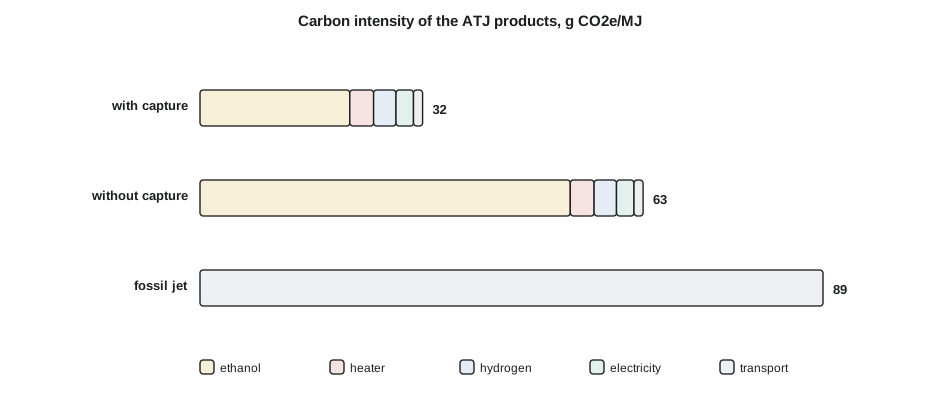
With capture, the products' carbon intensity is about 32 g CO₂e/MJ, of which 21 comes with the ethanol and 10 from the ATJ step itself: about 3.4 from the heater, 3.2 from the hydrogen, 2.5 from Iowa's more carbon-intensive electricity and 1.3 from transport and distribution. That is about 64 % below an illustrative fossil jet reference of 89 g/MJ. Without capture, the intensity is about 63 g/MJ, only 29 % below. The fermentation carbon dioxide capture project, which is outside the ATJ plant's battery limits, more than doubles the reduction.
What the carbon intensity is worth
Under the section 45Z clean fuel production credit, as amended in 2025, a producer earns up to 1.00 dollar per gallon (with prevailing wage and apprenticeship requirements met) multiplied by an emissions factor of (50 − CI)/50, with CI in kg CO₂e per million Btu and indirect land-use change excluded. The 2025 law removed the higher rate SAF previously had, so SAF and other fuels now share the 1.00 dollar maximum, and extended the credit through 2029. With capture, the products' CI is about 33.5 kg/MMBtu, the emissions factor 0.33, and the credit about 4.8 million dollars a year on the SAF and diesel. Without capture, the CI exceeds 50 kg/MMBtu and the credit is zero. The SAF also earns RINs under the Renewable Fuel Standard and, if sold into states with low carbon fuel programs, credits there; the team uses an illustrative combined value of 1.52 dollars per gallon, about 20 million dollars a year, and treats it as the largest risk in the revenue. One more question goes to Kingfisher's tax advisers: the capture project at the ethanol plant could alternatively claim the section 45Q credit for stored carbon dioxide, and the rules do not allow 45Q and 45Z to be claimed for the same facility in the same year. Which credit, at which facility, gives the best result is theirs to decide.
The credit calculations have a practical side that the team writes into the operating plan. Credits and RINs are generated only for fuel actually produced and sold, so the plant must keep records of each batch shipped, its carbon intensity and its buyer, and the records must survive audit. The carbon intensity must also reflect actual operation: if the capture plant is out of service, the intensity rises above the 45Z threshold for that fuel. Liam proposes a monthly carbon intensity report built from metered energy, hydrogen and product flows, with the capture plant's availability alongside it.
Two lessons for the design come from these numbers. The first is that the ATJ plant's own contribution, about 9 to 10 g/MJ, is worth reducing. Every gram per megajoule is worth about 2,000 credits or the equivalent a year at this scale. Green hydrogen from electrolysis, renewable electricity or electrification of the heater would each remove a few grams, at costs Liam compares in the report. The second is that the capture project is essential: without it the plant's product is low-carbon in name but earns little for it. The team's recommendation will make the ATJ investment conditional on the capture project, or on another way of lowering the ethanol's carbon intensity.
Worked problem
Value of a gram per megajoule
How many credits a year does a 1 g/MJ reduction in carbon intensity create for 2.08 PJ of product a year, and what is it worth at 120 dollars per credit?
Show solution
- Reduction \(= 1\ \text{g/MJ} \times 2.08\times10^{9}\ \text{MJ} = 2.08\times10^{9}\) g \(= 2\,080\) t CO₂e.
- Credits \(= 2\,080\) a year (more with a multiplier).
- Value \(= 2\,080 \times 120 = 250\,000\) dollars a year.
Answer: About 2,100 credits, or a quarter of a million dollars a year. Over the plant's life, a measure that cuts 3 g/MJ for less than about 6 million dollars of capital may pay for itself.
Beyond carbon
Wren asks the team to look beyond carbon intensity. Corn ethanol's environmental profile includes fertilizer runoff and water use on farms, which carbon intensity does not capture. SAF from the ATJ route also brings benefits that carbon intensity does not capture: its near absence of aromatics and sulfur reduces particulate emissions from aircraft engines, including the soot that seeds contrails. The team's report notes both, without quantifying them, as part of an honest account of the product's environmental case.
Common mistakes
MistakeCounting the carbon dioxide from burning bio-based fuel as an emission.
InsteadIt is biogenic and counted as zero; count the fossil inputs along the chain.
MistakeUsing the ethanol plant's carbon intensity without asking whether capture is assumed.
InsteadState the ethanol CI and its basis; capture more than doubles the reduction.
MistakeTreating proposed credit rules as enacted.
InsteadTest the economics with and without proposals.
MistakeIgnoring the plant's own process emissions because the ethanol dominates.
InsteadEach g/MJ has value; heater, hydrogen and power are design choices.
MistakeAssuming permits for a new unit on an existing site are routine.
InsteadCheck whether the addition changes the site's category or thresholds.
Summary and key terms
- The release inventory lists heater, flare, leaks, tanks, process water, spent caustic and catalysts with their controls.
- Permits cover the new air sources, water streams, emergency planning and fuel registration.
- Carbon intensity is a well-to-wake life-cycle result per megajoule; biogenic combustion carbon counts as zero.
- Energy allocation shares emissions among the products; SAF is 78 % of their energy.
- With capture, the products' CI is about a third of fossil jet; without it, only about a quarter below.
- Credit value depends on CI, policy and price; each g/MJ is worth about 2,000 credits a year here.
- Carbon intensity (CI)
- Life-cycle greenhouse gas emissions per unit of fuel energy.
- Well-to-wake
- A fuel life cycle from feedstock production to combustion in an aircraft.
- Biogenic carbon
- Carbon recently taken from the atmosphere by plants.
- Energy allocation
- Sharing emissions among co-products in proportion to their energy content.
- Leak detection and repair (LDAR)
- A program to find and fix equipment leaks.
- Functional unit
- The quantified output to which life-cycle results are referred, here 1 MJ of fuel.
Practice problems
Work each problem on paper first, then reveal the answer to check.
Which contributes most to the products' carbon intensity?
Show answer
The ethanol feedstock.
Why is energy allocation close to mass allocation here?
Show answer
The three products have nearly the same energy per kilogram.
What would replacing gray hydrogen with zero-carbon hydrogen save?
Show answer
About 3.2 g/MJ.
Why does capture of fermentation CO2 matter so much to the ATJ plant?
Show answer
It lowers the ethanol's CI, which dominates the product CI.
What is the largest conventional air emission of the ATJ plant?
Show answer
NOx from the fired heater.
Why are spent nickel and palladium catalysts not normally landfilled?
Show answer
Their metals are recovered by suppliers or refiners.
Lesson quiz · 5 questions
Score 60% or more to complete this lesson.
Create a free account to save your progress, take quizzes and earn a certificate.