
CHE-320 · Lesson 12 of 12 · 25 min
Capstone: choosing a thermodynamic model for the ethyl acetate line
At the end of the term, Ingrid asks Theo for the thermodynamic design basis of the ethyl acetate study: which property methods the simulation will use for each part of the plant, why, what data stand behind them, and what the first equipment checks show. She will review it and, if it holds up, put her seal as a licensed PE on the basis document so that the consulting engineers who design the line can rely on it. A wrong model at this stage is expensive: it can make a column look feasible that will not work, or hide a second liquid phase in a vessel designed for one. This capstone walks through Theo's basis section by section, using everything from lessons 1 to 11.
The process in outline
The concept from lesson 11 has four parts. Ethanol from the plant, 95 % by mass, and acetic acid bought from a supplier feed a reactive distillation column with an acid catalyst in its middle section. The overhead vapor, near the ternary azeotrope of ethyl acetate, ethanol and water, is condensed and cooled to about 40 °C in a decanter, where it splits into an ester-rich layer and a water-rich layer. Most of the ester layer returns to the column as reflux; the rest goes to a finishing column that makes ester of solvent grade. The water layer goes to a small stripper that recovers dissolved ester and ethanol before the water leaves for treatment. The line itself has no high-pressure gas section, but Theo includes Lakeshore Gas's compression in the basis because it shares the site and the same property review.
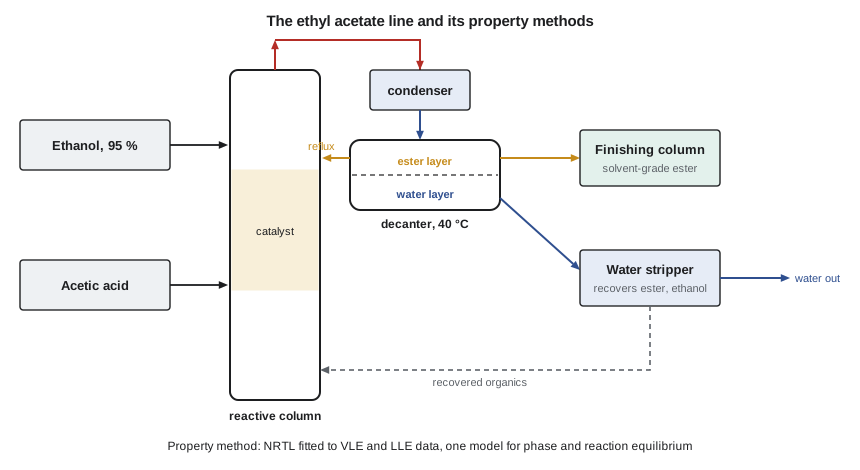
Step 1: classify each section
Theo's first move is to classify each part of the plant by the questions that decide the model: Are the components polar or hydrogen-bonding? Is the pressure high, or the system near a critical point? Can two liquid phases form? Are there measured data for the key pairs? The code turns these questions into a simple decision sequence, which reflects common published guidance rather than any one company's rules, and applies it to five sections of the site.
# Capstone: model choice and a flash-and-decant check for the ethyl acetate reactor overhead
import math

def choose_model(polar, P_bar, near_critical, two_liquids, data_available):
    if P_bar > 10 or near_critical:
        return "cubic equation of state (phi-phi), with fitted kij; check against data"
    if polar or two_liquids:
        m = "NRTL or UNIQUAC (gamma-phi)" if data_available else "UNIFAC to screen, then measure and fit NRTL"
        return m + (", fitted to LLE as well as VLE" if two_liquids else "")
    return "Raoult's law (ideal gamma-phi) or a simple equation of state"
cases = [("CO2 compression and drying", False, 20, False, False, True),
         ("ethanol-water rectifier", True, 1.0, False, False, True),
         ("ester overhead and decanter", True, 1.0, False, True, True),
         ("new bio-based solvent blend", True, 1.0, False, False, False),
         ("methanol in fuel ethanol", False, 1.0, False, False, True)]
for name, *args in cases:
    print(f"{name:28s} -> {choose_model(*args)}")

# Overhead vapor from the esterification column is condensed and cooled to 40 C, then decanted.
# Two-component screening model: ethyl acetate (1) and water (2), Margules fitted to solubilities (lesson 10)
A12, A21 = 4.117, 2.030
def lng(x):
    x2 = 1 - x
    return (x2 ** 2 * (A12 + 2 * (A21 - A12) * x), x * x * (A21 + 2 * (A12 - A21) * x2))
# phase compositions at the binodal from lesson 10 (the parameters were fitted to them)
xw, xo = 0.0175, 0.8570              # ethyl acetate mole fraction in water-rich and ester-rich phases
F, z = 100.0, 0.70                   # kmol/h condensate with 0.70 mole fraction ethyl acetate (the heteroazeotrope region)
Lo = F * (z - xw) / (xo - xw); Lw = F - Lo   # lever rule
print(f"decanter: ester phase {Lo:.1f} kmol/h (x1 = {xo}), water phase {Lw:.1f} kmol/h (x1 = {xw})")
print(f"ethyl acetate lost with the water phase: {Lw * xw * 88.11:.0f} kg/h unless it is stripped and recycled")

# Gibbs energy of mixing check: a phase split exists only where the mixture is unstable
def gmix(x):
    l1, l2 = lng(x); return x * math.log(x) + (1 - x) * math.log(1 - x) + x * l1 + (1 - x) * l2
def gmix_ideal(x): return x * math.log(x) + (1 - x) * math.log(1 - x)
xs = [i / 100 for i in range(1, 100)]
unstable = [x for x in xs[1:-1] if gmix(x + 0.01) + gmix(x - 0.01) - 2 * gmix(x) < 0]
print(f"Margules: Gibbs curve concave between x1 = {min(unstable):.2f} and {max(unstable):.2f} -> two liquids")
print(f"ideal solution: concave points = {sum(1 for x in xs[1:-1] if gmix_ideal(x + 0.01) + gmix_ideal(x - 0.01) - 2 * gmix_ideal(x) < 0)} -> no split predicted")

# Bubble point of the ester phase at 1 atm, with and without activity coefficients
ant = {"ea": (7.10179, 1244.95, 217.88), "w": (8.07131, 1730.63, 233.426)}
def psat(c, T):
    A, B, C = ant[c]; return 10 ** (A - B / (T + C)) * 0.133322
for label, use in (("Raoult", False), ("Margules", True)):
    lo, hi = 40.0, 110.0
    for _ in range(60):
        T = (lo + hi) / 2
        g1, g2 = (math.exp(v) for v in lng(xo)) if use else (1.0, 1.0)
        f = xo * g1 * psat("ea", T) + (1 - xo) * g2 * psat("w", T) - 101.325
        lo, hi = (lo, T) if f > 0 else (T, hi)
print(f"ester phase bubble point ({label}): {T:.1f} C")CO2 compression and drying -> cubic equation of state (phi-phi), with fitted kij; check against data ethanol-water rectifier -> NRTL or UNIQUAC (gamma-phi) ester overhead and decanter -> NRTL or UNIQUAC (gamma-phi), fitted to LLE as well as VLE new bio-based solvent blend -> UNIFAC to screen, then measure and fit NRTL methanol in fuel ethanol -> Raoult's law (ideal gamma-phi) or a simple equation of state decanter: ester phase 81.3 kmol/h (x1 = 0.857), water phase 18.7 kmol/h (x1 = 0.0175) ethyl acetate lost with the water phase: 29 kg/h unless it is stripped and recycled Margules: Gibbs curve concave between x1 = 0.10 and 0.64 -> two liquids ideal solution: concave points = 0 -> no split predicted ester phase bubble point (Raoult): 79.7 C ester phase bubble point (Margules): 70.4 C
For the carbon dioxide compression and drying, the answer is a cubic equation of state with fitted interaction parameters, as lessons 3, 4 and 9 used: the pressure is 20 bar, the gas is dominant and the traces are dilute. For the ethanol-water rectifier it is an activity coefficient model, NRTL or UNIQUAC, with the parameters fitted to the vapor-liquid data of lessons 6 and 7. For the ester overhead and decanter, the same family of models, but with parameters fitted to liquid-liquid data as well as vapor-liquid data, because one parameter set must predict both the azeotrope and the two-liquid split. For a new solvent blend with no data, UNIFAC is the starting point, followed by measurement. For the methanol trace in fuel ethanol, Raoult's law is enough.
Step 2: the decanter, and why the model matters
The decanter is the piece of equipment the whole concept depends on, so Theo checks it first. Taking the condensate as 100 kmol/h with 0.70 mole fraction ester on a two-component basis, and the phase compositions from the lesson 10 Margules fit, the lever rule gives 81.3 kmol/h of ester layer at \(x_1 = 0.857\) and 18.7 kmol/h of water layer at \(x_1 = 0.0175\). The water layer carries about 29 kg/h of dissolved ester, which justifies the stripper.
Then he checks what an ideal-solution model would have said. The code tests the curvature of the Gibbs energy of mixing. With the fitted Margules model, the curve is concave between \(x_1\) of about 0.10 and 0.64, so the liquid is unstable there and must split. With an ideal solution, the curve is convex everywhere: no split is predicted at all. A simulation run with the wrong property method would show a single liquid leaving the condenser and no decanter would appear in the design. The same check explains why Wilson's equation, which cannot predict splitting, is ruled out for this section.
The ester layer's bubble point at 1 atm makes the same point in another way. Raoult's law puts it at 79.7 °C; with the Margules activity coefficients it is 70.4 °C, matching the measured heterogeneous azeotrope. A 9 K error in the overhead temperature would undersize the condenser's driving force and misjudge the reflux.
Worked problem
The lever rule in the decanter
Condensate at 100 kmol/h with \(z = 0.70\) ester separates into phases with \(x_1 = 0.857\) and \(x_1 = 0.0175\). Find the flow of each layer.
Show solution
- Ester layer: \(L_o = F(z - x_w)/(x_o - x_w) = 100(0.6825)/(0.8395) = 81.3\) kmol/h.
- Water layer: \(L_w = 100 - 81.3 = 18.7\) kmol/h.
- Ester lost in the water layer: \(18.7 \times 0.0175 \times 88.11 = 29\) kg/h.
Answer: The stripper must recover about 29 kg/h of ester for this condensate.
Step 3: data behind the model
A property method is only as good as its parameters, so the basis lists the data source for every key binary. Ethanol-water: abundant vapor-liquid data, including the 1 atm set of lesson 6, and infinite-dilution data for the stripping section. Ethyl acetate-water: mutual solubilities over 10 to 70 °C, and vapor-liquid data at the heterogeneous azeotrope. Ethanol-ethyl acetate: vapor-liquid data showing a minimum-boiling azeotrope near 72 °C. Acetic acid with each of the others: data exist, but the acid's vapor-phase dimerization must be modeled, which simulators do with a chemical theory correction for the vapor. Theo checks that the simulator's built-in parameters were regressed from evaluated data, re-fits two pairs to the plant's own lab measurements, and records where the model was compared with the ternary azeotrope and with ternary liquid-liquid tie lines. A model that fits each binary well can still miss the ternary behavior, and the decanter depends on the ternary.
Step 4: reaction equilibrium and the column
For the reactive section, the basis uses activity-based equilibrium constants, consistent with the NRTL model used for the phase equilibrium, rather than the mole-fraction value of about 4 from lesson 11. Using one model for both is essential: if the reaction equilibrium and the phase equilibrium use different activity coefficients, the simulation will be thermodynamically inconsistent and can predict conversions that cannot happen. The kinetic data for the catalyst come from the vendor and are outside this basis, but Theo records that the column's conversion must be checked against the equilibrium limit at every stage.
Step 5: sensitivity and limits
Finally, the basis states where the model is uncertain and how much that matters. Theo varies the most uncertain parameters, the ethyl acetate-water liquid-liquid parameters, by amounts consistent with the scatter in the solubility data, and finds that the ester lost in the water layer changes by about 20 %, which changes the stripper size but not the concept. He notes that the activity models were fitted between about 25 and 100 °C, and lesson 10 showed what happens far outside a fitted range; no unit in the line operates outside it. And he lists the measurements still needed: a few ternary tie lines at 40 °C with the plant's actual composition, and the distribution of ethanol between the layers, which controls how much ethanol recycles.
Worked problem
Is the decanter safe from the plait point?
Ethanol makes ester and water more mutually soluble. If the condensate held so much ethanol that the two layers merged, the decanter would fail. How does Theo check this?
Show solution
- Plot the condensate composition on the ternary diagram at 40 °C using the fitted model.
- Confirm that it lies inside the two-phase region with a margin from the binodal and the plait point.
- Confirm the margin with measured tie lines from the lab, because the plait point region is where models are least reliable.
Answer: The basis requires the operating composition to stay well inside the two-phase region, with an alarm on decanter interface loss.
The review
Ingrid's review questions are pointed. Why NRTL and not UNIQUAC? Both are acceptable; NRTL has more published parameter sets for these binaries, and the choice is recorded with a check that UNIQUAC gives similar results. Is the decanter temperature fixed? It is set by cooling water, so the basis covers 30 to 45 °C. What happens if the plant's ethanol carries more water in summer? The esterification conversion and the decanter split were both checked with 93 % ethanol. She signs off the basis with two actions: the ternary tie lines to be measured before the design is frozen, and the acetic acid dimerization treatment to be confirmed with the simulator vendor. Wren adds a third: the water layer leaving the stripper must meet the plant's discharge limits under the permit and the site's wastewater agreement, which depends on the residual ester and ethanol, and so on the same model.
What the course has built
Theo's basis uses every lesson. The fundamental property relation and the chemical potential (lesson 1) give the criteria. Partial molar and excess properties (lesson 2) give the language of non-ideal mixtures. Fugacity and equations of state (lessons 3, 4 and 9) handle gases and high pressure. Raoult's law, activity coefficients and their models (lessons 5 to 7) handle polar liquids. Azeotropes (lesson 8), liquid-liquid and solid-liquid equilibrium (lesson 10) and reaction equilibrium (lesson 11) handle the phenomena that make real processes hard. The same framework, the equality of chemical potentials and the minimum of Gibbs energy, runs through all of them. CHE-350 now uses these models to design the separations stage by stage.
Common mistakes
MistakeChoosing a property method by habit.
InsteadClassify each section by polarity, pressure, phase splitting and data before choosing.
MistakeUsing parameters fitted to vapor-liquid data alone for a system with two liquids.
InsteadFit to liquid-liquid data as well, or the split will be wrong.
MistakeUsing different activity models for phase and reaction equilibrium in one column.
InsteadUse one consistent model for both.
MistakeTrusting binary fits for ternary behavior near a plait point.
InsteadCheck against measured ternary tie lines.
Summary and key terms
- Property method selection follows from polarity, pressure, the possibility of two liquids, and available data.
- Equations of state suit high-pressure gas sections; NRTL or UNIQUAC suit polar liquids at low pressure.
- An ideal-solution model predicts no decanter split; the fitted model predicts the 81/19 split and the 70.4 °C bubble point.
- Every key binary in the basis needs a stated data source, and ternary behavior must be checked.
- Phase and reaction equilibrium in one unit must use one consistent thermodynamic model.
- A design basis records uncertainties, sensitivities and the measurements still needed.
- Property method
- The set of models and parameters a simulator uses for phase equilibrium and properties.
- Design basis
- The documented assumptions, data and methods on which a design is built.
- Lever rule
- The material balance that gives the amounts of two coexisting phases from their compositions.
- Stability test
- A check, such as on the curvature of the Gibbs energy of mixing, of whether a phase will split.
- Thermodynamic consistency
- Use of one compatible model for all equilibrium calculations in a process.
- Ternary azeotrope
- An azeotrope of three components, such as ethyl acetate, ethanol and water near 70 °C.
Practice problems
Work each problem on paper first, then reveal the answer to check.
Condensate with \(z = 0.60\) splits into \(x_1 = 0.857\) and \(0.0175\) phases. What fraction is the ester layer?
Show answer
\((0.60 - 0.0175)/(0.8395) = 69\%\).
Which property method would Theo choose for a 60 bar carbon dioxide pipeline?
Show answer
A cubic equation of state with fitted interaction parameters.
Why is Wilson's equation ruled out for the decanter?
Show answer
It cannot predict two liquid phases.
Why must the reactive column use the same activity model for reaction and phase equilibrium?
Show answer
Otherwise the simulation is inconsistent and can predict impossible conversions.
Name two measurements Ingrid required before freezing the design.
Show answer
Ternary tie lines at decanter conditions and confirmation of the acetic acid dimerization treatment.
What does a stability test on \(\Delta G/RT\) look for?
Show answer
Regions where the curve is concave, which must split into two phases.
Lesson quiz · 5 questions
Score 60% or more to complete this lesson.
Create a free account to save your progress, take quizzes and earn a certificate.