
CHE-320 · Lesson 11 of 12 · 21 min
Chemical reaction equilibrium
The heart of the ethyl acetate line is a reversible reaction: ethanol and acetic acid, with an acid catalyst, give ethyl acetate and water. Ingrid's first question is how far it can go. A reactor can be made large enough to reach equilibrium, but no reactor can go past it. Her second question comes from the company's longer-term plans: ethanol can also be dehydrated over a solid catalyst to make ethylene, the building block of bio-based polyethylene. Under what conditions does that reaction go to completion? Both answers come from the Gibbs energy, exactly as phase equilibrium did.
The extent of reaction
For a reaction \(\sum_i \nu_iA_i = 0\), with stoichiometric numbers \(\nu_i\) positive for products and negative for reactants, every species changes in proportion: \(dn_i = \nu_i\,d\varepsilon\). The extent of reaction \(\varepsilon\) is the single variable that describes how far the reaction has gone, and the mole numbers are \(n_i = n_{i0} + \nu_i\varepsilon\). For the esterification, \(\nu = -1\) for ethanol and acetic acid and \(+1\) for ethyl acetate and water. At constant temperature and pressure, \(dG = \sum_i\mu_i\,dn_i = (\sum_i\nu_i\mu_i)\,d\varepsilon\), so the Gibbs energy is at its minimum when
This is the criterion of chemical reaction equilibrium, the reaction counterpart of equal chemical potentials between phases.
The equilibrium constant
Writing each chemical potential as \(\mu_i = G_i^\circ + RT\ln a_i\), where \(G_i^\circ\) is the standard Gibbs energy and \(a_i\) the activity relative to the standard state, turns the criterion into
The equilibrium constant \(K\) depends only on temperature, through the standard Gibbs energy change of reaction, which is computed from tabulated standard Gibbs energies of formation. The activities depend on the phase. For an ideal-gas mixture with a standard state of the pure gas at 1 bar, \(a_i = y_iP/P^\circ\). For a real gas, \(a_i = y_i\hat{\phi}_iP/P^\circ\). For a liquid solution with pure-liquid standard states, \(a_i = x_i\gamma_i\). The rest of the lesson uses these one at a time.
Temperature: the van 't Hoff equation
The equilibrium constant changes with temperature according to the standard enthalpy of reaction:
If \(\Delta H^\circ\) is roughly constant, integration gives \(\ln(K_2/K_1) = -(\Delta H^\circ/R)(1/T_2 - 1/T_1)\). Endothermic reactions, with \(\Delta H^\circ > 0\), have larger \(K\) at higher temperature; exothermic reactions, smaller. This is Le Chatelier's principle made quantitative. For accurate work over wide ranges, \(\Delta H^\circ\) is itself integrated from heat capacity data, as Thermodynamics I did for the ammonia synthesis.
Esterification in the liquid phase
For ethanol + acetic acid in the liquid, the equilibrium constant expressed in mole fractions is about 4 and changes little with temperature, because the reaction is nearly thermoneutral. With an ideal-solution approximation, \(K = x_{\text{EtAc}}x_{\text{W}}/(x_{\text{EtOH}}x_{\text{HOAc}})\), and the total moles do not change, so the extent can be found directly from the feed. The code solves it for several feeds.
# Chemical reaction equilibrium: esterification in the liquid and ethanol dehydration in the gas
import math
R = 8.314

# 1) Ethanol + acetic acid = ethyl acetate + water, liquid phase, K about 4 (nearly independent of T)
K = 4.0
def conversion(ratio, water0=0.0, K=K):
    # ratio = mol ethanol per mol acid; solve K = (x)(w0 + x) / ((1 - x)(ratio - x)) for x, the acid converted
    lo, hi = 0.0, min(1.0, ratio) - 1e-12
    for _ in range(80):
        x = (lo + hi) / 2
        f = x * (water0 + x) - K * (1 - x) * (ratio - x)
        lo, hi = (x, hi) if f < 0 else (lo, x)
    return x
for ratio in (1.0, 2.0, 3.0):
    print(f"ethanol:acid = {ratio:.0f}:1 -> equilibrium acid conversion {conversion(ratio) * 100:.1f} %")
print(f"1:1 feed using 95 % ethanol (0.13 mol water per mol ethanol): {conversion(1.0, 0.13) * 100:.1f} %")
# Keeping the water at one tenth of what it would otherwise be acts like a tenfold larger K
print(f"1:1 with the water held at one tenth: {conversion(1.0, K=40.0) * 100:.1f} %")

# 2) Ethanol(g) = ethylene(g) + water(g): bio-based ethylene
dG298 = 68.4 - 228.6 + 168.5          # kJ/mol from standard Gibbs energies of formation (approximate)
dH298 = 52.5 - 241.8 + 235.1          # kJ/mol from standard enthalpies of formation (approximate)
K298 = math.exp(-dG298 * 1000 / (R * 298.15))
print(f"dG298 = {dG298:.1f} kJ/mol, dH298 = {dH298:.1f} kJ/mol, K298 = {K298:.3g}")
print(" T/C     K        xi at 1 bar   xi at 5 bar")
for Tc in (25, 150, 250, 350, 450):
    T = Tc + 273.15
    KT = K298 * math.exp(-dH298 * 1000 / R * (1 / T - 1 / 298.15))   # van 't Hoff with constant dH
    xi = [math.sqrt(KT / (KT + P)) for P in (1.0, 5.0)]               # 1 mol ethanol, ideal gas, P in bar
    print(f"{Tc:4d}  {KT:9.3g}   {xi[0]:9.4f}   {xi[1]:9.4f}")

# Temperature for 99 % equilibrium conversion at 1 bar
lo, hi = 300.0, 1000.0
for _ in range(60):
    T = (lo + hi) / 2; KT = K298 * math.exp(-dH298 * 1000 / R * (1 / T - 1 / 298.15))
    lo, hi = (T, hi) if math.sqrt(KT / (KT + 1)) < 0.99 else (lo, T)
print(f"99 % equilibrium conversion at 1 bar needs about {T - 273.15:.0f} C")ethanol:acid = 1:1 -> equilibrium acid conversion 66.7 % ethanol:acid = 2:1 -> equilibrium acid conversion 84.5 % ethanol:acid = 3:1 -> equilibrium acid conversion 90.3 % 1:1 feed using 95 % ethanol (0.13 mol water per mol ethanol): 64.6 % 1:1 with the water held at one tenth: 86.3 % dG298 = 8.3 kJ/mol, dH298 = 45.8 kJ/mol, K298 = 0.0351 T/C K xi at 1 bar xi at 5 bar 25 0.0351 0.1843 0.0835 150 8.25 0.9444 0.7890 250 99.3 0.9950 0.9757 350 538 0.9991 0.9954 450 1.83e+03 0.9997 0.9986 99 % equilibrium conversion at 1 bar needs about 217 C
An equimolar feed reaches only 66.7 % conversion of the acid: with \(K = 4\), the extent satisfies \(\varepsilon^2/(1 - \varepsilon)^2 = 4\), so \(\varepsilon = 2/3\). Two moles of ethanol per mole of acid raise the conversion to 84.5 %, and three moles to 90.3 %, which is the Le Chatelier effect of an excess reactant. Using the plant's 95 % ethanol instead of anhydrous ethanol, which brings 0.13 mol of water with each mole of ethanol, lowers the equimolar conversion only to 64.6 %. Holding the water at one tenth of the level it would otherwise reach acts like a tenfold larger equilibrium constant and gives 86 %.
That last case points to the industrial answer. The reaction is commonly run in a reactive distillation column, in which the ethyl acetate-water heterogeneous azeotrope of lesson 8 carries both products overhead as they form. The condensate splits into ester and water layers in a decanter, the water leaves, and the ester returns or goes to finishing. Removing a product continuously keeps the reaction away from equilibrium and pushes conversion close to complete in one unit. Theo writes this into the concept for the line, with the decanter as a key piece of equipment.
Worked problem
Conversion with excess ethanol
With \(K = 4\) and a feed of 2 mol ethanol per mol acetic acid, find the equilibrium conversion of the acid.
Show solution
- At extent \(\varepsilon\) per mole of acid: ester \(\varepsilon\), water \(\varepsilon\), acid \(1 - \varepsilon\), ethanol \(2 - \varepsilon\).
- \(\varepsilon^2 = 4(1 - \varepsilon)(2 - \varepsilon)\), so \(3\varepsilon^2 - 12\varepsilon + 8 = 0\).
- \(\varepsilon = [12 - \sqrt{144 - 96}]/6 = 0.845\).
Answer: 84.5 % of the acid is converted; the excess ethanol is recovered and recycled.
Real liquid mixtures of these four polar compounds are not ideal solutions, and a rigorous treatment uses activities, \(K_a = \prod(x_i\gamma_i)^{\nu_i}\), with activity coefficients from a model such as NRTL fitted to all six binaries. The mole-fraction value of about 4 already absorbs typical activity effects, which is why it works for screening but drifts as the composition changes. Acetic acid also dimerizes strongly in the vapor, which matters for the column's vapor-liquid equilibrium and requires a special correction in the vapor fugacity. Lesson 12 lists these as items for the detailed design.
Ethanol dehydration in the gas phase
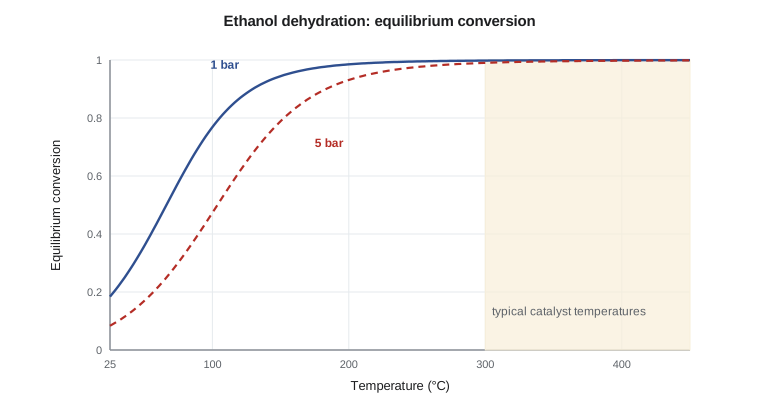
For \(\mathrm{C_2H_5OH(g) \longrightarrow C_2H_4(g) + H_2O(g)}\), approximate standard values at 25 °C give \(\Delta G^\circ = +8.3\) kJ/mol and \(\Delta H^\circ = +45.8\) kJ/mol. At 25 °C the reaction is unfavorable, with \(K = 0.035\): if it could happen at all at room temperature, which on a real catalyst it cannot, only 18 % of the ethanol would convert at 1 bar. Because it is endothermic, \(K\) rises steeply with temperature, to about 8 at 150 °C and about 100 at 250 °C, and above about 220 °C the equilibrium conversion at 1 bar exceeds 99 %. Industrial dehydration over alumina or zeolite catalysts runs at about 300 to 450 °C, where equilibrium is not the limit; the temperature is set by the catalyst's activity and by side reactions such as diethyl ether formation.
Pressure and inerts
For an ideal-gas reaction, \(K = \prod(y_iP/P^\circ)^{\nu_i}\). When the moles of gas increase on reaction, \(\sum\nu_i > 0\), as for dehydration (one mole becomes two), raising the pressure lowers the equilibrium conversion. At 150 °C the code gives 94 % at 1 bar but only 79 % at 5 bar; at 250 °C, 99.5 % and 97.6 %. The equilibrium constant is unchanged; what changes is the pressure term. Adding an inert gas, such as steam or nitrogen, lowers the partial pressures and has the same effect as lowering the pressure. For reactions that decrease the moles of gas, such as ammonia or methanol synthesis, the effects reverse, which is why those processes run at high pressure.
Multiple reactions
Real reactors usually host several reactions. The dehydration reactor also makes diethyl ether, \(2\,\mathrm{C_2H_5OH \longrightarrow (C_2H_5)_2O + H_2O}\), and a little acetaldehyde. With \(R\) independent reactions, there are \(R\) extents and \(R\) equilibrium equations, solved together with the material balances. An equivalent approach, used in most simulators, minimizes the total Gibbs energy of the mixture directly over all species, subject to element balances, without writing reactions at all. The two methods give the same answer. Gibbs minimization is convenient when many species are possible, such as in gasification or combustion, and the extent method when a few reactions are well defined.
Equilibrium is a limit, not a prediction
Equilibrium calculations say how far a reaction could go, not how fast or by what path. A reaction with a huge \(K\) may not occur at all without a catalyst, as ethanol dehydration at 25 °C shows, and a catalyst cannot change \(K\); it only changes the rate at which equilibrium is approached. Reactor design in CHE-345 combines both: thermodynamics sets the ceiling, and kinetics decides how close a reactor of practical size gets to it.
The same Le Chatelier reasoning explains a practical choice in the ethyl acetate concept. Excess ethanol raises the acid conversion, but the excess must be separated and recycled, and ethanol forms azeotropes with both ethyl acetate and water. Excess acetic acid would do the same job from the other side, but unreacted acid is corrosive and harder to separate from the ester. Theo's basis therefore uses a modest ethanol excess in the reactive column and relies mainly on product removal, a balance between equilibrium and separation cost that the detailed design will optimize.
Common mistakes
MistakeThinking a catalyst can push conversion beyond equilibrium.
InsteadA catalyst speeds both directions equally; it does not change \(K\).
MistakeApplying the pressure effect to \(K\).
Instead\(K\) depends only on temperature; pressure changes the composition through the activities.
MistakeUsing the van 't Hoff equation with constant \(\Delta H^\circ\) over hundreds of degrees for accurate work.
InsteadIntegrate heat capacity data for \(\Delta H^\circ(T)\) when precision matters.
MistakeIgnoring the water brought in with hydrous ethanol.
InsteadFeed water is a product of esterification and lowers the equilibrium conversion.
Summary and key terms
- Reaction equilibrium requires \(\sum\nu_i\mu_i = 0\), giving \(K = \prod a_i^{\nu_i} = \exp(-\Delta G^\circ/RT)\).
- \(K\) depends only on temperature; \(d\ln K/dT = \Delta H^\circ/RT^2\).
- Liquid esterification with \(K \approx 4\) converts 67 % of the acid from an equimolar feed and 84.5 % with 2:1 ethanol.
- Removing water by reactive distillation drives esterification close to completion.
- Ethanol dehydration is endothermic; above about 220 °C equilibrium conversion at 1 bar exceeds 99 %.
- Higher pressure lowers the conversion of reactions that increase the moles of gas.
- Extent of reaction
- The variable ε with dn_i = ν_i dε that measures how far a reaction has gone.
- Stoichiometric number
- ν_i, positive for products and negative for reactants.
- Equilibrium constant
- K = exp(−ΔG°/RT), equal to the product of activities raised to their stoichiometric numbers.
- Standard Gibbs energy of reaction
- ΔG° = Σ ν_i G_i°, computed from Gibbs energies of formation.
- Van 't Hoff equation
- d ln K/dT = ΔH°/RT², the temperature dependence of K.
- Reactive distillation
- Carrying out a reaction inside a distillation column so that products are removed as they form.
- Gibbs minimization
- Finding equilibrium by minimizing total Gibbs energy subject to element balances.
Practice problems
Work each problem on paper first, then reveal the answer to check.
Find \(K\) at 25 °C for a reaction with \(\Delta G^\circ = -10\) kJ/mol.
Show answer
\(\exp(10000/(8.314 \times 298.15)) = 56.5\).
For esterification with \(K = 4\) and an equimolar feed, what is the extent?
Show answer
\(2/3\), or 66.7 % conversion.
Estimate \(K\) for ethanol dehydration at 200 °C from \(K_{298} = 0.035\) and \(\Delta H^\circ = 45.8\) kJ/mol.
Show answer
\(0.035\exp[-(45800/8.314)(1/473.15 - 1/298.15)] = 32\).
At 1 bar, what extent of dehydration corresponds to \(K = 32\)?
Show answer
\(\varepsilon = \sqrt{K/(K + 1)} = 0.985\).
Would adding nitrogen to the dehydration feed raise or lower the equilibrium conversion?
Show answer
Raise it, by lowering the partial pressures.
Why does a catalyst not change the equilibrium constant?
Show answer
It lowers the barrier for both directions; \(K\) depends only on \(\Delta G^\circ\).
Lesson quiz · 5 questions
Score 60% or more to complete this lesson.
Create a free account to save your progress, take quizzes and earn a certificate.