
CHE-320 · Lesson 10 of 12 · 22 min
Liquid-liquid and solid-liquid equilibrium
The ethyl acetate study needs two more kinds of equilibrium. In the reaction section, crude ester leaving the reactor contains unreacted ethanol, and one way to remove it is to wash the ester with water, an extraction whose design rests on liquid-liquid equilibrium. And in the tank farm, Wren has a winter question from the operators in Cedar Rapids: a tank of dilute ethanol slop, about 10 to 20 % ethanol by mass, sits outdoors through an Iowa winter. At what temperature will ice start to form in it? That is solid-liquid equilibrium. Both use the same activity coefficients as vapor-liquid equilibrium, applied to a different pair of phases.
When a liquid splits into two
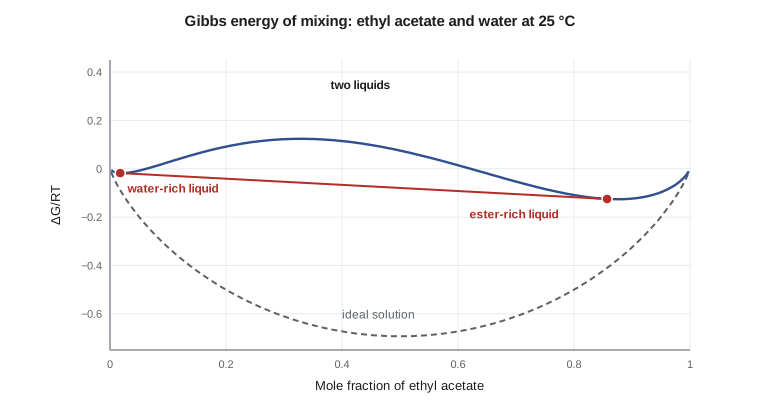
Two liquids are partially miscible when their mixture at some compositions has a higher Gibbs energy than a pair of separate liquid phases with the same overall composition. The condition is visible on a plot of the Gibbs energy of mixing, \(\Delta G/RT = x_1\ln x_1 + x_2\ln x_2 + G^E/RT\), against composition. For an ideal solution the curve is convex everywhere, and the mixture is stable at every composition. When \(G^E/RT\) is large enough, typically with a maximum above about 0.5 for a symmetric system, the curve develops a hump. A straight line tangent to the curve at two points then lies below it, and any mixture between those two compositions lowers its Gibbs energy by splitting into the two tangent-point liquids. This is the common-tangent construction, and the two compositions are the binodal points: the mutual solubilities.
The equations of liquid-liquid equilibrium
With phases \(\alpha\) and \(\beta\) both liquids at the same temperature and pressure, equal fugacities with the same pure-liquid reference state reduce to equal activities:
The vapor pressure does not appear at all, so liquid-liquid equilibrium is far less sensitive to temperature than vapor-liquid equilibrium, and only weakly sensitive to pressure. For a binary there are two equations; if the activity coefficient model is known, they can be solved for the two unknown compositions. Turned around, two measured mutual solubilities fix two model parameters exactly, which is the most common way to obtain parameters for partially miscible pairs.
For ethyl acetate and water at 25 °C, water dissolves about 8 % ester by mass (\(x_1 = 0.0175\)) and the ester dissolves about 3.3 % water (\(x_1 = 0.857\)), rounded published values. The code finds the two-parameter Margules constants that reproduce these solubilities exactly with Newton's method, then uses them for the rest of the lesson.
# Liquid-liquid equilibrium of ethyl acetate (1) and water (2), and freezing of ethanol-water solutions
import math
M1, M2 = 88.11, 18.02
def xfrom(wt1):   # mass % of component 1 -> mole fraction
    return (wt1 / M1) / (wt1 / M1 + (100 - wt1) / M2)
xa = xfrom(8.0)      # ethyl acetate in the water-rich phase at 25 C (about 8 mass %, approximate)
xb = xfrom(96.7)     # ethyl acetate in the ester-rich phase (about 3.3 mass % water, approximate)
print(f"measured mutual solubilities: water phase x1 = {xa:.4f}, ester phase x1 = {xb:.4f}")

def lng(p, x):       # two-parameter Margules
    A12, A21 = p; x2 = 1 - x
    return (x2 ** 2 * (A12 + 2 * (A21 - A12) * x), x * x * (A21 + 2 * (A12 - A21) * x2))
def resid(p):
    a1, a2 = lng(p, xa); b1, b2 = lng(p, xb)
    return (math.log(xa) + a1 - math.log(xb) - b1, math.log(1 - xa) + a2 - math.log(1 - xb) - b2)

p = [3.0, 2.0]
for it in range(40):                         # Newton's method with a numerical Jacobian
    r = resid(p); h = 1e-6
    J = [ [(resid([p[0] + h, p[1]])[i] - r[i]) / h, (resid([p[0], p[1] + h])[i] - r[i]) / h] for i in range(2)]
    det = J[0][0] * J[1][1] - J[0][1] * J[1][0]
    p = [p[0] - (r[0] * J[1][1] - r[1] * J[0][1]) / det, p[1] - (J[0][0] * r[1] - J[1][0] * r[0]) / det]
print(f"Margules parameters that reproduce the solubilities: A12 = {p[0]:.3f}, A21 = {p[1]:.3f}")
g1a = math.exp(lng(p, xa)[0])
print(f"activity coefficient of ethyl acetate dissolved in water: {g1a:.1f}; activities equal: "
      f"{xa * g1a:.3f} and {xb * math.exp(lng(p, xb)[0]):.3f}")

# One equilibrium stage: washing ethanol out of crude ethyl acetate with water
# Distribution ratio (mass fraction in ester phase / mass fraction in water phase) taken as 0.5, illustrative
KD = 0.5; ester, water, eth = 1000.0, 400.0, 60.0          # kg/h: ester phase, wash water, ethanol in crude ester
e_w = eth / (1 + KD * ester / water)                         # ethanol moving into the water
print(f"one stage: {e_w:.1f} kg/h of ethanol leaves with the water, {eth - e_w:.1f} kg/h stays in the ester")
for stages in (2, 3):
    left = eth
    for _ in range(stages):                                   # crosscurrent: fresh water each stage
        left = left - left / (1 + KD * ester / water)
    print(f"{stages} crosscurrent stages with fresh water each time: {left:.1f} kg/h ethanol left")

# Solid-liquid: freezing point of ethanol-water, ice as the solid, with van Laar activity of water
dHfus, Tm, R = 6010.0, 273.15, 8.314
A12, A21 = 1.672, 0.9304
for wt in (5, 10, 20, 30):
    x1 = (wt / 46.07) / (wt / 46.07 + (100 - wt) / 18.02); x2 = 1 - x1
    d = A12 * x1 + A21 * x2; g2 = math.exp(A21 * (A12 * x1 / d) ** 2)
    T_ideal = 1 / (1 / Tm - R * math.log(x2) / dHfus)
    T_real = 1 / (1 / Tm - R * math.log(x2 * g2) / dHfus)
    meas = {5: -2.0, 10: -4.4, 20: -10.9, 30: -20.5}[wt]       # published freezing points, approximate
print(f"{wt:2d} mass % ethanol: ice forms at {T_ideal - 273.15:6.1f} C (ideal), {T_real - 273.15:6.1f} C (van Laar from 80 C data), about {meas} C measured")measured mutual solubilities: water phase x1 = 0.0175, ester phase x1 = 0.8570 Margules parameters that reproduce the solubilities: A12 = 4.117, A21 = 2.030 activity coefficient of ethyl acetate dissolved in water: 49.6; activities equal: 0.867 and 0.867 one stage: 26.7 kg/h of ethanol leaves with the water, 33.3 kg/h stays in the ester 2 crosscurrent stages with fresh water each time: 18.5 kg/h ethanol left 3 crosscurrent stages with fresh water each time: 10.3 kg/h ethanol left 5 mass % ethanol: ice forms at -2.1 C (ideal), -2.0 C (van Laar from 80 C data), about -2.0 C measured 10 mass % ethanol: ice forms at -4.3 C (ideal), -3.8 C (van Laar from 80 C data), about -4.4 C measured 20 mass % ethanol: ice forms at -9.3 C (ideal), -7.3 C (van Laar from 80 C data), about -10.9 C measured 30 mass % ethanol: ice forms at -15.1 C (ideal), -10.4 C (van Laar from 80 C data), about -20.5 C measured
Reading the fit
The fitted parameters are \(A_{12} = 4.12\) and \(A_{21} = 2.03\), much larger than ethanol-water's 1.67 and 0.93. Ethyl acetate dissolved in water has an activity coefficient of about 50, so it is far less comfortable there than ethanol is. Both phases show the same ester activity, 0.867, as the equilibrium condition requires. The result is consistent with lesson 8: in the ester-rich layer the ester's activity is close to 1, and in the water-rich layer the water's activity is close to 1, which is why the heterogeneous azeotrope boils at a fixed temperature.
Extraction: distributing a solute
When a third component, such as ethanol, is present in small amounts in a two-liquid system, it divides between the phases in a ratio called the distribution coefficient or partition ratio, \(K_D = (\text{concentration in phase } \beta)/(\text{concentration in phase } \alpha)\). At equilibrium, \(x^\alpha\gamma^\alpha = x^\beta\gamma^\beta\) for the solute, so on a mole fraction basis \(K_D = \gamma^\alpha/\gamma^\beta\): the solute concentrates in the phase where its activity coefficient is lower. Ethanol likes water better than it likes ethyl acetate, so a water wash pulls it out of the ester, though not completely in one stage.
The code uses an illustrative mass-based \(K_D\) of 0.5 (ethanol in ester over ethanol in water) to wash 60 kg/h of ethanol from 1000 kg/h of crude ester with 400 kg/h of water. One equilibrium stage removes 27 kg/h and leaves 33 kg/h. Two crosscurrent stages, with fresh water each time, leave 18.5 kg/h; three leave 10.3 kg/h. Each stage removes the same fraction of what remains, about 44 %, so high removals need many stages or much more water. A countercurrent column is far more efficient, because the cleanest ester meets the freshest water, and CHE-350 designs one with the same equilibrium data. The water used also dissolves about 8 % of its mass as ester, which must be stripped back out and recycled. Theo marks the wash as worth testing in Dev's lab, with a measured distribution coefficient in place of the illustrative one.
Worked problem
A single wash stage
Crude ester (1000 kg/h) holds 60 kg/h of ethanol. It is mixed with 400 kg/h of water and settled. With \(K_D = 0.5\) on a mass-fraction basis, and treating the ester and water as immiscible carriers, how much ethanol leaves with the water?
Show solution
- Let \(E\) be ethanol to the water. Mass fractions: water phase \(E/400\), ester phase \((60 - E)/1000\).
- \((60 - E)/1000 = 0.5 \times E/400\), so \(60 - E = 1.25E\) and \(E = 26.7\) kg/h.
Answer: About 44 % of the ethanol goes with the water; 33 kg/h stays in the ester.
Ternary diagrams
Liquid-liquid systems with three components are shown on triangular diagrams. The binodal curve encloses the two-phase region, tie lines join the compositions of coexisting phases, and the plait point, where the tie lines shrink to zero length, marks where the two phases become identical. For ethyl acetate, ethanol and water, adding ethanol makes the ester and water more mutually soluble, so the two-phase region shrinks toward the ester-water edge and closes at a plait point. Too much ethanol in the decanter feed would stop it from separating at all, a design limit lesson 12 checks.
Solid-liquid equilibrium
When a pure solid crystallizes from a liquid solution, equilibrium requires the fugacity of that component in the liquid to equal the fugacity of the pure solid. Neglecting the small heat capacity terms, this gives
where \(\Delta H^{\text{fus}}\) is the enthalpy of fusion and \(T_m\) the melting point of the pure solid. With \(\gamma_i = 1\) it is the ideal solubility equation, which says that the solubility of a solid depends only on its own melting properties, not on the solvent. Real solubilities differ by the activity coefficient, often greatly. For the slop tank, the solid that forms is ice, so \(i\) is water, with \(\Delta H^{\text{fus}} = 6.01\) kJ/mol and \(T_m = 273.15\) K.
The freezing points, and a model used too far from home
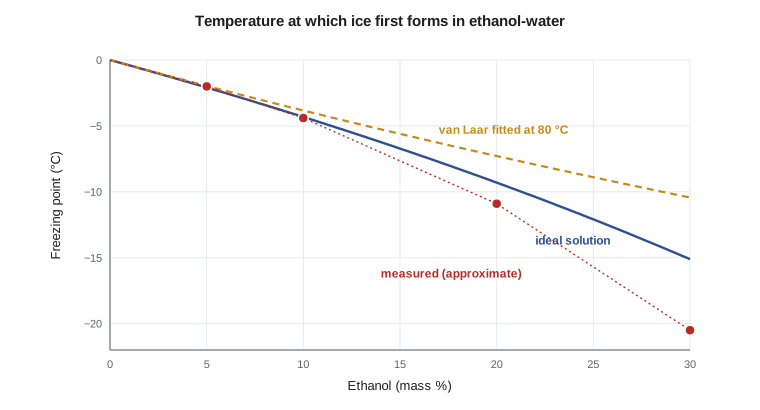
The output compares three answers. At 10 % ethanol by mass, the ideal-solution equation predicts ice at \(-4.3\) °C, the van Laar model \(-3.8\) °C, and measurements about \(-4.4\) °C. At 20 % the three are \(-9.3\), \(-7.3\) and about \(-10.9\) °C; at 30 %, \(-15.1\), \(-10.4\) and about \(-20.5\) °C. The van Laar model, which fitted vapor-liquid data so well at 80 to 95 °C, is the worst of the three at the freezing point. Its parameters say water is less comfortable in ethanol than ideal, so its activity is higher and it freezes more readily. Near 0 °C the opposite is true: ethanol-water mixing is exothermic, and by the Gibbs-Helmholtz relation of lesson 2 the excess Gibbs energy changes with temperature. A model fitted at one temperature carried 90 K away gives the wrong sign of the correction.
For Wren, the answer is practical: a slop tank at 10 % ethanol starts to form ice near \(-4\) °C, and at 20 % near \(-11\) °C, so the plant's heat tracing must cover the dilute tanks. For Theo, the lesson is general: an activity coefficient model is a fit, and it is only as good as the conditions of the data behind it. When a model is used outside that range, check it against any data available, even a handful of points.
Common mistakes
MistakeIncluding vapor pressures in liquid-liquid equilibrium.
InsteadWith a common pure-liquid reference state, the condition is equal activities, \(x_i^\alpha\gamma_i^\alpha = x_i^\beta\gamma_i^\beta\).
MistakeUsing Wilson's equation to model a two-liquid system.
InsteadUse NRTL, UNIQUAC or a fitted Margules form, which can predict splitting.
MistakeAssuming one wash stage removes most of a solute.
InsteadEach equilibrium stage removes a fixed fraction; high removal needs several stages or countercurrent flow.
MistakeUsing an activity model far outside its fitted temperature range.
InsteadCheck against data; the freezing point example shows the error can change sign.
Summary and key terms
- Liquids split when the Gibbs energy of mixing curve has a hump; the common tangent gives the mutual solubilities.
- Liquid-liquid equilibrium requires equal activities: \(x_i^\alpha\gamma_i^\alpha = x_i^\beta\gamma_i^\beta\).
- Two measured mutual solubilities fix two model parameters; for ethyl acetate-water, Margules gives about 4.1 and 2.0.
- A solute distributes between liquid phases in inverse proportion to its activity coefficients.
- Solid-liquid equilibrium: \(\ln(x_i\gamma_i) = -(\Delta H^{\text{fus}}/R)(1/T - 1/T_m)\).
- Ethanol-water at 10 % and 20 % by mass starts to freeze near \(-4\) and \(-11\) °C.
- Partial miscibility
- Limited mutual solubility of two liquids, which then form two liquid phases.
- Binodal curve
- The locus of compositions of liquid phases that coexist at equilibrium.
- Common-tangent construction
- The graphical method that finds coexisting phases from the Gibbs energy of mixing curve.
- Distribution coefficient
- The ratio of a solute’s concentrations in two coexisting liquid phases.
- Tie line
- A line joining the compositions of two phases in equilibrium.
- Plait point
- The point on a ternary binodal curve at which the two liquid phases become identical.
- Ideal solubility
- The solubility of a solid when the liquid solution is ideal, set only by its melting properties.
Practice problems
Work each problem on paper first, then reveal the answer to check.
Convert 8.0 % ethyl acetate by mass in water to mole fraction.
Show answer
\((8/88.11)/(8/88.11 + 92/18.02) = 0.0175\).
For a solute with \(\gamma^\alpha = 6\) and \(\gamma^\beta = 2\), what is the mole-fraction distribution coefficient \(x^\beta/x^\alpha\)?
Show answer
\(6/2 = 3\): it concentrates in phase \(\beta\).
With \(K_D = 0.5\) and equal masses of ester and water, what fraction of ethanol does one stage remove?
Show answer
\(1/(1 + 0.5) = 67\%\).
Estimate the ideal freezing point of water with \(x_w = 0.95\).
Show answer
\(1/T = 1/273.15 - (8.314/6010)\ln 0.95\); \(T = 268.0\) K, about \(-5.2\) °C.
Why is liquid-liquid equilibrium less sensitive to temperature than vapor-liquid equilibrium?
Show answer
No vapor pressure appears; only activity coefficients change with temperature.
What happens to the ester-water two-phase region as ethanol is added?
Show answer
It shrinks and closes at a plait point.
Lesson quiz · 5 questions
Score 60% or more to complete this lesson.
Create a free account to save your progress, take quizzes and earn a certificate.