
CHE-320 · Lesson 1 of 12 · 22 min
The fundamental property relation and chemical potential
Theo Laurent is back at Kingfisher Bioenergy in Cedar Rapids for another work term, and Ingrid Solheim has two projects waiting for him. The first is the drying end of the plant, where hydrous ethanol from the rectifier, about 95 % ethanol by mass, has to become fuel ethanol with less than 1 % water. The second is new: the company is studying a small line that would react some of its ethanol with acetic acid to make ethyl acetate, a solvent that sells for more than fuel. Both projects turn on phase and chemical equilibrium. Why does distillation stall just short of pure ethanol? How much ester can a reactor make before the reaction stops? Will the condensed overhead split into two liquids? This course gives Theo the tools to answer such questions, and it starts where Thermodynamics I ended: with the Gibbs energy.
From the first and second laws to one equation
For a closed system of fixed composition doing only expansion work, the first and second laws combine into the fundamental property relation for the internal energy, \(dU = T\,dS - P\,dV\). It is written in terms of state functions only, so it holds for any change between equilibrium states, reversible or not. The other energy functions follow by Legendre transformation: the enthalpy \(H = U + PV\), the Helmholtz energy \(A = U - TS\) and the Gibbs energy \(G = H - TS\). Each has its own natural variables, and for the Gibbs energy they are temperature and pressure, the two variables an engineer can most easily control and measure:
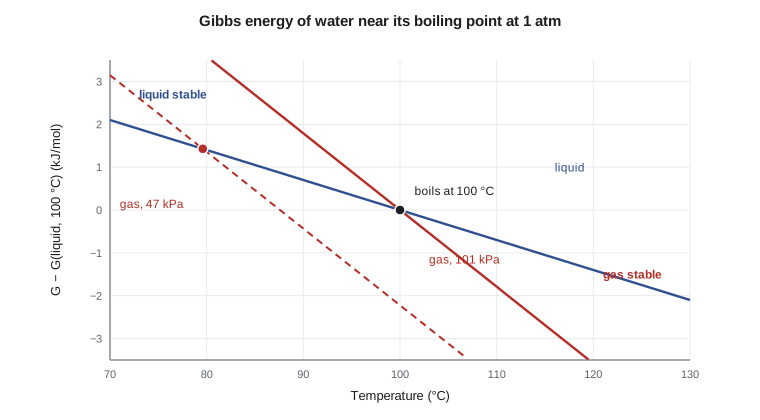
This compact equation contains a great deal. At constant temperature, \((\partial G/\partial P)_T = V\), so the Gibbs energy of a gas rises steeply with pressure while that of a liquid barely changes. At constant pressure, \((\partial G/\partial T)_P = -S\), so the Gibbs energy of every phase falls as temperature rises, and it falls fastest for the phase with the most entropy, which is usually the gas. Those two facts already explain why liquids boil when heated and why gases condense when compressed.
The Gibbs energy as the criterion of equilibrium
For a closed system held at constant temperature and pressure, the second law requires that any spontaneous change lowers the Gibbs energy: \((dG)_{T,P} \le 0\). Equilibrium is reached when \(G\) is at its minimum and no further change can lower it. This is the most useful form of the second law in chemical engineering, because process equipment usually operates at fixed temperature and pressure. A flash drum, a decanter and a reactor at steady conditions all settle where the total Gibbs energy of their contents is as small as it can be, subject to the material balances.
Think of water at 1 atm. Below 100 °C the liquid has the lower Gibbs energy, so water stays liquid. Above 100 °C the vapor has the lower Gibbs energy, so the liquid boils away. At exactly 100 °C the two molar Gibbs energies are equal, and liquid and vapor coexist in any proportion. Phase equilibrium is the condition that the Gibbs energy of a molecule is the same in every phase it can occupy.
Open systems and the chemical potential
Process streams change composition, so the fundamental relation has to allow for adding and removing material. For an open phase containing \(n_i\) moles of each species,
The new quantity \(\mu_i = [\partial(nG)/\partial n_i]_{T,P,n_j}\) is the chemical potential of species \(i\). Gibbs introduced it in the 1870s, and it plays the role for mass transfer that temperature plays for heat transfer. Heat flows from high temperature to low; a species moves from the phase where its chemical potential is high to the phase where it is low. When two phases \(\alpha\) and \(\beta\) at the same temperature and pressure reach equilibrium,
That single statement is the foundation of every phase equilibrium calculation in this course: vapor-liquid, liquid-liquid and solid-liquid. For a chemical reaction, a parallel condition, \(\sum_i \nu_i \mu_i = 0\), fixes the equilibrium composition, as lesson 11 shows. The difficulty is practical rather than conceptual. The chemical potential has no absolute value, it goes to minus infinity as a species becomes very dilute, and it cannot be measured directly. The next lessons build the more convenient quantities, fugacity and activity, that engineers use in its place.
The chemical potential of an ideal gas
For a pure ideal gas, \(V = RT/P\), so integrating \(dG = V\,dP\) at constant temperature gives \(G = G^\circ + RT\ln(P/P^\circ)\), where \(P^\circ\) is a reference pressure, usually 1 bar. In an ideal-gas mixture each component behaves as if it were alone at its partial pressure \(y_iP\), so
The term \(RT\ln y_i\) is always negative for a component in a mixture, which is the thermodynamic reason gases mix spontaneously and never unmix by themselves. The code below shows the size of the effect. At 32 °C, the temperature of the fermentation vent, ethanol at 1.5 mol % in carbon dioxide has a chemical potential 10.7 kJ/mol lower than pure ethanol vapor at the same temperature and pressure. That lowering is the price the scrubber of CHE-314 pays when it pulls ethanol out of the gas: separating a mixture always requires work or heat, because it raises the Gibbs energy of the separated products.
# Gibbs energy of liquid and gaseous water at 1 atm: where the curves cross is the boiling point
import math
R = 8.314                     # J/(mol K)
dHvap = 40660.0               # J/mol at the normal boiling point (approximate)
Tb = 373.15                   # K, normal boiling point
dSvap = dHvap / Tb            # J/(mol K), entropy of vaporization at Tb
print(f"entropy of vaporization at Tb = {dSvap:.1f} J/(mol K)")

# Taking the liquid as the reference, G(gas) - G(liquid) = dH - T dS (constant dH and dS near Tb)
for T in (353.15, 363.15, 373.15, 383.15, 393.15):
    dG = dHvap - T * dSvap
    phase = "liquid is stable" if dG > 0 else ("both phases coexist" if abs(dG) < 1e-6 else "gas is stable")
    print(f"T = {T - 273.15:5.1f} C: G_gas - G_liq = {dG:8.1f} J/mol -> {phase}")

# The same idea at a lower pressure: an ideal gas has G(P) = G(P0) + RT ln(P/P0)
P0 = 101.325
for P in (101.325, 70.0, 47.4):
    # find T where G_gas(T, P) = G_liq(T); the liquid is nearly independent of P
    lo, hi = 300.0, 400.0
    for _ in range(60):
        T = 0.5 * (lo + hi)
        f = dHvap - T * dSvap + R * T * math.log(P / P0)
        lo, hi = (T, hi) if f > 0 else (lo, T)
    print(f"P = {P:6.1f} kPa: water boils at about {T - 273.15:5.1f} C")

# Chemical potential of an ideal-gas component in a mixture relative to the pure gas at the same T and P
for y in (1.0, 0.5, 0.1, 0.015):
print(f"y = {y:5.3f}: mu - mu_pure = RT ln y = {R * 305.15 * math.log(y):8.1f} J/mol at 32 C")entropy of vaporization at Tb = 109.0 J/(mol K) T = 80.0 C: G_gas - G_liq = 2179.3 J/mol -> liquid is stable T = 90.0 C: G_gas - G_liq = 1089.6 J/mol -> liquid is stable T = 100.0 C: G_gas - G_liq = 0.0 J/mol -> both phases coexist T = 110.0 C: G_gas - G_liq = -1089.6 J/mol -> gas is stable T = 120.0 C: G_gas - G_liq = -2179.3 J/mol -> gas is stable P = 101.3 kPa: water boils at about 100.0 C P = 70.0 kPa: water boils at about 89.8 C P = 47.4 kPa: water boils at about 79.6 C y = 1.000: mu - mu_pure = RT ln y = 0.0 J/mol at 32 C y = 0.500: mu - mu_pure = RT ln y = -1758.5 J/mol at 32 C y = 0.100: mu - mu_pure = RT ln y = -5841.7 J/mol at 32 C y = 0.015: mu - mu_pure = RT ln y = -10654.7 J/mol at 32 C
Reading the results
The first part of the output shows the difference \(G_{\text{gas}} - G_{\text{liq}}\) changing sign at 100 °C. The entropy of vaporization of water, 109 J/(mol K), is larger than the 85 to 90 J/(mol K) of Trouton's rule for simple liquids, because hydrogen bonding orders the liquid. Below the boiling point the difference is positive, so the liquid is stable; above it, the gas is stable. The second part uses \(G = G^\circ + RT\ln(P/P^\circ)\) for the vapor to find where the curves cross at lower pressures: about 90 °C at 70 kPa and about 80 °C at 47 kPa. That is why the plant's evaporators and some of its columns run under vacuum: lowering the pressure lowers the boiling point and saves heat at high temperature. The answers are close to steam-table values; the small differences come from treating the enthalpy of vaporization as constant.
Worked problem
Boiling under vacuum
An evaporator in the stillage plant runs at 47 kPa. Using \(\Delta H^{\text{vap}} = 40.66\) kJ/mol at 100 °C and treating it as constant, estimate the boiling point of water.
Show solution
- Equate the Gibbs energies of vapor at 47 kPa and liquid: \(\Delta H - T\Delta S + RT\ln(P/P^\circ) = 0\), with \(\Delta S = \Delta H/T_b\).
- Rearranging gives the integrated Clausius-Clapeyron equation: \(1/T = 1/T_b - (R/\Delta H)\ln(P/P^\circ)\).
- \(1/T = 1/373.15 - (8.314/40660)\ln(47.4/101.3) = 0.002680 + 0.000155 = 0.002835\) K\(^{-1}\), so \(T = 352.8\) K.
Answer: About 79.6 °C, against 80.0 °C in the steam tables.
Criteria for equilibrium in practice
Three conditions must hold for two phases to be in equilibrium: equal temperatures (no driving force for heat), equal pressures (no driving force for bulk flow, apart from small effects such as surface tension in tiny drops), and equal chemical potentials of every species that can cross the boundary. Engineers often treat a process unit as if these conditions were met. A theoretical stage of a distillation column, the equilibrium flash drum of lesson 9 and the decanter of lesson 12 are all idealizations of this kind. Real equipment falls short because transfer takes time, and the mass transfer rates of CHE-314 measure how far short. Equilibrium tells the engineer where a process is heading; rates tell how quickly it gets there.
It is worth noticing what equilibrium thermodynamics does not need. It does not need a mechanism, a rate constant or any detail of molecular motion. It needs only the Gibbs energies of the possible phases and species, and those can be built up from measurable properties: heat capacities, vapor pressures, densities and a modest amount of mixture data. That is why a well-fitted thermodynamic model can predict the behavior of a distillation column that has never been built.
Where the course is going
Lessons 2 to 4 build the mixture properties that the chemical potential depends on: partial molar properties, and the fugacity of pure fluids and of components in mixtures, calculated from equations of state. Lessons 5 to 8 apply them to vapor-liquid equilibrium at low pressure, where the liquid is described by activity coefficients: Raoult's law, its modified form, the models used to fit data, and the azeotropes that make ethanol so hard to dry by distillation. Lesson 9 moves to higher pressures and flash calculations, lesson 10 to liquid-liquid and solid-liquid equilibrium, and lesson 11 to chemical reaction equilibrium. Lesson 12 puts the pieces together for the ethyl acetate line, where Theo must choose a thermodynamic model and defend it to Ingrid, who will put her seal as a licensed PE on the design basis.
Throughout, the course uses property values of the kind found in standard textbooks and handbooks. They are rounded and labeled approximate. A design for construction would use evaluated data from a recognized source and the property package of a validated simulator, checked against plant or laboratory measurements, and Theo's work this term is a study, not a construction design.
Common mistakes
MistakeSaying that equilibrium means no molecules move between phases.
InsteadMolecules keep crossing in both directions; at equilibrium the rates balance and the chemical potentials are equal.
MistakeUsing \(dG \le 0\) for a process that is not at constant temperature and pressure.
InsteadThe Gibbs criterion applies at fixed \(T\) and \(P\); other constraints use other functions, such as \(A\) at fixed \(T\) and \(V\).
MistakeTreating the chemical potential as an absolute quantity.
InsteadOnly differences are meaningful; every expression is relative to a chosen reference state.
MistakeAssuming that the phase with the lower enthalpy is always stable.
InsteadStability depends on \(G = H - TS\); at high temperature the entropy term favors the gas.
Summary and key terms
- For a closed system at constant composition, \(dG = -S\,dT + V\,dP\).
- At constant temperature and pressure, equilibrium is the state of minimum Gibbs energy.
- The chemical potential \(\mu_i = [\partial(nG)/\partial n_i]_{T,P,n_j}\) drives the transfer of species between phases.
- Phase equilibrium requires equal temperatures, equal pressures and equal chemical potentials of every species in every phase.
- For an ideal-gas mixture, \(\mu_i = G_i^\circ + RT\ln(y_iP/P^\circ)\); the term \(RT\ln y_i\) makes mixing spontaneous.
- The boiling point is where the Gibbs energies of liquid and vapor are equal; lowering the pressure lowers it.
- Fundamental property relation
- An equation such as dG = −S dT + V dP that combines the first and second laws in terms of state functions.
- Gibbs energy
- G = H − TS, the energy function whose minimum marks equilibrium at constant temperature and pressure.
- Chemical potential
- The partial molar Gibbs energy of a species, which must be equal in all phases at equilibrium.
- Natural variables
- The independent variables in which an energy function has its simplest differential form; T and P for G.
- Phase equilibrium
- The state in which two or more phases coexist with no net transfer of heat, volume or any species.
- Reference state
- A chosen state, such as the pure gas at 1 bar, against which chemical potentials are measured.
Practice problems
Work each problem on paper first, then reveal the answer to check.
Show that \((\partial G/\partial P)_T = V\) from \(G = H - TS\) and \(dH = T\,dS + V\,dP\).
Show answer
\(dG = dH - T\,dS - S\,dT = V\,dP - S\,dT\); at constant \(T\), \(dG = V\,dP\).
By how much does the molar Gibbs energy of an ideal gas rise when it is compressed isothermally from 1 to 20 bar at 35 °C?
Show answer
\(RT\ln 20 = 8.314 \times 308.15 \times 3.00 = 7.67\) kJ/mol.
Estimate the boiling point of water at 70 kPa with the method of the example.
Show answer
About 89.8 °C; steam tables give about 90.0 °C.
What is \(\mu_i - \mu_i^{\text{pure}}\) for a component at 10 mol % in an ideal-gas mixture at 32 °C?
Show answer
\(RT\ln 0.1 = -5.84\) kJ/mol.
Why can a liquid and its vapor coexist in any proportion at the boiling point?
Show answer
Their molar Gibbs energies are equal, so moving material between them does not change the total Gibbs energy.
Give two process units that are often modeled as equilibrium stages.
Show answer
A theoretical distillation tray and a flash drum, among others.
Lesson quiz · 5 questions
Score 60% or more to complete this lesson.
Create a free account to save your progress, take quizzes and earn a certificate.