
BUS-310 · Lesson 8 of 12 · 25 min
Compliance, codes and ethics programs
Almost every large organization has a code of conduct, an ethics hotline and mandatory online training. Yet many scandals have occurred at companies with impressive-looking programs. Enron had a 64-page code of ethics, and its board twice waived the code's conflict-of-interest provisions so that the chief financial officer could run partnerships that traded with the company. The question is not whether an organization has a program on paper but whether it works: whether it prevents, detects and responds to misconduct, and whether it shapes a culture in which people do the right thing when no one is watching. This lesson explains what compliance and ethics programs contain, how regulators and prosecutors judge their effectiveness, and how to design programs that change behavior rather than merely documenting it.
Compliance and integrity
Lynn Sharp Paine distinguished two strategies for managing organizational ethics. A compliance strategy emphasizes conformity with externally imposed rules, aims to prevent criminal misconduct, relies on monitoring, controls and penalties, and is typically led by lawyers. An integrity strategy emphasizes self-governance according to chosen values, aims to enable responsible conduct, relies on leadership, education and shared accountability, and is led by management with the support of legal and compliance staff. Paine argued that compliance alone is insufficient, because it treats employees as potential wrongdoers to be deterred and does little to help them handle the many situations rules do not cover.
Most effective programs combine both. Clear rules and controls are essential for high-risk areas such as bribery, competition law, trade sanctions, privacy and financial reporting, where the consequences of error are severe. But values, judgment and a culture of speaking up are needed for everything else. Research by the Ethics and Compliance Initiative consistently finds that strong ethical cultures, where leaders model integrity, supervisors reinforce it and peers support it, are associated with less observed misconduct, more reporting and less retaliation.
| Feature | Compliance strategy | Integrity strategy |
|---|---|---|
| Ethos | Conformity with external rules | Self-governance by shared values |
| Objective | Prevent and detect misconduct | Enable responsible conduct |
| Leadership | Lawyer-driven | Management-driven, supported by legal |
| Methods | Rules, monitoring, controls, penalties | Education, leadership, values, accountability |
| View of people | Self-interested, needing deterrence | Guided by values and ideals as well as interest |
| Risk | Box-ticking; little help in gray areas | Vague without clear rules for high-risk areas |
Why organizations need programs: corporate liability
Under US federal law, a corporation can be held criminally liable for crimes committed by any employee or agent acting within the scope of employment and at least partly to benefit the corporation, a broad standard called respondeat superior. Because liability is so broad, the existence and effectiveness of a compliance program matter greatly in prosecutors' decisions on whether to charge, what resolution to offer (such as a non-prosecution or deferred prosecution agreement) and whether to require a monitor, and in sentencing. The US Sentencing Guidelines for organizations reduce penalties for organizations with an effective compliance and ethics program, and the Department of Justice's Evaluation of Corporate Compliance Programs guides prosecutors' assessments. Debarment from federal contracts is a further consequence of misconduct.
Elements of an effective program
Regulators in many countries describe the elements of an effective program in similar terms. The US Sentencing Guidelines list seven elements, which have become a widely used template: standards and procedures to prevent and detect misconduct; oversight by the board and senior management with a designated, adequately resourced compliance officer; due diligence to avoid placing people with a history of misconduct in positions of authority; effective training and communication; monitoring, auditing and confidential reporting mechanisms, with evaluation of the program; consistent incentives and discipline; and appropriate response to misconduct, including remediation to prevent recurrence. The program should be based on a periodic risk assessment.
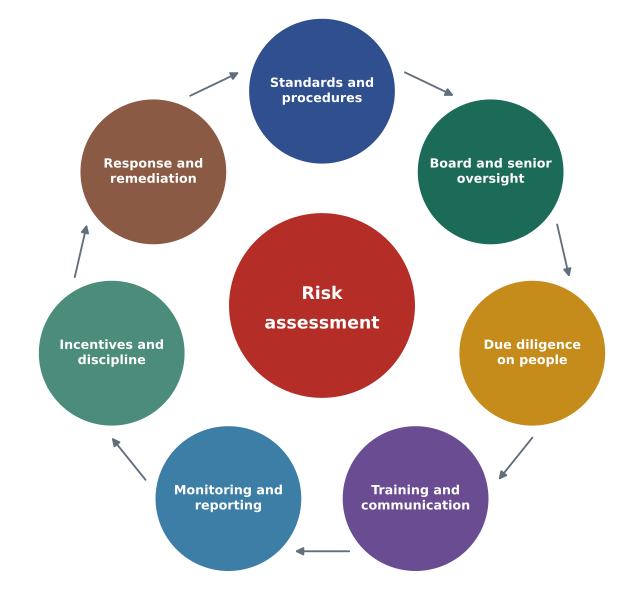
The Department of Justice's evaluation guidance asks three fundamental questions. Is the program well designed? Is it adequately resourced and empowered to function effectively? Does it work in practice? Prosecutors look for evidence beyond documents: how the company assesses risk using data, whether compliance staff have access to the board and to operational data, whether incentives reward ethical conduct, how the company learns from misconduct at its own and other companies, and how it manages emerging risks, including the use of artificial intelligence. Updates to the guidance in recent years have emphasized data analytics, protection against retaliation for reporting, and clawbacks of pay from people responsible for misconduct.
Risk assessment
A compliance risk assessment identifies the laws and ethical risks that apply to the business, assesses the likelihood and impact of violations, evaluates existing controls and prioritizes resources. The risks depend on the industry and geography: a mining company operating in countries with high corruption risk faces different priorities from a domestic software firm handling personal data. Scoring risks on likelihood and impact, adjusted for control effectiveness, helps focus effort where it matters.
Worked problem
Scoring compliance risks
A manufacturer scores four risks on likelihood (1–5) and impact (1–5), then multiplies to get inherent risk. Controls reduce the score by a factor reflecting their effectiveness (strong 0.4, moderate 0.7, weak 0.9). Risks: (a) bribery in a high-risk export market: likelihood 4, impact 5, controls weak; (b) workplace safety: likelihood 3, impact 5, controls strong; (c) privacy of customer data: likelihood 3, impact 4, controls moderate; (d) competition law in a trade association: likelihood 2, impact 5, controls weak. Rank the residual risks.
Show solution
- (a) Inherent 4 × 5 = 20; residual 20 × 0.9 = 18.0.
- (b) Inherent 3 × 5 = 15; residual 15 × 0.4 = 6.0.
- (c) Inherent 3 × 4 = 12; residual 12 × 0.7 = 8.4.
- (d) Inherent 2 × 5 = 10; residual 10 × 0.9 = 9.0.
- Ranking: bribery (18.0), competition law (9.0), privacy (8.4), safety (6.0).
Answer: Bribery in the export market is the top residual risk and warrants priority investment in controls; competition law follows because controls there are weak.
Scoring is a tool for judgment, not a substitute for it. Impact should consider harm to people and the environment, not only financial cost, and low-likelihood, high-impact risks such as catastrophic safety failures deserve attention even when their score is moderate.
Codes of conduct
A code of conduct sets out an organization's values and standards of behavior. Effective codes are written in plain language, organized around situations employees actually face, explain the reasons behind rules, give examples and decision tools, tell employees where to get advice and how to report concerns, promise protection against retaliation, and apply to everyone, including directors and senior executives. Codes typically cover conflicts of interest, gifts and entertainment, bribery, fair competition, confidentiality and data privacy, accurate records, use of company assets, insider trading, respectful workplace and harassment, health and safety, and environmental responsibility.
SEC rules require public companies to disclose whether they have a code of ethics for their senior financial officers and to disclose waivers, and the NYSE and Nasdaq require listed companies to adopt codes applying to all directors, officers and employees, with prompt disclosure of waivers for directors and executive officers.
Conflicts of interest and gifts
A conflict of interest exists when a personal interest could interfere, or appear to interfere, with a person's duty to the organization. Examples include hiring a relative, holding shares in a supplier, taking a second job with a competitor, or accepting valuable gifts from a vendor. As lesson 3 showed, conflicts bias judgment unconsciously, so the safest approach is to avoid them where possible and to disclose and manage those that cannot be avoided, typically by removing the conflicted person from the decision. Gifts and entertainment policies set limits, require approvals and registers, and prohibit cash or anything offered to influence a decision; stricter rules apply to government officials because of anti-corruption laws (lesson 9).
| Situation | Typical policy response |
|---|---|
| A supplier sends a $40 holiday gift basket | Usually acceptable if modest, infrequent and recorded; share with the team |
| A supplier bidding on a contract offers concert tickets worth $600 | Decline: high value during a procurement |
| A manager wants to hire her nephew into her department | Disclose; remove her from the hiring decision and reporting line |
| An engineer owns 1 % of a small component supplier | Disclose; exclude from decisions involving that supplier |
| A sales rep wants to take a customs officer to dinner to discuss clearances | Prohibited without legal approval; government officials carry anti-corruption risk |
Training, communication and culture
Annual online training is common and often ineffective when it consists of clicking through slides. Better approaches use realistic scenarios drawn from the company's own risks, target training to roles (procurement staff need deeper bribery and conflict training than most), deliver short and frequent messages, involve managers in discussing dilemmas with their teams, and measure understanding rather than completion. Culture surveys, focus groups and data on hotline reports and investigations help assess whether the program is working.
Middle managers are especially important. Employees take their cues from their immediate supervisor more than from the chief executive's speeches. A supervisor who reacts to a concern with irritation, or who praises results without asking how they were achieved, can undo the best program. Training managers to respond well to concerns, and holding them accountable for their teams' conduct, is one of the highest-value investments a program can make.
Monitoring, investigations and discipline
Programs need ways to detect misconduct: internal audits, data analytics on payments and expenses, reviews of high-risk transactions, and confidential reporting channels (lesson 10). When concerns arise, investigations should be prompt, independent of the people involved, proportionate, documented and fair to the people accused, with legal privilege where appropriate. Discipline must be consistent: if senior high performers escape consequences that junior staff face, employees conclude that the code does not really apply to everyone. Finally, every significant case should lead to root-cause analysis and remediation, asking why controls failed and what will change.
Measuring effectiveness
Measuring an ethics program is difficult because success means problems that did not happen. Useful indicators include awareness and use of reporting channels, the proportion of reports that come from identified rather than anonymous reporters (a sign of trust), substantiation rates, time to close investigations, repeat issues, perceptions of retaliation in surveys, and results of audits and testing of controls. A rise in hotline reports can be a good sign, indicating trust, rather than a sign of more misconduct. Boards should receive regular reports on these indicators, and the chief compliance officer should have direct access to the board or a board committee.
Common mistakes
MistakeEquating a code of conduct with an effective program.
InsteadTest whether the program prevents, detects and responds to misconduct in practice.
MistakeTreating training completion rates as proof of effectiveness.
InsteadMeasure understanding, behavior and culture, not only completion.
MistakeDisciplining junior staff while excusing senior high performers.
InsteadApply consequences consistently at every level.
MistakeReading an increase in hotline reports as a failure.
InsteadInterpret more reporting as a possible sign of trust, and analyze substantiation.
MistakeAllowing waivers of the code for senior executives quietly.
InsteadAvoid waivers; if granted, require board approval and disclosure.
Summary and key terms
- Compliance strategies rely on rules and controls; integrity strategies on values and self-governance; effective programs combine both.
- Corporate criminal liability is broad in the United States and reaches senior officers' conduct in Canada, making programs important.
- Remediation agreements in Canada and deferred prosecution agreements in the United States reward effective programs and cooperation.
- The seven elements of an effective program begin with a risk assessment.
- Prosecutors ask whether a program is well designed, resourced and empowered, and works in practice.
- Codes should be plain-language, practical and apply to everyone, with waivers disclosed.
- Conflicts of interest should be avoided or disclosed and managed by recusal.
- Culture, especially middle managers' behavior, consistent discipline and meaningful metrics determine whether programs work.
- Compliance strategy
- An approach to ethics management focused on conformity with external rules and deterrence.
- Integrity strategy
- An approach focused on shared values, self-governance and enabling responsible conduct.
- Respondeat superior
- The US doctrine under which corporations are liable for employees' acts within the scope of employment.
- Senior officer
- Under Canada's Criminal Code, a representative who plays an important role in policy or manages an important aspect of activities.
- Remediation agreement
- A Canadian agreement suspending prosecution of an organization for certain economic crimes if it meets conditions.
- Deferred prosecution agreement
- An agreement in which prosecutors file charges but defer prosecution if conditions are met.
- Compliance risk assessment
- A process to identify, score and prioritize legal and ethical risks.
- Code of conduct
- A document setting out an organization's values and standards of behavior.
- Conflict of interest
- A situation in which a personal interest could interfere with duty to the organization.
- Root-cause analysis
- Investigation of why controls failed, aimed at preventing recurrence.
Practice problems
Work each problem on paper first, then reveal the answer to check.
Contrast compliance and integrity strategies in one sentence each.
Show answer
Compliance: conform to rules through controls and penalties. Integrity: govern conduct by shared values with leadership and education.
Why is a compliance program especially important in the United States?
Show answer
Because respondeat superior makes corporate criminal liability very broad.
What Canadian event led to the 2004 Criminal Code amendments on organizational liability?
Show answer
The Westray mine disaster.
List the seven elements of an effective program.
Show answer
Standards, oversight, due diligence, training, monitoring and reporting, incentives and discipline, response and remediation.
Likelihood 3, impact 4, strong controls (0.4). What is the residual score?
Show answer
12 × 0.4 = 4.8.
What three questions does the DOJ ask about a compliance program?
Show answer
Is it well designed? Is it adequately resourced and empowered? Does it work in practice?
How should a conflict of interest that cannot be avoided be managed?
Show answer
Disclose it and remove the person from the related decisions.
Why are middle managers critical to ethical culture?
Show answer
Employees take cues mainly from immediate supervisors.
Why might rising hotline reports be a good sign?
Show answer
They may indicate that employees trust the system to listen and protect them.
Portfolio task: evaluate the code of conduct of a company you know against the features of an effective code.
Show answer
Answers vary; should assess language, scenarios, reporting and coverage.
Lesson quiz · 5 questions
Score 60% or more to complete this lesson.
Create a free account to save your progress, take quizzes and earn a certificate.