
BUS-310 · Lesson 6 of 12 · 25 min
Executive compensation and shareholder rights
Few governance topics provoke as much public reaction as executive pay. A Canadian Center for Policy Alternatives study published in January 2026 found that Canada's 100 highest-paid chief executives received an average of $16.2 million in 2024, a record and about 248 times the average worker's pay. In the United States, the AFL-CIO's 2026 Executive Paywatch report put average pay for S&P 500 chief executives at US$22.8 million in 2025, excluding one exceptionally large award to Tesla's chief executive, or about 312 times the pay of a typical production worker. Defenders say pay reflects the value that talented leaders create in very large companies; critics say it reflects weak bargaining by boards, rising stock markets and a ratchet effect from benchmarking. This lesson explains how executive pay is designed, the ethical and governance questions it raises, and the rights shareholders have to influence pay and other decisions.
Why executive pay matters
Executive pay matters for three reasons. First, it is an incentive: pay design shapes what executives pay attention to, which is why badly designed pay can encourage short-termism or excessive risk, as many argued it did in banks before the 2008 financial crisis. Second, it is a signal: pay tells employees and the public what the company values and whether its leaders share in bad times as well as good. Third, it is a test of governance: because executives influence their own pay, excessive or poorly linked pay can indicate that the board is not independent enough to bargain at arm's length. Lucian Bebchuk and Jesse Fried's managerial power theory argues that pay often reflects executives' influence over captured boards, constrained mainly by the risk of public 'outrage'.
The components of executive pay
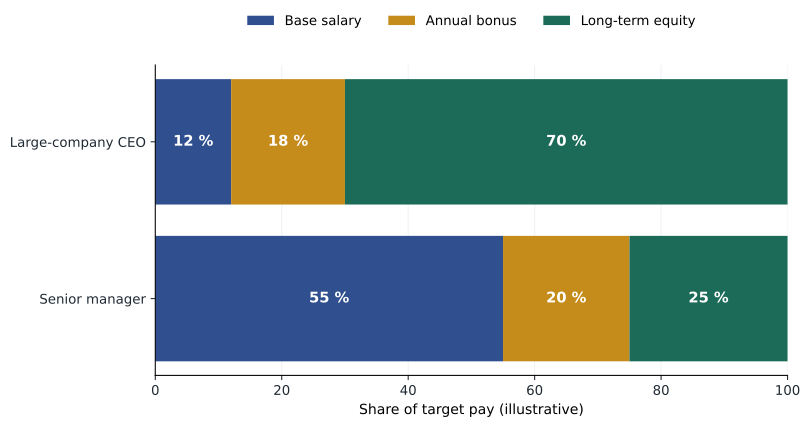
A typical executive pay package has several parts. Base salary provides fixed cash pay. An annual incentive, or short-term bonus, pays cash for meeting yearly targets for financial and other measures. Long-term incentives, usually the largest component, are paid in equity: performance share units (PSUs) that vest based on performance over three years, restricted share units (RSUs) that vest with continued service, and stock options that pay off only if the share price rises. Executives also receive pensions or retirement savings plans, benefits and perquisites, and severance and change-of-control arrangements.
| Component | Typical vehicle | Purpose | Risk if badly designed |
|---|---|---|---|
| Base salary | Cash | Attract and retain; reward the role | Ratchets up through benchmarking |
| Annual incentive | Cash bonus against a scorecard | Focus on yearly goals | Short-termism; easy targets |
| Performance share units | Shares vesting on three-year performance | Align with long-term results | Gaming of metrics; overly complex |
| Restricted share units | Shares vesting with service | Retention; ownership | Pay without performance |
| Stock options | Right to buy shares at a fixed price | Reward share price growth | Encourage risk-taking; windfalls in rising markets |
| Severance and change of control | Cash multiples of pay | Reduce resistance to beneficial deals | "Pay for failure" |
Worked problem
Calculating a performance share unit payout
A CEO is granted 40,000 PSUs. Vesting depends on the company's three-year total shareholder return (TSR) relative to a peer group: below the 25th percentile, 0 %; at the 25th percentile, 50 %; at the median, 100 %; at the 75th percentile or above, 200 %, with straight-line interpolation in between. The company's TSR ranks at the 62nd percentile. The share price at vesting is $48. What is the payout?
Show solution
- The 62nd percentile lies between the median (50th, 100 %) and the 75th (200 %).
- Interpolate: 100 % + (62 − 50) ÷ (75 − 50) × (200 % − 100 %) = 100 % + 0.48 × 100 % = 148 %.
- Shares earned = 40,000 × 1.48 = 59,200.
- Value = 59,200 × $48 = $2,841,600.
Answer: The CEO earns 148 % of target, 59,200 shares worth about $2.84 million.
Relative TSR is popular because it adjusts for market movements, but it has drawbacks: it rewards outperforming peers even when absolute returns are negative, it can be influenced by the timing of the measurement period, and it says nothing about how results were achieved. Many companies combine it with financial measures such as return on invested capital, and some include safety, customer or sustainability measures. Non-financial measures can broaden attention, but critics warn that they are often easier to meet and less transparent.
Pay ratios and fairness
Since 2018, the SEC's pay ratio rule, adopted under the Dodd-Frank Act, has required US public companies to disclose the ratio of the chief executive's total annual compensation to the median compensation of all other employees. Companies may use statistical sampling and reasonable estimates to identify the median employee, and they must describe their method. Ratios vary widely by industry: retailers and restaurant chains with many part-time workers report very high ratios, while firms with highly paid workforces report lower ones.
The pay ratio is a blunt measure. It depends on the workforce, including part-time and foreign workers, and on how equity awards are valued. But it draws attention to internal fairness, which matters for employee morale and trust. Lesson 2's justice lens is relevant: is the distribution of rewards fair given contributions, and are the processes that set pay fair and transparent? The short program below shows how a company might calculate a pay ratio from payroll data.
import random, statistics
random.seed(310)
# Illustrative payroll: 4,800 employees with a skewed pay distribution
pay = [round(random.lognormvariate(10.95, 0.45), -2) for _ in range(4800)]
median = statistics.median(pay)
ceo_total = 6_850_000  # salary + bonus + grant-date value of equity + other
print(f"median employee pay: {median:,.0f}")
print(f"CEO total compensation: {ceo_total:,.0f}")
print(f"pay ratio: {ceo_total / median:,.0f} to 1")
print(f"share of employees earning under 40,000: {sum(p < 40_000 for p in pay) / len(pay):.0%}")median employee pay: 57,500 CEO total compensation: 6,850,000 pay ratio: 119 to 1 share of employees earning under 40,000: 21%
In this illustration the median employee earns about $57,500 and the ratio is about 119 to 1. Because the distribution of pay is skewed, the median is lower than the average, and the ratio would change considerably if the company outsourced its lowest-paid work or added part-time staff, which is one reason ratios should be read alongside a description of the workforce.
Pay governance: how pay is set
Executive pay is set through a governance process, and the quality of that process matters as much as the outcome. The compensation committee, composed of independent directors, sets the pay philosophy, selects a peer group of comparable companies, approves performance measures and targets at the start of the year, assesses performance at the end, and recommends awards to the board. Many committees hire independent compensation consultants; good practice is for the consultant to report to the committee rather than to management and to disclose any other work it does for the company, because consultants who also sell services to management face a conflict of interest. The committee should also consider how pay plans could encourage excessive risk, stress-test payouts under different scenarios, and use discretion sparingly and transparently.
Peer group selection is a frequent weak point. Choosing larger or more successful companies as peers raises the benchmark, and targeting pay at or above the median of peers produces the ratchet effect: if every company aims to pay above average, average pay rises every year regardless of performance. Shareholders and proxy advisers therefore scrutinize peer groups and the use of discretionary adjustments that raise payouts after targets are missed.
Say on pay and shareholder votes on pay
Since 2011 the Dodd-Frank Act has required US public companies to hold a non-binding say-on-pay vote at least once every three years, with a separate vote on frequency; most companies hold it annually. Companies must also hold advisory votes on 'golden parachute' arrangements in mergers. Most say-on-pay votes pass with large majorities, but failures, typically below 50 %, and results below about 70 % attract scrutiny from proxy advisers and usually lead to engagement and changes. The vote is advisory, but boards that ignore a poor result risk votes against compensation committee members the following year.
Clawbacks and malus
Clawback policies allow or require a company to recover incentive pay that was awarded on the basis of results later found to be wrong, or after misconduct. Malus provisions reduce or cancel awards before they vest. Clawbacks respond to an obvious unfairness: executives should not keep bonuses earned on inflated numbers.
Under SEC Rule 10D-1, adopted in 2022, the stock exchanges have since late 2023 required listed companies to adopt and disclose clawback policies. If a company must restate its financial statements to correct a material error, it must recover incentive pay received by current and former executive officers during the preceding three fiscal years that exceeded what would have been paid under the restated results, regardless of whether the executive was at fault. Many companies also have broader discretionary clawbacks for misconduct.
Shareholder rights and voice
Shareholders influence companies mainly by voting, engaging and, if dissatisfied, selling. Votes cover the election of directors, appointment of the auditor, say on pay, fundamental changes such as mergers, and shareholder proposals. Over the past two decades, governance reforms have strengthened the vote: annual elections of individual directors instead of staggered boards or slates, majority voting rather than plurality voting, and in the United States proxy access, which lets large long-term shareholders nominate a minority of directors in the company's proxy materials.
US companies generally elect directors annually, although some still have staggered boards. Many large companies have adopted majority voting policies, under which a director who fails to receive a majority must offer to resign, and the board decides whether to accept; plurality voting remains the default under Delaware law. Shareholders may submit proposals for inclusion in the proxy statement under SEC Rule 14a-8 if they meet ownership thresholds. The SEC's process for deciding when companies may exclude proposals has changed several times; for the 2025–2026 season the SEC staff largely stopped responding to companies' requests for its view, leaving more decisions to companies and the courts. Since 2022 universal proxy cards have listed both management and dissident nominees in contested elections.
Shareholder activism ranges from private engagement by large index funds to public campaigns by hedge funds seeking board seats, asset sales or capital returns, and to proposals on environmental and social issues. Activism can discipline underperforming management, but critics argue that some campaigns push short-term financial engineering at the expense of long-term investment. In recent years support for environmental and social shareholder proposals has fallen sharply from its 2021 peak, reflecting both investor concerns about prescriptive proposals and political pressure on asset managers.
Ethical questions about executive pay
Executive pay raises ethical questions that go beyond governance mechanics. Is it fair for pay to rise much faster than workers' wages? Does very high pay reflect a market for scarce talent or rent extraction? Should leaders take pay cuts when they lay off workers? Should pay reward luck, such as rising commodity prices or interest rates, or only performance attributable to management? Reasonable people disagree, but boards should be able to explain how pay relates to performance, how it compares with the wider workforce and how it serves long-term value. A pay plan that boards would be embarrassed to explain to employees probably needs rethinking.
Common mistakes
MistakeBenchmarking every element of pay to the 75th percentile of peers.
InsteadUse peer data as a reference, not a target, to avoid a ratchet effect.
MistakeRelying on a single metric such as earnings per share.
InsteadCombine several measures, including returns on capital and how results are achieved.
MistakeTreating a passing say-on-pay vote as proof of good pay design.
InsteadRead the level of opposition and engage with shareholders who voted against.
MistakePaying large severance after poor performance.
InsteadLimit severance and use clawback and malus provisions.
MistakeIgnoring internal fairness when setting executive pay.
InsteadConsider pay ratios and workforce pay, and be able to explain the gap.
Summary and key terms
- Executive pay is an incentive, a signal and a test of governance.
- Pay packages combine salary, annual bonuses, long-term equity, pensions and severance; most CEO pay is variable.
- Relative TSR-based PSUs adjust for markets but can reward relative success during absolute losses.
- US companies must disclose the CEO-to-median-employee pay ratio; Canadian disclosure is voluntary.
- Say on pay is mandatory and advisory in the United States; in Canada it is widespread but voluntary while 2019 CBCA amendments await force.
- US exchanges require no-fault clawbacks after restatements; Canadian clawbacks are voluntary but common.
- Majority voting, annual individual elections and proposals give shareholders voice; activism can discipline or distract management.
- Boards should be able to explain pay in terms of performance, fairness and long-term value.
- Managerial power theory
- The view that executive pay reflects executives' influence over boards, constrained by outrage.
- Performance share unit
- An equity award that vests in a number of shares depending on performance over a period.
- Restricted share unit
- An equity award that vests with continued service.
- Total shareholder return
- Share price change plus dividends over a period, expressed as a percentage.
- Pay ratio
- The ratio of chief executive pay to median employee pay.
- Say on pay
- A shareholder vote, usually advisory, on executive compensation.
- Clawback
- Recovery of incentive pay already paid, after a restatement or misconduct.
- Malus
- Reduction or cancellation of unvested awards.
- Majority voting
- A rule that directors must receive more votes for than against to be elected or remain.
- Proxy access
- A right for qualifying shareholders to nominate directors in the company's proxy materials.
Practice problems
Work each problem on paper first, then reveal the answer to check.
Name the main components of executive pay.
Show answer
Base salary, annual incentive, long-term incentives (PSUs, RSUs, options), pensions and benefits, severance.
A CEO's relative TSR ranks at the 40th percentile. With 50 % at the 25th and 100 % at the median, what percentage vests?
Show answer
50 + (15 ÷ 25) × 50 = 80 %.
Why do stock options encourage risk-taking?
Show answer
They gain from upside but lose nothing extra below the exercise price.
CEO pay $9.6 million, median employee pay $64,000. What is the pay ratio?
Show answer
150 to 1.
Why are pay ratios hard to compare across industries?
Show answer
They depend on workforce composition, part-time and foreign workers, and valuation methods.
Is a say-on-pay vote binding?
Show answer
No; it is advisory in both countries, though boards face consequences for ignoring it.
What triggers a clawback under SEC Rule 10D-1?
Show answer
An accounting restatement to correct a material error, regardless of fault.
What is the difference between clawback and malus?
Show answer
Clawback recovers paid amounts; malus reduces unvested awards.
What does majority voting change compared with plurality voting?
Show answer
Directors need more for than against votes, so withhold campaigns can remove them.
Portfolio task: read a company's compensation discussion and analysis and assess how well pay is linked to performance.
Show answer
Answers vary; should identify metrics, mix and alignment.
Lesson quiz · 5 questions
Score 60% or more to complete this lesson.
Create a free account to save your progress, take quizzes and earn a certificate.