
BUS-310 · Lesson 2 of 12 · 29 min
Ethical theories for managers
When a manager says a decision 'feels wrong', the feeling usually rests on a principle: someone is being harmed, deceived, treated unfairly or used. Ethical theories make those principles explicit. They give managers a vocabulary for explaining a judgment, testing it against alternatives and persuading others. No single theory settles every question, and philosophers still argue about which is correct. But the main traditions agree far more often than they disagree, and when they point in the same direction a manager can act with confidence. When they conflict, the conflict itself shows where the hard trade-off lies.
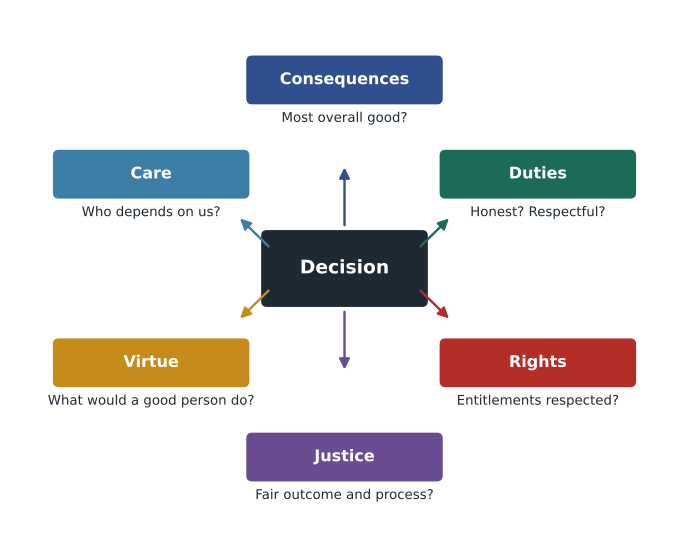
This lesson introduces six lenses that are widely used in business ethics: consequences (utilitarianism), duties (Kantian ethics), rights, justice, virtue and care. It then adds two perspectives that are increasingly important in Canadian and American organizations, relational and Indigenous ethics and contractualism, and closes with a practical way to combine the lenses. Lesson 3 then turns from what we ought to do to why people so often fail to do it.
Consequences: utilitarianism
Utilitarianism, developed by Jeremy Bentham and John Stuart Mill, holds that the right action is the one that produces the greatest total well-being for everyone affected. Its appeal for managers is obvious: it resembles cost–benefit analysis, it treats everyone's interests as counting equally, and it focuses attention on real outcomes rather than good intentions. Public policy analysis, safety regulation and many business decisions rely on consequentialist reasoning.
Utilitarianism has well-known weaknesses. Consequences are uncertain, and it is hard to measure and compare well-being across people. Adding up benefits and harms can justify sacrificing a minority for a majority, for example by exposing a small community to pollution because many others benefit from cheap power. It can also seem to ignore promises, rights and the special obligations we have to particular people. Rule utilitarianism responds by asking which general rules, if followed by everyone, would produce the best outcomes; rules such as 'keep promises' and 'do not deceive customers' usually pass that test even when breaking them once would pay.
Worked problem
A simple utilitarian comparison
A food company can (A) keep a cheaper preservative linked in some studies to a small health risk, or (B) switch to a costlier alternative. Analysts estimate the following annual effects in well-being units, using money as a rough proxy: option A saves the company and its customers $12 million in costs; option B avoids an expected $15 million in health harms and gains $2 million in customer goodwill. Which option does a utilitarian analysis favor, and what are the limits of this analysis?
Show solution
- Net benefit of A relative to B = +12 (cost savings) − 15 (health harms) − 2 (lost goodwill) = −5.
- So B produces 5 million more units of well-being than A; a utilitarian analysis favors switching.
- Limits: the health estimate is uncertain, the harms fall on particular people who did not consent, and a dollar may not measure a health effect well.
Answer: The utilitarian calculation favors switching to the safer preservative, but the uncertain numbers and the distribution of harm deserve separate attention.
Uncertainty can be handled by computing expected values over possible outcomes, as the short program below does for three scenarios. The point is not precision but making assumptions visible so they can be challenged.
# Expected net well-being of switching preservative under three health-risk scenarios
scenarios = {"low risk": (0.5, 6), "central": (0.3, 15), "high risk": (0.2, 40)}  # (probability, harm avoided $M)
cost_of_switch, goodwill = 12, 2
expected_harm_avoided = sum(p * h for p, h in scenarios.values())
print(f"expected harm avoided: {expected_harm_avoided:.1f} $M")
print(f"expected net benefit of switching: {expected_harm_avoided + goodwill - cost_of_switch:+.1f} $M")
for name, (p, h) in scenarios.items():
print(f" if {name:9}: net {h + goodwill - cost_of_switch:+5.1f} $M (probability {p:.0%})")expected harm avoided: 15.5 $M expected net benefit of switching: +5.5 $M if low risk : net -4.0 $M (probability 50%) if central : net +5.0 $M (probability 30%) if high risk: net +30.0 $M (probability 20%)
On these assumptions the switch is expected to add about $5.5 million of net benefit, even though in the most optimistic health scenario it would cost $4 million. A decision maker who gives extra weight to avoiding serious harm to people, as many ethicists argue we should, would find the case for switching stronger still, because the high-risk scenario is where the harms are worst.
Duties: Kantian ethics
Immanuel Kant argued that morality rests on duties that apply regardless of consequences. His categorical imperative has two famous formulations. The universalizability test asks whether you could will that everyone act on the principle behind your action; lying to gain an advantage fails, because if everyone lied when convenient, trust and therefore the advantage would disappear. The humanity formulation tells us always to treat people as ends in themselves and never merely as means: we may employ, sell to and negotiate with people, but we must respect their rational agency, which rules out deception, coercion and manipulation.
Kantian ethics explains why honesty, promise keeping and informed consent matter even when breaking them would produce good results. It gives a principled basis for refusing to mislead customers, for treating employees with dignity and for respecting contracts. Its weakness is rigidity: duties can conflict, and an absolute duty not to lie seems wrong when lying would save an innocent life. Most Kantians allow some ranking of duties, and in practice the theory works best as a strong presumption against deception and exploitation.
Rights
Rights-based ethics holds that people have entitlements that others must respect, regardless of aggregate benefits. Negative rights require others to refrain from interfering, such as rights to life, privacy, free expression and property. Positive rights require others to provide something, such as education or health care. In business, rights appear as rights to safe working conditions, to freedom of association, to non-discrimination, to privacy of personal information and to accurate product information. Many are protected by law, including the Canadian Charter of Rights and Freedoms and human rights codes in Canada and the Bill of Rights and civil rights statutes in the United States, but the moral claim exists whether or not the law recognizes it.
Rights act as constraints on the pursuit of good outcomes. A rights-based analysis asks whether a decision violates anyone's rights and, if rights conflict, which is weightier. The United Nations Guiding Principles on Business and Human Rights, discussed in lesson 12, translate this approach into a corporate responsibility to respect human rights throughout operations and supply chains.
Justice
Justice concerns the fair distribution of benefits and burdens and fair procedures. Distributive justice asks whether outcomes are allocated fairly, by equality, need, contribution or effort. Procedural justice asks whether the process was fair: consistent, unbiased, transparent and open to appeal. Retributive and restorative justice concern responses to wrongdoing. John Rawls proposed choosing principles from behind a 'veil of ignorance', not knowing what position you would occupy in society. He argued that people would choose equal basic liberties and fair equality of opportunity, and would accept inequalities only if they benefit the least advantaged (the difference principle). Robert Nozick countered that justice lies in fair acquisition and transfer, not in a particular distribution.
Justice questions run through business: how layoffs are decided, how pay is set, whether suppliers in poor countries receive a fair share, whether algorithms treat groups equally. BUS-130 showed that employees' perceptions of procedural and distributive justice strongly affect commitment and performance; justice is both an ethical standard and a practical necessity.
Virtue
Virtue ethics, rooted in Aristotle and also present in Confucian and many other traditions, shifts the question from 'what should I do?' to 'what kind of person, or organization, should I be?' Virtues are stable character traits such as honesty, courage, fairness, temperance, prudence and compassion; each lies between a vice of excess and one of deficiency, so courage lies between recklessness and cowardice. Practical wisdom is the virtue of knowing how to apply the others in a particular situation. A virtuous manager does the right thing reliably, not because a rule requires it.
Virtue ethics fits management well because so much depends on judgment in situations no rule anticipates, and because character is shaped by habits and communities, including workplaces. Its weakness is that it gives limited guidance in hard cases where virtues conflict, such as loyalty to a colleague against honesty to a client. Organizational virtue appears as integrity: consistency between stated values and actual conduct.
Care
The ethics of care, developed by Carol Gilligan, Nel Noddings and others, emphasizes relationships, responsiveness and responsibility for those who are vulnerable or dependent. It criticizes theories that treat people as abstract, interchangeable individuals. In business, care ethics directs attention to how decisions affect particular people, such as long-serving employees in a plant closure, customers who depend on a service, or communities tied to a single employer. It supports listening, maintaining relationships and attending to the vulnerable. Critics worry that it can favor people close to us over distant others; a balanced view uses care to supplement impartial principles, not to replace them.
Relational, Indigenous and contractual perspectives
Many Native American ethical traditions emphasize relationships among people, land, animals and future generations, reciprocity, and responsibility to the community. The Haudenosaunee idea of considering the effects of decisions on the seventh generation is often cited in American discussions of sustainability, and other nations have their own teachings. These traditions are diverse and belong to specific nations; organizations should learn from and with the communities concerned, not borrow ideas superficially. Lesson 12 discusses how tribal sovereignty and consultation shape business obligations in the United States.
Contractualism, associated with Thomas Scanlon and in business with integrative social contracts theory (Thomas Donaldson and Thomas Dunfee), holds that principles are justified if no one affected could reasonably reject them. Integrative social contracts theory distinguishes hypernorms, fundamental principles such as basic human rights that apply everywhere, from local norms that communities may legitimately set, such as gift-giving customs, provided they are consistent with hypernorms. This framework is especially useful in global business, where managers must decide which local practices to respect and which to refuse.
Combining the lenses
In practice, managers rarely apply one theory mechanically. A useful approach asks a sequence of questions and looks for convergence. What are the consequences for everyone affected? Does the decision respect duties of honesty and fair dealing? Does it violate anyone's rights? Is the distribution of benefits and burdens fair, and is the process fair? What would a person of good character do? How does it affect the relationships and people who depend on us? Would those affected accept the principle behind it?
| Lens | Key question | Strength | Typical weakness |
|---|---|---|---|
| Consequences | Which option produces the most overall good? | Focus on real outcomes; counts everyone | Can sacrifice minorities; outcomes uncertain |
| Duties | Could I universalize this? Am I using anyone merely as a means? | Explains honesty and respect | Rigid when duties conflict |
| Rights | Does this violate anyone's entitlements? | Protects individuals from being traded off | Rights can conflict; scope disputed |
| Justice | Are outcomes and procedures fair? | Addresses distribution and process | Different theories of fairness |
| Virtue | What would a person of good character do? | Fits judgment and culture | Limited guidance in hard cases |
| Care | How does this affect the people who depend on us? | Attends to relationships and vulnerability | May favor those close to us |
Worked problem
Applying the lenses to a plant closure
A manufacturer plans to close an older plant in a small town and move production to a new automated facility, cutting costs by $20 million a year. The plant employs 400 people, many for over 20 years, and is the town's largest employer. Apply the lenses to decide how, not only whether, to close the plant.
Show solution
- Consequences: the savings keep the firm competitive and protect jobs elsewhere, but the town faces serious losses; mitigation (retraining, transition support) improves the balance.
- Duties: honor all legal and contractual obligations, give honest and timely information, and do not mislead workers about the timing.
- Rights: respect collective agreement rights, statutory notice and severance, and freedom to organize.
- Justice: use fair, consistent criteria for transfers and severance and explain them; consider whether the gains are shared fairly.
- Virtue and care: show respect and compassion, involve local leaders, support affected families and long-serving employees.
Answer: The lenses do not forbid the closure but shape a more ethical process: early, honest notice, fair criteria, generous transition support and engagement with the community.
Common mistakes
MistakeTreating cost–benefit analysis as the whole of ethics.
InsteadUse consequences alongside rights, duties, justice, virtue and care.
MistakeApplying one theory mechanically to every case.
InsteadLook for convergence across lenses and treat conflicts as signs of a real trade-off.
MistakeAssuming rights protected by law are the only rights that matter.
InsteadRecognize moral claims, such as fair treatment, that the law may not yet protect.
MistakeEquating local custom with acceptable practice everywhere.
InsteadRespect local norms only when they are consistent with fundamental principles such as human rights.
MistakeBorrowing Indigenous teachings as slogans.
InsteadLearn from and with specific nations and communities, and act on what you learn.
Summary and key terms
- Ethical theories make the principles behind moral judgments explicit and testable.
- Utilitarianism seeks the greatest overall good but can sacrifice minorities and rests on uncertain estimates.
- Kantian ethics stresses universalizable duties and treating people as ends, never merely as means.
- Rights protect individuals' entitlements from being traded off for aggregate benefits.
- Justice addresses fair distribution and fair procedures; Rawls and Nozick offer contrasting views.
- Virtue ethics focuses on character and practical wisdom; care ethics on relationships and the vulnerable.
- Relational, Indigenous and contractualist perspectives add responsibility to future generations and a test of reasonable acceptance.
- Combining lenses and looking for convergence gives managers confidence and reveals real trade-offs.
- Utilitarianism
- The view that the right action produces the greatest total well-being for all affected.
- Rule utilitarianism
- The view that we should follow rules whose general adoption produces the best outcomes.
- Categorical imperative
- Kant's principle that we must act only on maxims we could will as universal laws and treat people as ends.
- Negative right
- An entitlement that others refrain from interfering, such as privacy.
- Positive right
- An entitlement to be provided with something, such as education.
- Distributive justice
- Fairness in how benefits and burdens are allocated.
- Procedural justice
- Fairness in the processes used to make decisions.
- Veil of ignorance
- Rawls's device of choosing principles without knowing one's own position in society.
- Practical wisdom
- The virtue of knowing how to act well in particular circumstances.
- Hypernorm
- In integrative social contracts theory, a fundamental principle that applies across all communities.
Practice problems
Work each problem on paper first, then reveal the answer to check.
Which lens would most directly object to deceiving a customer even if no harm results?
Show answer
Kantian (duty) ethics, which forbids treating people merely as means.
What is the main criticism of simple utilitarianism?
Show answer
It can justify sacrificing a minority for aggregate gains, and outcomes are hard to measure.
Give an example of a negative right and a positive right at work.
Show answer
Negative: privacy of personal data. Positive: training required for safe work.
Explain the difference principle.
Show answer
Inequalities are acceptable only if they benefit the least advantaged.
Option A: +$8M benefits, −$11M harms. Option B: +$5M, −$3M. Which does a utilitarian prefer?
Show answer
B (net +2) over A (net −3).
Which virtue lies between recklessness and cowardice?
Show answer
Courage.
How does care ethics view a plant closure differently from utilitarianism?
Show answer
It focuses on obligations to particular people and relationships, not only net totals.
What is a hypernorm? Give an example.
Show answer
A fundamental principle valid everywhere, such as a prohibition on forced labor.
Why is convergence across lenses useful?
Show answer
It gives confidence that a decision is sound; divergence highlights the real trade-off.
Portfolio task: apply at least four lenses to a decision in the news and state your conclusion.
Show answer
Answers vary; should name each lens and its conclusion.
Lesson quiz · 5 questions
Score 60% or more to complete this lesson.
Create a free account to save your progress, take quizzes and earn a certificate.