
BUS-120 · Lesson 3 of 12 · 31 min
The writing process and style
Good business writing rarely comes out right the first time. Experienced writers produce clear documents quickly not because they write perfect first drafts, but because they follow a process: they plan before drafting, draft without stopping to polish, and then revise and proofread in separate passes. This lesson walks through that process, then turns to style: the sentence- and paragraph-level choices that make writing concise, clear and appropriate in tone. It ends with the conventions that differ between Canadian and American business writing, so you can write confidently for readers on both sides of the border.
A three-stage process
Many business writing textbooks describe the process in three stages. Prewriting covers analyzing purpose and audience (lesson 2), gathering information and choosing an organization. Drafting covers getting the content down in a logical order. Revising covers improving content, organization and style, then proofreading for errors and evaluating whether the document achieves its purpose. The stages overlap and loop back; you may discover during drafting that you need more information, or during revision that the organization does not work. But keeping them separate in your mind prevents the most common inefficiency in writing: trying to plan, draft and polish every sentence at once.
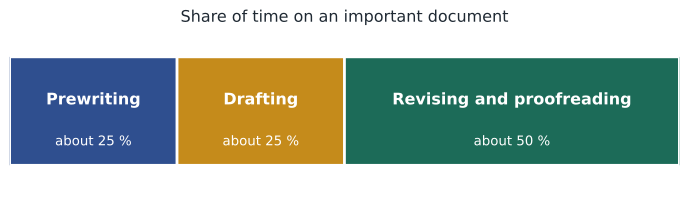
A common rule of thumb for important documents is to spend about a quarter of your time on prewriting, a quarter on drafting and half on revising and proofreading. For a quick email, the proportions shrink but the order stays: think for a moment about purpose and audience, draft, then reread before you send.
Worked problem
Budgeting time for a report
You have three working days (about 18 hours of available time after meetings) to produce a 10-page recommendation report. Apply the 25/25/50 rule and plan the work.
Show solution
- Prewriting: 0.25 × 18 = 4.5 hours for clarifying the purpose with your manager, gathering data and building an outline.
- Drafting: 0.25 × 18 = 4.5 hours, or about 27 minutes a page, writing straight through from the outline.
- Revising and proofreading: 0.50 × 18 = 9 hours, including a content review by a colleague, a style pass, a check of every figure and table, and a final proofread on a printed copy or in a different view.
- Schedule: day 1 prewriting and start drafting; day 2 finish drafting and send for review; day 3 revise, proofread and submit.
Answer: About 4.5 hours each for prewriting and drafting and 9 hours for revision. Building review time into day 2 lets a colleague catch problems while there is still time to fix them.
Prewriting: gathering and organizing
Information can come from informal sources (conversations, past files, brainstorming, quick searches) or formal research (surveys, interviews, databases, experiments). Once you have material, organize it. Two simple techniques help. Brainstorming or mind mapping puts every idea on a page without judgment, then groups related ideas into clusters. Outlining turns clusters into an ordered structure of main points and supporting points. A scratch outline of five or six lines is enough for a long email; a formal outline with numbered headings suits a report.
Choose between two basic patterns of organization. The direct pattern puts the main idea first, followed by details and explanation. Use it when the reader is likely to be pleased, neutral or simply needs information, which covers most business messages. The indirect pattern opens with context or a buffer, builds the explanation and then presents the main idea. Use it when the reader may be resistant, disappointed or need to be persuaded. Lessons 5 and 6 apply these patterns to good news, bad news and persuasion.
| Pattern | Order | Use when the reader is | Examples |
|---|---|---|---|
| Direct | Main idea, then details, then close | Pleased, neutral or busy | Routine requests, confirmations, good news, most emails and reports |
| Indirect | Context or buffer, reasons, then main idea, then close | Resistant, disappointed or skeptical | Refusals, bad news, persuasive requests to uninterested readers |
Drafting: getting it down
When drafting, aim for momentum rather than perfection. Work from your outline, start with the section you find easiest, and leave placeholders (such as [CHECK FIGURE]) rather than stopping to look things up. Write in paragraphs that each develop one idea, beginning with a topic sentence that states the paragraph's point. Use transitions (however, therefore, for example, as a result, in contrast) to show how ideas connect. Keep paragraphs short in business documents, usually three to six sentences, and shorter still in emails read on phones.
Writing clear, concise sentences
Most of the style improvements that readers notice come from a handful of sentence-level habits.
- Prefer the active voice. In the active voice, the subject does the action: "The committee approved the budget." In the passive voice, the subject receives it: "The budget was approved by the committee." Active sentences are shorter and say who is responsible. Use the passive when the actor is unknown or unimportant, or when you deliberately want to soften or depersonalize a message ("Mistakes were made in the order" is evasive; "The invoice was issued twice" can be appropriately neutral).
- Use strong verbs instead of nouns made from verbs. "We conducted an analysis of" becomes "We analyzed"; "make a recommendation" becomes "recommend".
- Cut empty words and redundancy: "past history", "advance planning", "final outcome", "each and every", "basic fundamentals".
- Avoid long lead-ins: "I am writing this email to let you know that" can almost always be deleted.
- Keep subjects and verbs close together, and put the most important information at the end of the sentence, where it gets natural emphasis.
- Use parallel structure for items in a series: "planning, drafting and revising", not "planning, to draft and revision".
- Average 15 to 20 words a sentence, with variety; very long sentences should be split.
Worked problem
A before-and-after rewrite
Revise this 71-word paragraph from a project update: "I am writing to inform you that at this point in time the implementation of the new scheduling software has been delayed due to the fact that a number of technical issues were identified by the IT department during the testing phase. It is anticipated that a resolution of these issues will be achieved in the near future and that the system will be operational by the end of next month."
Show solution
- Identify the main point: the software launch is delayed to the end of next month because of technical issues found in testing.
- Delete the lead-in "I am writing to inform you that" and replace wordy phrases: "at this point in time" (delete), "due to the fact that" (because), "a number of" (several), "in the near future" (soon).
- Change passive to active: "were identified by the IT department" becomes "IT found"; "it is anticipated that a resolution… will be achieved" becomes "IT expects to fix them".
- Add a specific date to replace "the end of next month".
- Rewrite: "The new scheduling software will launch on March 31, a month later than planned. During testing, IT found several technical problems, which it expects to fix by mid-March." (28 words.)
- Reduction: (71 − 28) ÷ 71 ≈ 61 % fewer words.
Answer: The rewrite cuts about three-fifths of the words, puts the new date first and says who is doing what.
Tone and formality
Tone is the attitude a message conveys: friendly or cold, confident or uncertain, respectful or condescending. In business writing, aim for a tone that is professional, courteous and confident, adjusting formality to the relationship and context. A message to a long-standing colleague can be conversational; a letter to a regulator or a first contact with a senior client should be more formal. Avoid both extremes: stiff legalistic language ("Please be advised that pursuant to your request…") and over-familiar slang or excessive exclamation marks. Be confident without being arrogant; replace hedges such as "I just wanted to maybe ask if possibly" with a clear request, while keeping courtesy ("Could you please…").
| Too formal or stiff | Professional and natural | Too casual |
|---|---|---|
| Enclosed herewith please find the requested documentation. | I have attached the documents you asked for. | Here's the stuff lol. |
| We regret to inform you that your application has been unsuccessful. | Thank you for applying. We have chosen another candidate for this role. | Sorry, you didn't get it. |
| It is incumbent upon all personnel to ensure compliance. | Please follow these steps. | Just do it, ok?!! |
Revising and proofreading
Revise in passes, from big to small. First check content: is everything needed there, and is anything unnecessary? Then organization: is the main point first, are headings informative, does each paragraph do one job? Then style: are sentences clear and concise, is the tone right? Finally proofread: spelling, grammar, punctuation, names, numbers, dates, links and formatting. Spelling and grammar checkers and AI writing assistants catch many errors, but they miss wrong words that are correctly spelled ("form" for "from", "manger" for "manager"), wrong numbers and wrong names. Read important documents aloud, change the view (print it or enlarge the font), and check numbers against the source. For documents with legal or financial consequences, ask a second person to proofread.
Canadian and American conventions
Canadian and American business writing are very similar, but readers notice differences in spelling, vocabulary and formatting. Canadian business writing typically follows Canadian spelling as recorded in Canadian dictionaries, The Canadian Press Stylebook or The Canadian Style; American writing follows Merriam-Webster and style guides such as The Chicago Manual of Style or the AP Stylebook. The safest rule is to follow your organization's style guide and to match the conventions of your reader's country when writing externally. The table below shows the most common differences.
| Convention | Canadian practice | American practice |
|---|---|---|
| -our or -or | colour, labour, favour | color, labor, favor |
| -re or -er | centre, theatre, metre | center, theater, meter |
| Doubled l | travelled, cancelled, counselling | traveled, canceled, counseling |
| -ence or -ense | defence, licence (noun), offence | defense, license, offense |
| Other words | cheque, catalogue, grey | check, catalog, gray |
| -ize or -ise | organize, realize (the -ize form is standard in Canada) | organize, realize |
| Percentages | per cent in running text (or %), as in Canadian Press style | percent in running text (or %) |
| Dates | Varies; the all-numeric ISO form 2026-10-19 avoids confusion, and writing the month in words is safest | October 19, 2026, or 10/19/2026 (month first) |
| Measurement | Metric (kilometres, kilograms, Celsius), with some imperial in construction and retail | US customary units (miles, pounds, Fahrenheit) |
| Addresses | Province abbreviation and postal code: Halifax NS B3H 4R2 | State abbreviation and ZIP code: Boston, MA 02110 |
| Currency | Write C$ or CAD when amounts could be confused with US dollars | Write US$ or USD in international documents |
| Bilingual elements | French accents kept in names (Québec, Montréal) in many styles; bilingual packaging and signage are common | English; Spanish versions common for consumer materials |
For your own writing in this course, follow American conventions, but when you write to a client or partner in Canada, remember that they may use Canadian spelling, metric units and different date formats, and that consumer materials in Canada often need to be bilingual. Consistency matters more than either choice: a document that mixes the two styles looks careless.
Worked problem
Adapting a document for a cross-border reader
A Calgary firm is sending a one-page price confirmation to a customer in Denver. The draft says: "Delivery of 12 tonnes on 03/04/2027, total $48,600, as per our catalogue." List the changes needed to avoid confusion.
Show solution
- Units: convert 12 tonnes to US customary units (about 13.2 short tons, since 1 metric ton ≈ 1.102 short tons) or show both: "12 metric tons (about 13.2 short tons)".
- Date: "03/04/2027" could be read as March 4 or April 3. Write "March 4, 2027" (or whichever date is meant) in words.
- Currency: state "C$48,600" or "US$…" so the customer knows which dollars.
- Wording: use the customer's spelling for a word such as catalogue, and drop "as per", which is stiff; write "as listed in our price list".
Answer: Spell out the date, state the currency, show the units the reader uses and adapt the spelling. Each change removes a real risk of a costly misunderstanding.
Portfolio task for lesson 3: take a piece of writing of about 300 words that you produced in the past year. Revise it in four passes (content, organization, style, proofreading), keep a log of the changes in each pass and calculate the percentage reduction in length. Then convert it for a reader in the other country.
Common mistakes
MistakePolishing each sentence while drafting.
InsteadDraft straight through from an outline, then revise in separate passes.
MistakeUsing the passive voice by habit.
InsteadPrefer the active voice; use the passive only when the actor is unknown or unimportant, or to soften deliberately.
MistakeRelying on a spell checker or AI tool as the final proofread.
InsteadCheck names, numbers, dates and correctly spelled wrong words yourself, ideally on a printed copy or a different view.
MistakeWriting dates such as 04/05/2027 for international readers.
InsteadWrite the month in words or use the ISO form 2027-05-04 and say so.
MistakeMixing Canadian and American spellings in one document.
InsteadChoose one convention, usually your organization's or your reader's, and apply it consistently.
MistakeSounding tentative with hedges and apologies.
InsteadMake clear, courteous requests: "Could you please send the report by Friday?"
Summary and key terms
- Follow a three-stage process: prewriting, drafting, revising and proofreading.
- For important documents, spend roughly half your time revising.
- Use the direct pattern for most messages and the indirect pattern for bad news or resistant readers.
- Draft in paragraphs with topic sentences and transitions.
- Write concise sentences: active voice, strong verbs, no redundancy, parallel structure, 15 to 20 words on average.
- Aim for a professional, courteous, confident tone matched to the relationship.
- Canadian and American writing differ in spelling, percentages, dates, units, addresses and currency; follow one convention consistently.
- Prewriting
- The planning stage: purpose, audience, research and organization.
- Outline
- An ordered list of main and supporting points used to structure a document.
- Direct pattern
- An organization that states the main idea first.
- Indirect pattern
- An organization that builds context and reasons before the main idea.
- Topic sentence
- The sentence that states the main point of a paragraph.
- Active voice
- A construction in which the subject performs the action.
- Passive voice
- A construction in which the subject receives the action.
- Parallel structure
- Using the same grammatical form for items in a series.
- Tone
- The attitude a message conveys to the reader.
- Proofreading
- The final check for errors in spelling, grammar, punctuation, facts and formatting.
Practice problems
Work each problem on paper first, then reveal the answer to check.
Convert to active voice: "The proposal was rejected by the board."
Show answer
"The board rejected the proposal."
Give a situation where the passive voice is appropriate.
Show answer
When the actor is unknown or unimportant, such as "The building was constructed in 1962", or to avoid blame in a sensitive message.
Shorten "We are in receipt of your letter".
Show answer
"Thank you for your letter" or "We have received your letter".
Fix the parallelism: "Duties include answering phones, to schedule meetings and the preparation of reports."
Show answer
"Duties include answering phones, scheduling meetings and preparing reports."
A paragraph is cut from 140 to 84 words. What is the percentage reduction?
Show answer
(140 − 84) ÷ 140 = 40 %.
With 10 hours for a report, how long should you spend revising under the 25/25/50 rule?
Show answer
About 5 hours.
Which pattern suits an announcement of a bonus for all staff?
Show answer
The direct pattern, because the news is welcome.
Why is "02/03/2027" risky in a cross-border message?
Show answer
Canadian and other readers may read it as March 2, while American readers read it as February 3.
Name three passes of revision after drafting.
Show answer
Content, organization, style and proofreading (any three).
Rewrite with a confident, courteous tone: "Sorry to bother you, I was just wondering if maybe you could possibly look at this?"
Show answer
"Could you please review the attached draft by Thursday?"
Lesson quiz · 5 questions
Score 60% or more to complete this lesson.
Create a free account to save your progress, take quizzes and earn a certificate.