
BUS-120 · Lesson 10 of 12 · 32 min
Meetings, teamwork and cross-cultural communication
Much of the communication that shapes an organization happens not in documents but between people: in meetings, team discussions, one-on-one conversations, feedback sessions and the daily give-and-take of working with colleagues from different backgrounds. This lesson covers how to run meetings that are worth attending, how teams communicate and handle conflict, the interpersonal skills of listening and giving feedback, and how to communicate across cultures and languages, including the official-language duties that shape many Canadian workplaces and the multilingual realities of American ones.
The real cost of meetings
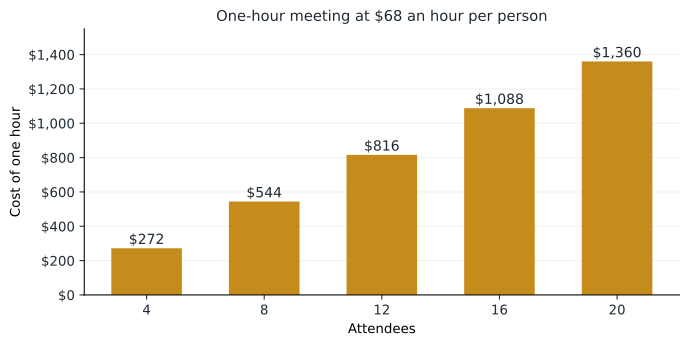
Meetings are expensive because their cost is multiplied by the number of people in the room. A one-hour meeting with ten people uses ten hours of working time, plus preparation and the time needed to get back into focused work afterward. Many surveys of managers report that a large share of meetings are unproductive. Estimating the cost of a meeting is a simple but powerful way to decide whether it is needed and who really needs to attend.
Worked problem
Costing a weekly status meeting
A department holds a weekly 60-minute status meeting with 14 attendees whose average loaded cost (salary plus benefits and overhead) is $68 an hour. The manager proposes replacing it with a 25-minute stand-up for 8 core people plus a written update for everyone else, which takes each of the 14 people 5 minutes to read. What is the annual saving over 48 weeks?
Show solution
- Current cost per week = 14 × $68 × 1.0 h = $952.
- New meeting cost per week = 8 × $68 × (25 ÷ 60) h = $226.67.
- Reading the update = 14 × $68 × (5 ÷ 60) h = $79.33.
- New total per week = $226.67 + $79.33 = $306.00; saving = $952 − $306 = $646 a week.
- Annual saving = $646 × 48 = $31,008.
Answer: The change saves about $31,000 a year in working time, or roughly 456 person-hours, without losing information.
Running effective meetings
Effective meetings share a few features. They have a clear purpose that cannot be achieved more cheaply another way, such as making a decision, solving a problem, generating ideas or building relationships; routine information sharing can usually be done in writing. They include only the people needed to achieve that purpose. They have an agenda, sent in advance, that lists topics as questions or outcomes, with a time and an owner for each item. They have a facilitator who keeps discussion on track, draws out quiet members and manages time, and a note-taker who records decisions and action items. And they end with a summary of decisions and actions, followed by brief written minutes.
| Agenda item | Desired outcome | Lead | Time |
|---|---|---|---|
| 1. Review action items from last meeting | Confirm status | Chair | 5 min |
| 2. Which vendor should we choose for the new payroll system? | Decision | Finance lead | 20 min |
| 3. How do we reduce overtime in the warehouse in Q4? | List of options for the next meeting | Operations manager | 15 min |
| 4. Holiday schedule | Information only (see attached memo) | HR | 5 min |
| 5. Summary of decisions and actions | Agreed list | Chair | 5 min |
Action items should say who will do what by when: "Leila to send the vendor contract to legal by Friday, October 23." Minutes need not record every comment. For most business meetings, action minutes, which list attendees, decisions and action items, are enough. Formal bodies such as boards and councils often follow Robert's Rules of Order or a similar procedure, with motions, seconders and recorded votes, and their minutes are legal records.
Worked problem
Writing action minutes
From the agenda above, write action minutes for items 2 and 3, given that the group chose Vendor B and brainstormed four overtime options.
Show solution
- Header: Operations leadership meeting, October 19, 2026, 10:00 to 10:50; present: six names; absent: one name.
- Item 2 decision: "Vendor B selected for the payroll system, subject to legal review of the contract. Reason: lowest five-year cost and best integration with our scheduling system."
- Item 2 actions: "Leila: send contract to legal by October 23. Marc: notify Vendors A and C by October 26."
- Item 3 outcome: "Four options identified: staggered shifts, cross-training, seasonal hires, revised order cut-off times."
- Item 3 actions: "Priya: cost each option and circulate by November 2 for decision at the November 9 meeting."
Answer: Action minutes record only decisions, reasons and actions with owners and dates, so they take minutes to write and seconds to read.
Communication in teams
Teams often move through stages that the psychologist Bruce Tuckman named forming, storming, norming and performing (with adjourning added later). In the forming stage, members are polite and uncertain; in storming, disagreements surface about goals and roles; in norming, the team agrees on how to work; in performing, it works effectively. Communication needs change at each stage: clear goals and introductions at the start, open discussion of disagreements in storming, explicit agreements such as a team charter in norming, and efficient coordination in performing.
Conflict is normal in teams and can be productive when it concerns ideas (task conflict) rather than personalities (relationship conflict). The Thomas-Kilmann model describes five conflict-handling styles: competing (assertive, uncooperative), accommodating (cooperative, unassertive), avoiding (neither), compromising (partly both) and collaborating (both assertive and cooperative). No style is always best; collaborating suits important issues where both sides' concerns matter, while avoiding may suit trivial ones.
| Style | Assertive | Cooperative | When it fits |
|---|---|---|---|
| Competing | High | Low | Emergencies, unpopular but necessary decisions |
| Accommodating | Low | High | When the issue matters more to the other person, or to build goodwill |
| Avoiding | Low | Low | Trivial issues, or when emotions need to cool |
| Compromising | Medium | Medium | Time pressure, equal power, temporary solutions |
| Collaborating | High | High | Important issues where both sides' concerns must be met |
Listening and feedback
Listening is the most used and least taught communication skill. Active listening means giving full attention, showing that you are listening (eye contact, nods, brief verbal signals), asking open questions, paraphrasing to check understanding ("So your main concern is the deadline, not the budget?") and withholding judgment until the speaker has finished. In remote meetings, active listening also means turning off notifications and resisting the urge to multitask.
Giving feedback is easier and more useful with a structure. The Situation-Behavior-Impact (SBI) model, developed by the Center for Creative Leadership, describes the specific situation, the observable behavior and its impact, then invites a response. It keeps feedback factual and avoids judgments about character. The same model works for positive feedback, which should be given far more often than criticism.
Worked problem
Giving feedback with the SBI model
A team member, Devon, interrupted a client twice during a video call yesterday. Give constructive feedback using the SBI model.
Show solution
- Situation: "In yesterday's call with Harbourview Foods,"
- Behavior: "you began answering twice while their director was still explaining their concern about delivery dates."
- Impact: "She paused and then said, 'Let me finish,' and I noticed she was shorter with us for the rest of the call."
- Invite a response: "How did the call feel from your side?" Then agree on a next step: "In the next call, let's pause a beat after they finish and summarize their concern before we answer."
Answer: The feedback describes a specific, observable behavior and its effect, without labels such as "rude", and ends with a shared plan.
Communicating across cultures
Workplaces in Canada and the United States are among the most culturally diverse in the world, and many organizations work with partners, suppliers and customers abroad. Cultural differences affect how people communicate in predictable ways, although every individual is different and generalizations should be held loosely. The anthropologist Edward T. Hall distinguished high-context cultures, where much of the meaning lies in shared context, relationships and non-verbal cues (common in Japan, China, Korea and many Arab and Latin American countries), from low-context cultures, where meaning is carried mainly by explicit words (common in Germany, Scandinavia, the United States and English-speaking Canada). Geert Hofstede's research identified dimensions such as power distance (acceptance of hierarchy), individualism versus collectivism and uncertainty avoidance, which affect how people disagree, make decisions and respond to direct requests.
| Dimension | One tendency | The other tendency | Communication implication |
|---|---|---|---|
| Context | Low context: explicit, direct | High context: implicit, relational | Adjust directness; read silence and non-verbal cues; build relationships before business |
| Power distance | Low: flat, informal | High: hierarchical, formal | Use titles and formal channels where hierarchy matters; expect less open disagreement with superiors |
| Individualism | Individual achievement | Group harmony and loyalty | Credit teams as well as individuals; avoid public criticism |
| Time | Monochronic: one thing at a time, punctual | Polychronic: flexible, many things at once | Clarify deadlines; allow for different views of schedules |
| Feedback | Direct negative feedback | Indirect, softened feedback | Be explicit about the severity of problems; listen for softened signals |
Practical strategies help in any cross-cultural exchange. Use plain language and avoid idioms, slang, sports metaphors and humor that may not translate ("hit it out of the park", "touch base", "ballpark figure"). Speak clearly and a little more slowly, without raising your voice. Confirm understanding by asking open questions rather than "Do you understand?", which invites a polite yes. Put agreements in writing. Learn the basics of greetings, names and titles. Above all, be curious rather than judgmental: when behavior seems odd, consider that it may make perfect sense in another context.
Language at work: Canada and the United States
The United States has a highly multilingual workforce. According to the Census Bureau's American Community Survey, about one in five residents aged 5 and over speaks a language other than English at home, most often Spanish, followed by Chinese, Tagalog, Vietnamese and Arabic. A 2025 executive order designated English as the official language of the United States, but no federal statute does so, and about 30 states have official-English laws of varying scope. For employers, the key rules come from anti-discrimination law: the Equal Employment Opportunity Commission treats rules requiring employees to speak only English at work as potential national origin discrimination under Title VII of the Civil Rights Act unless they are justified by business necessity, such as communication during emergencies or with customers who speak only English. Many organizations provide safety training and key policies in the languages their workers speak, and federal OSHA guidance expects training to be given in a language and vocabulary workers understand. Federal agencies and recipients of federal funding have language access obligations to people with limited English proficiency, although the 2025 order changed the federal guidance on how agencies apply them.
Worked problem
Planning communication for a multilingual team
A logistics company with a distribution center near Houston is rolling out a new safety procedure for 220 warehouse employees, about 40 % of whom speak Spanish as their main language and 10 % Vietnamese. Plan the language aspects of the communication.
Show solution
- Legal and safety requirements: OSHA expects training in a language and vocabulary workers understand, so the procedure and training must be available in English, Spanish and Vietnamese.
- A professional translator (not a machine translation alone) produces the Spanish and Vietnamese versions, reviewed by bilingual supervisors for workplace terminology.
- Training: sessions in each language with bilingual trainers or interpreters; demonstrations and pictograms supplement words.
- Check understanding: short practical demonstrations by each employee rather than a written quiz alone.
- Policy: avoid blanket English-only rules; any language rule must be justified by business necessity, such as clear communication during an emergency.
Answer: Plan the languages from the start, use qualified translators, rely on demonstration as well as words and check understanding through practice.
Portfolio task for lesson 10: plan a 45-minute team meeting on a real or realistic decision. Write the agenda with outcomes, leads and times; calculate its cost; then write action minutes for an imagined outcome. Add a short note on how you would adapt the meeting for a participant joining from another country.
Common mistakes
MistakeHolding meetings to share information that could be written.
InsteadUse a written update for routine information and keep meetings for decisions, problems and relationships.
MistakeInviting everyone who might be interested.
InsteadInvite only the people needed; share minutes with others.
MistakeEnding a meeting without clear actions.
InsteadSummarize decisions and action items with owners and dates before closing.
MistakeGiving feedback as a judgment ("You were rude").
InsteadDescribe the situation, the behavior and its impact, then invite a response.
MistakeAsking "Do you understand?" in cross-cultural conversations.
InsteadAsk open questions that invite the person to explain or summarize.
MistakeUsing idioms and sports metaphors with international colleagues.
InsteadUse plain, literal language and confirm agreements in writing.
Summary and key terms
- Meeting cost = attendees × loaded hourly cost × duration; use it to decide whether a meeting is needed.
- Effective meetings have a clear purpose, the right people, an agenda with outcomes, a facilitator and action minutes.
- Teams move through forming, storming, norming and performing; conflict about tasks can be productive.
- The Thomas-Kilmann styles are competing, accommodating, avoiding, compromising and collaborating.
- Active listening and the SBI feedback model build trust and improve performance.
- Cultural differences in context, power distance, individualism, time and feedback affect communication; use plain language and check understanding.
- In the United States, English-only rules must be justified by business necessity, and safety training must be given in a language workers understand.
- Loaded hourly cost
- An employee's hourly pay plus benefits and overhead.
- Agenda
- A list of meeting topics, ideally with outcomes, leads and times.
- Action minutes
- Minutes recording only attendees, decisions and action items.
- Action item
- A task assigned in a meeting, with an owner and a due date.
- Task conflict
- Disagreement about ideas, goals or methods.
- Active listening
- Attentive listening that includes paraphrasing and open questions.
- SBI model
- A feedback model describing situation, behavior and impact.
- High-context culture
- A culture in which much meaning comes from context, relationships and non-verbal cues.
- Power distance
- The extent to which people accept unequal distribution of power.
- Official language
- A language given legal status for government and, in some cases, workplace use.
Practice problems
Work each problem on paper first, then reveal the answer to check.
What does a 90-minute meeting with 9 people at $60 an hour cost?
Show answer
9 × $60 × 1.5 = $810.
A meeting costs $1,200 per hour with 16 people. What is the average loaded hourly cost?
Show answer
$75.
Rewrite the agenda item "Budget" as an outcome-focused item.
Show answer
For example, "Decide how to cut $40,000 from the Q4 budget (decision; 20 min)."
What three parts should every action item have?
Show answer
An owner, a task and a due date.
Which Tuckman stage involves open disagreement over roles?
Show answer
Storming.
Which conflict style is high in both assertiveness and cooperation?
Show answer
Collaborating.
Paraphrase: "I can't take on the audit; I'm already covering for Sam."
Show answer
"So your workload is full because you are covering Sam's work, and the audit would be too much right now?"
Give an example of positive feedback using SBI.
Show answer
"In this morning's presentation, you showed the cost table before the options, and the directors approved the plan in ten minutes."
Replace the idiom "ballpark figure" in a message to international partners.
Show answer
"An approximate figure" or "a rough estimate".
When may a US employer adopt an English-only rule?
Show answer
When it is justified by business necessity, such as safety-critical communication, and applied narrowly.
Lesson quiz · 5 questions
Score 60% or more to complete this lesson.
Create a free account to save your progress, take quizzes and earn a certificate.