
BUS-101 · Lesson 6 of 12 · 28 min
Human resources and the workforce
A business's people are often its largest cost and its most important source of advantage. Human resource management (HRM) is the set of activities that attract, develop, reward and retain the people an organization needs, while complying with employment law. This lesson covers workforce planning, recruiting and selection, training, compensation and benefits, performance management, employment standards and human rights law, labor unions and current workforce trends.
What human resource management does
In a small business, the owner handles hiring and payroll personally. In a larger one, an HR department supports managers with expertise and systems, but line managers still do much of the day-to-day people work. The main HR activities follow the employee life cycle:
- Workforce planning: forecasting how many people with which skills will be needed and when.
- Recruiting and selection: attracting applicants and choosing the best fit.
- Onboarding, training and development: helping people become productive and grow.
- Compensation and benefits: designing pay and benefits that are fair, competitive and affordable.
- Performance management: setting expectations, giving feedback and evaluating results.
- Employee relations, health and safety: maintaining a safe, respectful and lawful workplace, including dealing with unions where they exist.
- Separation: managing resignations, retirements, layoffs and dismissals fairly and legally.
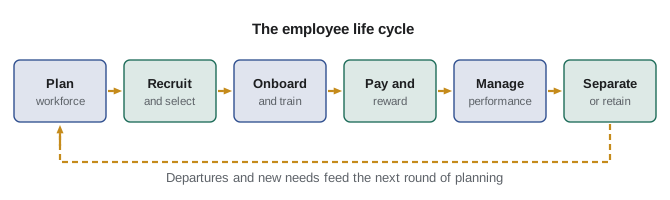
Workforce planning
Workforce planning compares the people the organization will need with the people it has and will lose through turnover and retirement. The gap tells managers how many people to hire, train or redeploy. Planning also considers whether work should be done by full-time employees, part-time staff, temporary workers, contractors or automation.
Worked problem
Forecasting hiring needs
A home-care company employs 240 personal support workers. It expects client demand to grow by 15 % next year and annual turnover is 25 %. How many workers must it hire next year to meet demand?
Show solution
- Workers needed at year end = 240 × 1.15 = 276.
- Expected departures during the year = 240 × 25 % = 60.
- Workers remaining without hiring = 240 − 60 = 180.
- Hires needed = 276 − 180 = 96.
- If new hires also leave at a similar rate within the year, the company should plan for more, say 100 to 110 hires.
Answer: The company needs about 96 hires, and more in practice. Note that replacing turnover (60) requires more hiring than growth does (36), which is why reducing turnover is often the cheapest way to staff a business.
Recruiting and selection
Recruiting builds a pool of qualified applicants. Internal recruiting promotes or transfers current employees, which rewards loyalty and is cheaper, while external recruiting brings in new skills and ideas through job boards, referrals, campus recruiting, social media and agencies. A good recruiting process starts with a job analysis, which produces a job description (duties and responsibilities) and a job specification (the skills, education and experience needed).
Selection narrows the pool to the best candidate. Typical steps are screening applications, interviews, skills tests or work samples, reference checks and a job offer. Structured interviews, in which every candidate is asked the same job-related questions and scored against the same criteria, predict job performance much better than unstructured conversations and reduce bias. Questions must relate to the job.
Under federal law, including Title VII of the Civil Rights Act of 1964, the Age Discrimination in Employment Act and the Americans with Disabilities Act, employers may not discriminate on the basis of race, color, religion, sex (including pregnancy, sexual orientation and gender identity), national origin, age (40 and older), disability or genetic information. The Equal Employment Opportunity Commission (EEOC) enforces these laws, and many states add further protected characteristics. Employers must provide reasonable accommodation for disabilities and religious practices unless it causes undue hardship.
Training and development
Onboarding introduces new hires to the organization, their job and their colleagues, and a good onboarding process significantly reduces early turnover. Training improves skills for the current job through methods such as on-the-job training, job rotation, apprenticeships, classroom courses, online modules and simulations. Development prepares people for future roles through mentoring, coaching, stretch assignments and leadership programs. Training is an investment: it costs money and time but raises productivity, quality and safety, and it is one of the strongest signals to employees that the employer values them.
Compensation and benefits
Compensation includes direct pay, such as wages, salaries, commissions and bonuses, and indirect pay, such as benefits. Wages are paid per hour; salaries are fixed annual amounts. Incentive pay ties part of compensation to results, through commissions, piece rates, bonuses, profit sharing or stock options. Employers set pay by comparing jobs inside the organization (internal equity) and checking market surveys (external competitiveness).
In the United States, employers withhold and pay Social Security and Medicare (FICA) taxes, pay federal and state unemployment taxes and carry workers' compensation insurance. Because there is no universal public health insurance for working-age people, employer-sponsored health insurance is a major and expensive benefit; employers with 50 or more full-time-equivalent employees face Affordable Care Act requirements to offer coverage. Retirement benefits are commonly 401(k) plans with employer matching.
Worked problem
Total cost of an employee
A Chicago firm hires a coordinator at $60,000 a year. Statutory payroll costs (FICA, unemployment taxes and workers' compensation) add about 9 %, the employer's share of health insurance costs $9,000 and the employer matches 401(k) contributions of 4 % of salary. What is the total annual cost of the employee, and the cost as a percentage of salary?
Show solution
- Statutory payroll costs = 9 % × $60,000 = $5,400.
- Health insurance = $9,000.
- 401(k) match = 4 % × $60,000 = $2,400.
- Total cost = $60,000 + $5,400 + $9,000 + $2,400 = $76,800.
- Cost as a percentage of salary = $76,800 ÷ $60,000 = 128 %.
Answer: The employee costs about $76,800, or 28 % more than salary. Budgets that use salary alone understate staffing costs.
Performance management
Performance management is the ongoing process of setting goals, coaching and evaluating results. Many organizations have moved from a single annual review toward regular check-ins, because feedback is most useful soon after the work. Common appraisal methods include rating scales, goal-based reviews against agreed objectives and 360-degree feedback from managers, peers and direct reports. Common errors include the halo effect (letting one strong trait color the whole rating), recency bias (weighting the last few weeks too heavily) and leniency (rating everyone highly to avoid conflict).
Employment standards
In the United States, the federal Fair Labor Standards Act (FLSA) sets a federal minimum wage of $7.25 an hour, which has not changed since 2009, requires overtime at one and a half times the regular rate for non-exempt employees after 40 hours in a workweek and restricts child labor. Many states and cities set higher minimum wages, and the higher rate applies. Unlike in many countries, federal law does not require paid vacation or paid holidays, although some states and cities require paid sick leave. Most employment is at will: employers can dismiss employees for any lawful reason without notice, although discrimination and retaliation are illegal and contracts can change the rule, and the WARN Act requires 60 days' notice of certain mass layoffs.
Worked problem
Overtime pay
A warehouse worker covered by the FLSA earns $22.00 an hour and works 50 hours in a workweek. Overtime is 1.5 times the regular rate after 40 hours. What is the gross pay for the week?
Show solution
- Regular hours = 40; regular pay = 40 × $22.00 = $880.00.
- Overtime hours = 50 − 40 = 10.
- Overtime rate = 1.5 × $22.00 = $33.00.
- Overtime pay = 10 × $33.00 = $330.00.
- Gross pay = $880.00 + $330.00 = $1,210.00.
Answer: Gross pay is $1,210.00. Some states also require daily overtime, so the rules of the jurisdiction matter.
Health and safety
The Occupational Safety and Health Act requires employers to provide a workplace free from recognized serious hazards and to follow OSHA standards; about half the states run their own approved plans. Workers have the right to information about hazards, to request inspections and to be protected from retaliation for raising safety concerns. State workers' compensation systems provide no-fault benefits for workplace injuries.
Labor unions
A labor union is an organization that represents workers in collective bargaining with their employer over wages, hours, benefits and working conditions. In the United States, roughly one in ten wage and salary workers belongs to a union, and private-sector membership is about 6 %, much lower than in the public sector. The National Labor Relations Act protects the right of most private-sector employees to organize and bargain, and the National Labor Relations Board runs union elections and handles unfair labor practice charges. About half the states have right-to-work laws, which prevent contracts from requiring workers to pay union dues. When bargaining fails, unions may strike and employers may lock out.
A collective agreement typically sets wages, benefits, seniority rules, grievance procedures and job security. Supporters say unions raise wages, improve safety and give workers a voice; critics say they can raise costs and reduce flexibility. For managers, the practical lesson is that in a unionized workplace the collective agreement governs, and changes must be negotiated.
Workforce trends
Several trends are reshaping work at the time of writing (October 2026): hybrid and remote work for office jobs, an aging workforce and labor shortages in skilled trades and health care, the growth of gig and contract work, rising attention to mental health and pay transparency, and the spread of artificial intelligence tools, which are changing tasks in many jobs and raising new questions about training, monitoring and fairness in hiring.
Retention and employee engagement
Because replacing an employee commonly costs from a few months' to a full year's pay once recruiting, training and lost productivity are counted, retaining good people is one of the most valuable things a manager can do. Research on engagement consistently points to the same drivers: a capable and fair immediate manager, clear expectations, the tools to do the job, recognition, opportunities to learn and grow, reasonable workload and flexibility, and a sense that the work matters. Pay must be competitive, but beyond that point money alone rarely keeps people who dislike their manager or see no future. Exit interviews and short regular pulse surveys help managers find out why people leave before more of them do.
Dismissal deserves special care. Managers should document performance problems, give clear warnings and a fair chance to improve, follow the organization's policy and the applicable law consistently, and seek HR or legal advice before terminating anyone. Treating departing employees with respect also protects the reputation that attracts the next round of applicants.
Finally, HR increasingly relies on data. Human resource information systems hold employee records, payroll and benefits; applicant tracking systems manage hiring; and people analytics look for patterns in turnover, engagement and performance. Used carefully, such data improves decisions, but employers must protect employee privacy and check automated hiring tools for bias.
Common mistakes
MistakeBudgeting staff at salary alone.
InsteadAdd payroll taxes, benefits and retirement contributions; total cost often runs 20 % to 30 % above salary.
MistakeAsking interview questions about age, family plans or religion.
InsteadAsk only job-related questions, the same for every candidate.
MistakeAssuming the same employment rules apply everywhere.
InsteadCheck federal, state and city rules; the most generous to the worker applies.
MistakeHolding feedback for the annual review.
InsteadGive feedback regularly, close to the event.
MistakeIgnoring turnover in hiring plans.
InsteadPlan hires for both growth and expected departures.
Summary and key terms
- HRM attracts, develops, rewards and retains people while complying with the law.
- Workforce planning compares needed and available staff, including turnover.
- Structured, job-related interviews predict performance better and reduce bias.
- Total employee cost includes payroll taxes, benefits and retirement contributions.
- The FLSA sets the federal minimum wage and overtime rules; states may set higher standards.
- Federal anti-discrimination laws enforced by the EEOC forbid discrimination and require reasonable accommodation.
- Unions bargain collectively; a collective agreement governs the unionized workplace.
- Human resource management
- Activities that attract, develop, reward and retain employees.
- Job description
- A statement of a job's duties and responsibilities.
- Job specification
- The skills, education and experience a job requires.
- Structured interview
- An interview with the same job-related questions and scoring for every candidate.
- Turnover
- The rate at which employees leave and must be replaced.
- Incentive pay
- Pay linked to individual, team or company results.
- Fair Labor Standards Act
- Federal law setting the minimum wage, overtime and child labor rules.
- At-will employment
- Employment that either side may end for any lawful reason without notice.
- Collective bargaining agreement
- A contract between an employer and a union.
- Right-to-work law
- A state law that bars requiring union dues as a condition of employment.
Practice problems
Work each problem on paper first, then reveal the answer to check.
A firm of 100 expects 10 % growth and 20 % turnover. How many hires?
Show answer
30 (110 needed, 80 remaining).
What is the difference between a job description and a job specification?
Show answer
The description lists duties; the specification lists required qualifications.
Why are structured interviews preferred?
Show answer
They predict performance better and reduce bias.
Salary $50,000; payroll costs 10 %; benefits $6,000. Total cost?
Show answer
$61,000.
A worker earns $20 an hour and works 48 hours with overtime after 40. Gross pay?
Show answer
$1,040 (800 + 240).
Name two appraisal errors.
Show answer
Any two of halo effect, recency bias, leniency, central tendency.
Which agency enforces federal anti-discrimination law?
Show answer
The EEOC.
Name the three basic health and safety rights.
Show answer
The right to know, to participate and to refuse unsafe work.
Give two examples of incentive pay.
Show answer
Commissions, bonuses, profit sharing, piece rates or stock options.
Why is reducing turnover often cheaper than hiring?
Show answer
Replacing staff costs recruiting, training and lost productivity.
Lesson quiz · 5 questions
Score 60% or more to complete this lesson.
Create a free account to save your progress, take quizzes and earn a certificate.