
BUS-101 · Lesson 11 of 12 · 28 min
Global business and trade
Very few businesses are untouched by international trade. A café imports coffee beans, a farmer sells canola or soybeans abroad, a software company serves customers on several continents and nearly every retailer sells goods made in other countries. This lesson explains why countries trade, how trade is measured, how exchange rates affect businesses, the ways firms enter foreign markets, trade barriers and agreements, and the trade environment at the time of writing (October 2026), which has been unusually turbulent.
Why countries trade
Countries trade for the same reason people do: specialization makes everyone better off. A country has an absolute advantage in a good if it can produce more of it with the same resources. More importantly, it has a comparative advantage if it can produce the good at a lower opportunity cost, that is, by giving up less of other goods. Economist David Ricardo showed two centuries ago that even if one country is better at producing everything, both countries gain when each specializes in what it does relatively best and trades for the rest.
Worked problem
Comparative advantage
In one day, a worker in Country A can produce 10 metric tons of wheat or 5 machines; a worker in Country B can produce 6 metric tons of wheat or 1 machine. Which country has the absolute advantage in each good, which has the comparative advantage, and how should they specialize?
Show solution
- Country A is better at both goods (10 > 6 wheat; 5 > 1 machines): absolute advantage in both.
- Opportunity cost in A: 1 machine costs 10 ÷ 5 = 2 metric tons of wheat; 1 metric ton of wheat costs 0.5 machines.
- Opportunity cost in B: 1 machine costs 6 ÷ 1 = 6 metric tons of wheat; 1 metric ton of wheat costs about 0.17 machines.
- A gives up less wheat per machine (2 vs 6), so A has the comparative advantage in machines.
- B gives up fewer machines per metric ton of wheat (0.17 vs 0.5), so B has the comparative advantage in wheat. Any trade price between 2 and 6 metric tons of wheat per machine benefits both.
Answer: Country A should specialize in machines and Country B in wheat, then trade. Both can consume more than they could produce alone, even though A is more productive at everything.
Trade also gives consumers more variety and lower prices, lets firms reach larger markets and achieve economies of scale, and spreads technology and ideas. The gains are not evenly shared, though: workers and communities in industries that face new import competition can lose jobs, which is why trade policy is politically contentious.
Measuring trade
Exports are goods and services sold to other countries; imports are goods and services bought from them. The balance of trade is exports minus imports. A trade surplus means exports exceed imports; a trade deficit means the reverse. The broader current account adds investment income and transfers. A deficit is not necessarily bad: a fast-growing country may import capital goods, and a country's deficit with one partner may be offset by surpluses with others.
Trade is important to the US economy, although it is a smaller share of GDP than in most other countries because the domestic market is so large. Canada and Mexico are the largest US trading partners, followed by China, the European Union, Japan and South Korea. The United States runs a large overall goods trade deficit but a surplus in services such as software, finance, travel and intellectual property.
Exchange rates
When businesses trade across borders, someone has to exchange currencies. The exchange rate is the price of one currency in terms of another. Exchange rates move with interest rates, inflation, commodity prices, economic growth and investor sentiment. A weaker home currency makes exports cheaper for foreign buyers and imports more expensive at home; a stronger currency does the opposite.
Worked problem
Exchange rates and a cross-border sale
An Ohio manufacturer buys components from a Canadian supplier for C$68,500. When the order is signed, US$1 = C$1.37. When payment is due three months later, US$1 = C$1.33. How much does the manufacturer pay in US dollars at each rate, and how could it have protected itself?
Show solution
- At signing: C$68,500 ÷ 1.37 = US$50,000.
- At payment: C$68,500 ÷ 1.33 = US$51,504.
- Extra cost from the stronger Canadian dollar = US$51,504 − US$50,000 = US$1,504, or about 3.0 %.
- If the manufacturer's margin on the finished product was 8 %, this one move absorbed a large share of it.
- A forward contract with its bank, locking in a rate at signing, or negotiating prices in US dollars, would have removed the risk.
Answer: The manufacturer pays US$51,504 instead of US$50,000. Importers can manage currency risk with forward contracts, options, pricing in their own currency or matching revenue and costs in the same currency.
Ways to enter foreign markets
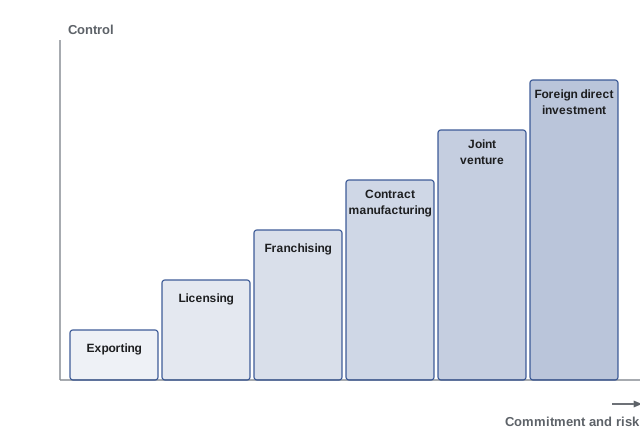
Firms can go international with different levels of commitment, cost, control and risk:
- Exporting: selling goods produced at home to foreign buyers, directly or through agents and distributors. Low risk and investment, but subject to tariffs and transport costs.
- Licensing: allowing a foreign firm to use a patent, trademark or technology in exchange for royalties. Low investment, but less control and the risk of creating a competitor.
- Franchising: licensing a whole business system, common in restaurants and hotels.
- Contract manufacturing and outsourcing: having a foreign firm produce goods or services to your specifications.
- Joint ventures and strategic alliances: sharing ownership, costs and control with a local partner who knows the market.
- Foreign direct investment: building or buying operations abroad, such as a plant or subsidiary. Highest control and potential return, and highest cost and risk.
A multinational corporation operates in many countries. Companies must also adapt to differences in culture, language, business customs, laws, tax and political risk. Hofstede's research, for example, found countries differ in attitudes to hierarchy, individualism, risk and long-term orientation, all of which affect management and marketing.
Trade barriers
Governments restrict trade for several reasons: to protect domestic industries and jobs, to raise revenue, to protect national security, or to retaliate against other countries' policies. The main barriers are:
- Tariffs: taxes on imported goods, usually a percentage of their value. They are paid by the importer, and much of the cost is typically passed on to buyers.
- Quotas: limits on the quantity of a good that can be imported.
- Embargoes and sanctions: bans on trade with certain countries or in certain goods.
- Non-tariff barriers: product standards, licensing requirements, buy-local rules, subsidies to domestic producers and slow customs procedures.
Worked problem
Who pays a tariff?
A US retailer imports a product that costs $40 at the factory, plus $5 of freight. A 25 % tariff applies to the factory value. The retailer previously sold the product for $90. If it absorbs half the tariff and passes half on to customers, what is the new price and how much has its gross profit per unit fallen?
Show solution
- Tariff = 25 % × $40 = $10 per unit.
- Landed cost = $40 + $5 + $10 = $55, up from $45.
- Price increase to customers = half of $10 = $5; new price = $95.
- Old gross profit = $90 − $45 = $45; new gross profit = $95 − $55 = $40.
- Gross profit falls by $5 per unit (11 %), and the higher price may also reduce sales volume.
Answer: The tariff raises the landed cost by $10. Customers pay $5 more and the retailer earns $5 less per unit. Although tariffs are aimed at foreign producers, they are collected from importers and much of the cost falls on domestic businesses and consumers.
Trade agreements and organizations
The World Trade Organization (WTO), with 166 members, sets rules for trade between countries, provides a forum for negotiations and settles disputes; its appeals body has been unable to function since 2019, weakening dispute settlement. Regional and bilateral free trade agreements reduce or eliminate tariffs among members.
The United States' most important regional agreement is the United States–Mexico–Canada Agreement (USMCA), which replaced NAFTA in 2020. The United States also has free trade agreements with about 20 countries, including South Korea, Australia, Chile and several Central American countries, but it is not a member of the CPTPP or a comprehensive agreement with the European Union.
The trade environment at the time of writing
US trade policy has changed rapidly since early 2025. At the time of writing (October 2026), the main developments are these. In February 2026, the Supreme Court ruled in Learning Resources v. Trump that the International Emergency Economic Powers Act does not authorize tariffs, ending the tariffs imposed under that law. Tariffs under Section 232 on steel, aluminum, autos and parts, lumber and other goods, and under Section 301 on many imports from China, remain in place, and a temporary global tariff was imposed under Section 122 of the Trade Act of 1974 in February 2026, a measure limited to 150 days unless Congress extends it, with USMCA-qualifying goods largely exempt. At the USMCA joint review on July 1, 2026, the United States declined to extend the agreement for a new 16-year term, which triggers annual reviews; the agreement remains in force until 2036 unless the parties agree otherwise. Importers have responded by checking rules of origin, diversifying suppliers and building tariff scenarios into their pricing. Because trade policy is changing quickly, always check the latest rules before quoting a price or signing a contract.
| Factor | What to check | Why it matters |
|---|---|---|
| Rules of origin | Whether goods qualify for USMCA treatment | Qualifying goods face lower or no duties |
| Tariff classification | The correct Harmonized System code | The code determines the duty rate |
| Exchange rate | Current rate and hedging options | Currency moves can erase margins |
| Incoterms | Who pays freight, insurance and duties | Avoids disputes over who bears costs and risk |
| Sanctions and export controls | Whether the buyer, country or product is restricted | Violations bring heavy penalties |
Practical steps for a first-time exporter
A small firm thinking about selling abroad can reduce risk by starting with one nearby or familiar market, researching demand and competitors there, confirming the tariff classification and any duties, checking product standards and labeling rules, choosing a reliable distributor or online channel, agreeing clear Incoterms and payment methods such as letters of credit or export credit insurance, and pricing to cover freight, duties and currency risk. Government trade services can help with market research, contacts and financing.
Global business also raises ethical questions, such as working conditions at overseas suppliers, bribery and environmental standards. Firms that source abroad increasingly audit suppliers and publish codes of conduct, a subject the next lesson takes up.
Common mistakes
MistakeThinking a country gains from trade only if it is better at producing something.
InsteadComparative advantage, based on opportunity cost, is what creates gains from trade.
MistakeAssuming foreign exporters pay tariffs.
InsteadImporters pay tariffs, and much of the cost passes to domestic buyers.
MistakeIgnoring currency risk on contracts paid later.
InsteadHedge with forward contracts or price in your own currency.
MistakeTreating trade rules as stable.
InsteadCheck current tariffs, rules of origin and agreements before quoting or signing.
MistakeChoosing an entry mode on cost alone.
InsteadWeigh control, risk, local knowledge and the protection of intellectual property.
Summary and key terms
- Comparative advantage, based on opportunity cost, explains the gains from trade.
- The balance of trade is exports minus imports.
- A weaker home currency helps exporters and hurts importers; currency risk can be hedged.
- Entry modes range from exporting and licensing to joint ventures and foreign direct investment.
- Trade barriers include tariffs, quotas, embargoes and non-tariff barriers.
- The USMCA is the most important US regional trade agreement.
- At the time of writing, tariffs and the shift to annual USMCA reviews make trade rules uncertain.
- Comparative advantage
- The ability to produce a good at a lower opportunity cost than others.
- Balance of trade
- The value of exports minus the value of imports.
- Exchange rate
- The price of one currency in terms of another.
- Forward contract
- An agreement to exchange currency at a set rate on a future date.
- Licensing
- Allowing a foreign firm to use intellectual property for a royalty.
- Joint venture
- A business owned jointly by two or more firms.
- Foreign direct investment
- Building or buying operations in another country.
- Tariff
- A tax on imported goods.
- Rules of origin
- Criteria deciding whether goods qualify for a trade agreement's lower duties.
- World Trade Organization
- The international body that sets and enforces rules for trade.
Practice problems
Work each problem on paper first, then reveal the answer to check.
Country X can make 8 shirts or 4 phones per worker-day; Y can make 6 shirts or 1 phone. Who has the comparative advantage in phones?
Show answer
X (opportunity cost 2 shirts vs 6).
Exports $600 billion, imports $650 billion. Balance of trade?
Show answer
A deficit of $50 billion.
Does a weaker home currency help exporters or importers?
Show answer
Exporters.
US$10,000 at US$1 = C$1.35. Canadian dollar amount?
Show answer
C$13,500.
Name the entry mode with the highest control and risk.
Show answer
Foreign direct investment.
A 10 % tariff applies to a $200 import. Tariff paid?
Show answer
$20.
Who collects and pays a tariff at the border?
Show answer
The importer.
What is a quota?
Show answer
A limit on the quantity of a good that may be imported.
How can an exporter protect against currency moves?
Show answer
A forward contract, options or invoicing in its own currency.
What did the Supreme Court decide in February 2026?
Show answer
That the International Emergency Economic Powers Act does not authorize tariffs.
Lesson quiz · 5 questions
Score 60% or more to complete this lesson.
Create a free account to save your progress, take quizzes and earn a certificate.