
BLR-320 · Lesson 7 of 12 · 20 min
Jurisdictions, the National Board and registration
V-414 was built to Section VIII, but in the United States the ASME code alone does not decide whether it can be installed. That is up to the jurisdiction where it will run, which for Northgate is Louisiana, and to the owner's insurer and specification. Harjit brings the V-414 file to class: the U-1A data report, the drawings, the calculations and the confirmation from the National Board that the vessel's data report has been registered. "ASME tells us how to build it," he says. "The jurisdiction and the National Board decide who has to see it and how it's tracked for the rest of its life." This lesson covers jurisdictions and their chief inspectors, the National Board of Boiler and Pressure Vessel Inspectors, the National Board registration of an item, and how a registered item is tracked from shop to service.
Jurisdictions and chief inspectors
In the United States, pressure equipment is regulated by states and by some large cities, each called a jurisdiction. Most jurisdictions have a boiler law and rules made under it, and a chief inspector who runs the program. The rules adopt the ASME code for construction and, for repairs and in-service work, the National Board Inspection Code, the NBIC. Jurisdictions differ in what they cover: some regulate boilers only, some boilers and pressure vessels, and some include piping or exempt classes such as vessels at certain industrial sites. Louisiana's program, run by the Office of State Fire Marshal, centers on boilers, and the state's rules require repairs and alterations to be made under the NBIC by the owner-user or by an organization holding the National Board R certificate.
Because the rules differ, a fabricator shipping to several states checks each one. A vessel built for a site that is exempt from the state's vessel rules may still need to be code-stamped and registered because the owner's specification or insurer requires it. In practice, almost all refinery and chemical plant vessels in the United States are built to Section VIII, stamped and registered with the National Board, whether or not the state itself inspects them, and the owner's own inspection program carries them through their service life.
| Role | Canada (Alberta) | United States (Louisiana) |
|---|---|---|
| Law | Safety Codes Act | State boiler law |
| Regulation | Pressure Equipment Safety Regulation | State administrative rules |
| Who administers | ABSA, under delegation from the province | Office of State Fire Marshal, with the chief inspector |
| Construction code | ASME, through CSA B51 | ASME |
| Repair code | CSA B51 and ABSA requirements, with the NBIC where called for | NBIC |
| Design approval before building | Design registration and CRN | Not usually required; the inspector reviews the design |
| Registration of the item | With ABSA | With the National Board, and with the state where required |
The National Board
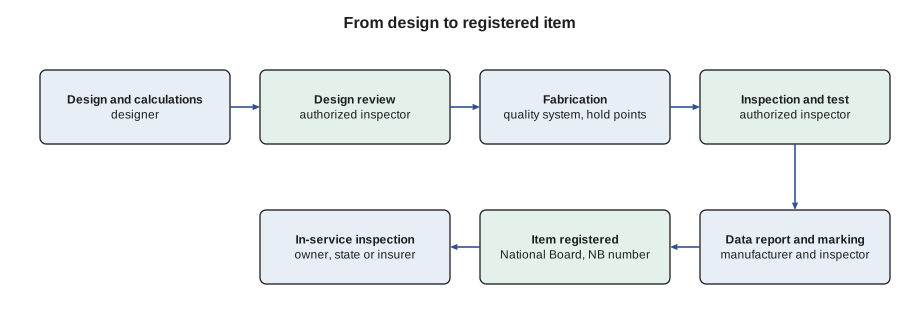
The National Board of Boiler and Pressure Vessel Inspectors was founded in 1919 by the chief inspectors of the states and cities that had boiler laws, so that a boiler built and inspected in one state could be accepted in another. Its members are still the chief inspectors of the jurisdictions. It writes and publishes the NBIC, commissions inspectors after examination, accredits organizations for repairs and alterations with the R certificate and for safety valve repair, accredits the authorized inspection agencies that employ inspectors, and keeps a registry of data reports.
An inspector who wants to inspect ASME work must hold a National Board commission, which is earned by examination and experience and is backed by employment with an authorized inspection agency. Most authorized inspection agencies are insurance companies that insure boilers and pressure vessels, which is why an insurer's inspector may be the one who signs a new vessel's data report in the shop and later inspects it in service. Grant Mahler, who signs Ironbridge's work, is employed by such an insurer and holds a National Board commission.
National Board registration
When a vessel is complete and its data report has been signed by the manufacturer and the inspector, the manufacturer can register it with the National Board. The vessel is then given a National Board number, stamped on its nameplate with the letters NB, and the data report is kept in the National Board's registry. Years later, when a repair organization needs to know how the vessel was built, it can ask the National Board for a copy of the data report. Many jurisdictions require National Board registration for boilers and vessels installed within them, and many owners require it whether or not the jurisdiction does.
A National Board number is an item number, not a design number. V-412 and V-414 are built to the same design but each has its own serial number, its own data report and its own National Board number. In service, the owner usually adds its own equipment tag, so that the nameplate, the drawings, the inspection records and the maintenance system can all be tied together.
Who needs to see what
For a new vessel, the inspector reviews the design calculations at the start of the job, examines the work at hold points set in the shop's quality control system, witnesses the hydrostatic test and signs the data report. For a repair or alteration, the inspector accepts the repair plan before work starts, examines the work and signs the repair or alteration report. The jurisdiction, in states that regulate the item, issues a certificate to operate after an inspection and keeps the record of inspections. The owner keeps everything: the data report, drawings, calculations, repair reports and inspection records, for the life of the item.
Worked problem
Checking V-414's documentation package
Before V-414 ships, Kiera checks its documentation package against the list of what the inspector and the owner need.
Show solution
- List what the package contains.
- List what it must contain.
- Report anything missing before it goes.
Answer: The program finds two gaps: there is no nameplate rubbing or photograph in the package, and the partial data reports for the purchased heads are missing. Both must be added before the data report is registered.
# Data report and registration package for V-414 before the inspector signs (illustrative checklist)
package = ["U-1A data report", "drawings", "design calculations", "material test reports", "WPS and PQR list", "NDE reports", "hydrostatic test record"]
needed = ["U-1A data report", "drawings", "design calculations", "material test reports", "WPS and PQR list", "NDE reports", "hydrostatic test record", "nameplate rubbing or photo", "partial data reports for the heads"]
missing = [d for d in needed if d not in package]
for d in needed:
    print(("  [x] " if d in package else "  [ ] ") + d)
print("package complete" if not missing else f"{len(missing)} item(s) missing: " + ", ".join(missing))[x] U-1A data report [x] drawings [x] design calculations [x] material test reports [x] WPS and PQR list [x] NDE reports [x] hydrostatic test record [ ] nameplate rubbing or photo [ ] partial data reports for the heads 2 item(s) missing: nameplate rubbing or photo, partial data reports for the heads
Kiera's check is a small part of the job, but it is the kind of work that keeps a vessel moving. A package that goes out incomplete comes back weeks later with a letter listing what is missing, and the vessel sits in the yard in the meantime. Harjit's rule is that nothing leaves quality control until it has been checked against the list twice, once by the person who assembled it and once by somebody else.
Certificates to operate
In jurisdictions that regulate an item, the owner must register it with the state when it is installed and keep a current certificate to operate, issued after an inspection. For a power boiler, the certificate is usually renewed each year after the certificate inspection; for a heating boiler, less often. The certificate is posted near the boiler, and an inspector who finds a boiler running without one can order it shut down. Items that the state does not regulate are still tracked by the owner's own program, using the National Board number, the serial number and the owner's tag.
When equipment moves between jurisdictions, the new jurisdiction decides whether to accept it. A vessel built to the ASME code and registered with the National Board is usually accepted in another state, because both states rely on the same code and the same registry, which is the reason the National Board was founded. An item without a National Board number may need special acceptance, and an item without a data report may not be accepted at all.
Other jurisdictions, other rules
Ironbridge's Port Allen shop also builds for customers in Texas, Mississippi and other states. Each jurisdiction has its own rules on which items it regulates, which code editions it accepts, whether it requires National Board registration and who may inspect. A few large cities have their own programs inside their states. Before quoting, Harjit checks the rules where the item will be installed, the owner's specification and the insurer's requirements, because the strictest of the three usually decides what the shop has to do.
| Item | Who decides |
|---|---|
| Which items the state regulates | The state law and rules |
| Code edition accepted | The jurisdiction's adoption |
| National Board registration | The jurisdiction, the owner and the insurer |
| Inspection in service | The state inspector or the insurer's inspector |
Kiera asks what happens if a design is changed after it is registered. Harjit's answer is simple: any change that affects the design, whether a new nozzle, a different material, a thicker or thinner part or a new rating, goes back to the designer, is recalculated and is reviewed by the inspector before the change is built. Small drawing changes that do not affect the design, such as a corrected title block, are handled by the shop's own drawing control, and the quality control manual says which is which.
Why the system exists
Kiera's first reaction to the National Board system is that it duplicates the inspector's work. Harjit explains the difference. The inspector checks that the vessel was built to its design and signs for it; the National Board registry makes sure that the record of what was built survives, in one place, for as long as the vessel exists, whoever owns it and wherever it goes. A repair organization working on a forty-year-old vessel in another state can get the original data report from the registry in a day, which tells it the materials, thicknesses, radiography and heat treatment before it plans a single weld.
Registration also protects the owner. When Northgate buys a used vessel from another plant, the first thing Ruth checks is its National Board number and data report. A vessel with both can be accepted at a new site with ordinary paperwork; one without them may need a full engineering assessment before it can be used, and sometimes it cannot be used at all.
Harjit ends the evening with a question for the class: if the paperwork for a vessel is lost, what is left that proves the vessel is safe? The answer, after some silence, is the nameplate, which is why lesson 11 spends so much time on it.
Where boilermakers meet registration
Registration sounds like office work, and most of it is, but it reaches the shop floor in small ways every day. The drawing a fitter works from must be the revision that was reviewed, and the drawing control stamp on it says so. A nozzle cannot be moved, a pad cannot be enlarged and a plate thickness cannot be changed without the change going back through the inspector, so a fitter who sees a clash between a nozzle and a support stops and asks rather than shifting the nozzle a few millimeters. Valves, flanges and fittings arriving for a job are checked for their markings and certification as well as their heat numbers, and the receiving inspector holds any that cannot be matched.
In the field the same thing happens in reverse. When a crew is asked to install a vessel, a valve or a fitting that came from somewhere unusual, such as a surplus yard or another plant, the first question is whether it is registered and acceptable to the jurisdiction and the owner. Kiera has already seen a lead hand refuse to install a used relief valve until its paperwork turned up, and in the code block she finds out why he was right.
Common mistakes
MistakeStarting a vessel without confirming the jurisdiction's rules for it.
InsteadCheck what the state and the owner require before work starts.
MistakeTreating the National Board number as a design number.
InsteadThe NB number identifies one item; vessels built to the same design have different numbers.
MistakeAssuming an exempt state means no paperwork.
InsteadThe owner, insurer or specification may still require stamping and registration.
MistakeSending out a package without a second check.
InsteadCheck every package against its list, twice.
Summary and key terms
- US jurisdictions adopt ASME for construction and the NBIC for repair and in-service work.
- The National Board, made up of the chief inspectors, commissions inspectors and accredits repair organizations.
- Completed items can be registered with the National Board and given an NB number.
- Most authorized inspection agencies are insurers, and their inspectors hold National Board commissions.
- The owner keeps the data report and all records for the item's life.
- Packages are checked against their lists before they leave quality control.
- Jurisdiction
- A state or city that regulates boilers and pressure vessels.
- Chief inspector
- The official who runs a jurisdiction's boiler and pressure vessel program.
- National Board
- The organization of chief inspectors that publishes the NBIC and commissions inspectors.
- Authorized inspection agency
- An organization, usually an insurer, accredited to employ inspectors for code work.
- NB number
- The National Board registration number of a completed item.
- R certificate
- National Board accreditation to make repairs and alterations.
Practice problems
Work each problem on paper first, then reveal the answer to check.
Who sets the rules for whether a vessel in a given state must be inspected by the state?
Show answer
The jurisdiction, through its law and rules.
Two vessels are built to the same design. Do they have the same NB number?
Show answer
No; each completed item has its own National Board number.
Who usually employs the inspector who signs a new vessel's data report?
Show answer
An authorized inspection agency, usually an insurance company.
Why check a package twice before it leaves?
Show answer
Because an incomplete package comes back weeks later and holds up the job.
Lesson quiz · 5 questions
Score 60% or more to complete this lesson.
Create a free account to save your progress, take quizzes and earn a certificate.