
BLR-130 · Lesson 7 of 12 · 20 min
Rolled shells: circumference, rolling and seam allowances
The shell of a vessel, a stack or a tank is made of plates rolled into cylinders and joined by long seams along their length and circumferential seams between courses. A shell course that comes out of the rolls the wrong length will not close: if the plate is too long, the long seam overlaps; if it is too short, the root opening is too wide to weld, or the course is undersize and the next course will not fit it. Getting the cut length right is the layout hand's most important calculation on a vessel, and this lesson covers how it is done, how plates are rolled, and how the courses are arranged.
The neutral axis and the mean diameter
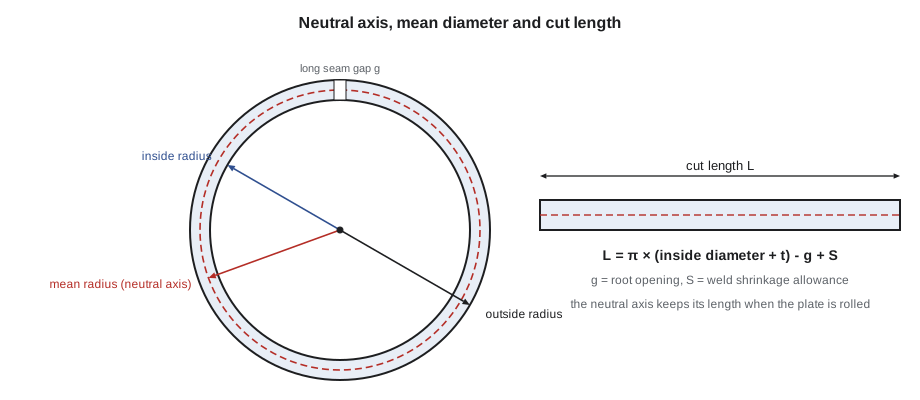
When a plate is bent into a cylinder, its outside surface stretches and its inside surface is compressed. Somewhere between them is a surface that neither stretches nor compresses, called the neutral axis. For plate rolled into a cylinder of reasonable size, the neutral axis lies very close to the middle of the thickness. Its length does not change in rolling, so the flat plate's length equals the circumference of the cylinder measured at mid-thickness. That circumference is π times the mean diameter, which is the inside diameter plus one plate thickness, or the outside diameter minus one thickness.
Using the wrong diameter is a classic mistake. If a layout hand calculates the plate length from the inside diameter, the plate is short by π times the thickness; from the outside diameter, it is long by the same amount. For a 5/8 in plate, that is about 2 in either way, far more than any fit-up can absorb.
From circumference to cut length
The mean circumference is not quite the cut length. Two corrections apply. First, the long seam has a root opening, the gap the drawing calls for at the root of the groove weld, so the plate must be shorter than the circumference by that gap. Second, when the long seam is welded, the weld metal shrinks as it cools, pulling the plate edges together and reducing the circumference slightly. To finish at the right diameter, the plate must be cut a little longer to make up for the shrinkage. Lesson 11 shows how the shrinkage is estimated; for a single-V seam in plate of this thickness, it is about 3/32 in.
For V-412, the inside diameter is 72 in and the plate is 5/8 in, so the mean diameter is 72 5/8 in. The long seam has a 1/8 in root opening, and the shop allows 3/32 in for weld shrinkage. The plates are bought 240 in long, so Kiera also checks how many plates each course needs and how much crop is left.
# Shell course layout: from diameter to cut length (US units)
from math import pi, gcd
MODE = "in"

def frac(x, den=16):
    sign = "-" if x < 0 else ""
    n = round(abs(x) * den); whole, rem = divmod(n, den)
    if rem == 0:
        return f"{sign}{whole} in"
    g = gcd(rem, den)
    return f"{sign}{whole} {rem // g}/{den // g} in" if whole else f"{sign}{rem // g}/{den // g} in"

def show(x):
    return f"{x:,.1f} mm" if MODE == "mm" else f"{x:.3f} in ({frac(x)})"

ID, t = 72, 0.625          # inside diameter and plate thickness
gap = 0.125                # root opening of the long seam
shrink = 0.094             # transverse shrinkage of the long seam
Dm = ID + t                # mean diameter: the neutral axis does not stretch in rolling
C = pi * Dm
cut = C - gap + shrink
print("mean diameter", show(Dm))
print("mean circumference", show(C))
print("plate cut length", show(cut))
print("compare: on the inside", show(pi * ID), "and on the outside", show(pi * (ID + 2 * t)))

stock = 240            # length of plate available
n = int(-(-cut // stock))  # plates needed per course (round up)
print(f"plates per course from {show(stock)} stock: {n}; crop left over {show(n * stock - cut)}")

seams = [0, 120, 240]            # long seam position of each course, degrees from 0
for a, b in zip(seams, seams[1:]):
    sep = abs(a - b) % 360
    sep = min(sep, 360 - sep)
    arc = C * sep / 360
    print(f"seam offset {sep:.0f} deg = {show(arc)} around the shell; minimum 5t = {show(5 * t)}",
"OK" if arc >= 5 * t else "TOO CLOSE")mean diameter 72.625 in (72 5/8 in) mean circumference 228.158 in (228 3/16 in) plate cut length 228.127 in (228 1/8 in) compare: on the inside 226.195 in (226 3/16 in) and on the outside 230.122 in (230 1/8 in) plates per course from 240.000 in (240 in) stock: 1; crop left over 11.873 in (11 7/8 in) seam offset 120 deg = 76.053 in (76 1/16 in) around the shell; minimum 5t = 3.125 in (3 1/8 in) OK seam offset 120 deg = 76.053 in (76 1/16 in) around the shell; minimum 5t = 3.125 in (3 1/8 in) OK
The cut length is 228 1/8 in, against an inside circumference of 226 3/16 in and an outside circumference of 230 1/8 in, so the choice of diameter changes the answer by about 2 in each way. One plate makes each course, leaving a crop of about 11 7/8 in at one end, which goes into stock for clips and pads.
When a plate is not long enough to make a whole course, the course is made of two or more plates, each with its own long seam, and the circumference is shared among them, each plate's cut length being its share of the mean circumference less its root opening plus its shrinkage. Large tanks have many plates per course, and their layout is a matter of dividing the circumference evenly while keeping the vertical seams staggered.
How plates are rolled
Plate rolls come in three-roll and four-roll designs. In a three-roll pyramid machine, the plate passes between two lower rolls and is bent by the upper roll pressing down between them. A pyramid roll cannot bend the very ends of the plate, which come out flat for a length about half the distance between the lower rolls. Those flats must be removed, either by pre-bending the ends on a press brake before rolling or by cutting them off, which means cutting the plate longer and trimming after rolling. A three-roll double-pinch or initial-pinch machine and a four-roll machine pinch the plate's edge between two rolls and bend the end with a third, so the ends can be pre-bent in the rolls themselves, and the flat left at each end is very short.
Rolling is done in several passes, bringing the plate gradually to the radius, and the roll operator checks the curve with a template as it closes. The plate tends to spring back a little after each pass, and thicker, stronger plate springs back more, so the operator over-bends slightly and lets it relax. A plate that has been over-rolled, bent too tight, can be opened up in the rolls, but repeated bending works the steel and some specifications limit it.
Rolling also has limits set by the material. Cold forming stretches the outside fiber by about half the thickness divided by the radius; for V-412, that is under 1 percent, which is no concern. For thick plate rolled to a small radius, the strain can be large enough that the code requires heat treatment after forming, or the plate must be formed hot. The engineering office checks this, but a layout hand who sees thick plate going to a small radius should ask.
Peaking and flats at the long seam
Where the two ends of a rolled plate meet at the long seam, they should form a smooth circle. If the ends were not properly pre-bent, the seam has a flat or a ridge. A ridge pointing outward is called peaking; a flat or inward ridge is sometimes called banding or a flat spot. Peaking concentrates stress at the long seam, which is the most highly stressed seam in a cylinder under pressure, and purchasers' specifications often limit it, measured with a template spanning the seam. Lesson 11 shows the check. Prevention is in the rolling: the ends are pre-bent properly, and the seam is checked with the template before it is tacked.
Arranging the courses
A shell of several courses has a circumferential seam between each pair, and each course has its own long seam. The long seams of adjacent courses are offset around the circumference rather than lined up, so that the seams do not form a continuous line along the vessel and do not meet at a single four-way intersection. Codes require a minimum offset unless the intersection is examined; a common rule is at least five times the thickness of the thicker plate, and shops usually go much further. Purchasers may add their own rules: that long seams avoid nozzles, supports and clips, or that they sit in particular quadrants where they can be inspected.
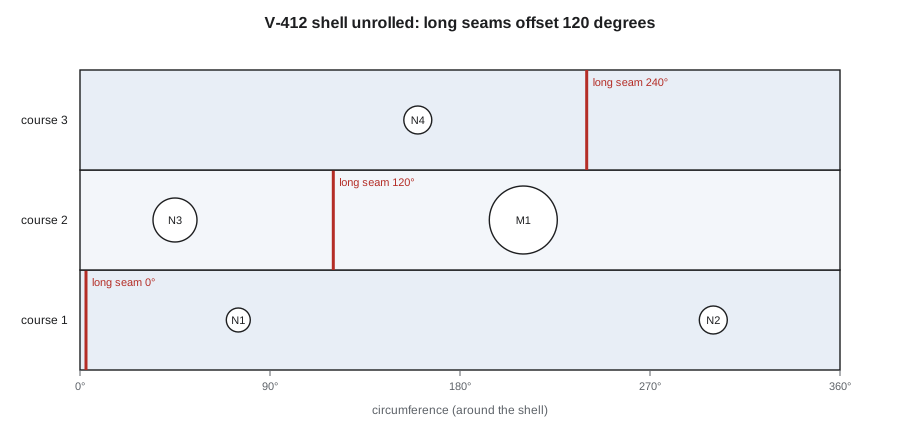
On V-412, the shop drawing places the long seams of the three courses at 0, 120 and 240 degrees, measured from the vessel's 0-degree reference. The offset between adjacent seams is about 76 in around the shell, many times the minimum. Before accepting the arrangement, Kiera checks the nozzle schedule: none of the nozzles or their reinforcing pads falls on a seam, and the manway in course 2 is a full quarter turn from that course's long seam.
Marking a rolled course
Once a course is rolled and its long seam is welded, it needs reference marks for fitting the next course and for laying out nozzles. The quarter lines, at 0, 90, 180 and 270 degrees, are transferred from the flat plate, where they were marked as arc lengths, and checked on the rolled course with a flexible tape around the outside. Because the outside circumference is larger than the mean, the quarter lines measured on the outside are each a quarter of the outside circumference apart. The layout hand marks them at both ends of the course, so that the next course's quarter lines can be matched to them at fit-up.
Worked problem
Cut length for a shell plate
A shell has an inside diameter of 96 in and is made of 3/4 in plate. The root opening is 1/8 in and the shrinkage allowance 3/32 in. What is the cut length for a one-plate course?
Show solution
- Mean diameter: 96 + 0.75 = 96.75 in.
- Mean circumference: π × 96.75 = 303.95 in.
- Cut length: 303.95 − 0.125 + 0.094 = 303.92 in.
Answer: About 303 15/16 in.
Rolling tank plates and cones of large radius
Tank shell plates are rolled to a much larger radius than vessel shells, 100 ft for Tank 14, and the challenge is the opposite one: the curve is so gentle that a plate can look flat. The plates are rolled in a few light passes and checked with a long template or with a straightedge and the calculated sagitta from lesson 5. Because each Tank 14 plate is only part of a course, the plate's cut length is its share of the course's circumference, measured at mid-thickness, less its share of the vertical seam gaps, and the plates are rolled to the radius rather than to a closed circle. On the ground, the rolled plates are stored on curved racks so that they do not flatten or twist under their own weight before erection.
Plates for small diameters and thick walls go the other way: they need large rolling forces and may need to be formed hot, which changes the layout, because hot-formed plate shrinks as it cools and the scale it forms is removed afterwards. These cases are planned by the engineering office, but a layout hand should recognize them and ask how much allowance to add.
Checking a rolled course
Once a course is closed and its long seam is welded, it is checked before it goes to the next fit. The diameters are measured at several cross sections; the circumference is measured with a tape around the outside and compared with the calculated outside circumference; the ends are checked for squareness to the axis by measuring the course height at the quarter lines; and the long seam is checked for peaking. A course whose circumference has come out a few millimeters small or large can usually still be fitted, with the difference spread around the circumferential seam, but a larger error means a new plate, which is why the cut length is checked by a second person before the plate is cut.
Common mistakes
MistakeCalculating the plate length from the inside or outside diameter.
InsteadUse the mean diameter, inside plus one thickness.
MistakeForgetting the root opening.
InsteadSubtract the root opening the drawing calls for.
MistakeIgnoring weld shrinkage on the long seam.
InsteadAdd the shrinkage allowance so the course finishes at size.
MistakeRolling a plate on a pyramid roll without pre-bending the ends.
InsteadPre-bend the ends or allow extra length and trim the flats.
MistakeLining up the long seams of adjacent courses.
InsteadOffset them by at least the code minimum, and keep them clear of nozzles.
Summary and key terms
- A rolled plate's length equals the circumference at its neutral axis, near mid-thickness.
- Mean diameter is inside diameter plus one thickness; mean circumference is π times it.
- Cut length is the mean circumference, less the root opening, plus the weld shrinkage allowance.
- Pyramid rolls leave flats at the plate ends; pinch and four-roll machines pre-bend them.
- Peaking at the long seam is prevented by proper pre-bending and checked with a template.
- Long seams in adjacent courses are offset and kept clear of nozzles and supports.
- Neutral axis
- The surface in a bent plate that neither stretches nor compresses.
- Mean diameter
- The diameter at mid-thickness of a shell.
- Cut length
- The length a plate is cut to before rolling.
- Pre-bending
- Forming the ends of a plate to the radius before or at the start of rolling.
- Peaking
- An outward ridge at the long seam of a rolled shell.
- Course
- One ring of a shell, made from one or more rolled plates.
Practice problems
Work each problem on paper first, then reveal the answer to check.
What is the mean circumference of a shell with 60 in inside diameter and 1/2 in plate?
Show answer
π × 60.5 = 190.07 in, about 190 1/16 in.
How much shorter is a plate cut from the inside circumference, for 1/2 in plate?
Show answer
π × 0.5 = about 1 9/16 in.
Why are long seams in adjacent courses offset?
Show answer
To avoid continuous seam lines and four-way intersections at highly stressed joints.
Why does a pyramid roll leave flats?
Show answer
It cannot bend the plate ends that lie outside its lower rolls.
Lesson quiz · 5 questions
Score 60% or more to complete this lesson.
Create a free account to save your progress, take quizzes and earn a certificate.