
BLR-120 · Lesson 2 of 12 · 20 min
Load weight and center of gravity of vessels and components
Every lift plan begins with two numbers: how much the load weighs and where its center of gravity is. Get either one wrong and everything that follows, from the choice of crane to the length of the slings, is built on a mistake. For the small loads in Kiera's core course, the weight came from a tag, a catalog or a quick calculation. The loads on the Northgate turnaround are different. A coker drum, a reboiler shell or an exchanger bundle is a one-off item with a weight that depends on plate thickness, nozzles, internals, insulation and whatever the process has left inside it. This lesson shows how a boilermaker builds up a vessel's weight and finds its center of gravity, and how to judge how far those numbers can be trusted.
Where weights come from
The best weight is a measured one. Some loads can be weighed directly: a vessel lifted at the fabricator's shop with a crane fitted with a load indicator, or a component weighed on a truck scale on the way to site. Many fabricators weigh large vessels before shipping and record the weight on the shipping documents. The next best source is the fabricator's weight calculation, which adds up every plate, nozzle and attachment from the shop drawings. After that come the vessel's general arrangement drawing, which usually states an empty weight, an operating weight and a test weight, and the nameplate, which on a pressure vessel may or may not give a weight.
For old equipment being removed, the weight is harder to know. The original drawings may be lost or out of date; the equipment may have been repaired, re-trayed or modified; and it will almost certainly contain something the drawing does not show. A coker drum that has been in service for twenty years has thinner walls in some places from corrosion, thicker ones in others from weld overlay repairs, and may carry several tons of coke stuck to its walls even after it has been cut out and steamed. An exchanger bundle may hold sludge and scale; a boiler tube panel may be full of water or ash. Dale's rule for removed equipment is simple: treat the drawing weight as a minimum, look inside if you can, and add a contingency that matches how little you know.
| Source | Confidence | Typical contingency used |
|---|---|---|
| Weighed on a calibrated scale or load cell | High | 0 to 3 percent |
| Fabricator's detailed weight calculation | Good | 3 to 5 percent |
| General arrangement drawing weight | Fair | 5 to 10 percent |
| Estimated from dimensions by the crew | Fair to poor | 10 percent or more, and a trial lift |
| Old equipment with residue or unknown repairs | Poor | 10 to 20 percent, inspection inside, trial lift with a load cell |
Contingency is not a fudge factor to make a lift look comfortable; it is an honest statement of uncertainty. The crane and the rigging must be chosen for the contingency weight, not the best guess.
Building up a vessel's weight
When no reliable weight is available, the crew builds one from the drawings, piece by piece, the same way the fabricator would. Each part of the vessel is a simple shape whose weight is its volume of steel multiplied by the density of steel, 490 lb/ft³.
For a cylindrical shell, the steel volume is the circumference times the length times the wall thickness, using the mean diameter for accuracy or the outside diameter for a slightly conservative answer. Heads are harder. A 2:1 ellipsoidal head, the most common shape on pressure vessels, has a surface area of about 1.084 times the square of the diameter; a hemispherical head has an area of half a sphere; cones and flat heads follow from their geometry. Nozzles, manways, flanges, skirts, saddles, internal trays, baffles, platforms clips and lifting lugs are added from the drawing or the fabricator's list, and refractory or insulation, if installed, is added by its own density.
| Material | Approximate density |
|---|---|
| Carbon and low-alloy steel | 490 lb/ft³ |
| Stainless steel | 495 to 500 lb/ft³ |
| Water | 62.4 lb/ft³ |
| Dense castable refractory | 125 to 150 lb/ft³ |
| Insulating castable | 30 to 75 lb/ft³ |
| Petroleum coke, loose | 45 to 55 lb/ft³ |
Center of gravity
The center of gravity is the point where the whole weight of the load can be considered to act. A freely suspended load always hangs with its center of gravity directly below the hook. If the hook is not above the center of gravity when the load leaves the ground, the load will swing or tilt until it is, and in doing so it changes the loads in the slings, may strike something and can shift the crane's radius. For a symmetrical object of uniform material the center of gravity is at its geometric center. For a vessel with a heavy cone at one end, thick nozzles at the other, and a skirt, it is somewhere else, and has to be calculated.
The calculation uses moments. Each part's weight is multiplied by the distance from a reference point, such as the base of the skirt, to that part's own center of gravity; the moments are added; and the total moment is divided by the total weight.
For a vertical vessel, the useful distance is the height above the base, because it decides where the trunnions and tailing lug must be and how the load shares between the main crane and the tail crane. For a horizontal vessel or an exchanger, the useful distances are along its length and across it, because they decide where the hook must be and how long each sling must be.
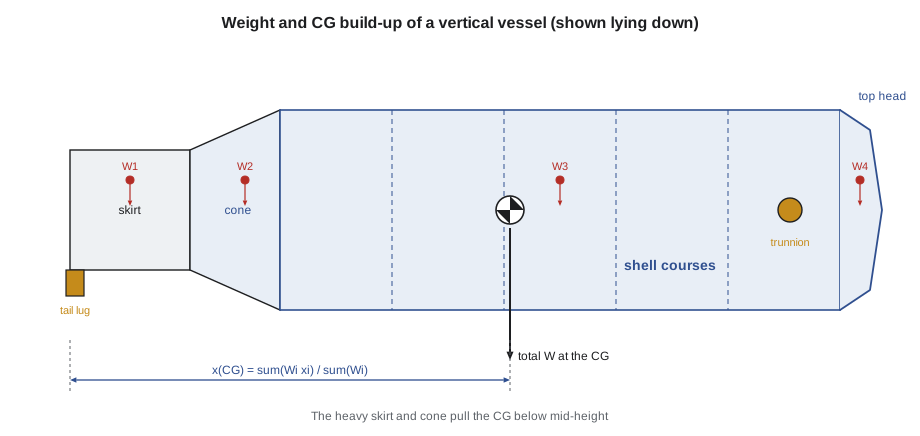
The Northgate coker drum
The new coker drum has been fabricated in sections, joined at the fabricator's yard and shipped to Northgate by road in one piece, arriving on a multi-axle trailer. The fabricator's weight report is on its way, but Wade wants his own check before the lift engineer finalizes the plan. He gives Kiera the general arrangement drawing and asks her to build up the weight and center of gravity. The drum is 28 ft in diameter, with a shell 88 ft long, a bottom cone 18 ft deep to the skirt, a 2:1 ellipsoidal top head and a skirt 20 ft tall. Its average wall is 1.25 in and the skirt is 1 in. The drawing lists nozzles, clips, the lifting trunnions and the tail lug at about 40,000 lb, and the top platform steel that will be pre-dressed on the drum before the lift at about 20,000 lb.
# Weight and center of gravity of the new coker drum (US units, illustrative)
import math
rho = 490                 # steel density
D, t = 28.0, 1.25 / 12             # shell outside diameter and average wall thickness
parts = []                  # (name, weight, height of its own CG above the skirt base)
skirt_h, cone_h, shell_h = 20.0, 18.0, 88.0
shell = math.pi * D * shell_h * t * rho
parts.append(("shell courses", shell, skirt_h + cone_h + shell_h / 2))
head = 1.084 * D ** 2 * t * rho                  # 2:1 ellipsoidal head, surface area 1.084 D^2
parts.append(("top head", head, skirt_h + cone_h + shell_h + D / 8))
cone = math.pi * (D / 2) * math.hypot(D / 2, cone_h) * t * 1.25 * rho   # thicker bottom cone
parts.append(("bottom cone", cone, skirt_h + cone_h * 2 / 3))
skirt = math.pi * D * skirt_h * 1.0 / 12 * rho
parts.append(("skirt", skirt, skirt_h / 2))
parts.append(("nozzles, clips, trunnions", 40_000, skirt_h + cone_h + shell_h * 0.8))
parts.append(("platform steel (pre-dressed)", 20_000, skirt_h + cone_h + shell_h + 1.0 * 3.3))
total = sum(w for _, w, _ in parts)
cg = sum(w * h for _, w, h in parts) / total
for name, w, h in parts:
    print(f"{name:<30} {w:9,.0f} lb   CG at {h:5.1f} ft")
print(f"{'total':<30} {total:9,.0f} lb")
print(f"overall height {skirt_h + cone_h + shell_h + D / 4:.1f} ft, center of gravity {cg:.1f} ft above the skirt base")
print(f"with a 3 % weight contingency for the lift plan: {total * 1.03:,.0f} lb")shell courses 395,108 lb CG at 82.0 ft top head 43,378 lb CG at 129.5 ft bottom cone 63,990 lb CG at 32.0 ft skirt 71,838 lb CG at 10.0 ft nozzles, clips, trunnions 40,000 lb CG at 108.4 ft platform steel (pre-dressed) 20,000 lb CG at 129.3 ft total 634,314 lb overall height 133.0 ft, center of gravity 75.2 ft above the skirt base with a 3 % weight contingency for the lift plan: 653,343 lb
Kiera's build-up gives 634,314 lb, against the fabricator's figure, when it arrives, of 641,000 lb. The difference is under 1 percent, which gives Wade confidence in both numbers. The lift plan uses the fabricator's weight plus a 3 percent contingency, because the drum is new and its records are good. The center of gravity sits about 75 ft above the skirt base, a little below mid-height, because the skirt and the thick bottom cone are heavy, even though the platform steel and nozzles add weight near the top.
The same build-up is done for the old drum, which comes out first, and there the answer is less certain. The old drum's walls have been weld overlaid in several areas over the years, and the inspector believes that a layer of hard coke remains on the upper walls after decoking. Wade adds a 15 percent contingency to the old drum's weight and plans a trial lift with a load cell under the main hook before the old drum is fully freed.
Contents, residues and things that move
Loads that contain liquids or loose solids have a second problem: the center of gravity can move during the lift. A vessel partly full of water will slosh when tilted, shifting its weight toward the low end and suddenly loading one sling more than the other. Coke, catalyst, sand or ash can slide. Even a bundle of tubes can shift inside a frame. The only good answer is to empty and clean the load before lifting it, and to confirm it is empty: open the drains, look inside, weigh it if possible. Where a load cannot be emptied completely, the lift plan treats the contents as a moving weight and checks the worst position.
Equipment removed from a plant may also hold residual hydrocarbons, hydrogen sulfide or pyrophoric scale. These are not just a weight problem; they are a hazard to the riggers who attach the slings and a fire hazard if cutting is planned nearby. The owner's decontamination and gas testing must be complete before the rigging crew approaches, and the hazards from the first course apply here as much as in a confined space.
Checking the center of gravity on the hook
However good the calculation, the first few centimeters of a lift tell the truth. A trial lift, sometimes called a test pick, raises the load just clear of its supports and holds it. The crew watches for tilt, for one sling tightening before another, for the crane's load indicator reading more than the plan, and for anything that moves inside the load. If the load tilts, the hook is not over the center of gravity. The load is set back down, the rigging adjusted, and the trial repeated. Lifting a tilting load higher in the hope it will settle is how slings are overloaded and loads are dropped.
Kiera will see this on the old drum. The trial lift shows a load cell reading 6 percent over the drawing weight, inside the contingency, and a slight tilt toward the bottom. Dale and Wade adjust the tail rigging, try again, and the drum hangs level.
Worked problem
Finding the center of gravity of an exchanger
An exchanger lies horizontally, 30 ft long. Its shell and tubes weigh 31,000 lb with their center at mid-length, the channel head at the left end weighs 7,700 lb with its center 2 ft from the left end, and the floating head cover at the right end weighs 3,300 lb with its center 1.3 ft from the right end. Where is the center of gravity?
Show solution
- Measure from the left end. Shell and tubes: 31,000 × 15 = 465,000 lb·ft.
- Channel head: 7,700 × 2 = 15,400 lb·ft.
- Floating head cover: 3,300 × 28.7 = 94,710 lb·ft.
- Total weight 42,000 lb; total moment 575,110 lb·ft.
- Center of gravity: 575,110 / 42,000 = 13.7 ft from the left end.
Answer: The center of gravity is about 1.3 ft left of mid-length, toward the heavy channel head. The hook must be over that point, so the slings will not be the same length.
Common mistakes
MistakeUsing the drawing weight for old equipment without allowing for residue, overlay and repairs.
InsteadTreat the drawing weight as a minimum; inspect, add contingency and weigh during a trial lift.
MistakeAssuming the center of gravity is at the middle.
InsteadCalculate it from the parts; heavy heads, cones and skirts move it.
MistakeLifting a load that tilts in the trial lift.
InsteadSet it down and adjust the rigging until it hangs as planned.
MistakeLifting a vessel with water or loose solids inside.
InsteadDrain, clean and confirm it is empty, or plan for the moving weight.
MistakeChoosing the crane for the best-guess weight.
InsteadChoose the crane and rigging for the weight with contingency.
Summary and key terms
- The best weight is measured; next come the fabricator's calculation, the drawing and the crew's own estimate.
- Old equipment usually weighs more than its drawing because of residue, overlay, repairs and contents.
- A weight build-up adds the steel in each part at 490 lb/ft³ plus nozzles, internals, refractory and attachments.
- The center of gravity is the weighted average of the parts' centers, found by adding moments and dividing by the total weight.
- A suspended load hangs with its center of gravity under the hook; if the hook is not there, the load tilts or swings.
- A trial lift checks the weight and center of gravity before the load is committed.
- Center of gravity
- The point at which the whole weight of an object can be considered to act.
- Contingency
- An allowance added to an estimated weight to cover uncertainty.
- Weight build-up
- An estimate of a load's weight made by adding the weights of its parts.
- Trial lift
- Lifting a load just clear of its supports to check its weight, balance and rigging before the full lift.
- Moment
- A weight multiplied by its distance from a reference point.
- Load cell
- A calibrated device placed in the rigging that measures the load directly.
Practice problems
Work each problem on paper first, then reveal the answer to check.
What is the steel weight of a cylindrical shell 10 ft in diameter, 33 ft long and 3/4 in thick?
Show answer
π × 10 × 33 × 0.0625 × 490 = 31,750 lb.
A load is made of a 20,000 lb part with its center 6 ft from a reference point and a 10,000 lb part with its center 24 ft away. Where is the center of gravity?
Show answer
(20,000 × 6 + 10,000 × 24) / 30,000 = 12 ft from the reference point.
Why does an old coker drum weigh more than its drawing?
Show answer
Weld overlay repairs, remaining coke and other residues, and attachments added over the years.
What should the crew do if the load tilts in the trial lift?
Show answer
Set it down and adjust the rigging so the hook is over the center of gravity.
Lesson quiz · 5 questions
Score 60% or more to complete this lesson.
Create a free account to save your progress, take quizzes and earn a certificate.