
BLR-120 · Lesson 7 of 12 · 20 min
Tandem lifts and tailing vessels
The new coker drum arrives at Northgate lying on its side on a multi-axle trailer. It will stand upright on its foundation in the coker structure. Getting it from horizontal to vertical, a process called upending, takes two cranes working together: the main crane lifts the top of the drum by its trunnions while a tail crane holds the bottom by the tail lug, keeping the skirt off the ground until the drum hangs vertically from the main crane alone. Any lift with two cranes on one load is a tandem lift, and tandem lifts are among the most demanding in rigging, because neither crane can be operated as if it were alone. This lesson covers how a load is shared between two cranes, how upending works, and the rules that keep tandem lifts under control.
Why two cranes are harder than one
A crane alone lifting a load sees exactly the load on its hook. Two cranes sharing a load see whatever share the geometry and their motions give them, and that share can change during the lift. If one crane hoists faster than the other, the load tilts and more of it shifts onto the lower crane. If one crane swings or booms out, its line goes out of vertical and pulls sideways on the other. If the load's center of gravity is not where it was assumed, the shares are wrong from the start. Each crane's operator can see only his or her own load indicator, and the two indicators together must stay within both cranes' charts at every moment.
For these reasons, tandem lifts are critical lifts under nearly every owner's procedure, and most require each crane to work at a lower percentage of its chart than a single-crane lift would allow, to leave room for shifts in load. Common limits are 75 to 85 percent of chart for each crane. OSHA's 1926.1432 requires a plan developed by a qualified person for any lift where more than one crane supports the load, with engineering expertise where the qualified person decides it is needed, a lift director who reviews the plan with everyone involved, and the lift carried out under that director's control.
Load share between two cranes
For a load carried horizontally by two cranes with vertical hook lines, the share follows the same moment rule as two slings: each crane carries the part of the weight given by the distance from the other crane's lifting point to the center of gravity, divided by the distance between the lifting points. A crane lifting near the center of gravity carries more. If the hook lines are not vertical, each line also pulls sideways, and the vertical shares change; tandem lifts are therefore planned with both lines vertical, and the riggers and signal person watch the lines throughout.
The load share also changes if the load tilts. When one end of a horizontal load is raised higher than the other, the horizontal distances from the lifting points to the center of gravity change, and if the lifting points are above or below the center of gravity, the share shifts toward the lower crane. A load with its lifting points well above its center of gravity is stable and shifts little; a load lifted from points at or below its center of gravity can shift sharply. That is one reason the trial lift is held level and the cranes hoist in small, coordinated steps.
Upending a vertical vessel
Upending begins with the vessel lying horizontal, supported on saddles or on its trailer. The main crane is rigged to the top trunnions, usually through a lifting beam, and the tail crane to the tail lug at the base. Both cranes take up the load together and lift the vessel clear of its supports, level. Then the main crane hoists while the tail crane holds its hook height or lowers slowly, and the vessel rotates around its trunnions toward vertical. As it rotates, the tail crane moves toward the main crane, by traveling, booming or swinging, so that its hook line stays vertical. When the vessel hangs vertically, all the weight is on the main crane, the tail crane's rigging goes slack and is removed, and the main crane carries the vessel to its foundation alone.
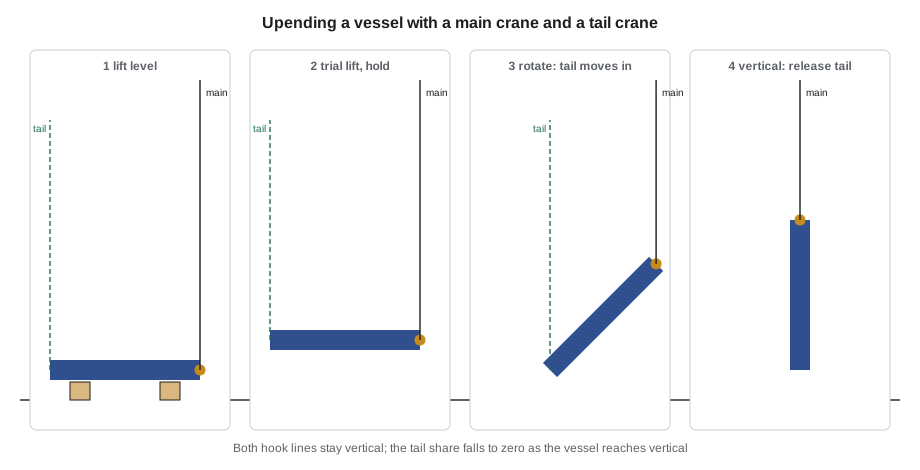
The tail crane's load during upending depends on where the center of gravity lies between the trunnions and the tail lug, and on how the lug sits relative to the vessel's axis. With the trunnions on the axis at the top and the tail lug at the base, the tail crane's share at the start is the distance from the trunnions to the center of gravity, divided by the distance from the trunnions to the tail lug. A drum whose center of gravity is low, near the base, puts a large share on the tail crane. As the vessel rises, the tail share falls, slowly at first and then quickly near vertical, until it reaches zero.
Here x is the distance along the vessel from the trunnions to the center of gravity, L is the distance from the trunnions to the tail lug, e is the tail lug's offset from the vessel's axis, and θ is the angle of the vessel above horizontal. Lift engineers produce an upending table from the drawings that gives both cranes' loads, radii and boom angles at each step, and the operators and lift director follow it.
For the coker drum, the trunnions are 118.7 ft from the tail lug along the drum's axis, and the center of gravity is 44.5 ft from the trunnions. The tail lug sits on the skirt's base ring, 15 ft off the axis on the side away from the main crane.
# Tailing crane load while upending a vertical vessel (US units)
import math
W = 634_300          # vessel weight (lb)
Lt = 118.7        # distance along the vessel from the top trunnions to the tail lug (ft)
xcg = 44.5      # distance along the vessel from the top trunnions to the CG (ft)
e = 15.0          # tail lug offset from the vessel axis, on the side away from the lift crane (ft)
print(f"vessel {W:,} lb, CG {xcg} ft and tail lug {Lt} ft from the trunnions")
print(" angle   tail crane   lift crane   tail share")
for ang in (0, 15, 30, 45, 60, 75, 85, 90):
    a = math.radians(ang)
    # both hook lines vertical: moments about the trunnions
    x_cg = xcg * math.cos(a)
    x_tail = Lt * math.cos(a) + e * math.sin(a)
    tail = W * x_cg / x_tail
print(f"{ang:4d} deg {tail:10,.0f} {W - tail:11,.0f} {100 * tail / W:6.1f} %")vessel 634,300 lb, CG 44.5 ft and tail lug 118.7 ft from the trunnions angle tail crane lift crane tail share 0 deg 237,796 396,504 37.5 % 15 deg 230,008 404,292 36.3 % 30 deg 221,626 412,674 34.9 % 45 deg 211,117 423,183 33.3 % 60 deg 195,094 439,206 30.8 % 75 deg 161,588 472,712 25.5 % 85 deg 97,282 537,018 15.3 % 90 deg 0 634,300 0.0 %
At the start of the upending, the tail crane carries 237,800 lb, about 37 percent of the drum's weight, and the main crane 396,500 lb. By 60 degrees the tail share has fallen to 31 percent, by 85 degrees to 15 percent, and at vertical to nothing. The main crane's load grows from 396,500 lb to the full 634,300 lb as the drum rises, so the main crane must be checked at the full weight at the radius where the drum becomes vertical, and the tail crane at its largest share, at the start, at the radius where it picks.
Tailing methods
Not every vessel is tailed with a crane. Smaller vessels can be tailed with a tailing frame or a tail dolly: a wheeled or skidded frame under the base that rolls toward the main crane as the top is raised, keeping the base on the ground. The vessel's base and skirt must be strong enough to carry the load on the dolly, and the ground or track under the dolly must be smooth and level. Very tall, light vessels such as columns and stacks are sometimes upended with the base hinged at its foundation, on a tailing hinge, and the top lifted by one crane; the hinge carries the base and the vessel rotates about it. Each method has its own engineering, and the vessel must be designed for the loads it will see during upending, which can be higher in places than any load it sees in service.
| Method | How the base is supported | Typical use |
|---|---|---|
| Tail crane | Second crane on the tail lug | Heavy vessels and drums, congested sites |
| Tail dolly or tailing frame | Wheeled or skidded frame rolling toward the main crane | Medium vessels on good level ground |
| Tailing hinge at the foundation | Base pinned to a hinge on the foundation | Tall, light columns and stacks |
| Tilt with jacks or gantry | Base supported while the top is raised in steps | Where no crane can reach |
Rules for tandem lifts
Northgate's procedure for tandem lifts reflects the hazards above, and Wade goes through it with the crew before the drum lift.
- One lift director controls both cranes; each operator responds only to the designated signal person for that lift.
- Each crane works within the percentage of chart set in the plan: for the coker drum, 85 percent for the main crane and 75 percent for the tail crane.
- Both hook lines are kept vertical; a rigger at each crane watches the line and reports any lean.
- The cranes hoist, lower, swing and travel in small, separate steps, one crane moving at a time unless the plan calls for both, and the load indicators are read out after each step.
- The plan gives each crane's load, radius and boom angle at each step of the upending table, and any departure from the table stops the lift.
- The tail crane's rigging is released only when the main crane carries the full weight, confirmed by the main crane's load indicator.
- The exclusion zone covers both cranes and the whole swing path of the load.
Kiera's role on the day will be on the tail crane's tagline and as a second set of eyes on the tail line. Dale tells her that on a tandem lift the most important thing a hand can say is that a line is not vertical.
Load indicators and load cells
On a tandem lift, each crane's rated capacity limiter shows that crane's load, but the reading includes the hook block and rigging and has a tolerance. For heavy and critical tandem lifts, a calibrated load cell is often put in the rigging under one or both hooks, giving a direct reading of the load on each line. The readings are compared with the upending table at each step. If the tail crane reads more than the table predicts, the center of gravity is probably farther from the trunnions than assumed, and the lift stops for a review.
Worked problem
Load share for a horizontal tandem lift
Two cranes carry a horizontal exchanger weighing 106,000 lb. Crane A is attached 6.5 ft from the center of gravity and crane B 13 ft from it, with both lines vertical. What does each crane carry, and what happens if the center of gravity is actually 1.6 ft closer to crane B?
Show solution
- Crane A: 106,000 × 13 / 19.5 = 70,700 lb.
- Crane B: 106,000 × 6.5 / 19.5 = 35,300 lb.
- If the center of gravity is 1.6 ft closer to B, A is 8.1 ft away and B 11.4 ft.
- Then crane A carries 106,000 × 11.4 / 19.5 = 62,000 lb and crane B 44,000 lb.
Answer: A shift of the center of gravity by 1.6 ft moves 8,700 lb from crane A to crane B, a 25 percent increase in B's load. Tandem plans allow for such errors with lower chart limits.
Common mistakes
MistakePlanning a tandem lift as two single lifts.
InsteadPlan the shares, the motions and the limits together, under one lift director.
MistakeLetting a hook line lean during upending.
InsteadKeep both lines vertical; the tail crane moves toward the main crane as the vessel rises.
MistakeChecking the main crane only at the start of upending.
InsteadThe main crane carries the full weight at vertical; check it at that radius.
MistakeReleasing the tail rigging before the main crane carries the full load.
InsteadConfirm the full load on the main crane's indicator first.
MistakeMoving both cranes at once without a plan.
InsteadMove in small, separate steps and read out the loads after each.
Summary and key terms
- A tandem lift uses two cranes on one load; the shares change with geometry, motions and the true center of gravity.
- Tandem lifts are critical lifts with reduced chart limits, one lift director and one signal person per lift.
- For a horizontal load with vertical lines, each crane's share follows the moment rule.
- In upending, the tail crane's share starts at its largest and falls to zero as the vessel reaches vertical, while the main crane's load grows to the full weight.
- Tail dollies, tailing frames and hinges are alternatives to a tail crane, each with its own engineering.
- An upending table gives both cranes' loads and positions at each step; load cells confirm them.
- Tandem lift
- A lift in which two cranes support the same load.
- Upending
- Rotating a vessel from horizontal to vertical during a lift.
- Tail crane
- The crane that supports the base of a vessel during upending.
- Tail dolly
- A wheeled or skidded frame that supports a vessel's base and rolls toward the main crane during upending.
- Upending table
- A table from the lift engineer giving both cranes' loads, radii and boom angles at each step of an upending.
- Load share
- The part of a load's weight carried by each crane or lifting point.
Practice problems
Work each problem on paper first, then reveal the answer to check.
A 132,000 lb load is carried by two cranes, with A 10 ft and B 6 ft from the center of gravity. What does each carry?
Show answer
A: 132,000 × 6 / 16 = 49,500 lb; B: 132,000 × 10 / 16 = 82,500 lb.
At what stage of upending does the tail crane carry its largest load?
Show answer
At the start, with the vessel horizontal.
Why does the tail crane move toward the main crane during upending?
Show answer
To keep its hook line vertical as the vessel's base swings in.
When may the tail rigging be released?
Show answer
When the main crane's indicator confirms it carries the full weight.
Lesson quiz · 5 questions
Score 60% or more to complete this lesson.
Create a free account to save your progress, take quizzes and earn a certificate.