
BLR-120 · Lesson 10 of 12 · 20 min
Signals, radios and lift communication
On a heavy lift, the crane operator is often the person who can see the least. From the cab of the main crawler at Northgate, the operator, Gord Elliott, will see the coker drum leave the trailer, but once it rises above the coker structure and is lowered onto its foundation, the drum's base and the anchor bolts will be hidden behind steel, more than 200 ft away and several decks down. Every motion of the crane at that point will be made on the word of a signal person who can see what Gord cannot. This lesson covers how that communication works: hand signals, radio procedure, the signal person's role, and two outside conditions the whole team must watch and talk about during any lift, the wind and overhead power lines.
One voice
The basic rule of lift communication is that the operator takes signals from one designated signal person at a time, and from nobody else, with one exception: anyone can give the emergency stop, and the operator must obey it. The rule prevents the most dangerous kind of confusion, two people giving different signals to the same crane at once. When the lift passes from one signal person to another, for example from a rigger at the pick to a rigger on the coker deck at the set, the handover is made clearly, by radio, with both signal persons and the operator confirming it.
OSHA's crane rules require a signal person whenever the operator cannot see the load or its path, or the load's landing area, or when the operator or the person handling the load decides one is needed. Under 1926.1428 the signal person must be qualified, by a third-party evaluator or the employer's own qualified evaluator, and must know the standard signals, the crane's basic operations and the rules for power lines. Northgate requires the signal person's qualification documentation to be on site and the signal person to be named on the lift plan.
Hand signals
Hand signals for cranes follow a standard set used across North America, published in ASME B30.5 and shown in the crane rules, with signals for hoist, lower, boom up and down, swing, stop, emergency stop, extend and retract the boom, travel and dog everything, which means stop all motions and hold. Signals are given clearly, from a position where the operator can see the signal person and the signal person can see the load, and they are continuous: the operator moves the crane only while the signal is being given, and stops when it stops. Unclear signals are not followed; the operator stops and asks.
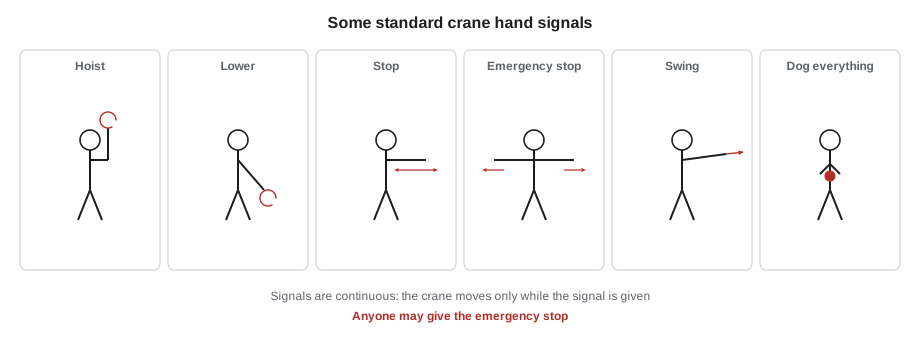
Hand signals have limits. They need line of sight, so they fail when the operator is far away, when the load passes behind structure or when the signal person is in shadow or glare. They are hard to see at night without lighting, and impossible in fog or heavy snow. On heavy industrial lifts, radio is the main means of signaling, and hand signals are the backup.
Radio procedure
A radio-directed lift uses a dedicated channel, used for nothing else during the lift. The signal person speaks to the operator by name or crane number at the start of each instruction, gives the motion and the direction, and keeps talking during the motion, in a steady count or a running commentary, so that the operator knows the radio is working. If the operator stops hearing the signal person, the operator stops the crane. Silence means stop.
Instructions are short and use agreed words: hoist, lower, swing left or right as seen by the operator, boom up, boom down, travel forward, stop, all stop. Distances are given in the same units throughout the lift. The signal person tells the operator what is happening as well as what to do, such as that the load is clearing the rack or that the tagline is tight, because a good operator uses that information to anticipate the next motion.
At Northgate, the radio plan for the coker drum lift sets three channels: one for the lift itself, used only by the lift director, the two operators and the two signal persons; one for the riggers and taglines; and the plant's own channel for the operators in the control room, monitored by Corinne Masse. Radios are checked at the pre-lift meeting, and spare batteries are kept at each crane.
| Phase | Who signals the main crane | Means |
|---|---|---|
| Pick from the trailer, tandem lift | Signal person at ground level, in view of both cranes | Radio, hand signals as backup |
| Upending | Same signal person, with readings called by riggers at each crane | Radio |
| Swing to the structure | Same signal person, watching the swing path and the exclusion zone | Radio |
| Set on the foundation | Signal person on the coker deck, after a confirmed handover | Radio only; the operator cannot see the set |
Wind
Wind affects a lift in two ways. It pushes on the crane's boom and on the load, adding a sideways force that the boom was not designed to carry in large amounts and that can swing the load or turn it on its slings. And it adds to the load moment when it blows from behind the crane, pushing the load and boom outward. Crane makers set maximum wind speeds for each configuration, often lower for long booms and for loads with a large area exposed to the wind, and many charts include a method for reducing the allowable wind speed for loads with a large sail area. The wind speed that counts is at the boom tip, which can be much higher than at the ground.
Large, light loads are the most vulnerable. A coker drum is heavy, but it is also a cylinder more than 130 ft long and 28 ft across, presenting a very large area when lifted side-on. The wind force on it is small compared with its weight, but large compared with what the boom can resist sideways and with what taglines can hold.
Wind pressure grows with the square of the wind speed, so doubling the wind speed quadruples the force. Wade has Kiera estimate the wind force on the drum side-on, using a projected area of 3,724 ft² and a drag coefficient of 1.2.
# Wind on a large load (US units; simplified, the crane maker's wind rules govern)
area = 3_724          # projected area of the drum facing the wind (ft2)
Cd = 1.2            # drag coefficient for a cylinder side-on (rounded up)
W = 634_300             # load weight (lb)
for v in (10, 15, 20, 25, 30):
    q = 0.00256 * v ** 2                   # wind pressure
    F = q * area * Cd
    print(f"wind {v:3} mph: force on the load about {F:9,.0f} lb ({100 * F / (W * 1):4.1f} % of its weight)")
print(f"crane maker's limit for this configuration: 22 mph at the boom tip for this load; site stop rule: suspend the lift at 20 mph sustained or any gust over 25 mph")wind 10 mph: force on the load about 1,144 lb ( 0.2 % of its weight) wind 15 mph: force on the load about 2,574 lb ( 0.4 % of its weight) wind 20 mph: force on the load about 4,576 lb ( 0.7 % of its weight) wind 25 mph: force on the load about 7,150 lb ( 1.1 % of its weight) wind 30 mph: force on the load about 10,296 lb ( 1.6 % of its weight) crane maker's limit for this configuration: 22 mph at the boom tip for this load; site stop rule: suspend the lift at 20 mph sustained or any gust over 25 mph
At 20 mph the wind pushes on the drum with about 4,600 lb, the weight of a pickup truck, and at 30 mph more than double that. Those forces are under 2 percent of the drum's weight, but they act sideways on the load, at the end of a boom more than 200 ft long, and they can swing the drum against the structure. The crane maker's limit for this configuration, from the manual's wind chart for loads with a large sail area, is 22 mph at the boom tip, and the plan stops the lift at 20 mph sustained or any gust over 25 mph.
Wind is measured by an anemometer at the boom tip, read in the cab, and by a handheld anemometer at the lift. The lift is planned for a day with a good forecast, and the forecast is checked again on the morning of the lift. Any team member who notices the wind rising tells the lift director, and the lift director decides whether to continue, to land the load or to hold it in a safe position.
Overhead power lines
Contact between a crane and an overhead power line is one of the deadliest crane accidents, and most of the victims are not the operator but the riggers holding the load or a tagline, through whom the current reaches the ground. Power lines on industrial sites run along plant roads and to substations, and they are easy to forget when the attention is on the load.
OSHA's 1926.1408 requires the employer to identify any power lines within the crane's work zone and, for lines up to 350 kV, to keep the crane, load and rigging at least 20 ft away, or to have the utility confirm the voltage and use the minimum clearance distances in OSHA's Table A, which rise with voltage. For lines over 350 kV up to 1,000 kV the minimum is 50 ft, and above that the distance is set by the utility or a registered engineer. When a crane could come within 20 ft of a line, the rules require a planning meeting, an elevated warning line or barricade, and at least one further measure, such as a dedicated spotter, a proximity alarm or a range limiter. Before a crane works near a line, the line's owner is contacted to confirm the voltage, and if the work cannot keep the safe limit, the line is de-energized or other arrangements are made with its owner.
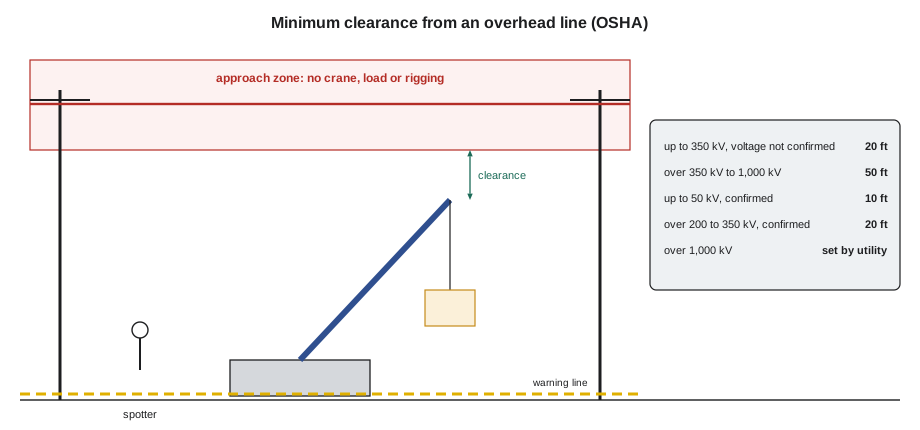
On the coker drum lift, the nearest line is a plant distribution line along the road to the laydown yard, well outside the crane's reach, but the main crane's travel route from its assembly area passes under it. The plan sets a travel route that keeps the boom lowered and clear of the line by more than the limit, with a spotter walking ahead.
Before, during and after
Communication on a lift begins at the pre-lift meeting and continues until the rigging is off. At the meeting, the lift director reviews the plan, names the signal persons and the handovers, confirms the radio channels and tests them, and asks everyone to repeat their role. During the lift, the signal person keeps up a running commentary and the riggers report what they see. After the lift, a short debrief records what went well and what did not, and the lessons go into the next plan.
Worked problem
Choosing the signaling method
A crane will set a valve on a deck inside a structure. The operator can see the pick but not the deck. The lift passes behind a column for part of the swing. How should signals be given?
Show solution
- The operator cannot see the landing, so a signal person is required.
- Hand signals will fail where the load passes behind the column, so radio is the main method.
- A dedicated channel is assigned, and the signal person is positioned to see the load and the landing.
- If a second signal person is needed at the deck, the handover is made clearly by radio and confirmed by the operator.
Answer: Radio on a dedicated channel, one signal person at a time, with hand signals as backup and a confirmed handover if a second signal person takes over.
Taglines
Taglines are ropes attached to the load so that workers on the ground can control its rotation and swing without touching it. They are part of the communication of a lift as much as its rigging: the tagline hands tell the signal person when the load is turning, and the signal person tells them when to hold or ease off. Taglines must be long enough to let the hands stay out from under the load and clear of pinch points, and they are never wrapped around a hand or body, because a load caught by the wind can pull a worker off a deck. Near power lines, taglines must be non-conductive and dry. On the coker drum lift, four tagline crews work from the ground during the swing and from the deck at the set, each with its own position marked in the plan.
Common mistakes
MistakeLetting several people give signals to the operator.
InsteadOne designated signal person at a time; anyone may give the emergency stop.
MistakeContinuing a radio-directed motion after the signal person goes quiet.
InsteadSilence means stop.
MistakeReading the wind at the ground and ignoring the boom tip.
InsteadWind at the boom tip is usually stronger; use the boom tip anemometer and the maker's limits.
MistakeAssuming a heavy load is unaffected by wind.
InsteadA large sail area puts large side loads on the boom and swings the load.
MistakeWorking near a power line without confirming its voltage and clearance.
InsteadContact the line's owner, keep the required distance and use a spotter.
Summary and key terms
- The operator takes signals from one designated signal person at a time; anyone can give the emergency stop.
- Standard hand signals are continuous and clear; unclear signals are not followed.
- Radio signaling uses a dedicated channel, a running commentary and the rule that silence means stop.
- Wind force grows with the square of the speed; large-area loads and long booms are most affected, and the crane maker's limits govern.
- OSHA requires 20 ft from lines up to 350 kV unless the voltage is confirmed, with larger distances above that.
- The pre-lift meeting sets the signal persons, handovers and channels; a debrief follows every lift.
- Signal person
- The designated person who directs the crane operator.
- Dog everything
- A signal meaning stop all motions and hold.
- Dedicated channel
- A radio channel used only for the lift.
- Sail area
- The area of a load or boom exposed to the wind.
- Anemometer
- An instrument that measures wind speed.
- Safe limit of approach
- The minimum distance that a crane, load or rigging must stay from an energized power line.
Practice problems
Work each problem on paper first, then reveal the answer to check.
The wind speed rises from 12 mph to 24 mph. By how much does the wind force on the load increase?
Show answer
By four times, because force grows with the square of the speed.
What minimum clearance does OSHA require from a power line of up to 350 kV if the voltage has not been confirmed?
Show answer
20 ft.
What should the operator do if the signal person's radio goes silent during a motion?
Show answer
Stop the crane.
Who may give an emergency stop signal?
Show answer
Anyone.
Lesson quiz · 5 questions
Score 60% or more to complete this lesson.
Create a free account to save your progress, take quizzes and earn a certificate.