
BIOL-321 · Lesson 11 of 12 · 27 min
Human evolution
Humans are one product of evolution among millions, but our own history attracts special interest, and it has been transformed in the past two decades by new fossils and by ancient DNA. This lesson reviews the hominin fossil record, the origin and spread of Homo sapiens, interbreeding with Neanderthals and Denisovans, and examples of recent human adaptation such as lactase persistence and skin pigmentation. It also explains why human genetic variation is mostly clinal and why race is not a biological category. BIOL-108 introduced the main hominin groups; here the emphasis is on evidence and genetic analysis.
Human origins are a sensitive subject for some people, including those who see a conflict between evolution and their religious beliefs. This course presents the scientific evidence and the conclusions that the scientific community draws from it, while respecting that students come to the topic from many backgrounds.
Our place among the apes
Humans are great apes. Genome comparisons show that our closest living relatives are chimpanzees and bonobos, which shared a common ancestor with us roughly 6 to 8 million years ago, followed by gorillas and then orangutans. On average, human and chimpanzee genomes differ by about 1.2 % in single-nucleotide substitutions across alignable sequence, with additional differences from insertions and deletions. About 15 % of the human genome is more closely related to the gorilla than to the chimpanzee in local gene trees, because ancestral variation was sorted incompletely during rapid speciation, an example of incomplete lineage sorting (Lesson 8).
Hominins are species more closely related to humans than to chimpanzees. Defining features in the fossil record include bipedalism, inferred from the position of the foramen magnum, the shape of the pelvis and the structure of the knee and foot, and reduced canine teeth. A large brain came much later than bipedalism.
The hominin fossil record
| Group or species | Approximate age (millions of years ago) | Key features and finds |
|---|---|---|
| Sahelanthropus tchadensis | about 7 | Chad; small brain; debated evidence of bipedalism |
| Ardipithecus ramidus | about 4.4 | Ethiopia; bipedal on the ground with a grasping big toe |
| Australopithecus afarensis | about 3.9 to 2.9 | “Lucy” (about 3.2 Ma); Laetoli footprints show bipedal walking 3.66 Ma |
| Paranthropus | about 2.7 to 1.2 | Robust jaws and teeth; a side branch |
| Early Homo (e.g. H. habilis) | about 2.4 to 1.5 | Larger brains; associated with stone tools |
| Homo erectus | about 1.9 to 0.1 | Human-like body proportions; first to leave Africa; Acheulean hand axes |
| Homo naledi | about 0.34 to 0.24 | South Africa; small brain at a late date |
| Homo floresiensis | about 0.1 to 0.06 (skeletal remains) | Flores, Indonesia; about 1 m tall |
| Neanderthals (H. neanderthalensis) | about 0.4 to 0.04 | Europe and western Asia; large brains; genomes sequenced |
| Denisovans | from about 0.2; date of disappearance uncertain | Known first from DNA; Harbin skull identified as Denisovan in 2025 |
| Homo sapiens | about 0.3 to present | Jebel Irhoud, Morocco, about 300,000 years ago |
The hominin tree is bushy, not a ladder: several hominin species often lived at the same time. Around 2 million years ago in East Africa, Paranthropus, early Homo and possibly late Australopithecus coexisted. Less than 100,000 years ago, Homo sapiens shared the planet with Neanderthals, Denisovans, H. floresiensis and possibly H. luzonensis in the Philippines. Stone tools are now known from 3.3 million years ago at Lomekwi in Kenya, earlier than the oldest known fossils of Homo, so tool use may have begun with australopiths.
Denisovans were first identified in 2010 from the genome of a finger bone found in Denisova Cave, Siberia, an extraordinary case of a hominin group known from DNA before its anatomy. Subsequent finds include a jaw from the Tibetan Plateau identified by ancient proteins. In June 2025, researchers led by Qiaomei Fu reported that the Harbin skull from northeastern China, at least 146,000 years old, was Denisovan, based on ancient proteins and mitochondrial DNA recovered from dental calculus, giving the first good picture of a Denisovan face and skull (reported in Science and Cell, June 2025; checked October 2026).
The origin and spread of Homo sapiens
Fossils and genetics agree that Homo sapiens originated in Africa. The Jebel Irhoud fossils in Morocco, dated to about 300,000 years ago, have a modern face combined with a more elongated braincase, suggesting that modern features accumulated gradually across Africa, perhaps among interconnected populations rather than in a single place. African populations today carry more genetic diversity than populations elsewhere, and diversity declines with distance from East Africa along likely migration routes, consistent with a series of founder events as small groups moved outward.
import numpy as np
rng = np.random.default_rng(321)
# Serial founder model: heterozygosity declines with each founder event (illustrative)
H0 = 0.78                 # heterozygosity of the source population (illustrative)
Nf = 600                  # effective founding size at each step
steps = 20
H = [H0]
for k in range(steps):
    # each founding event loses about 1/(2N) of heterozygosity, plus slight recovery by mutation is ignored
    H.append(H[-1] * (1 - 1/(2*Nf))**25)   # about 25 generations of small size per step
dist = np.arange(steps + 1) * 1250       # km per step along the route (illustrative)
for d, h in list(zip(dist, H))[::5]:
    print(f"distance {d:6d} km: expected heterozygosity {h:.3f}")
slope = np.polyfit(dist, H, 1)[0]
print(f"linear slope: {slope*1e4:.4f} per 10,000 km")distance 0 km: expected heterozygosity 0.780 distance 6250 km: expected heterozygosity 0.703 distance 12500 km: expected heterozygosity 0.633 distance 18750 km: expected heterozygosity 0.571 distance 25000 km: expected heterozygosity 0.514 linear slope: -0.1061 per 10,000 km
This simple model reproduces the observed pattern, studied by Sohini Ramachandran and colleagues in 2005: heterozygosity declines nearly linearly with geographic distance from East Africa. Genetic evidence indicates that the ancestors of most present-day non-Africans left Africa in a major dispersal roughly 60,000 to 50,000 years ago, although some earlier groups of H. sapiens reached the Levant and possibly beyond. Modern humans reached Australia by at least about 50,000 years ago and the Americas, by routes from northeastern Asia, by at least about 16,000 years ago and possibly earlier, as fossil footprints from White Sands, New Mexico, dated to about 23,000 to 21,000 years ago, suggest.
Interbreeding with archaic humans
In 2010, Svante Pääbo’s group published a draft Neanderthal genome and found that people outside Africa carry a small fraction of Neanderthal DNA, now estimated at about 1 to 2 %, while many African populations carry less, introduced in part by later back-migration. Pääbo received the 2022 Nobel Prize in Physiology or Medicine for this work. Melanesians and Aboriginal Australians carry several percent Denisovan ancestry, and East and South Asians carry smaller amounts. Genetic dating suggests that most Neanderthal admixture into the ancestors of non-Africans occurred around 47,000 years ago, over a period of several thousand years.
Introgression is detected with statistics such as Patterson’s D (the ABBA–BABA test). For an African genome H1, a non-African genome H2, a Neanderthal genome H3 and a chimpanzee outgroup, sites where H2 and H3 share a derived allele not found in H1 (ABBA) should be equally frequent as sites where H1 and H3 share one (BABA) under incomplete lineage sorting alone. An excess of ABBA sites indicates gene flow between H3 and H2.
import numpy as np
rng = np.random.default_rng(321)
# Invented counts of ABBA and BABA site patterns in 100 genomic blocks
abba = rng.poisson(110, 100)
baba = rng.poisson(100, 100)
D = (abba.sum() - baba.sum()) / (abba.sum() + baba.sum())
# Block jackknife standard error
n = len(abba); Dj = np.empty(n)
for i in range(n):
    a = abba.sum() - abba[i]; b = baba.sum() - baba[i]
    Dj[i] = (a - b) / (a + b)
se = np.sqrt((n - 1) / n * np.sum((Dj - Dj.mean())**2))
print(f"ABBA = {abba.sum()}, BABA = {baba.sum()}")
print(f"D = {D:.4f}, jackknife SE = {se:.4f}, Z = {D/se:.1f}")ABBA = 11032, BABA = 9936 D = 0.0523, jackknife SE = 0.0073, Z = 7.1
A Z-score above about 3 is usually taken as significant evidence of gene flow; the jackknife over large genomic blocks accounts for the fact that nearby sites are not independent. Real analyses of Neanderthal introgression give D values of a few percent with very high Z-scores. Some introgressed segments were favored by selection: a Denisovan-derived variant of EPAS1, a gene affecting the response to low oxygen, is common in Tibetans and helps adaptation to high altitude, and Neanderthal-derived variants affect immune genes and skin and hair traits. Other introgressed DNA was harmful and has been removed from gene-rich regions, especially on the X chromosome, suggesting some degree of incompatibility.
Recent human adaptation
Humans have continued to evolve since leaving Africa, as populations adapted to new diets, climates and diseases. Lactase persistence, the ability to digest lactose in adulthood, is the textbook example. In most mammals, including most humans, production of the enzyme lactase declines after weaning. In populations with a history of dairying, variants in an enhancer upstream of the lactase gene LCT, within the neighboring gene MCM6, keep lactase active. The −13910*T allele is common in northern Europe, while different variants, such as −14010*C, arose independently in East African pastoralist populations, a striking case of convergent evolution in humans. Ancient DNA shows that the European variant was rare until a few thousand years ago and then rose rapidly, implying strong selection, though why it was so strong is still debated.
import numpy as np
from scipy.optimize import brentq
# Estimate the selection coefficient needed for a dominant beneficial allele
# to rise from 1 % to 60 % in a given number of generations (deterministic model)
def freq_after(s, p0, gens):
    p = p0
    for _ in range(gens):
        q = 1 - p
        wbar = 1 + s*(p*p + 2*p*q)   # dominant: AA and Aa both have fitness 1 + s
        p = p*(1 + s) / wbar
    return p
for years in (4000, 6000, 8000):
    gens = years // 28
    s = brentq(lambda s: freq_after(s, 0.01, gens) - 0.60, 1e-4, 0.5)
print(f"{years} years ({gens} generations): s = {s:.3f}")4000 years (142 generations): s = 0.047 6000 years (214 generations): s = 0.031 8000 years (285 generations): s = 0.023
Selection coefficients of several percent per generation are among the strongest known in humans. Other examples of recent adaptation include high-altitude adaptation in Tibetans (EPAS1), Andeans and Ethiopian highlanders, each by different genetic routes; resistance to malaria through variants such as the sickle-cell allele and the Duffy-null allele (BIOL-201); and changes in genes involved in fat metabolism in Greenlandic Inuit (FADS).
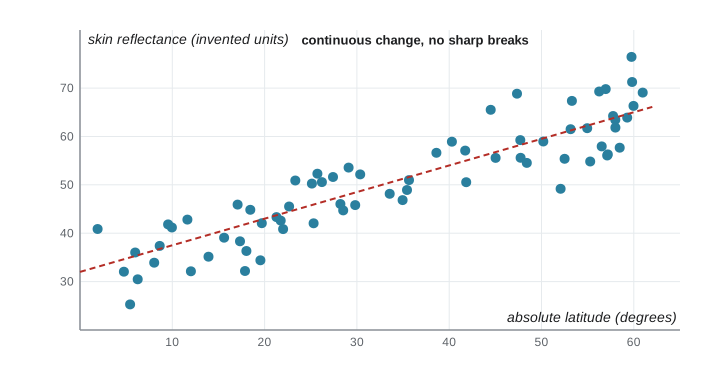
Skin pigmentation illustrates both adaptation and the clinal nature of human variation. Darker skin, rich in eumelanin, protects against ultraviolet radiation, which can damage skin and break down folate in the blood. Lighter skin allows more vitamin D synthesis where UV levels are low. Nina Jablonski and George Chaplin showed that skin reflectance is strongly correlated with UV intensity. Genes involved include SLC24A5 and SLC45A2, whose light-skin alleles rose to high frequency in Europe within the past several thousand years, and MC1R. Several genes contributing to light skin in Europeans and East Asians differ, so lighter skin evolved at least partly independently. And there is great diversity in pigmentation and its genetics within Africa, where both some of the darkest and some relatively light skin tones are found, including light-skin alleles at genes such as MFSD12 and OCA2 that are ancient and shared across populations.
Human variation is clinal, and race is not a biological category
Humans are a young species with relatively little genetic diversity: any two people differ at about 1 in 1,000 nucleotide positions, and two chimpanzees from the same region of Africa often differ more than two humans from different continents. Richard Lewontin showed in 1972 that about 85 % of human genetic variation is found within local populations, with only a small fraction distinguishing major geographic regions. Later studies with genome-wide data confirm this pattern, while showing that combining many loci allows individuals to be assigned to broad geographic regions of ancestry with high accuracy. These two findings are compatible: small differences in frequency at many loci add up to detectable geographic structure, even though most variation is shared.
import numpy as np
rng = np.random.default_rng(321)
# Stepping-stone populations along a line: allele frequencies change gradually with distance
n_pop, n_loci, n_ind = 30, 2000, 40
# Each locus has a smooth spatial trend plus local noise (isolation by distance, illustrative)
x = np.linspace(0, 1, n_pop)
base = rng.uniform(0.1, 0.9, n_loci)
trend = rng.normal(0, 0.12, n_loci)
freqs = np.clip(base[None, :] + trend[None, :]*(x[:, None] - 0.5)*2 + rng.normal(0, 0.03, (n_pop, n_loci)), 0.01, 0.99)
geno = rng.binomial(2, freqs[:, None, :], (n_pop, n_ind, n_loci))
total_var = geno.reshape(-1, n_loci).var(axis=0).sum()
within = geno.var(axis=1).mean(axis=0).sum()
print(f"share of genetic variance within local populations: {within/total_var:.2f}")
# Adjacent populations are similar; distant ones differ more, with no sharp breaks
d = lambda i, j: np.abs(freqs[i] - freqs[j]).mean()
for j in (1, 5, 10, 20, 29):
print(f"mean allele-frequency difference, population 0 vs {j:2d}: {d(0, j):.3f}")share of genetic variance within local populations: 0.92 mean allele-frequency difference, population 0 vs 1: 0.033 mean allele-frequency difference, population 0 vs 5: 0.045 mean allele-frequency difference, population 0 vs 10: 0.071 mean allele-frequency difference, population 0 vs 20: 0.134 mean allele-frequency difference, population 0 vs 29: 0.188
The simulation reproduces two key features of human variation: most genetic variance lies within local populations, and differences between populations increase gradually with distance, without sharp boundaries. Real human populations fit this isolation-by-distance pattern, with some additional structure caused by geographic barriers such as oceans, deserts and mountains and by migration and admixture.
Socially defined racial categories do not correspond to discrete biological groups. They are based on a few visible traits, such as skin color, that vary clinally and are controlled by a small number of genes, often under selection related to climate, and these traits do not predict variation at the rest of the genome. People classed together by skin color, such as Indigenous Australians and sub-Saharan Africans, can be among the most genetically distant groups. Racial categories also vary between countries and over time, which reflects their social origin. The 2023 report of the US National Academies of Sciences, Engineering, and Medicine on population descriptors in genetics recommended that researchers not use race as a proxy for genetic ancestry. This does not mean that race is meaningless: as a social reality, racism has real effects on health, opportunity and well-being, and health differences among groups often reflect social and environmental causes rather than genetics. Geographic ancestry can be medically relevant for some variants, but it is continuous and individual, not a fixed set of boxes.
Common mistakes
MistakeHumans evolved from chimpanzees.
InsteadHumans and chimpanzees share a common ancestor that lived roughly 6 to 8 million years ago; neither descends from the other.
MistakeHominin evolution was a single ladder from ape to human.
InsteadThe hominin tree is bushy, with several species often coexisting.
MistakeA big brain evolved first and led to bipedalism.
InsteadBipedalism evolved millions of years before large brains.
MistakeNeanderthals were a separate dead end with no connection to living people.
InsteadNon-Africans carry about 1 to 2 % Neanderthal DNA from interbreeding.
MistakeHuman evolution stopped when civilization began.
InsteadLactase persistence, altitude adaptation and pigmentation changes show strong recent selection.
MistakeHuman races are distinct biological subspecies.
InsteadHuman variation is mostly within populations and clinal; racial categories are social, not genetic, divisions.
Summary and key terms
- Humans are great apes; our lineage split from that of chimpanzees and bonobos roughly 6 to 8 million years ago.
- Hominin evolution was bushy; bipedalism and tool use preceded large brains.
- Homo sapiens originated in Africa about 300,000 years ago; a major dispersal out of Africa occurred roughly 60,000 to 50,000 years ago.
- Genetic diversity declines with distance from Africa, as expected from serial founder events.
- Non-Africans carry about 1 to 2 % Neanderthal DNA; some populations carry Denisovan DNA, including the EPAS1 altitude variant.
- Lactase persistence and skin pigmentation show strong recent selection, often with convergent evolution.
- Human variation is mostly within populations and clinal; race is a social category, not a biological one.
- hominin
- A species more closely related to humans than to chimpanzees.
- bipedalism
- Habitual walking on two legs.
- serial founder effect
- Loss of genetic diversity through a series of founding events during range expansion.
- introgression
- Movement of genes from one species or population into another through hybridization.
- Patterson’s D
- A statistic comparing ABBA and BABA site patterns to detect gene flow.
- Denisovans
- An archaic human group first identified from ancient DNA.
- lactase persistence
- Continued production of lactase into adulthood.
- cline
- Gradual change in a trait or allele frequency across geography.
- isolation by distance
- Increasing genetic difference with geographic distance because of limited dispersal.
- genetic ancestry
- The genetic contributions from past populations to an individual, varying continuously.
Practice problems
Work each problem on paper first, then reveal the answer to check.
What features in fossils indicate bipedalism?
Show answer
A forward-placed foramen magnum, a short broad pelvis, angled femur and arched foot.
Why is the hominin tree described as bushy?
Show answer
Several hominin species often lived at the same time, and many lineages left no descendants.
How were Denisovans first identified?
Show answer
From the genome of a finger bone in Denisova Cave, Siberia, in 2010.
Why do African populations have the highest genetic diversity?
Show answer
H. sapiens originated in Africa, and populations elsewhere descend from smaller founding groups.
Calculate D for 1,200 ABBA and 1,000 BABA sites.
Show answer
D = 200/2,200 ≈ 0.091.
What does EPAS1 show about introgression?
Show answer
An introgressed Denisovan variant was favored by selection for high-altitude adaptation in Tibetans.
Why is lactase persistence an example of convergent evolution?
Show answer
Different variants with the same effect arose independently in Europe and East Africa.
What selective factors may explain the cline in skin pigmentation?
Show answer
Protection from UV and folate breakdown at low latitudes; vitamin D synthesis at high latitudes.
What did Lewontin find about human genetic variation?
Show answer
About 85 % is found within local populations.
Why is race not a biological category?
Show answer
Variation is clinal and mostly shared; visible traits do not predict variation across the genome; categories are social.
Lesson quiz · 5 questions
Score 60% or more to complete this lesson.
Create a free account to save your progress, take quizzes and earn a certificate.