
BIOL-108 · Lesson 5 of 12 · 23 min
The history of life on Earth
Earth is about 4.54 billion years old, and life has been present for most of that time. The history of life is written in rocks, in fossils and in the genomes of living things. This lesson covers how scientists date rocks and fossils, the major chapters of life's history from the first cells to the present, the mass extinctions that repeatedly reset the living world, and some of the remarkable fossil sites that let us read the story. Lesson 6 then shows how to reconstruct the branching relationships among the organisms involved.
Reading the rock record
Most fossils are found in sedimentary rocks, which form when layers of sand, mud or other particles settle and harden. The principle of superposition, set out by Nicolas Steno in the 1600s, states that in undisturbed layers the lower ones are older. This gives relative dates: we can say one fossil is older than another without knowing either age in years. Geologists matched layers across regions using distinctive index fossils, building the geological time scale in the 1800s long before absolute ages were known.
Fossilization is rare. Most organisms decay or are eaten; hard parts such as shells, bones and teeth fossilize far more often than soft tissues; and organisms living where sediment accumulates, such as shallow seas and river floodplains, are much better represented than those in mountains or forests. The fossil record is therefore incomplete and biased, but it is still enormous, and its overall order has been confirmed again and again. Fossils include not only petrified remains but also molds and casts, footprints and burrows (trace fossils), amber-preserved insects, frozen mammoths and molecular traces.
Radiometric dating
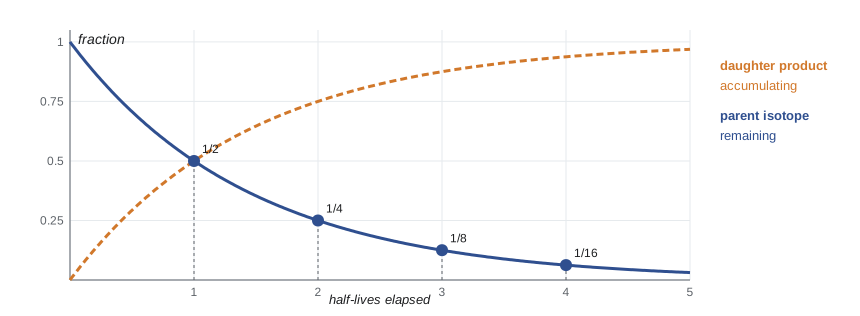
Absolute ages come from radiometric dating, which uses the steady decay of radioactive isotopes. Each radioactive isotope (the parent) decays into a daughter product at a fixed rate, described by its half-life: the time for half of the parent atoms in a sample to decay. Measuring the ratio of parent to daughter in a mineral tells how long ago the mineral formed.
| Isotope system | Half-life | Useful range | Used for |
|---|---|---|---|
| Carbon-14 to nitrogen-14 | 5,730 years | Up to about 50,000 years | Bones, wood, charcoal and shells of once-living material |
| Potassium-40 to argon-40 | 1.25 billion years | About 100,000 years to billions | Volcanic ash and lava layers above and below fossils |
| Uranium-238 to lead-206 | 4.47 billion years | About 1 million to 4.5 billion years | Zircon crystals; the age of Earth’s oldest rocks |
| Rubidium-87 to strontium-87 | 49 billion years | Tens of millions to billions of years | Old igneous and metamorphic rocks |
Carbon-14 dating works differently from the others. Living things take in carbon-14 from the atmosphere while alive, keeping a roughly constant proportion; after death the carbon-14 decays without replacement. It is useful only for remains younger than about 50,000 years. Most fossils are far older, so they are dated indirectly: sedimentary rocks cannot usually be dated radiometrically, but volcanic ash layers above and below a fossil can, bracketing its age.
import math
# Radiometric ages from the fraction of parent isotope remaining
def age(fraction_left, half_life):
    return half_life * math.log2(1 / fraction_left)

print(f"Charcoal with 25% of its original C-14: {age(0.25, 5730):,.0f} years")
print(f"Bone with 10% of its original C-14:     {age(0.10, 5730):,.0f} years")
# K-Ar: each decayed K-40 atom here is assumed to leave one Ar-40 atom (simplified)
ar_per_k = 0.0035                     # ratio of Ar-40 to remaining K-40 in a volcanic ash
fraction_left = 1 / (1 + ar_per_k)
print(f"Ash with Ar/K = {ar_per_k}: {age(fraction_left, 1.25e9)/1e6:,.1f} million years")Charcoal with 25% of its original C-14: 11,460 years Bone with 10% of its original C-14: 19,035 years Ash with Ar/K = 0.0035: 6.3 million years
Real potassium–argon dating must also account for the fact that only about 11 percent of potassium-40 decays to argon-40 (the rest becomes calcium-40), and modern laboratories use the more precise argon–argon method. But the principle is exactly as shown: a measured ratio and a known half-life give an age.
The geological time scale
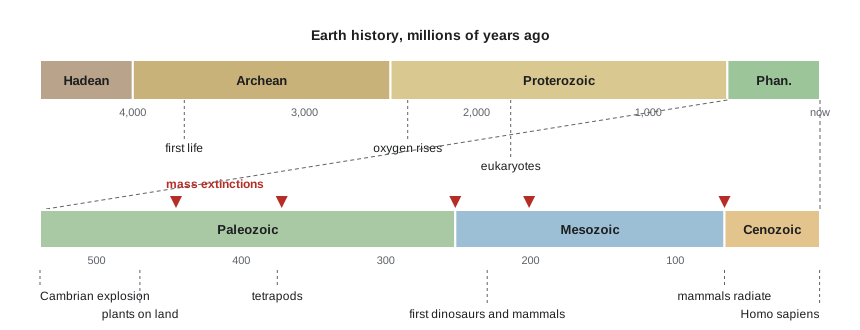
Earth's history is divided into eons, eras, periods and epochs, with boundaries often marked by major changes in the fossil record. The Phanerozoic eon, meaning visible life, covers the last 539 million years, when animals with hard parts became abundant. Everything before it, nearly nine-tenths of Earth's history, is informally called the Precambrian.
| Time (million years ago) | Event |
|---|---|
| 4,540 | Earth forms |
| About 3,700 to 3,500 | Earliest widely accepted evidence of life: chemical traces and stromatolites built by microbial mats |
| About 2,400 | Great Oxidation Event: oxygen from photosynthetic cyanobacteria builds up in the atmosphere |
| About 1,800 to 1,600 | Earliest eukaryotic cells (lesson 8) |
| About 1,200 | Earliest multicellular red algae |
| About 635 to 539 | Ediacaran period: the first large, soft-bodied multicellular organisms |
| About 539 to 515 | Cambrian explosion: most animal phyla appear in the fossil record |
| About 470 | Plants colonize land (lesson 9) |
| About 375 to 360 | First tetrapods move onto land |
| About 320 | First amniotes (reptile-like animals with shelled eggs) |
| About 230 to 200 | First dinosaurs and first mammals |
| About 150 | Archaeopteryx, an early bird relative |
| About 130 | First flowering plants |
| 66 | End-Cretaceous mass extinction; mammals radiate |
| About 6 to 7 | Human and chimpanzee lineages split |
| About 0.3 | Homo sapiens appears in Africa |
Deep time is hard to grasp. One common way is to compress Earth's history into a single calendar year. The code below does that conversion.
from datetime import datetime, timedelta
# Compress Earth's 4,540-million-year history into one calendar year
EARTH = 4540e6
start = datetime(2026, 1, 1)
events = [("first life", 3700e6), ("oxygen builds up", 2400e6), ("first eukaryotes", 1800e6),
          ("Cambrian explosion", 539e6), ("plants on land", 470e6), ("dinosaurs extinct", 66e6),
          ("Homo sapiens", 0.3e6)]
for name, ago in events:
    t = start + timedelta(days=365 * (1 - ago / EARTH))
print(f"{name:<20} {t:%B %d, %H:%M}")first life March 09, 12:47 oxygen builds up June 22, 01:09 first eukaryotes August 09, 06:52 Cambrian explosion November 18, 15:59 plants on land November 24, 05:07 dinosaurs extinct December 26, 16:39 Homo sapiens December 31, 23:25
On this calendar, life appears in early March, but animals with shells and skeletons do not appear until mid-November, the dinosaurs die out on December 26 and our own species shows up only in the last 35 minutes of December 31. For most of its history, life on Earth was entirely microbial.
The origin of life
How life began is still an open research question, but there has been real progress. In 1953 Stanley Miller and Harold Urey showed that amino acids form spontaneously when electric sparks pass through a mixture of gases thought to resemble the early atmosphere. Later work has shown that nucleotides, lipids that self-assemble into membrane-bound vesicles, and short RNA chains can all form under plausible early-Earth conditions.
A leading hypothesis is the RNA world: early life may have used RNA both to store information, as DNA does now, and to speed up chemical reactions, as protein enzymes do now. Ribozymes, RNA molecules with catalytic activity, still exist; the core of the ribosome that builds every protein is itself RNA. Candidate settings include warm shallow ponds that dry and refill and deep-sea hydrothermal vents, where mineral surfaces and chemical gradients could have driven early metabolism. What is clear is that by about 3.5 billion years ago, microbial life was well established.
Mass extinctions
Background extinction, the steady loss of species, goes on all the time; the average species lasts perhaps one to ten million years. Five times in the Phanerozoic, extinction rates spiked dramatically, removing large fractions of all species in geologically short intervals.
| Extinction | Age (million years ago) | Estimated species lost | Likely causes |
|---|---|---|---|
| End-Ordovician | About 445 | About 85 percent of marine species | Glaciation and sea-level fall |
| Late Devonian | About 372 (a series of pulses) | About 75 percent | Ocean oxygen loss; possibly changes linked to spreading land plants |
| End-Permian | 252 | Over 80 percent of marine species (estimates up to about 90 percent) | Massive volcanism in Siberia, global warming, ocean acidification and oxygen loss |
| End-Triassic | 201 | About 75 percent | Volcanism as the Atlantic began to open |
| End-Cretaceous | 66 | About 75 percent, including all non-avian dinosaurs | Asteroid impact at Chicxulub, Mexico, plus Deccan volcanism in India |
Evidence for the end-Cretaceous impact includes a worldwide thin layer of clay rich in iridium, an element rare in Earth's crust but common in asteroids, first reported by Luis and Walter Alvarez in 1980, and the 180-kilometer Chicxulub crater buried beneath the Yucatán Peninsula. Mass extinctions matter for evolution because they clear ecological space; the survivors then radiate. Mammals had lived alongside dinosaurs for over 100 million years as mostly small animals, but after the extinction they diversified rapidly into whales, bats, horses, primates and much more.
Many biologists argue that human activity is now driving a sixth mass extinction. Current extinction rates for well-studied groups such as mammals, birds and amphibians are estimated at tens to hundreds of times the background rate, driven by habitat loss, overexploitation, invasive species, pollution and climate change. Lesson 12 returns to biodiversity loss and conservation.
Windows into the past: exceptional fossil sites
Most fossil sites preserve only hard parts, but a few, called Lagerstätten, preserve soft tissues in remarkable detail. They give glimpses of whole ancient communities.
The United States holds some of the world’s most important fossil sites. The Morrison Formation of Colorado, Utah and Wyoming yielded famous Jurassic dinosaurs such as Stegosaurus, Allosaurus and giant sauropods; Dinosaur National Monument preserves a wall of bones in place. The Hell Creek Formation of Montana and the Dakotas records the last dinosaurs, including Tyrannosaurus and Triceratops, right up to the end-Cretaceous boundary. The Green River Formation of Wyoming preserves 50-million-year-old fish, birds and plants in fine detail, and the La Brea Tar Pits in Los Angeles hold tens of thousands of Ice Age mammals. The Paleontological Resources Preservation Act of 2009 requires permits to collect vertebrate fossils on federal land, while fossils on private land generally belong to the landowner. Canada’s Burgess Shale in British Columbia remains the classic window into Cambrian life.
Each of these sites tells part of the same story. Their fossils appear in the order evolutionary theory predicts: no rabbits in the Cambrian, no dinosaurs below the first reptiles, no flowering plants before the first seed plants. In over 150 years of collecting, no fossil has turned up seriously out of sequence.
Common mistakes
MistakeCarbon-14 dating is used to date dinosaur fossils.
InsteadCarbon-14 works only for remains younger than about 50,000 years; dinosaur ages come from potassium–argon, argon–argon or uranium–lead dating of nearby volcanic layers.
MistakeThe fossil record is too incomplete to say anything.
InsteadIt is incomplete and biased toward hard parts, but its overall order is consistent and confirmed by radiometric dating and genetics.
MistakeHumans and dinosaurs lived at the same time.
InsteadNon-avian dinosaurs died out 66 million years ago; Homo sapiens appeared about 300,000 years ago. Birds, however, are living dinosaurs.
MistakeMass extinctions are purely destructive for evolution.
InsteadThey remove many lineages but open ecological space that survivors fill through adaptive radiations.
MistakeA half-life means all the atoms decay after two half-lives.
InsteadAfter each half-life, half of the remaining atoms decay: a quarter is left after two, an eighth after three.
Summary and key terms
- Superposition gives relative ages; radiometric dating with known half-lives gives absolute ages.
- Carbon-14 dates material younger than about 50,000 years; potassium–argon and uranium–lead date older volcanic rocks and minerals.
- Life appeared by about 3.5 to 3.7 billion years ago; for most of Earth’s history it was entirely microbial.
- Key milestones include oxygen build-up, eukaryotes, multicellularity, the Cambrian explosion and the colonization of land.
- Hypotheses for life’s origin include an RNA world in ponds or at hydrothermal vents.
- Five mass extinctions removed most species; the end-Cretaceous asteroid impact ended the non-avian dinosaurs and opened the way for mammals.
- Exceptional fossil sites preserve soft-bodied organisms and whole ancient communities.
- superposition
- The principle that in undisturbed rock layers, lower layers are older.
- index fossil
- A widespread, short-lived species used to match and date rock layers.
- radiometric dating
- Dating rocks or remains from the decay of radioactive isotopes.
- half-life
- The time for half the atoms of a radioactive isotope to decay.
- Precambrian
- The informal name for Earth’s history before the Phanerozoic, about 4.54 billion to 539 million years ago.
- stromatolite
- A layered rock structure built by microbial mats, among the oldest evidence of life.
- Cambrian explosion
- The rapid appearance of most animal phyla in the fossil record, beginning about 539 million years ago.
- RNA world
- The hypothesis that early life used RNA for both information storage and catalysis.
- mass extinction
- A geologically brief event in which a large fraction of species dies out.
- Lagerstätte
- A fossil site with exceptional preservation, often including soft tissues.
Practice problems
Work each problem on paper first, then reveal the answer to check.
A sample retains 12.5 percent of its original carbon-14. How old is it?
Show answer
Three half-lives: 3 × 5,730 = 17,190 years.
Why can most fossils not be dated directly by radiometric methods?
Show answer
They are in sedimentary rocks, whose minerals came from older rocks; dates come from volcanic layers above and below.
What does the principle of superposition allow, and what does it not?
Show answer
It gives relative order of layers and fossils, but not ages in years.
What was the Great Oxidation Event and what caused it?
Show answer
The build-up of oxygen in the atmosphere about 2.4 billion years ago, caused by photosynthesis in cyanobacteria.
Name two pieces of evidence for the end-Cretaceous asteroid impact.
Show answer
A worldwide iridium-rich clay layer and the Chicxulub crater in Mexico.
Why is the RNA world hypothesis attractive?
Show answer
RNA can store genetic information and act as a catalyst, so one molecule type could do both jobs early on.
On a one-year calendar of Earth’s history, roughly when does the Cambrian explosion occur?
Show answer
In mid-November.
What makes the Burgess Shale special?
Show answer
It preserves soft-bodied Cambrian animals in fine detail, about 508 million years old.
Why are mass extinctions often followed by adaptive radiations?
Show answer
Surviving lineages diversify into the ecological roles left empty.
Why is hard-part bias a problem in the fossil record?
Show answer
Soft-bodied organisms rarely fossilize, so they are under-represented compared with shelled or bony ones.
Lesson quiz · 5 questions
Score 60% or more to complete this lesson.
Create a free account to save your progress, take quizzes and earn a certificate.