
BIOL-108 · Lesson 11 of 12 · 24 min
Animal diversity II: vertebrates and human evolution
Vertebrates are a small fraction of animal species, about 70,000, but they include the largest animals that have ever lived and the animals most familiar to us, including ourselves. This lesson traces vertebrate evolution through a series of innovations: the notochord and backbone, jaws, limbs, the amniotic egg and the features of mammals. It ends with the evolution of humans, one of the best documented and most intensively studied stories in biology.
Chordates
Vertebrates belong to the phylum Chordata, deuterostomes that share four features at some stage of life: a notochord, a flexible rod that supports the body; a dorsal hollow nerve cord, which becomes the brain and spinal cord; pharyngeal slits or pouches behind the mouth; and a muscular tail extending beyond the anus. Humans show all four as embryos: the notochord survives as the soft centers of the discs between vertebrae, the pharyngeal pouches become parts of the ear, tonsils and glands, and the embryonic tail is reabsorbed to form the coccyx.
Two groups of invertebrate chordates help reveal the ancestral body plan. Lancelets are small, fish-shaped filter feeders that keep all four features throughout life. Tunicates, or sea squirts, have a tadpole-like larva with all four features, but adults settle down as sac-like filter feeders. Genomic studies suggest tunicates are the closest living relatives of vertebrates.
The vertebrate tree
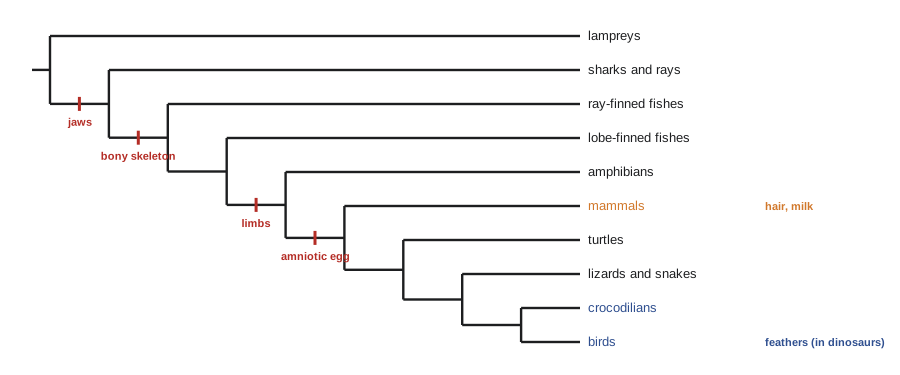
Vertebrates are chordates with a backbone of vertebrae around the nerve cord, a skull protecting a well-developed brain, and, in most, an internal skeleton of bone. Their evolution can be read as a nested series of innovations, each defining a clade.
| Group | Approximate living species | Defining features | Examples |
|---|---|---|---|
| Lampreys and hagfishes | About 125 | Jawless; skeleton of cartilage | Sea lamprey, an invasive pest in the Great Lakes |
| Cartilaginous fishes | About 1,300 | Jaws; skeleton of cartilage; tooth-like scales | Sharks, skates, rays |
| Ray-finned fishes | About 33,000 | Bony skeleton; fins supported by thin rays; swim bladder | Salmon, cod, perch, seahorses |
| Lobe-finned fishes | 8 | Fleshy fins with bones like those of limbs | Coelacanths and lungfishes |
| Amphibians | About 8,700 | Four limbs; moist skin; most lay eggs in water | Frogs, salamanders, caecilians |
| Reptiles (including birds) | About 12,000 non-bird reptiles and 11,000 birds | Amniotic egg; scales or feathers | Turtles, lizards, snakes, crocodiles, birds |
| Mammals | About 6,600 | Hair; mammary glands; three middle ear bones | Platypus, kangaroos, bats, whales, humans |
Jaws, bone and fins
The first vertebrates, about 530 million years ago, were jawless. Jaws evolved about 440 million years ago from the skeletal supports of the front pharyngeal slits, an elegant example of evolution modifying existing structures. Jaws turned vertebrates into effective predators and set off a radiation of jawed fishes. Ray-finned fishes are now the largest vertebrate group, about half of all vertebrate species. Many have a swim bladder, a gas-filled sac that adjusts buoyancy and that evolved from the lungs of early bony fishes, not the other way around.
Onto land: tetrapods
Tetrapods, the four-limbed vertebrates, evolved from lobe-finned fishes. Fossils from about 385 to 360 million years ago document the transition in remarkable detail: Eusthenopteron, a fish with limb bones in its fins; Tiktaalik, with a neck, sturdy shoulders and wrist-like joints (lesson 1); and Acanthostega and Ichthyostega, with true limbs bearing seven or eight digits, which still lived mostly in water. Limbs seem to have evolved first for moving through shallow, weedy water, and were later used on land.
Amphibians were the first tetrapods to exploit land widely, but most still need water to reproduce: they lay shell-less eggs in water, and many have aquatic larvae, such as tadpoles, that metamorphose into adults. Their thin, moist skin is used for breathing, which makes them sensitive to pollution and drying, and many species are declining because of habitat loss and the chytrid fungus (lesson 8).
The amniotic egg and reptiles
About 320 million years ago, a group of tetrapods evolved the amniotic egg: an egg with a shell and internal membranes that hold water, store food, exchange gases and handle waste. It let vertebrates reproduce on dry land, away from water. The amniotes soon split into two lineages: one led to mammals, the other to reptiles. Living reptiles include turtles, lizards and snakes, the tuatara of New Zealand, crocodilians and birds.
Birds are reptiles: specifically, they are living dinosaurs. Fossils such as Archaeopteryx, from about 150 million years ago in Germany, and many feathered dinosaurs found in China since the 1990s show that feathers evolved in theropod dinosaurs before flight, probably first for insulation and display. Birds and crocodilians are each other's closest living relatives. Alberta's badlands have produced some of the best-preserved feathered dinosaur and early bird-relative fossils, and in 2016 a small feathered dinosaur tail preserved in amber from Myanmar was described, showing the structure of the feathers in three dimensions.
Mammals
Mammals are amniotes with hair, mammary glands that produce milk, three middle ear bones (two of which evolved from jaw bones of their reptile-like ancestors, a transition well documented in fossils) and, in most, a diaphragm and teeth of different shapes. They are endothermic, generating body heat internally. Mammals originated about 200 million years ago and remained mostly small during the age of dinosaurs, radiating spectacularly after the end-Cretaceous extinction.
| Group | Reproduction | Examples |
|---|---|---|
| Monotremes | Lay eggs; young lap milk from patches of skin | Platypus, echidnas (Australia and New Guinea) |
| Marsupials | Very short pregnancy; tiny young develop attached to a nipple, often in a pouch | Kangaroos, koalas, opossums (the Virginia opossum is North America’s only marsupial) |
| Eutherians (placental mammals) | Long pregnancy nourished by a complex placenta | Rodents, bats, whales, carnivores, hoofed mammals, primates |
Body size shapes almost everything about how animals live. Larger animals have lower metabolic rates per kilogram, live longer and reproduce more slowly. In 1932, Max Kleiber showed that across mammals, whole-body metabolic rate scales roughly with body mass to the three-quarters power: \(B \propto M^{0.75}\). Per kilogram, then, metabolism falls as \(M^{-0.25}\).
# Kleiber's law: basal metabolic rate B = 3.4 * M^0.75 watts (M in kg; constant approximate)
animals = {"deer mouse": 0.02, "red squirrel": 0.2, "beaver": 20, "human": 70,
           "moose": 450, "blue whale": 100_000}
for name, m in animals.items():
    b = 3.4 * m ** 0.75
print(f"{name:<12} {m:>9,.2f} kg: {b:>9,.1f} W total, {b/m:6.2f} W per kg")deer mouse 0.02 kg: 0.2 W total, 9.04 W per kg red squirrel 0.20 kg: 1.0 W total, 5.08 W per kg beaver 20.00 kg: 32.2 W total, 1.61 W per kg human 70.00 kg: 82.3 W total, 1.18 W per kg moose 450.00 kg: 332.2 W total, 0.74 W per kg blue whale 100,000.00 kg: 19,119.6 W total, 0.19 W per kg
Per kilogram, a deer mouse burns energy roughly 12 times faster than a moose, and a moose about four times faster than a blue whale. That is why small mammals must eat almost constantly, why shrews and mice can starve within hours, and why small mammals in Canada's winters hibernate or shelter beneath the snow, while large mammals such as moose and bison endure the cold in the open.
Primates and human origins
Primates are mammals adapted, in their ancestry, to life in trees: grasping hands and feet with nails, forward-facing eyes with depth perception, and large brains relative to body size. Apes, including gibbons, orangutans, gorillas, chimpanzees, bonobos and humans, lack tails. As lesson 6 showed, genetic evidence places chimpanzees and bonobos as our closest living relatives, sharing a common ancestor with us roughly 6 to 7 million years ago.
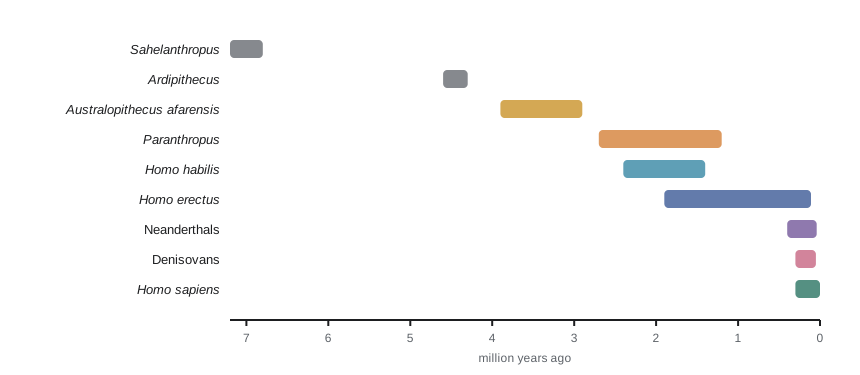
Hominins are the species on the human side of that split. The fossil record now includes about two dozen named hominin species, and it shows that human evolution was not a single march but a branching bush, with several species often alive at once. Bipedalism, walking upright on two legs, came first, millions of years before large brains or stone tools.
| Species | Approximate age | Brain size (cm³) | Notes |
|---|---|---|---|
| Sahelanthropus tchadensis | About 7 million years ago | About 350 | Possible early hominin from Chad |
| Australopithecus afarensis | 3.9 to 2.9 million years ago | About 450 | “Lucy” (Ethiopia, 1974); bipedal; Laetoli footprints in Tanzania |
| Homo habilis | 2.4 to 1.4 million years ago | About 600 | Associated with early stone tools |
| Homo erectus | 1.9 million to about 110,000 years ago | About 900 to 1,100 | First to leave Africa; used fire; long-distance walker |
| Homo neanderthalensis | About 400,000 to 40,000 years ago | About 1,400 | Europe and western Asia; buried dead; made complex tools |
| Homo sapiens | About 300,000 years ago to present | About 1,350 | Oldest fossils from Jebel Irhoud, Morocco; spread worldwide |
import numpy as np
# Brain size in hominins over time (approximate values from the table above)
age_myr = np.array([7.0, 3.4, 1.9, 1.0, 0.2])     # million years ago
brain = np.array([350, 450, 600, 1000, 1350])     # cm^3
slope, intercept = np.polyfit(-age_myr, np.log(brain), 1)
print(f"average growth rate: {slope:.3f} per million years (natural log units)")
print(f"brain size doubling time: about {np.log(2)/slope:.1f} million years")
for a, b in zip(age_myr, brain):
print(f"{a:4.1f} million years ago: {b:5d} cm3")average growth rate: 0.188 per million years (natural log units) brain size doubling time: about 3.7 million years 7.0 million years ago: 350 cm3 3.4 million years ago: 450 cm3 1.9 million years ago: 600 cm3 1.0 million years ago: 1000 cm3 0.2 million years ago: 1350 cm3
The simple fit hides an uneven history: brain size changed little for millions of years among the australopiths, then rose rapidly in the genus Homo over the last two million years. Body size also increased, and part of the change reflects larger bodies.
Out of Africa, and interbreeding
Fossils and genetics agree that Homo sapiens evolved in Africa and that modern humans spread out of Africa beginning roughly 60,000 to 70,000 years ago, eventually reaching every continent except Antarctica. African populations hold the most genetic diversity of any people, as expected if other populations descend from subsets that left Africa (a series of founder effects, lesson 3).
Ancient DNA has transformed the story. In 2010 Svante Pääbo's team published the Neanderthal genome; Pääbo received the 2022 Nobel Prize in Physiology or Medicine for this work. It showed that people outside Africa carry about 1 to 2 percent Neanderthal DNA, from interbreeding after modern humans left Africa. DNA from a finger bone in Denisova Cave in Siberia revealed another group, the Denisovans, who contributed DNA especially to people of Oceania and parts of Asia. Some of this inherited DNA was useful: a Denisovan gene variant helps Tibetans live at high altitude.
People reached the Americas at least 15,000 years ago, and footprints at White Sands National Park in New Mexico suggest perhaps 21,000 to 23,000 years ago, crossing from Siberia via the Bering land bridge and moving south along the Pacific coast or through an ice-free corridor east of the Rockies. Genetic studies of ancient and present-day people show that the ancestors of Native American peoples came from these first populations. In the United States, the Native American Graves Protection and Repatriation Act governs human remains and ancestral objects, and research involving ancient DNA increasingly follows the CARE principles for Indigenous data governance and is conducted in partnership with tribes.
Human evolution did not stop with the origin of our species. Lactase persistence, the ability to digest milk sugar as an adult, spread through natural selection in dairying populations in Europe, Africa and the Middle East within the last 10,000 years. Variants protecting against malaria, such as the sickle-cell allele, are common where malaria has long been present. Skin color varies with the intensity of ultraviolet light, balancing protection of folate against the need to make vitamin D. All living humans belong to one species with very low genetic diversity compared with chimpanzees, and most human genetic variation is found within, not between, populations.
Common mistakes
MistakeHumans evolved from monkeys or chimpanzees.
InsteadHumans and chimpanzees share a common ancestor about 6 to 7 million years ago; neither descended from the other.
MistakeHuman evolution was a straight line from ape to modern human.
InsteadIt was a branching bush, with several hominin species often alive at the same time.
MistakeBirds and reptiles are separate groups.
InsteadBirds are reptiles, descended from theropod dinosaurs; the traditional class Reptilia without birds is paraphyletic.
MistakeBig brains came before walking upright.
InsteadBipedalism evolved millions of years before the large increase in brain size.
MistakeHumans have stopped evolving.
InsteadLactase persistence and malaria resistance are examples of recent and ongoing human evolution.
Summary and key terms
- Chordates share a notochord, dorsal hollow nerve cord, pharyngeal slits and post-anal tail at some stage.
- Vertebrate innovations include the backbone, jaws (from gill supports), bone, lobed fins and limbs, the amniotic egg, feathers and hair.
- Fossils such as Tiktaalik document the fish-to-tetrapod transition about 385 to 360 million years ago.
- The amniotic egg allowed reproduction on land; birds are living theropod dinosaurs.
- Mammals have hair, milk and three middle ear bones; metabolic rate scales with mass to the three-quarters power.
- Hominin evolution was a branching bush; bipedalism preceded large brains, which grew rapidly in Homo.
- Homo sapiens arose in Africa about 300,000 years ago, spread worldwide and interbred with Neanderthals and Denisovans.
- chordate
- An animal with a notochord, dorsal hollow nerve cord, pharyngeal slits and post-anal tail at some stage.
- notochord
- A flexible supporting rod along the back of chordate embryos.
- vertebrate
- A chordate with a backbone and skull.
- tetrapod
- A vertebrate with four limbs, or descended from four-limbed ancestors.
- amniotic egg
- An egg with a shell and internal membranes that allows development on land.
- endotherm
- An animal that generates most of its body heat metabolically.
- marsupial
- A mammal whose young are born very small and develop attached to a nipple, often in a pouch.
- hominin
- A species on the human side of the split from chimpanzees.
- bipedalism
- Habitual walking on two legs.
- Kleiber’s law
- The observation that metabolic rate scales roughly with body mass to the three-quarters power.
Practice problems
Work each problem on paper first, then reveal the answer to check.
Name the four chordate features and what each becomes in humans.
Show answer
Notochord (centers of spinal discs), dorsal nerve cord (brain and spinal cord), pharyngeal pouches (parts of ear, tonsils, glands), tail (coccyx).
From what structure did jaws evolve?
Show answer
From the skeletal supports of the front pharyngeal (gill) slits.
Why is the amniotic egg important?
Show answer
It holds water, food and gas exchange membranes inside a shell, allowing reproduction on dry land.
Why are birds classified as reptiles?
Show answer
They descend from theropod dinosaurs; excluding them would make reptiles paraphyletic.
Name the three groups of living mammals and how they reproduce.
Show answer
Monotremes lay eggs; marsupials have short pregnancies and pouch development; eutherians have long pregnancies with a placenta.
Using B = 3.4 M^0.75, compare per-kilogram metabolic rates of a 1 kg and an 81 kg mammal.
Show answer
Per kg scales as M^−0.25: 81^−0.25 = 1/3, so the small mammal’s per-kg rate is 3 times higher.
Which came first in hominin evolution, bipedalism or large brains?
Show answer
Bipedalism, by millions of years.
What evidence shows that modern humans interbred with Neanderthals?
Show answer
People outside Africa carry about 1 to 2 percent Neanderthal DNA.
Why do African populations have the most genetic diversity?
Show answer
Other populations descend from subsets that left Africa, which carried only part of the variation (founder effects).
Give an example of recent human evolution.
Show answer
Lactase persistence in dairying populations or the sickle-cell allele where malaria is common.
Lesson quiz · 5 questions
Score 60% or more to complete this lesson.
Create a free account to save your progress, take quizzes and earn a certificate.