
BIOL-108 · Lesson 10 of 12 · 24 min
Animal diversity I: invertebrates
Animals are multicellular heterotrophs that ingest their food, and most move actively at some stage of life. About 1.5 million living animal species have been described, and perhaps several times that number remain unnamed. Fewer than 5 percent of described species have a backbone. The rest, the invertebrates, range from sponges with no tissues at all to octopuses that solve puzzles. This lesson explains how biologists classify animals by body plan and surveys the major invertebrate groups. Lesson 11 covers vertebrates; BIOL-350 (Animal Physiology) explains how animal bodies work.
What makes an animal
Animals share a set of features: they are multicellular eukaryotes without cell walls, held together by proteins such as collagen; they are heterotrophs that eat other organisms; most have nerve and muscle cells; and nearly all reproduce sexually, with a large egg and small, swimming sperm. Most animals also pass through a hollow ball of cells called a blastula early in development. Molecular trees show that animals are a clade whose closest living relatives are single-celled choanoflagellates, which look strikingly like the feeding cells of sponges.
Animals appear in the fossil record in the Ediacaran period, about 570 million years ago, as soft-bodied forms whose relationships are still debated, and then in abundance during the Cambrian explosion (lesson 5). Within about 25 million years, nearly all the major animal body plans, or phyla, that exist today appear as fossils. Possible triggers include rising oxygen, the evolution of predation, which favored shells and armor, and new genetic tools for building complex bodies.
Body plans
Zoologists traditionally group animals by features of their body plan. Molecular phylogenies have confirmed some of these groupings and overturned others, but the features remain useful for describing animals.
| Feature | Options | Examples |
|---|---|---|
| Tissues | None (sponges) or true tissues (all others) | Sponges lack organized tissues; jellyfish and all other animals have them |
| Symmetry | Radial (body parts arranged around a central axis) or bilateral (left and right sides) | Jellyfish and sea anemones are radial; worms, insects and humans are bilateral |
| Germ layers | Two (diploblastic) or three (triploblastic) | Jellyfish have two; bilateral animals have three, adding mesoderm, which forms muscle |
| Body cavity | None, a body cavity lined with mesoderm (coelom), or a partly lined cavity | Flatworms lack a cavity; earthworms and humans have a coelom |
| Early development | Protostome (mouth forms first) or deuterostome (anus forms first) | Insects, snails and worms are protostomes; sea stars and vertebrates are deuterostomes |
Bilateral symmetry was a key innovation. A bilateral animal has a front end that meets the world first, so sense organs and nerve cells concentrated there, producing a head (cephalization). Bilateral animals move purposefully forward, which favored fast, directed locomotion.
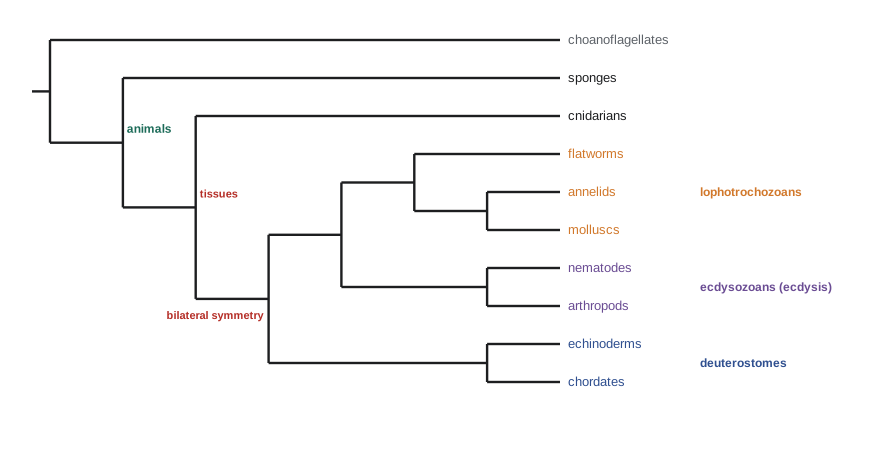
Molecular data reorganized the protostomes into two great clades. The ecdysozoans, including roundworms and arthropods, grow by molting their outer covering, a process called ecdysis. The lophotrochozoans, including flatworms, segmented worms and molluscs, are named for two features some members have: a feeding crown of tentacles called a lophophore, or a swimming larva called a trochophore.
Sponges and cnidarians
Sponges (phylum Porifera) are simple filter feeders. Water is drawn in through pores by flagellated collar cells (choanocytes), food particles are trapped, and water leaves through a large opening. Sponges have specialized cells but no true tissues or organs. About 9,000 species are known, mostly marine, though freshwater sponges grow in Canadian and American lakes and streams.
Cnidarians include jellyfish, sea anemones, corals and the freshwater Hydra. They are radially symmetric, with a sac-like gut with one opening and a ring of tentacles armed with stinging cells (cnidocytes) that fire tiny harpoons, sometimes venomous, to capture prey. Many alternate between a stationary polyp and a free-swimming medusa form. Reef-building corals host photosynthetic dinoflagellate partners in their tissues, which supply much of their food; when water gets too warm, corals expel these partners and bleach, and repeated marine heatwaves have caused mass bleaching on reefs worldwide.
Flatworms, segmented worms and molluscs
Flatworms (phylum Platyhelminthes) are flattened, bilateral animals with no body cavity. Because they lack circulatory and respiratory systems, every cell must be close to the surface for oxygen to diffuse in, which limits their thickness to a few millimeters. Free-living flatworms such as planarians can regenerate an entire body from a small fragment. Many flatworms are parasites, including tapeworms and the flukes that cause schistosomiasis, which infects over 200 million people in tropical regions.
Annelids, or segmented worms, have bodies divided into repeated segments, a coelom and a closed circulatory system. They include earthworms, which aerate and enrich soils; leeches; and many marine bristle worms. Darwin's last book, published in 1881, was about earthworms, estimating that they could bring more than ten tons of soil to the surface per acre each year. Most earthworms in Canada and the northern United States are actually introduced European species, because native worms were wiped out by the glaciers; in hardwood forests these invaders consume the leaf litter that native plants and salamanders depend on.
Molluscs, with about 85,000 living species, share a body plan with a muscular foot, a visceral mass containing the organs and a mantle that often secretes a shell. Gastropods (snails and slugs) usually have a single coiled shell; bivalves (clams, mussels, oysters and scallops) have two hinged shells and filter-feed; cephalopods (squid, octopuses, cuttlefish and the shelled nautilus) are active predators with large brains, excellent eyes and arms derived from the foot. Octopuses can open jars, escape enclosures and change color and texture in a fraction of a second.
Roundworms and arthropods
Roundworms, or nematodes, are among the most numerous animals on Earth: a spadeful of soil can contain thousands. They are unsegmented, with a tough cuticle that they molt as they grow. Most are free-living decomposers, but some are parasites of plants and animals, including hookworms, the pinworms common in children and the Trichinella worms that can be caught from undercooked bear meat or pork. The tiny nematode Caenorhabditis elegans was the first animal to have its complete genome sequenced, in 1998, and is a major model organism.
Arthropods are the most successful animals by any measure: over a million described species, more than all other animals combined, living in every habitat from deep sea to mountaintop. Their body plan combines a segmented body grouped into regions; jointed appendages specialized for walking, swimming, feeding, sensing and mating; and an exoskeleton of chitin and protein that protects the body and anchors muscles but must be molted for the animal to grow.
| Group | Body regions and legs | Examples |
|---|---|---|
| Chelicerates | Two body regions; four pairs of walking legs; no antennae; fang-like chelicerae | Spiders, scorpions, ticks, mites, horseshoe crabs |
| Myriapods | Head plus many leg-bearing segments | Centipedes (one pair of legs per segment), millipedes (two pairs) |
| Crustaceans | Two pairs of antennae; many with gills; mostly aquatic | Crabs, lobsters, shrimp, crayfish, barnacles, krill, copepods, woodlice |
| Insects | Head, thorax and abdomen; three pairs of legs; usually one pair of antennae and often wings | Beetles, butterflies, bees, ants, flies, mosquitoes, dragonflies |
Insects alone account for about two-thirds of all described animal species, and beetles about a quarter. Their success has many sources: flight, which evolved about 400 million years ago, long before any vertebrate flew; small size, which lets them exploit tiny habitats; rapid reproduction; and complete metamorphosis in many groups, with larvae and adults that live and feed in different ways and so do not compete. The exoskeleton also limits size. Mass grows with the cube of length while the strength of the exoskeleton and the area for gas exchange through the breathing tubes (tracheae) grow only with the square, one reason giant insects lived only when atmospheric oxygen was higher, in the Carboniferous.
# Why insects stay small: volume grows as length^3, surface and cross-section as length^2
for scale in (1, 2, 5, 10):
    area = scale ** 2          # exoskeleton cross-section, tracheal surface
    volume = scale ** 3        # body mass to support and supply with oxygen
print(f"length x{scale:2d}: area x{area:4d}, mass x{volume:5d}, area per unit mass x{area/volume:.2f}")length x 1: area x 1, mass x 1, area per unit mass x1.00 length x 2: area x 4, mass x 8, area per unit mass x0.50 length x 5: area x 25, mass x 125, area per unit mass x0.20 length x10: area x 100, mass x 1000, area per unit mass x0.10
Arthropods matter enormously to people. Insects pollinate crops, recycle dead material and feed birds, fish and bats. Crustaceans such as krill and copepods are central to ocean food webs. Some arthropods are pests and disease vectors: mosquitoes transmit malaria, dengue and West Nile virus, ticks transmit Lyme disease, and forest insects can kill trees across whole regions.
In the United States, the mountain pine beetle has killed trees across millions of hectares of western forests from Colorado to Montana, helped by mild winters that failed to kill overwintering larvae. The invasive emerald ash borer, first found near Detroit, Michigan, in 2002, has killed hundreds of millions of ash trees across more than 35 states, and the spotted lanternfly has spread from Pennsylvania since 2014.
Echinoderms: our invertebrate cousins
Echinoderms, including sea stars, sea urchins, sand dollars and sea cucumbers, look nothing like us, yet they are deuterostomes and among the closest invertebrate relatives of vertebrates. Adults are radially symmetric, usually with five parts, but their larvae are bilateral, revealing their bilateral ancestry. They have an internal skeleton of calcium carbonate plates and a unique water vascular system that operates hundreds of tube feet by hydraulic pressure. From 2013, sea star wasting disease killed billions of sea stars along the Pacific coast from Alaska to Mexico, including more than 90 percent of sunflower sea stars, which allowed sea urchins to multiply and graze down kelp forests.
Identifying invertebrates
Biologists identify organisms with dichotomous keys: a series of paired choices, each leading to another pair or to a name. Keys work only on visible features, and they are only as good as their choices, but they are fast and reliable in the field. The function below is a simple key to the groups in this lesson.
# A simple dichotomous key to major invertebrate groups
def key(f):
    if not f["tissues"]:
        return "sponge (Porifera)"
    if f["symmetry"] == "radial" and not f["tube_feet"]:
        return "cnidarian (jellyfish, anemone, coral)"
    if f["tube_feet"]:
        return "echinoderm (sea star, urchin)"
    if f["jointed_legs"]:
        legs = f["legs"]
        if legs == 6: return "insect"
        if legs == 8: return "chelicerate (spider, tick, mite)"
        if legs > 14: return "myriapod (centipede, millipede)"
        return "crustacean"
    if f["shell_or_mantle"]:
        return "mollusc"
    if f["segments"]:
        return "annelid (segmented worm)"
    return "flatworm" if f["flat"] else "roundworm (nematode)"

base = dict(tissues=True, symmetry="bilateral", tube_feet=False, jointed_legs=False,
            legs=0, shell_or_mantle=False, segments=False, flat=False)
samples = {"garden spider": dict(jointed_legs=True, legs=8),
           "earthworm": dict(segments=True),
           "moon jelly": dict(symmetry="radial"),
           "blue mussel": dict(shell_or_mantle=True),
           "lady beetle": dict(jointed_legs=True, legs=6),
           "planarian": dict(flat=True)}
for name, traits in samples.items():
print(f"{name:<16} -> {key({**base, **traits})}")garden spider -> chelicerate (spider, tick, mite) earthworm -> annelid (segmented worm) moon jelly -> cnidarian (jellyfish, anemone, coral) blue mussel -> mollusc lady beetle -> insect planarian -> flatworm
Common mistakes
MistakeSpiders are insects.
InsteadSpiders are chelicerates with eight legs and two body regions; insects have six legs and three body regions.
MistakeJellyfish are fish.
InsteadJellyfish are cnidarians, invertebrates with stinging cells and no backbone.
MistakeInvertebrates are a natural group.
InsteadInvertebrate just means lacking a backbone; it includes many unrelated phyla and is paraphyletic.
MistakeSea stars are closely related to jellyfish because both are radial.
InsteadSea stars are deuterostomes related to vertebrates; their radial symmetry evolved from bilateral ancestors, as their larvae show.
MistakeEarthworms in North American forests are all native and always beneficial.
InsteadMost are European introductions in formerly glaciated regions, and they can harm forest floors.
Summary and key terms
- Animals are multicellular heterotrophs without cell walls; their closest relatives are choanoflagellates.
- Most animal body plans appeared in the Cambrian explosion.
- Body plans are described by tissues, symmetry, germ layers, body cavity and protostome or deuterostome development.
- Sponges lack tissues; cnidarians are radial with stinging cells; flatworms, annelids and molluscs are lophotrochozoans.
- Ecdysozoans, including nematodes and arthropods, molt; arthropods are the most diverse animals.
- Insects owe their success to flight, small size, rapid reproduction and metamorphosis; the square–cube law limits their size.
- Echinoderms are deuterostomes related to vertebrates, with bilateral larvae and a water vascular system.
- invertebrate
- An animal without a backbone; not a natural group.
- phylum
- A major group of animals sharing a basic body plan.
- bilateral symmetry
- A body plan with matching left and right halves and distinct front and back ends.
- cephalization
- Concentration of sense organs and nerves at the front end of the body.
- coelom
- A fluid-filled body cavity lined with mesoderm.
- protostome
- An animal in whose embryo the first opening becomes the mouth.
- deuterostome
- An animal in whose embryo the first opening becomes the anus.
- ecdysozoan
- A member of the protostome clade that grows by molting, including arthropods and nematodes.
- exoskeleton
- A hard external skeleton, such as the chitin cuticle of arthropods.
- metamorphosis
- A major change in body form between larval and adult stages.
Practice problems
Work each problem on paper first, then reveal the answer to check.
What features do all animals share?
Show answer
Multicellular, eukaryotic, heterotrophic by ingestion, no cell walls, usually nerves and muscles and sexual reproduction.
Why did bilateral symmetry favor cephalization?
Show answer
A front end meets the environment first, so concentrating sense organs and nerves there helps directed movement.
Why can flatworms not be thick?
Show answer
Without circulatory or respiratory systems, oxygen must diffuse to every cell from the surface.
Name the three body parts shared by molluscs.
Show answer
A muscular foot, a visceral mass and a mantle (often secreting a shell).
How do ecdysozoans grow?
Show answer
By molting their outer cuticle or exoskeleton.
Give two differences between insects and spiders.
Show answer
Insects have six legs and three body regions (and usually antennae); spiders have eight legs, two regions and no antennae.
If an insect doubled in length, by how much would its mass increase relative to its exoskeleton cross-section?
Show answer
Mass increases 8 times but cross-section only 4 times, so each unit of skeleton supports twice the mass.
Why are echinoderms grouped with vertebrates as deuterostomes?
Show answer
They share deuterostome development, and their bilateral larvae reveal bilateral ancestry.
What helped mountain pine beetle outbreaks spread?
Show answer
Mild winters that failed to kill overwintering larvae, plus large areas of mature pine.
How does a dichotomous key work?
Show answer
It offers a series of paired choices about observable features that lead step by step to a name.
Lesson quiz · 5 questions
Score 60% or more to complete this lesson.
Create a free account to save your progress, take quizzes and earn a certificate.