
BAS-430 · Lesson 11 of 12 · 20 min
Standards: ISA/IEC 62443 and NIST guidance
▶ Video coming soon A video version of this lesson is on the way.
Thistledown's questionnaire had a second page, and its first line asked: "Which recognized cybersecurity standard or framework does the building's management follow for its building systems?" Ilona did not know. Neither, until 2025, had Margit. "I'd been doing most of the right things," she told Callie, "but I couldn't have told a customer which standard they came from, and I couldn't show anyone what was missing. A standard gives you the list you didn't know you needed."
This lesson introduces the two families of guidance that matter most for building control systems: the ISA/IEC 62443 series of standards for industrial automation and control systems, and the NIST publications that earlier lessons have already used. It also covers national guidance and the building-industry documents that refer to them.
Why standards help
Standards do three useful things for a building system's security. They give owners, IT departments, contractors and vendors a shared vocabulary, so that "zone", "security level" and "incident" mean the same thing to everyone. They give specifications and contracts something definite to refer to, rather than a vague promise of "industry best practice". And they give a way to measure: where a site is now, where it should be, and what lies between.
They do not replace judgment. A standard written for chemical plants and power stations has to be applied sensibly to a library with eight VAV boxes, and much of the skill is in choosing how much of it a given building needs.
The ISA/IEC 62443 series
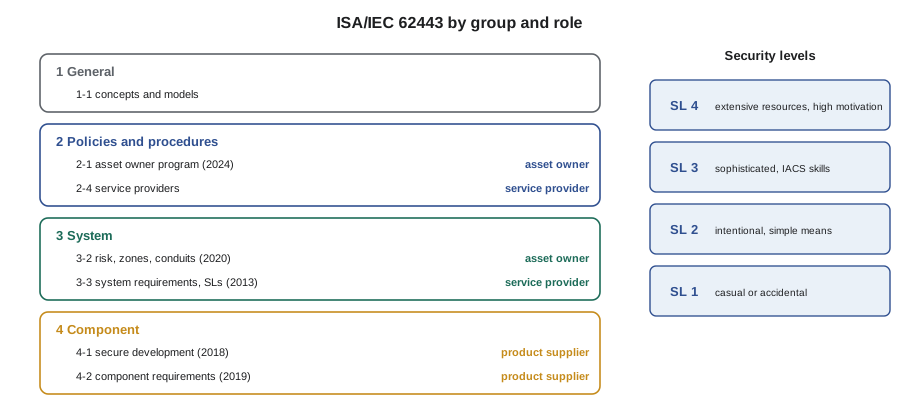
ISA/IEC 62443 is a series of standards for the security of industrial automation and control systems, developed by the International Society of Automation (ISA) and published internationally by the International Electrotechnical Commission (IEC). It is written for any automation system, and building automation fits it well. The series is organized in four groups.
| Group | Covers | Parts most used in buildings |
|---|---|---|
| 1 General | Concepts, terms and models | 62443-1-1, the concepts and models used by the rest |
| 2 Policies and procedures | The security program of the people who own and service a system | 62443-2-1: security program requirements for asset owners (edition 2, 2024, with a maturity model); 62443-2-4: requirements for service providers such as integrators and maintenance contractors |
| 3 System | Securing a whole system | 62443-3-2: security risk assessment, zones and conduits (2020); 62443-3-3: system security requirements and security levels (2013) |
| 4 Component | Securing the products in a system | 62443-4-1: secure product development for suppliers (2018); 62443-4-2: technical security requirements for components such as controllers (2019) |
The series assigns duties by role, and each role in a building maps onto it neatly. The asset owner is the building owner, such as Halvern Properties, Harcastle College or Ninefield's owner through Ilona. The service provider is the controls contractor, Quillon, when it integrates and maintains a system. The product supplier is the maker of the controllers, front end and gateways. Each has its own parts of the series: owners 2-1 and 3-2, service providers 2-4 and 3-3, suppliers 4-1 and 4-2.
Zones, conduits and the risk assessment
Lesson 3 used two words from 62443-3-2: zones and conduits. That part of the series describes how an asset owner, usually with its integrator, assesses the risk to a system and divides it up. In outline, the steps are:
- Define the system under consideration: what is in scope and what connects to it.
- Carry out an initial risk assessment of the whole system, looking at the worst things that could happen if it were misused.
- Divide the system into zones and conduits, grouping devices of similar purpose and risk.
- Assess each zone and conduit in more detail, and give each a target security level.
- Record the resulting requirements, including any compensating countermeasures, for the people who will build and maintain it.
The output is a document that a specification can point to and that a later review can check against. Callie's zone list for Ninefield in lesson 3 was a first, informal version of that third step.
Foundational requirements and security levels
62443-3-3 and 62443-4-2 group their technical requirements under seven foundational requirements. They are a useful checklist even without the rest of the standard, because each maps to work earlier lessons have covered.
| Foundational requirement | In plain terms | Lessons |
|---|---|---|
| FR 1 Identification and authentication control | Know who and what is connecting | 4, 6, 8 |
| FR 2 Use control | Let each user and device do only what it should | 4, 8 |
| FR 3 System integrity | Protect software, firmware and data from unauthorized change | 5, 6 |
| FR 4 Data confidentiality | Keep information from people who should not see it | 6 |
| FR 5 Restricted data flow | Segment into zones and control the conduits | 2, 3 |
| FR 6 Timely response to events | Log, monitor and respond | 7, 10 |
| FR 7 Resource availability | Keep the system running and recoverable | 9, 10 |
Security levels describe how strong the protection of a zone or component needs to be, in terms of the kind of threat it should withstand.
- Security level 1: protection against casual or accidental misuse, such as a contractor's laptop plugged into the wrong port.
- Security level 2: protection against intentional misuse by someone with simple means, few resources, general skills and low motivation.
- Security level 3: protection against someone with sophisticated means, moderate resources, skills specific to control systems and moderate motivation.
- Security level 4: protection against someone with sophisticated means, extensive resources and high motivation.
Three versions of the level are used. The target level (SL-T) is what the risk assessment says a zone needs. The capability level (SL-C) is what a product or system can deliver when properly configured. The achieved level (SL-A) is what is actually in place on site. The gaps between them are the work to be done.
Most building zones need level 1 or 2. Zones whose misuse could hurt people or cause large losses, such as a hospital's operating room ventilation, a laboratory's exhaust and pressurization, or a data center's cooling, may justify level 2 or 3. Boundary zones, such as the DMZ that faces remote users and the internet, often need a higher level than the zones behind them, because they face a wider range of threats.
Worked problem
Finding the gaps
For Ninefield, Callie's draft gave target levels to four zones: field controllers SL-T 1, supervisory and plant SL-T 2, site servers SL-T 2, boundary DMZ SL-T 2. Her estimate of the capability of what is installed was: field controllers SL-C 1 (no authentication on MS/TP), supervisory and plant SL-C 1 (classic BACnet/IP, default web settings unchanged on one gateway), site servers SL-C 2 (front end supports roles and MFA once upgraded), DMZ not yet built. Which zones have gaps, and how can each be closed?
Show solution
- Field controllers: target 1, capability 1: no gap, provided the trunks stay physically protected and reachable only through their routers.
- Supervisory and plant: target 2, capability 1: a gap. The devices cannot reach level 2 on their own, so the gap is closed with compensating countermeasures at the zone's conduits (strict firewall rules, passive monitoring) and by changing the gateway's settings.
- Site servers: target 2, capability 2 after the January upgrade: the gap closes when the upgrade and MFA are in place.
- DMZ: target 2, nothing achieved yet: the jump host and edge gateway must be built to level 2.
Answer: Two zones need work and one needs building. A zone whose devices cannot meet the target is protected by what surrounds it, which is exactly the defense in depth idea from lesson 1.
Products can be certified against 62443-4-2, and makers against 62443-4-1, by independent certification schemes. A growing number of building automation products and makers hold such certifications. A specification can ask for them, and the capability levels they state make the gap analysis above much easier.
For a service provider like Quillon, 62443-2-4 is the most directly relevant part. It sets requirements for integrators and maintenance providers in areas such as staff training, account management, patch and backup practices, remote access and handover documentation. Margit used it in 2025 to check her security file, which is how the offline backup drives and the vendor access register came about.
NIST guidance
The US National Institute of Standards and Technology publishes guidance that is free to read and used well beyond the US government. Earlier lessons used several of its documents.
| Publication | What it is | Used in |
|---|---|---|
| Cybersecurity Framework (CSF) 2.0, February 2024 | A framework for managing cybersecurity risk for any organization, organized into six functions | Lessons 10, 11 |
| SP 800-82 Rev. 3, September 2023 | Guide to Operational Technology Security, with OT overlays for NIST's security control catalog | Lessons 1, 10 |
| SP 800-61 Rev. 3, April 2025 | Incident response recommendations, built around CSF 2.0 | Lesson 10 |
| SP 800-63B-4, July 2025 | Digital identity guidelines for authentication, including passwords and MFA | Lesson 4 |
The Cybersecurity Framework is the easiest of these to use as a whole. Version 2.0 groups outcomes into six functions. Govern, added in 2.0, covers strategy, roles, policy and supply chain risk. Identify covers knowing the assets and risks; Protect, the safeguards; Detect, finding problems; Respond, acting on them; and Recover, getting back to normal. The framework does not say how to do any of it; it lists outcomes and points to other documents, such as 62443 or SP 800-82, for the methods.
| CSF 2.0 function | What it means for a building system | Example from this course |
|---|---|---|
| Govern | Someone owns building system security; roles, policies and vendor rules are written down | Responsibility table; vendor clauses (lesson 8) |
| Identify | Know the assets, connections and risks | Inventory and network drawing (lesson 2); risk grid (lesson 1) |
| Protect | Segmentation, accounts, patching, secure protocols, backups | Lessons 3 to 6 and 9 |
| Detect | Logs, monitoring and alarms that someone reads | Lesson 7 |
| Respond | An incident plan that is practiced | Lesson 10 |
| Recover | Restore and return to normal, then improve | Lessons 9 and 10 |
National guidance
In the US, CISA publishes guidance that applies directly to building systems, including its Cross-Sector Cybersecurity Performance Goals, a short list of high-impact practices for organizations of any size, and joint guidance with partner agencies in other countries on OT asset inventories and on security questions to ask when buying OT products. Its ICS advisories and KEV catalog (lesson 5) are the main public sources for vulnerabilities in building control products. Sector rules apply in some buildings, such as federal facilities and healthcare, and CIRCIA's reporting rule will apply to covered critical infrastructure entities once it takes effect (lesson 10).
Building-industry documents
Several documents written for the building industry point to these standards or add to them.
- ANSI/ASHRAE Standard 135, the BACnet standard, includes BACnet Secure Connect, and BTL testing and listing now cover BACnet/SC functions (lesson 6).
- ASHRAE Guideline 13, Specifying Building Automation Systems, includes cybersecurity considerations for the BAS and its network infrastructure in its 2024 edition, and is a common starting point for the security section of a controls specification.
- ASHRAE Standard 223P, still under development, defines a semantic data model for describing building systems and their points. It is not a security standard, but a machine-readable model of what is installed, like the tagging covered in BAS-320, makes an asset inventory easier to build and keep current.
- Specifications for individual projects, such as Tamsworth's draft for Sandmere, increasingly ask for 62443-certified products, BACnet/SC and documented handover of accounts and certificates.
Using standards without drowning in them
Margit's advice to Callie was practical. Start with the framework, not the detail: use the six CSF functions to check that nothing is missing entirely. Use 62443-3-2's zones, conduits and target levels to decide how much protection each part of a building needs. Use 62443-2-4 to check Quillon's own practice as a service provider. Use the national agency's short lists as the minimum for every site. And use the specific publications, such as SP 800-63B-4 for passwords, for the questions they answer best.
Her draft answer to Thistledown's question, to go to Ilona with the hardening plan, was one paragraph: the building's systems are being assessed against the NIST Cybersecurity Framework 2.0, using ISA/IEC 62443-3-2 zones and conduits, with Quillon working to ISA/IEC 62443-2-4 as service provider, and a hardening plan will be provided with the fit-out documents. Lesson 12 is that plan.
Common mistakes
MistakeTreating 62443 as only for factories and power plants.
InsteadIt is written for any automation and control system, and building automation fits it well.
MistakeGiving every zone the highest security level.
InsteadSet target levels from the risk assessment; most building zones need level 1 or 2, boundaries often more.
MistakeConfusing a framework with a method.
InsteadCSF 2.0 lists outcomes; 62443, SP 800-82 and other documents describe how to achieve them.
MistakeCiting ASHRAE 223P as a security standard.
Instead223P is a semantic data model; it helps inventories but sets no security requirements.
Summary and key terms
- Standards give a shared vocabulary, something definite for contracts, and a way to measure progress.
- ISA/IEC 62443 has four groups: general, policies and procedures (2-1 for owners, 2-4 for service providers), system (3-2 zones and conduits, 3-3 system requirements) and component (4-1, 4-2).
- Seven foundational requirements cover identification, use control, integrity, confidentiality, restricted data flow, response to events and availability.
- Security levels 1 to 4 describe the threat a zone should withstand; target, capability and achieved levels show the gaps.
- NIST CSF 2.0 (2024) has six functions, including the new Govern; SP 800-82r3, SP 800-61r3 and SP 800-63B-4 cover OT security, incident response and authentication.
- CISA's performance goals, joint guidance, ICS advisories and KEV catalog add national guidance, with CIRCIA to come.
- ASHRAE 135 (BACnet/SC), Guideline 13-2024 and project specifications bring these standards into building work.
- ISA/IEC 62443
- A series of international standards for the security of industrial automation and control systems.
- Asset owner
- In 62443, the organization that owns and is accountable for a control system, such as a building owner.
- Service provider
- In 62443, an integrator or maintenance contractor that installs or services a control system.
- Security level (SL)
- A 1 to 4 rating of the threat a zone or component should be able to withstand.
- Foundational requirements
- The seven groups of technical security requirements in ISA/IEC 62443-3-3 and 4-2.
- NIST Cybersecurity Framework (CSF)
- A framework of cybersecurity outcomes organized into six functions: Govern, Identify, Protect, Detect, Respond and Recover.
Practice problems
Work each problem on paper first, then reveal the answer to check.
Which 62443 part sets requirements for a controls contractor that integrates and maintains systems?
Show answer
62443-2-4, requirements for service providers.
A zone needs SL-T 2 but its controllers can deliver only SL-C 1. What closes the gap?
Show answer
Compensating countermeasures around the zone, such as strict conduit firewall rules and monitoring, until the devices can be replaced.
Which CSF 2.0 function was added in version 2.0, and what does it cover?
Show answer
Govern: strategy, roles, policy and supply chain risk management.
Why is ASHRAE 223P useful for security even though it is not a security standard?
Show answer
A machine-readable model of the installed system makes it easier to build and maintain an asset inventory.
Lesson quiz · 5 questions
Score 60% or more to complete this lesson.
Create a free account to save your progress, take quizzes and earn a certificate.