
BAR-205 · Lesson 6 of 12 · 20 min
What the written exam tests and where California law appears
▶ Video coming soon A video version of this lesson is on the way.
Two of Sofia's July essays were weak, and when Marchetti reads Sofia's notes on them, a pattern appears. On one, a wills essay, Sofia wrote a clean answer under the majority rules she had learned for the MBE and missed the California rule the call of the question asked for. On the other, she ran out of time. 'The second problem is pacing, and we'll fix it,' Marchetti says. 'The first problem is knowing, subject by subject, when California law is the answer.'
The thirteen subjects
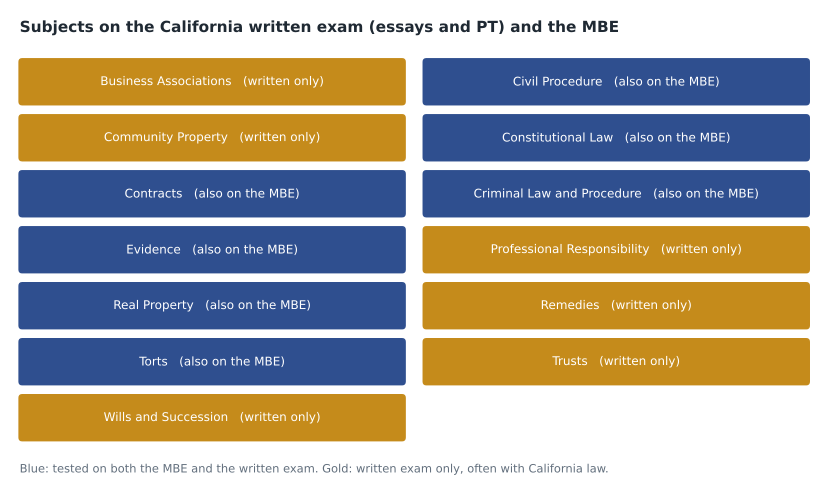
The State Bar's exam scope lists thirteen subjects that may appear on the essays and the performance test: business associations, civil procedure, community property, constitutional law, contracts, criminal law and procedure, evidence, professional responsibility, real property, remedies, torts, trusts, and wills and succession. Seven of them are also MBE subjects. The other six, business associations, community property, professional responsibility, remedies, trusts, and wills and succession, appear only on the written exam. The MPRE is a separate requirement and is not part of the exam.
The State Bar publishes a content outline for each subject, which describes the topics that may be tested. Those outlines are the best guide to depth, and Sofia keeps the outlines for community property, wills and succession, and trusts open beside her study notes.
Five essays from thirteen subjects means not every subject appears on every exam. Essays often combine two subjects, such as a contracts problem that ends with remedies, a wills problem that turns on community property, or a business associations problem with a professional responsibility issue for the corporation's lawyer. Candidates cannot safely skip any subject.
Where California law matters
Some essays tell the applicant which law to apply, and some ask for California law specifically. The general pattern on the California exam, which bar-prep providers and the State Bar's own outlines reflect, looks like this:
| Subject | Law usually applied | What to know |
|---|---|---|
| Community property | California law | Family Code characterization, presumptions, transmutation, reimbursement, division at divorce and death (Lesson 7) |
| Civil procedure | Federal rules, and California law when asked | Know both: the Federal Rules for most questions and Code of Civil Procedure distinctions when the call says California (Lesson 8) |
| Evidence | Federal Rules, and California law when asked | Know the major California Evidence Code differences and Proposition 8 (Lesson 8) |
| Wills and succession | California law | Probate Code execution, holographic wills, intestacy with community property, omitted spouses and children (Lesson 9) |
| Trusts | California law and general trust principles | Creation, revocation, modification, fiduciary duties (Lesson 9) |
| Professional responsibility | ABA Model Rules and California law | Answer under both when the call asks; California rules and Business and Professions Code section 6068 (Lesson 10) |
| Remedies | General law | Damages, injunctions, restitution, specific performance, rescission and reformation |
| Business associations | General law | Agency, partnership, corporations, LLCs |
| Contracts, torts, property, criminal law, constitutional law | General and majority law | The same law the MBE tests, with occasional California points such as comparative fault |
The rule that governs everything is to read the call of the question. If it asks for California law, answer under California law. If it asks for both the ABA Model Rules and California law, as professional responsibility questions often do, discuss both and point out where they differ. If it says nothing, use the law the subject usually calls for, and where California and the majority rule differ in a way that matters, a short sentence noting the difference can earn credit without wasting time.
Remedies
Remedies is a written-only subject, and California candidates see it often, usually paired with contracts, torts or property. It tests the choice and limits of remedies: compensatory damages, including expectation, reliance and consequential damages, the limits of foreseeability, certainty and mitigation; restitution and unjust enrichment; equitable remedies such as specific performance and injunctions, with their requirements of an inadequate legal remedy, feasibility and balancing of hardships; and rescission and reformation. An organized remedies answer works through each remedy the facts support, legal and equitable, and explains why each is or is not available.
Business associations
Business associations covers agency, partnerships, corporations and limited liability companies. California essays test general principles: actual and apparent authority, partners' liability, fiduciary duties of directors and officers, the business judgment rule, piercing the corporate veil, and shareholder rights. Unlike the MEE, which since July 2026 no longer tests some subjects, California's written exam keeps business associations among its thirteen subjects.
The MBE subjects on the essays
When contracts, torts, property, criminal law, constitutional law, civil procedure or evidence appear on a California essay, the law is usually the same law the MBE tests, but the essay rewards fuller analysis: each issue identified, the rule stated, the facts applied and a conclusion. A few California points come up often enough to know.
Torts. California follows pure comparative negligence, adopted by the California Supreme Court in Li v. Yellow Cab Co. (1975). After Proposition 51, Civil Code section 1431.2 makes each defendant's liability for noneconomic damages several only, in proportion to fault, while liability for economic damages remains joint and several. An essay asking about apportionment among defendants in California can turn on that split.
Criminal law. California essays generally test common law and Model Penal Code principles, with California rules where the call asks. Candidates should know, for example, that California's felony-murder rule was narrowed by statute in 2018, effective in 2019, which limits murder liability for participants who were not the actual killer, did not intend to kill and were not major participants acting with reckless indifference.
Contracts and real property. These essays usually follow the common law and Article 2 of the Uniform Commercial Code for contracts, and general property law. California has its own statutes on many property topics, such as landlord-tenant law, but essays generally reward the general rules unless the call says otherwise.
Worked problem
Reading the call
Three calls from different essays: (1) "What rights, if any, does Ana have in the house? Answer according to California law." (2) "What ethical violations, if any, has Lee committed? Answer according to California and ABA authorities." (3) "What remedies may Brett obtain against Corva Inc.?"
Show solution
- Call 1: California law governs; this is a community property question, and the answer uses the Family Code.
- Call 2: discuss both the ABA Model Rules and California law, and note where they differ.
- Call 3: a remedies question with no jurisdiction stated; use general remedies law and address each available remedy.
Answer: One sentence in the call tells you which body of law earns the points.
How California essays are graded
Graders on the California exam score essays from 40 to 100 in five-point steps, as Lesson 4 explained. Without published model point sheets, candidates rely on the State Bar's released selected answers from past exams, which show real applicants' answers that scored well. Studying them teaches the expected depth and organization, especially for the California-specific subjects. Marchetti cautions Sofia to read them as examples of good answers, not perfect ones; selected answers sometimes contain errors and still pass.
Time per essay
Each essay is designed for one hour. Most strong candidates spend 15 to 20 minutes reading and outlining and 40 to 45 minutes writing. In a three-hour morning with three essays, the danger is running long on the first essay and short on the third. Sofia's July problem was exactly that: she gave her first essay more than 70 minutes and finished the third in bullet points. Her new rule is to stop writing each essay at the hour mark, move on and return only if time remains at the end of the session.
Common mistakes
MistakeAnswering a wills or community property essay under general majority rules.
InsteadCalifornia law governs these subjects; use the Probate Code and Family Code.
MistakeAnswering a professional responsibility call that names both authorities under only one.
InsteadDiscuss the ABA Model Rules and California law and note the differences.
MistakeSkipping remedies or business associations because they are not MBE subjects.
InsteadBoth are on California's list of thirteen and appear often.
MistakeApplying joint and several liability to all damages in a California apportionment question.
InsteadAfter Proposition 51, liability for noneconomic damages is several only (Civil Code 1431.2).
Building an essay answer
Graders read hundreds of answers. An answer that is easy to follow earns more than one with the same content buried in long paragraphs. Marchetti teaches Sofia a structure that works on any California essay.
First, organize by the call. If the call asks about three parties' rights, use three main headings. If it asks about violations, use one heading per issue. Graders look for the call's structure in the answer.
Second, for each issue, write a short heading, state the rule in one or two sentences, apply it to the specific facts, and reach a conclusion. The application is where most points are earned: use the facts, explain why each fact matters, and address the facts that point the other way.
Third, flag California law clearly. When a California rule differs from the general rule, a sentence such as 'Under California Probate Code section 6110(c)(2), however, ...' tells the grader you know the difference, which is often what the question is testing.
Fourth, finish. A conclusion for every issue, even a short one, is worth more than an unfinished analysis of the first issue.
Worked problem
One issue, written well
A short excerpt from a model community property answer on a house bought before marriage.
Show solution
- Heading: Character of the Elm Street house.
- Rule: Property acquired before marriage is separate (Fam. Code 770), but when community funds reduce the principal of a loan on separate property, the community acquires a pro rata interest (Moore; Marsden).
- Application: Wren bought the house in 2010 with a loan; after the 2014 marriage, community salaries paid 80,000 dollars of principal against a 400,000-dollar price, so the community share is 20 percent of the price plus 20 percent of appreciation during marriage. Interest payments do not count.
- Conclusion: the house is mixed property: about one-fifth community, measured as above, and the rest Wren's separate property.
Answer: Heading, rule, facts, conclusion: about 120 words, and every one earns credit.
Using released selected answers
The State Bar releases essay questions and selected answers from past exams. Sofia uses them in a specific way. She writes her own answer under time first, then reads two selected answers, and lists what they did that she did not: issues spotted, rules stated, facts used. She does not memorize them; she uses them to calibrate depth. For California-law subjects, she checks that the selected answers' rules are still current, since some answers predate changes such as the 2018 Rules of Professional Conduct.
A study plan built on the thirteen subjects
Marchetti and Sofia rank the thirteen subjects by two measures: how often each has appeared on recent California exams, judged from the State Bar's released questions, and how confident Sofia is in each. Subjects that appear often and that Sofia finds hard get the most practice. For Sofia, that means community property, professional responsibility, wills and succession, and remedies first, then evidence and civil procedure with their California distinctions, then trusts and business associations. The MBE subjects she writes about less often get one practice essay each, mainly to practice the structure of a full answer rather than the multiple-choice reasoning she already knows.
Two habits help across all thirteen. First, Sofia keeps a one-page rule sheet for each written-only subject, with the California statutes she must cite by number, such as Family Code sections 760, 770, 852, 2581 and 2640 and Probate Code sections 6110, 6111, 21110, 21610 and 21620. Second, she writes the first line of every practice answer as a direct response to the call, so the grader knows from the start which law she is applying.
When California and the majority rule differ
Some differences matter often enough to keep on a single page. In wills, California's harmless error rule, its revocable-trust presumption and its omitted spouse and child statutes. In evidence, the broader prior inconsistent statement rule and the social-interest declaration against interest. In civil procedure, fact pleading, the demurrer, the anti-SLAPP motion and section 998. In professional responsibility, the narrow confidentiality exception, written fee agreements and informed written consent. Sofia calls this page her California traps list.
Summary and key terms
- California's written exam tests thirteen subjects; six of them are not MBE subjects.
- California law matters most in community property, wills and succession, trusts, professional responsibility, and in civil procedure and evidence when the call asks.
- Read the call: it tells you whether to apply California law, ABA authorities, both, or general law.
- California follows pure comparative fault (Li v. Yellow Cab) and makes noneconomic damages several only (Proposition 51).
- Budget one hour per essay; stop at the hour and move on.
- Call of the question
- The final sentence or sentences of an essay prompt that state what the applicant must answer.
- Selected answers
- Real applicants' high-scoring answers that the State Bar releases from past exams.
- Proposition 51
- The 1986 initiative making liability for noneconomic damages several only, codified in Civil Code section 1431.2.
- Pure comparative negligence
- A system that reduces a plaintiff's recovery by the plaintiff's share of fault without barring it, adopted in California in Li v. Yellow Cab.
- Remedies
- The subject covering damages, restitution and equitable relief.
Practice problems
Work each problem on paper first, then reveal the answer to check.
Name the six written-only subjects on the California exam.
Show answer
Business associations, community property, professional responsibility, remedies, trusts, and wills and succession.
A professional responsibility call asks for California and ABA authorities. How should you answer?
Show answer
Discuss both and identify where California differs from the Model Rules.
In California, a defendant 20 percent at fault owes how much of the plaintiff's noneconomic damages?
Show answer
20 percent, because liability for noneconomic damages is several only under Civil Code 1431.2.
Lesson quiz · 5 questions
Score 60% or more to complete this lesson.
Create a free account to save your progress, take quizzes and earn a certificate.