
BAR-205 · Lesson 12 of 12 · 20 min
Capstone: California practice essays and an exam-day plan
▶ Video coming soon A video version of this lesson is on the way.
On the last call before Thanksgiving, Marchetti sends Sofia a capstone built for the California written day: eight short questions on California admission and law, two practice essays with model answer outlines, and a worksheet for planning exam week. 'Write each essay in one hour, then grade yourself against the outline,' she writes. 'You tend to grade yourself about a point low, so be fair to yourself.' Sofia writes the essays on Sunday, November 22, 2026, and the plans for December and January that follow are just that, plans.
Part A: eight questions
Answer each question before reading the explanation that follows it.
Question 1. An applicant scored 84 on the MPRE in 2023 and passed the July 2026 California exam. Can she be admitted? (A) Yes, because she passed the bar exam. (B) Yes, because NCBE lists no time limit on California MPRE scores. (C) No, she needs a scaled score of 86. (D) No, because the score is more than two years old.
Answer: C. California requires 86. NCBE lists no time limit on the score, so age is not the problem; the score is.
Question 2. A Washington lawyer licensed and active for three years, who passed the UBE there with a 300, wants to practice in California. Which is correct? (A) She can transfer her UBE score. (B) She can be admitted on motion. (C) She may take the Attorneys' Examination now. (D) She must take the General Bar Examination unless she waits until she has four years of active practice.
Answer: D. California accepts no transferred scores and has no admission on motion. The Attorneys' Examination requires four years active and in good standing immediately before the exam.
Question 3. An applicant's first-read total is 1,362. What happens? (A) She fails. (B) She passes. (C) Her written answers are read a second time by different graders and the scores averaged. (D) She may request a regrade for a fee.
Answer: C. Totals from 1,350 to 1,389 receive a second reading, and an averaged total of 1,390 or more passes.
Question 4. A couple married in New York, where the husband earned and saved 300,000 dollars during the marriage. They move to California and divorce. How is the 300,000 dollars treated? (A) His separate property. (B) Quasi-community property, divided equally. (C) Community property only if titled jointly. (D) Divided under New York law.
Answer: B. Family Code section 125 treats it as quasi-community property, divided equally at divorce like community property.
Question 5. A will is signed by the testator and two witnesses, but the witnesses signed at different times. Which is correct under California law? (A) The will is void. (B) The will is valid only if holographic. (C) The will may be treated as valid if clear and convincing evidence shows the testator intended it as her will. (D) The will is valid only for gifts to family members.
Answer: C. Probate Code section 6110(c)(2), the harmless error rule, applies to witnessing defects.
Question 6. A trust instrument does not say whether the trust is revocable. Under California law it is: (A) irrevocable; (B) revocable by the settlor; (C) revocable only by court order; (D) revocable only with the beneficiaries' consent.
Answer: B. Probate Code section 15400.
Question 7. A client tells his California lawyer that he used the lawyer's documents to defraud investors and will keep doing it. Under California law, the lawyer may: (A) reveal the fraud to the investors; (B) reveal the fraud to the SEC; (C) not reveal it, but must not assist and must withdraw if continuing would further the fraud; (D) reveal it after informing the client.
Answer: C. California has no financial-fraud exception to confidentiality; disclosure is permitted mainly to prevent a criminal act likely to cause death or substantial bodily harm.
Question 8. A defendant moves to strike a defamation complaint based on statements she made at a city council meeting. Under California law, the motion is: (A) a demurrer; (B) an anti-SLAPP motion under CCP 425.16; (C) a section 998 offer; (D) a section 170.6 challenge.
Answer: B. Statements in an official proceeding are protected activity; the plaintiff must then show a probability of prevailing.
Part B: a community property and wills essay
Write for one hour, then compare your answer with the model outline. The facts are invented.
Facts. Hal and Wren married in 2012 and have lived in California throughout. Before the marriage, Hal owned a condominium worth 400,000 dollars, bought in 2009 for 300,000 dollars with a 60,000-dollar down payment and a 240,000-dollar loan, of which 220,000 dollars remained at the marriage. During the marriage they paid 100,000 dollars of loan principal from their salaries. In 2018 Wren inherited 150,000 dollars from her aunt and used it as the down payment on a vacation cabin titled "Hal and Wren, as joint tenants"; the rest of the price was paid with salaries. In 2020 Hal typed a will leaving "all my property" to his brother Ike. Hal signed it in front of his neighbor, Jo, who signed as a witness; Hal's coworker signed as the second witness two days later, after Hal told him by phone that it was his will. In 2025 Hal and Wren had a daughter, Lia. Hal died in 2026. The condominium is now worth 900,000 dollars and the loan balance is 120,000 dollars; the cabin is worth 500,000 dollars and free of debt.
Call. What are the rights of Wren, Ike and Lia in the condominium and the cabin? Answer according to California law.
Worked problem
Model answer outline
Estate of Hal (fictional).
Show solution
- Characterization of the condominium: separate property under Family Code section 770, because Hal bought it before marriage, but the community acquired an interest under Moore/Marsden by paying down principal during marriage.
- Moore/Marsden computation: community principal payments of 100,000 over the 300,000 price = one-third. Appreciation during marriage = 900,000 - 400,000 = 500,000; one-third is about 166,667. Community share = 100,000 + 166,667 = about 266,667. Equity = 900,000 - 120,000 = 780,000; Hal's separate share = about 513,333.
- Characterization of the cabin: acquired during marriage in joint form, so at divorce it would be presumed community under section 2581; at death, a joint tenancy title can pass by right of survivorship, and an essay should note the tension between joint tenancy and community property. Wren's 150,000-dollar inheritance was her separate property; under section 2640 she would be reimbursed at divorce, and at death a court would consider tracing her separate contribution.
- At death, Wren owns her half of all community property; Hal could dispose of only his half of the community and his separate property (Probate Code 100).
- Validity of the will: the witnesses were not present at the same time, so the will fails section 6110(a), but section 6110(c)(2) treats it as valid if clear and convincing evidence shows Hal intended it as his will; the typed document, his signature before Jo and his phone call support intent. It is not holographic because it is typed.
- Omitted spouse: Wren is not omitted, because she married Hal before he made the will.
- Omitted child: Lia was born after Hal executed the will and is not provided for; under section 21620 she takes her intestate share unless an exception in section 21621 applies, such as an intentional omission appearing in the will. "All my property" to Ike does not show an intent to omit a later child.
- Lia's intestate share: Hal's half of the community would pass to Wren in intestacy, so Lia's share comes from his separate property; with one child, Wren and Lia would each take half of his separate property in intestacy (section 6401). Lia therefore takes half of Hal's separate property, about 256,667 of the condominium's separate share, and the rest of his estate passes under the will to Ike.
- Conclusions: Wren keeps her half of the community (including her half of the condominium's community share and, depending on characterization, the cabin by survivorship or her half plus a tracing claim); Lia takes her omitted-child share; Ike takes the remainder of Hal's estate under the will if 6110(c)(2) is satisfied.
Answer: A strong answer shows each step: presumptions, Moore/Marsden numbers, the harmless error rule and the omitted child statute.
Marchetti's notes for self-grading: full credit requires the Moore/Marsden steps with numbers, the section 6110(c)(2) analysis, and the omitted child analysis. Partial credit for recognizing the cabin's joint title issue even without a firm conclusion, because California law on joint tenancy and community property at death is genuinely complex. Graders reward an answer that identifies the issue and reasons through it.
Part C: a professional responsibility essay outline
Facts. Mara, a California lawyer, represents Bo in a contract dispute under a written contingency fee agreement that Bo signed but that does not say how costs will be paid. Bo tells Mara that he backdated a key letter. Mara does not have malpractice insurance and never told Bo. Mara also refers Bo's brother to a lawyer at another firm and agrees with that lawyer, by email, to receive a third of the fee; the brother is never told. Call: What ethical violations has Mara committed? Answer according to California and ABA authorities.
Worked problem
Model answer outline
In re Mara (fictional).
Show solution
- Fee agreement: California B&P 6147 requires a written contingency agreement stating how costs are handled; noncompliance makes it voidable by Bo, with Mara limited to a reasonable fee. ABA Rule 1.5(c) also requires a written contingency agreement that explains expenses.
- Backdated letter: Mara may not offer false evidence or assist fraud (Rule 3.3, 3.4 under both systems); if Bo insists on using it, she must refuse and may need to withdraw (Rule 1.16). Confidentiality: in California, no exception lets her reveal the fraud absent a threat of death or substantial bodily harm; under the ABA rules, remedial measures under Rule 3.3 may require disclosure to the tribunal if false evidence has been offered.
- Insurance: California Rule 1.4.2 required written disclosure that she lacks malpractice insurance; the Model Rules have no counterpart.
- Referral fee: California Rule 1.5.1 requires a written agreement and the client's written consent after full written disclosure; the brother was never told, so it violates the rule. ABA Rule 1.5(e) requires proportion to work or joint responsibility and client agreement confirmed in writing; a pure referral fee violates it.
- Conclusions under each authority for each issue.
Answer: The points are in the differences: 6147 versus 1.5(c), California's narrow confidentiality exception, Rule 1.4.2 and the two fee-division rules.
Part D: exam week
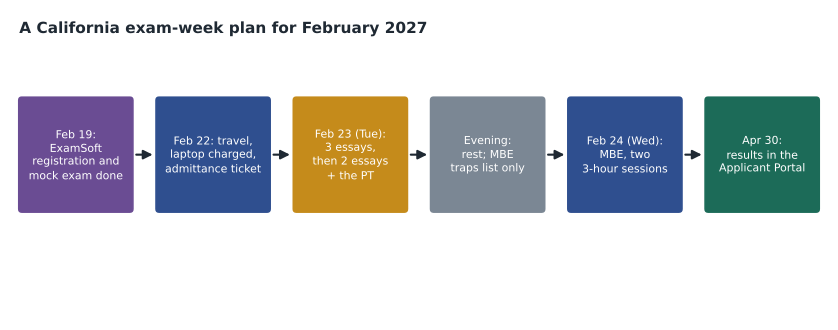
| When | Task | Sofia's plan |
|---|---|---|
| December (plan) | Two timed essays a week, one California-law subject each | Community property, wills and PR first |
| January (plan) | Two full written days under time | Saturdays in mid-January; grade the next day |
| January 26 | Admittance ticket available | Print it and save a copy |
| February 19 | ExamSoft registration and mock exam | Done by February 12 to leave a buffer |
| February 22 | Travel to Oakland; check the route | Stay near the convention center |
| February 23 | Written day | Hard stop at 60 minutes per essay; read the PT task memo twice |
| February 24 | MBE day | About 1.8 minutes per question; flag and move on |
| April 30 | Results | Applicant Portal |
Three California-specific points belong in every plan. Complete the ExamSoft mock exam early, because typing depends on it. Know your test center's location and arrival time, because the exam starts promptly. And plan the written day by session: three essays in the morning, two essays and the performance test in the afternoon, with no carrying time between sessions.
Final advice
Marchetti's closing note to Sofia is one she gives every California candidate. 'Your MBE is fine. Your law is fine. February is about time and the call of the question. Stop at the hour, read every call twice, and when the call says California, give them California.'
Common mistakes
MistakeUsing a majority rule on a wills or community property call that asks for California law.
InsteadApply the Probate Code and the Family Code.
MistakeForgetting the omitted child statute when a child is born after the will.
InsteadProbate Code section 21620 gives an intestate share unless an exception applies.
MistakeWriting past the hour on the first essay.
InsteadStop at 60 minutes and move on.
MistakeLeaving the ExamSoft mock exam to the last day.
InsteadFinish it early; the deadline for February 2027 is February 19.
How Sofia scored herself
Sofia's self-grading of the capstone, which Marchetti reviews that evening, follows the pattern in her other practice: she gives herself a point less than her coach does. On Part B she computed the Moore/Marsden shares correctly and caught the omitted child, but she spent too long on the cabin and finished the conclusion in a rush. On Part C she found every issue but wrote the referral-fee analysis only under the ABA rule at first, adding California's Rule 1.5.1 in the last minute. Marchetti's grades are a solid pass on both. Her note: 'Same lesson as July, smaller margin. Watch the clock on the issue you find most interesting.'
Summary and key terms
- California capstone questions combine admission rules with California law in community property, wills, trusts, civil procedure, evidence and professional responsibility.
- A strong community property answer states presumptions, applies Moore/Marsden with numbers and addresses reimbursement and joint title.
- A strong wills answer checks execution, the harmless error rule, revocation, lapse and omitted spouses and children.
- A strong professional responsibility answer applies both ABA and California authorities and highlights the differences.
- An exam-week plan should cover ExamSoft, travel, session timing, sleep and MBE pacing.
- Capstone
- A final exercise combining the course's material.
- Self-grading
- Scoring your own practice answer against a model outline before a coach grades it.
- Hard stop
- A fixed time at which you stop writing one answer and move to the next.
- Traps list
- A short list of points where your instincts are likely to lead you astray.
- Session timing
- Planning the time for each question within a single exam session.
Practice problems
Work each problem on paper first, then reveal the answer to check.
In Part B, why is Wren not an omitted spouse?
Show answer
She married Hal before he executed the will.
In Part B, what would change if Hal had written the will entirely by hand and signed it?
Show answer
It would be a valid holographic will under section 6111 without needing section 6110(c)(2).
In Part C, what single fact would cure the referral-fee problem under California law?
Show answer
A written agreement with the client's written consent after full written disclosure under Rule 1.5.1.
Lesson quiz · 5 questions
Score 60% or more to complete this lesson.
Create a free account to save your progress, take quizzes and earn a certificate.