
BAR-205 · Lesson 2 of 12 · 18 min
Eligibility, legal education and application deadlines
▶ Video coming soon A video version of this lesson is on the way.
On their second call Marchetti asks Sofia a question she has never had to answer for a bar exam in another state: 'Which kind of law school did you go to?' Sofia graduated from a law school accredited by the State Bar of California but not approved by the ABA. In most states that degree would not qualify her to sit at all. In California it does, and California is the reason her school exists.
This lesson covers who may sit for the California Bar Examination, the routes through legal education, the First-Year Law Students' Examination, registration and the filing calendar for the February 2027 exam.
Registration comes first
Every California applicant starts by registering with the State Bar. Law students register as law students, usually early in law school, and lawyers licensed elsewhere register as attorney applicants. Registration opens the applicant's file in the Applicant Portal, the State Bar's online system, and the moral character application and the exam application both build on it. Students in some routes must register within a set time after starting law study so that their study counts, and the admissions rules set those timelines. A candidate who missed registration should contact the Office of Admissions before doing anything else, because late registration can affect credit for law study.
The routes through legal education
California recognizes more paths to the exam than almost any other state. The State Bar's admissions rules and the Business and Professions Code describe them, and NCBE's chart for California lists them: graduates of ABA-approved schools, graduates of schools accredited by the Committee of Bar Examiners, students of registered unaccredited schools, including fixed-facility, distance-learning and correspondence schools, students in the Law Office Study Program, and foreign-educated applicants who meet additional requirements.
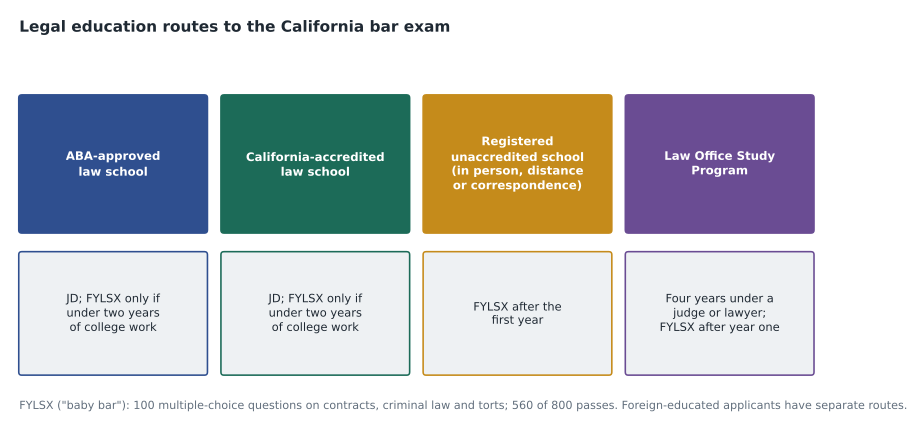
ABA-approved law schools are the route most applicants take. A JD from an ABA-approved school satisfies California's legal education requirement.
California-accredited law schools are schools the Committee of Bar Examiners accredits under its own standards. Many serve working students in part-time and evening programs. A JD from one qualifies a graduate to sit for the California exam, though usually not for exams in other states, which typically require ABA approval. That limit matters later for portability: a lawyer from a California-accredited school who wants to practice elsewhere should check each state's rules for graduates of non-ABA schools.
Registered unaccredited law schools are schools that register with the State Bar and follow its rules but are not accredited. They include fixed-facility schools that hold classes in person, distance-learning schools that teach online in real time, and correspondence schools. Their students must pass the First-Year Law Students' Examination after their first year before their later study counts.
The Law Office Study Program lets a person study law in a law office or judge's chambers under the supervision of a California lawyer or judge, without attending law school. The rules set the hours of study, the reporting and the supervisor's duties. Participants must also pass the baby bar after the first year.
Foreign-educated applicants have their own routes. Depending on their education and admissions, they may need an additional year at an ABA-approved or California-accredited school, an LLM from an ABA-approved school, a determination of educational equivalency, or admission in another jurisdiction. NCBE's chart notes that an LLM from an ABA-approved school can be enough by itself for some foreign-educated applicants. The details depend on the applicant's degree and are handled individually.
The First-Year Law Students' Examination
The First-Year Law Students' Examination, or FYLSX, is California's checkpoint for students outside the traditional law school route. The State Bar describes who must take it. Students who complete their first year at a registered unaccredited school, including distance-learning and correspondence schools, or in the Law Office Study Program must take it. So must students at ABA-approved or California-accredited schools who began law school without at least two years of college work. Students who have advanced to their second year at an ABA-approved or California-accredited school and who have at least 60 semester or 90 quarter units of undergraduate work are generally exempt.
| Feature | First-Year Law Students' Examination |
|---|---|
| Who takes it | Students in unaccredited registered schools and the Law Office Study Program; students without two years of college at accredited schools |
| Format | 100 multiple-choice questions |
| Subjects | Contracts, criminal law and torts |
| Scored questions | 90, 30 per subject; 10 are pretest or replacement questions |
| Scale | Equated to a scale with a theoretical maximum of 800 |
| Passing score | 560 or higher |
| Dates | June and October; results generally in August and December |
The exam has changed over time. Earlier versions included essay questions, and older study guides still describe them. The State Bar's current pages describe a 100-question multiple-choice exam, offered in morning and afternoon sessions with a set break in each, and they explain that raw scores are weighted and then equated, so a scaled score of 560 passes regardless of small differences in difficulty between forms.
Passing matters because credit for law study depends on it. The Business and Professions Code and the admissions rules govern how much study counts if a student takes longer to pass and what happens to study completed before passing. A student in one of these routes should plan to sit for the baby bar promptly after the first year and should read the State Bar's rules on credit before deciding whether to continue studying while waiting for results.
Worked problem
Who takes the baby bar?
Four students: (1) Ana, in her second year at an ABA-approved school, with a bachelor's degree; (2) Ben, who finished his first year at a California-accredited school with 70 semester units of college; (3) Chen, who finished his first year at a registered distance-learning school; (4) Dara, in the Law Office Study Program, finishing her first year.
Show solution
- Ana: exempt; she is past her first year at an approved school with far more than two years of college.
- Ben: generally exempt; he has more than 60 semester units and is at an accredited school, once he advances to the second year.
- Chen: must take it; he is in a registered unaccredited school.
- Dara: must take it; she is in the Law Office Study Program.
Answer: The FYLSX turns on the type of education, not on how well a student is doing.
Sofia did not need the baby bar. She entered her California-accredited school with a bachelor's degree, so she was exempt. Two people in her evening section did take it, one because he started law school with only one year of college, and one who transferred in after a first year at a distance-learning school.
Applying for the exam
The exam application is filed in the Applicant Portal. It asks for the applicant's education, the exam date and testing site preference, and whether the applicant will type or handwrite the written portion. Applicants who will type pay a laptop fee and must register with ExamSoft and complete a mock exam before the deadline the State Bar sets. Applicants with disabilities request testing accommodations through a separate process with its own deadlines.
Fees
NCBE's chart for California lists the bar exam fees as of November 2026: 878 dollars for general applicants, first-time or repeat, 1,650 dollars for attorney applicants and for the Attorneys' Examination, and a 153-dollar laptop fee for those who type. Registration and the moral character application carry their own fees, and late filing adds the late fees described below. Check the State Bar's fee schedule for current amounts before you pay, because fees are set by the State Bar and can change.
The February 2027 calendar
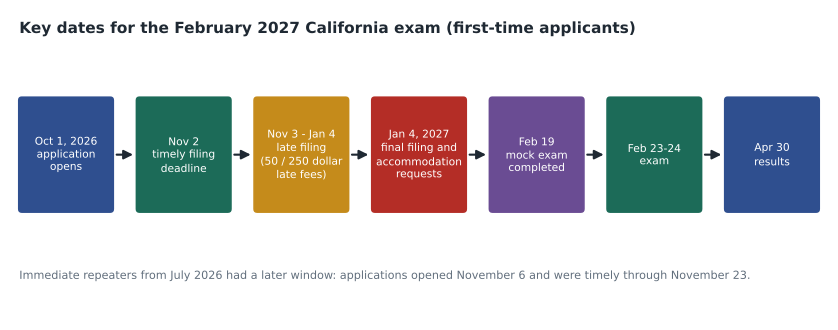
The State Bar's page for the February 2027 exam sets out a detailed schedule. For first-time applicants, and for anyone who did not sit in July 2026, the application opened on October 1, 2026, and was timely through November 2. Applications filed from November 3 through November 30 carry a 50-dollar late fee, and those filed from December 1 through January 4, 2027 carry a 250-dollar late fee. January 4 is also the final filing deadline and the last day to request testing accommodations.
Immediate repeaters from July 2026, like Sofia, had a different window. Their application opened on November 6, the timely deadline was November 23, a 50-dollar late fee applied from November 24 through December 18, and a 250-dollar late fee from December 19 through January 4. Repeaters who were absent from any session in July follow the first-time schedule.
| Date | What happens (February 2027 exam) |
|---|---|
| January 26 | Admittance tickets available; ExamSoft registration opens |
| February 1 | Last day to appeal accommodation decisions and to request a test center change |
| February 9 | Proof of eligibility from law schools, transcripts and proof of law study due; attorney applicants' certificates of good standing due |
| February 12 | Last day for emergency accommodation requests |
| February 19 | ExamSoft registration and the mandatory mock exam completed |
| February 23 and 24 | The exam |
| April 30 | Results scheduled for release in the Applicant Portal |
Withdrawals and refunds
Applicants who withdraw receive a partial refund on a sliding schedule. For first-time February 2027 applicants, the State Bar lists a 60 percent refund through December 2, a 30 percent refund from December 3 through December 17, and no refund from December 18 through February 9. Immediate repeaters have their own schedule: 60 percent from November 24 through December 23, 30 percent from December 24 through December 28, and none afterward. The practical lesson is to decide early whether you are ready, because the refund falls quickly.
Sofia filed on November 12, well before the repeaters' November 23 deadline, chose typing and the Oakland test center and paid her laptop fee. Marchetti asks her to put four dates in her calendar: February 9 for her law school's proof of eligibility, which her school sends but she should confirm, February 19 for the mock exam, the exam days, and April 30 for results.
Common mistakes
MistakeAssuming a California-accredited JD qualifies a graduate for other states' exams.
InsteadMost states require an ABA-approved degree; check each state's rules for non-ABA graduates.
MistakeDescribing the baby bar as an essay exam.
InsteadThe State Bar's current FYLSX is 100 multiple-choice questions on contracts, criminal law and torts, with 560 of 800 to pass.
MistakeUsing first-time deadlines when you are an immediate repeater, or the reverse.
InsteadCheck which schedule applies; repeaters absent from a July session follow the first-time schedule.
MistakeForgetting the mock exam.
InsteadApplicants who type must register with ExamSoft and complete the mandatory mock exam by the deadline.
Accommodations
Applicants with disabilities may request testing accommodations, such as extra time, a separate room, rest breaks or assistive technology. California handles accommodation requests through its own process, separate from the exam application, with its own forms and supporting documentation. For the February 2027 exam, January 4 was the final day to file accommodation requests, February 1 the last day to appeal a decision, and February 12 the last day for emergency requests based on conditions that arose late. Applicants who expect to need accommodations should file early, because supporting documentation from a treating professional can take time to gather and incomplete requests delay decisions.
Applicants with approved accommodations may test at a separate accommodation site and may have extended testing days, and the State Bar lists separate sites for them in each region. An applicant who received accommodations on an earlier California exam should still check whether a new request is needed for the next one.
Planning a repeat attempt
For a repeater like Sofia, the filing calendar is only part of the plan. Marchetti suggests three decisions to make before filing. First, choose the test center that minimizes stress, not only travel time; Sofia picked Oakland because she can sleep at home the night before. Second, decide whether to type or handwrite. Sofia typed in July and will type again, so she must complete the ExamSoft steps again for February. Third, decide on a withdrawal date in advance, before the refund falls to zero, and commit to an honest self-assessment by then: if her timed essays in late November are not improving, she would rather withdraw with a partial refund and sit in July than sit unprepared.
Marchetti also reminds Sofia that her application is not finished when she files it: the State Bar may ask for more information, and she should watch the Applicant Portal for messages until the exam.
Summary and key terms
- Every applicant registers with the State Bar first, as a law student or attorney applicant.
- California accepts graduates of ABA-approved and California-accredited schools, students of registered unaccredited schools, Law Office Study Program participants and qualifying foreign-educated applicants.
- The FYLSX is required in unaccredited routes and for students without two years of college; it has 100 multiple-choice questions and a passing scaled score of 560.
- For February 2027, first-time applicants filed timely by November 2 and immediate repeaters by November 23; January 4 was the final deadline.
- Exam fees were 878 dollars for general applicants and 1,650 dollars for attorney applicants, plus a 153-dollar laptop fee for typists.
- California-accredited law school
- A school accredited by the Committee of Bar Examiners but not approved by the ABA.
- Registered unaccredited law school
- A school registered with the State Bar but not accredited, including fixed-facility, distance-learning and correspondence schools.
- Law Office Study Program
- A route in which a person studies law under a California lawyer or judge instead of attending law school.
- FYLSX
- The First-Year Law Students' Examination, a 100-question test on contracts, criminal law and torts.
- Immediate repeater
- An applicant who sat the previous exam and applies for the next one, with a later filing window.
Practice problems
Work each problem on paper first, then reveal the answer to check.
A student finishes the first year at a correspondence school. Must she take the FYLSX?
Show answer
Yes; students in registered unaccredited schools, including correspondence schools, must pass it.
What scaled score passes the FYLSX?
Show answer
560 on a scale with a theoretical maximum of 800.
A first-time applicant files on December 10 for the February 2027 exam. What late fee applies?
Show answer
250 dollars, for filings from December 1 through January 4.
Lesson quiz · 5 questions
Score 60% or more to complete this lesson.
Create a free account to save your progress, take quizzes and earn a certificate.