
AWS-121 · Lesson 8 of 12 · 20 min
Costs of AI over the full life cycle
▶ Video coming soon A video version of this lesson is on the way.
When Lorraine read the first draft of the call-note summarizer proposal, she circled one line in red. The vendor-style estimate said the model would cost "about 150 dollars a year" to run. "That can't be the cost of this project," she wrote in the margin. "What else is there?" She was right to ask. The model calls were indeed cheap. Everything around them was not.
This lesson is about total cost of ownership (TCO): every cost an AI solution creates from the first idea to the day it is retired. The exam guide asks strategists to implement basic cost controls, including cost planning and optimization, and to understand how AWS pricing models affect business cases. Both start with knowing where the costs really are.
The life cycle of an AI solution
Costs arise at every stage of a solution's life. Noor listed them for Andre in six groups.
| Stage | Typical costs |
|---|---|
| Discovery and design | Workshops, use case canvases, process mapping, legal and privacy review, early experiments |
| Data preparation | Cleaning, labeling, joining sources, building pipelines, master data work |
| Build and integration | Development, prompt and guardrail design, connection to existing systems, testing, security review |
| Evaluation and launch | Building evaluation sets, expert review time, pilot running costs, training staff, change management |
| Operation | Model and service usage, infrastructure, storage, logging, monitoring, human review of outputs, support, retraining or prompt updates, audits |
| Retirement or replacement | Data export, migration, running old and new side by side, decommissioning, contract exit fees |
The operation stage usually lasts longest, so its costs add up most. And within operation, people are often the largest item: the staff who review outputs, follow up on predictions, monitor quality and handle exceptions.
A full TCO for the call-note summarizer
Andre and Noor rebuilt the summarizer estimate from the bottom up, for a three-year period. The emergency hospital takes about 14,600 calls a year. All prices are illustrative and rounded, and AWS prices change, so a real estimate would use the AWS Pricing Calculator with current rates.
| Item | One-time (dollars) | Each year (dollars) |
|---|---|---|
| Discovery, design and privacy review | 15,000 | |
| Integration with the phone system and VetLedger, plus testing | 40,000 | |
| Evaluation: two emergency veterinarians reviewing 300 test transcripts | 6,000 | |
| Staff training and change management | 8,000 | |
| Speech to text for 14,600 calls averaging 6 minutes, at an illustrative 0.024 dollars a minute | 2,102 | |
| Foundation model summaries in a nightly batch: 14,600 × (2,000 input + 300 output tokens) at illustrative on-demand rates of 0.003 and 0.015 dollars per 1,000 tokens, halved for batch | 77 | |
| Guardrails, logging and storage | 1,500 | |
| Clinical audit: 10 summaries a week × 3 minutes of a veterinarian's time at 120 dollars an hour | 3,120 | |
| Support, prompt updates and monitoring | 12,000 | |
| Retirement or replacement allowance in year 3 | 3,000 | |
| Total | 72,000 | 18,799 |
Worked problem
Working out the three-year TCO
Calculate the three-year TCO and the share of it that goes to foundation model usage.
Show solution
- Model usage per summary on demand: 2 × 0.003 + 0.3 × 0.015 = 0.006 + 0.0045 = 0.0105 dollars.
- Per year on demand: 14,600 × 0.0105 ≈ 153 dollars; in batch at about half the price, about 77 dollars.
- Annual running cost: 2,102 + 77 + 1,500 + 3,120 + 12,000 = 18,799 dollars.
- Three-year TCO: one-time 72,000 + 3 × 18,799 = 72,000 + 56,397 = 128,397 dollars.
- Model usage over three years: 3 × 77 = 231 dollars, which is about 2 in every 1,000 dollars of the TCO.
Answer: The three-year TCO is about 128,400 dollars. The foundation model itself accounts for roughly 230 dollars of it. Integration, people and support dominate.
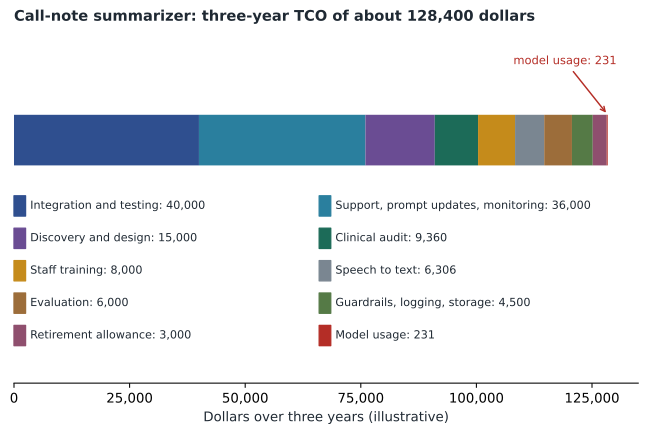
Lorraine's red circle was vindicated. The "150 dollars a year" was accurate for the thing it described and almost irrelevant to the decision. This is a common pattern for generative AI used at modest volumes: token prices are small, and the costs that matter are design, integration, evaluation and the people who keep the system safe and useful. At very high volumes, such as a public assistant answering millions of questions, usage costs can become significant, which is why the pricing model still matters.
How AWS prices AI services
The exam guide names three pricing patterns that affect AI business cases. Each behaves differently as use grows.
| Pricing model | How it works | Examples | Cost behavior |
|---|---|---|---|
| Consumption-based | Pay for what you use, measured in units such as tokens, pages, minutes or requests | Amazon Bedrock on-demand inference priced per token; Amazon Textract per page; Amazon Transcribe per minute | Rises in line with volume; no cost when idle |
| Instance-based | Pay for capacity by the hour, whether or not it is fully used | A SageMaker AI endpoint on an instance; Amazon Bedrock Provisioned Throughput | Fixed per hour; cheaper per unit at high, steady use; wasteful when idle |
| Seat-based | Pay per user per month for access | Business assistants and productivity tools such as Amazon Quick, and many third-party AI products | Rises with the number of users, not with how much each uses it |
Choosing the right pattern for a workload is a cost decision in its own right. A workload with spiky, low volume suits consumption pricing. A workload with high, steady volume may be cheaper on reserved capacity. A tool that many people use lightly may be cheaper per seat than per use, or the reverse, depending on how heavily each person uses it.
Commitments and Savings Plans
AWS offers lower prices in exchange for commitments. Savings Plans give a discount on compute in return for committing to a steady amount of hourly spending for one or three years; there are Savings Plans that cover Amazon SageMaker AI usage as well as general compute. Amazon Bedrock offers Provisioned Throughput with optional commitment terms for workloads that need guaranteed capacity. Commitments make sense only when usage is predictable. A pilot whose volume might double or disappear is a poor candidate.
Worked problem
An endpoint, a commitment or a batch
The no-show model could be hosted on a SageMaker AI endpoint running all year at an illustrative 0.20 dollars an hour, or the same endpoint covered by a one-year commitment at an illustrative effective rate of 0.13 dollars an hour. Alternatively, it could score each day's bookings in a batch job taking about an hour. Compare the yearly costs.
Show solution
- Always-on endpoint: 0.20 × 8,760 hours = 1,752 dollars a year.
- With the commitment: 0.13 × 8,760 = 1,138.80 dollars, a saving of 613.20 dollars.
- Daily batch of one hour: 0.20 × 365 = 73 dollars a year.
Answer: The commitment saves about 613 dollars a year, but the bigger saving comes from changing the design: the bookings only need scoring once a day, so a daily batch costs about 73 dollars. Right-sizing the design beats discounting the wrong one.
Cost controls in practice
Cost control has two halves: planning, before money is spent, and optimization, while the solution runs. Noor gave Andre a list of basic controls that any AI initiative should have from the start.
- Estimate before building. Use the AWS Pricing Calculator to estimate service costs from expected volumes, and add the people and integration costs it does not cover.
- Tag everything. Apply cost allocation tags, such as project and environment, to every resource so the bill can be broken down by initiative. Cascade Ridge tagged every AI resource with its use case name.
- Set budgets and alerts. Use AWS Budgets to set a monthly budget for each initiative, with alerts when actual or forecast spending passes a threshold.
- Watch the trend. Use AWS Cost Explorer to see spending by service, tag and time, and to spot unexpected growth early.
- Right-size models. Use the smallest model that meets the quality bar. A smaller foundation model can cost a fraction of a larger one per token and respond faster. Test on the evaluation set to find where quality starts to drop.
- Control output and input length. Set a maximum output length and send only the context a task needs; tokens are the meter for most generative AI pricing.
- Batch and cache. Use batch inference for work that does not need an immediate answer, and reuse results or cached prompt prefixes where the platform supports it.
- Limit runaway use. Apply quotas or rate limits to public-facing applications so a surge, an error loop or misuse cannot run up an unlimited bill.
- Review the people costs. Measure the time spent reviewing and acting on AI outputs, because improving precision or confidence routing can reduce it more than any infrastructure change.
Cost per outcome
Total cost is the start, not the end, of cost thinking. A more useful measure for decisions is cost per outcome: what it costs to produce one unit of the result the business wants. For the no-show initiative, the relevant figure is the cost per recovered appointment. With annual running costs of about 34,000 dollars and about 1,480 recovered appointments, that is about 23 dollars each, against a contribution margin of about 90 dollars. Cost per outcome makes initiatives comparable and shows quickly whether a change in design helps or hurts.
It also exposes a trap. Reducing cost per transaction is not the same as reducing cost per outcome. If a cheaper model summarizes calls for less money but produces summaries that technicians must rewrite, the cost per useful note goes up. Lorraine liked to say: "Cheap and wrong is expensive."
Hidden and rising costs
Some costs are easy to miss in early estimates:
- Growth in use. Successful tools are used more. A client assistant that answers 2,000 questions a month in the pilot might answer 20,000 after launch. Estimate costs at the expected scale, not the pilot scale.
- Retraining and updates. Prediction models drift as behavior changes and need retraining. Foundation models are updated or retired by providers, so prompts and evaluations must be revisited.
- Compliance and audit. Logging, retention, reviews and evidence for auditors take time and storage every year.
- Running two systems. During a transition, old and new run side by side, and costs overlap.
- Exit. Leaving a product or partner may involve fees, data export work and a migration project.
Estimating at scale
Pilot costs can mislead in both directions. Some costs grow with use: model usage, transcription, storage and the staff time spent on each output. Others are mostly fixed: integration, monitoring and governance. A good estimate separates the two and projects each to the expected scale. For the client-support assistant, Andre asked the partner to estimate usage costs at three volumes: the pilot volume of about 2,000 questions a month, an expected volume of about 8,000 after launch, and a high case of 20,000 if clients took to it quickly. The usage cost grew tenfold across that range; the fixed costs barely moved.
Projecting at scale also shows when a pricing model should change. At low volume, consumption pricing for the assistant was clearly cheapest. At the high case, the partner suggested that reserved capacity or a smaller model for simple questions might cost less, and that a cache of approved answers to the most common questions would avoid calling a model at all for many of them. None of these changes was needed for the pilot, but knowing the break points in advance meant the group would not be surprised by its bill if the assistant succeeded. Cost planning is partly about preparing for success.
Finally, cost estimates should be revisited after launch. Andre asked Noor to compare actual monthly costs for each initiative against the estimate in its business case, using the tags and Cost Explorer reports, and to explain any gap larger than a fifth. Over time, this comparison improves the accuracy of future estimates, which is one of the less visible benefits of good cost discipline: each business case becomes easier to believe than the last.
Common mistakes
MistakeTreating model usage as the cost of the project.
InsteadCount every life-cycle cost; people, integration and support often dominate.
MistakeBuying commitments for an unpredictable pilot.
InsteadCommit only when usage is steady and predictable; first right-size the design.
MistakeLaunching without tags or budgets.
InsteadTag resources by initiative and set budgets with alerts from the first day.
MistakeOptimizing cost per transaction alone.
InsteadTrack cost per outcome; a cheaper output that needs rework can cost more.
Summary and key terms
- Total cost of ownership covers discovery, data preparation, build and integration, evaluation and launch, operation, and retirement.
- For many generative AI uses at modest volume, model usage is a small share and people, integration and support dominate.
- AWS AI services are priced by consumption, by instance or capacity, or by seat, and each pattern behaves differently as use grows.
- Savings Plans and other commitments lower prices for predictable usage.
- Basic cost controls include estimates with the AWS Pricing Calculator, cost allocation tags, AWS Budgets alerts, monitoring in AWS Cost Explorer, right-sized models, length limits, batching, caching and quotas.
- Cost per outcome is the most useful measure for decisions.
- Total cost of ownership
- Every cost a solution creates over its whole life.
- Consumption-based pricing
- Paying per unit of use, such as per token, page or minute.
- Instance-based pricing
- Paying for capacity by the hour whether or not it is fully used.
- Seat-based pricing
- Paying per user per month.
- Savings Plans
- Lower prices in return for a one- or three-year commitment to steady usage.
- Cost per outcome
- The cost of producing one unit of the business result, such as one recovered appointment.
Practice problems
Work each problem on paper first, then reveal the answer to check.
A tool costs 12,000 dollars a year to run and produces 400 useful outcomes. What is its cost per outcome?
Show answer
12,000 ÷ 400 = 30 dollars per outcome.
Which pricing pattern suits a low, spiky workload?
Show answer
Consumption-based pricing, because there is no cost when the system is idle.
Name three basic cost controls for an AI initiative.
Show answer
For example cost allocation tags, AWS Budgets alerts, right-sized models, output length limits, batching or quotas.
Lesson quiz · 5 questions
Score 60% or more to complete this lesson.
Create a free account to save your progress, take quizzes and earn a certificate.