
AWS-121 · Lesson 2 of 12 · 18 min
Identifying and prioritizing use cases
▶ Video coming soon A video version of this lesson is on the way.
Andre's second session began with a long list. Over two weeks he had collected AI ideas from clinic managers, veterinarians, reception leads, the finance team and two vendor presentations. After removing duplicates there were nineteen. Some were precise ("read the lab-report PDFs and put the values into VetLedger"); some were vague ("use AI for marketing"); one was simply "something like ChatGPT for everyone".
"Nineteen ideas and money for maybe four," Andre said. "How do I choose without it turning into a popularity contest?" Noor's answer took the whole session: first make the ideas comparable, then score them against criteria agreed in advance, then decide what to do with each one, including stopping some.
Finding use cases worth considering
Good use cases rarely arrive fully formed. Organizations find them in a few reliable ways, and a sound process uses more than one:
- Start from objectives. Work down a value tree, as in lesson 1, and ask where an AI capability could move a driver.
- Follow the pain. Ask front-line staff where time goes, where errors happen and what they do twice. At Cascade Ridge, technicians named the overnight call notes and reception named the lab-report typing.
- Follow the data. Look at the data the organization already holds and ask what it could predict or explain. Three years of appointments made the no-show idea possible.
- Look at the customer journey. Walk through a client's experience from booking to follow-up, and note every wait, repeat question and handoff.
- Learn from the industry. Note what peers and competitors are doing with AI, without assuming the same thing will work for you. Lesson 11 returns to this.
Vendor pitches are a sixth source, but Noor treated them with care. A vendor's use case is shaped by what the vendor sells. It may be a good idea; it should still enter the same process as every other idea.
Writing each idea on one page
To compare ideas fairly, each one needs the same basic description. Noor gave Andre a one-page use case canvas with eight boxes. An idea that cannot fill most of the boxes is not ready to be scored; it goes back to its sponsor with questions.
| Box | What it asks | Example: lab-report extraction |
|---|---|---|
| Problem | What is going wrong today, for whom, and how often? | Reception staff type values from about 180 outside lab-report PDFs a day into VetLedger; errors reach patient records |
| Objective served | Which business objective from the annual plan does it support? | Reduce administrative load; keep client trust |
| Proposed AI capability | What would the AI do? | Extract test names, values, units and reference ranges from PDFs into a review screen |
| Users and workflow | Who uses the output, and what changes in their work? | Reception staff check and approve extracted values instead of typing them |
| Measures | How will success be measured? | Minutes per report; transcription errors found in audits |
| Data | What data is needed, and is it available and lawful to use? | The PDFs themselves; a sample of 500 past reports with correct entries |
| Risks | What could go wrong, and how badly? | A wrong value accepted without checking; mitigated by side-by-side review |
| Rough size | Order-of-magnitude cost and benefit | Low build cost using a managed document extraction service; about 0.5 full-time role of typing saved |
Writing canvases removed six of the nineteen ideas immediately. Some turned out to be the same idea under different names. One ("use AI for marketing") could not name a problem or a measure. And "something like ChatGPT for everyone" was rewritten into two specific ideas: a staff assistant for the procedure manual and a tool for clinic managers to query shift reports.
Criteria agreed before scoring
The exam guide lists the factors for prioritizing AI initiatives: business value, feasibility, sustainability and strategic alignment. Most organizations also score risk separately, because a valuable idea with severe risks needs different treatment from a valuable idea with mild ones. The criteria, and their weights, should be agreed before anyone scores a single idea. If they are chosen afterwards, people tend to pick weights that favor the ideas they already like.
| Criterion | Question | How Cascade Ridge scored it (1 to 5) | Weight |
|---|---|---|---|
| Business value | How large is the benefit, and how directly does it reach a tracked measure? | 5 = large, realized benefit with a clear owner | 0.35 |
| Feasibility | Do we have the data, skills, systems and time? | 5 = data ready, proven approach, small integration | 0.25 |
| Risk (inverted) | How serious are the potential harms, and can they be controlled? | 5 = low risk, easy to control | 0.15 |
| Strategic alignment | How closely does it serve the board's stated objectives? | 5 = directly serves a top objective | 0.15 |
| Sustainability | Can it be run, maintained and paid for over years, including its environmental and staffing costs? | 5 = low running cost and effort, energy-efficient | 0.10 |
Sustainability in this sense has two parts. One is whether the organization can keep the system running: the ongoing costs, skills and attention it needs after the launch excitement fades. The other is environmental: a solution that meets the need with a smaller model, or runs only when needed, uses less energy than one that runs a large model continuously. Both parts point the same way, toward right-sized solutions.
Scoring the shortlist
Andre, Noor, Lorraine, Dr. Kaur and Hannah scored the thirteen remaining ideas separately, then met to discuss any score where they differed by two points or more. The discussion mattered more than the arithmetic. Dr. Kaur scored the call-note summarizer's risk much lower than Andre had, because she knew how a missing medication could hurt a patient. After hearing her, Andre changed his score. Eight ideas went forward to the final comparison.
| Use case | Value | Feasibility | Risk (inv.) | Alignment | Sustain. | Weighted score |
|---|---|---|---|---|---|---|
| No-show reminders | 4 | 4 | 4 | 5 | 4 | 4.15 |
| Lab-report extraction | 3 | 4 | 4 | 3 | 4 | 3.50 |
| Pharmacy demand forecast | 4 | 2 | 4 | 4 | 3 | 3.40 |
| Review-comment themes | 2 | 5 | 5 | 2 | 4 | 3.40 |
| Call-note summaries | 4 | 3 | 2 | 4 | 3 | 3.35 |
| Client-support assistant | 3 | 3 | 3 | 4 | 3 | 3.15 |
| Radiograph quality check | 3 | 2 | 3 | 3 | 3 | 2.75 |
| Marketing images | 1 | 5 | 3 | 1 | 2 | 2.40 |
Worked problem
Calculating a weighted score
Check the weighted score for the call-note summaries: value 4, feasibility 3, risk 2, alignment 4, sustainability 3.
Show solution
- Multiply each score by its weight: 4 × 0.35 = 1.40; 3 × 0.25 = 0.75; 2 × 0.15 = 0.30; 4 × 0.15 = 0.60; 3 × 0.10 = 0.30.
- Add the products: 1.40 + 0.75 + 0.30 + 0.60 + 0.30 = 3.35.
- \[S = \sum_i w_i x_i = 1.40 + 0.75 + 0.30 + 0.60 + 0.30 = 3.35\]
- Compare with the others: it sits fifth, behind two ideas with lower value but much lower risk.
Answer: The weighted score is 3.35. Its value is high, but its low risk score pulls it down, which is a prompt to ask whether stronger controls could raise that score before it is ranked lower for good.
A weighted score is a tool for discussion, not a verdict. Three ideas scored within 0.05 of each other: the pharmacy forecast, review-comment themes and call-note summaries. Differences that small say nothing about which is better. Noor's advice was to treat scores as bands: clearly high, middle and clearly low. Within a band, the decision rests on judgment and on the questions the scores raise.
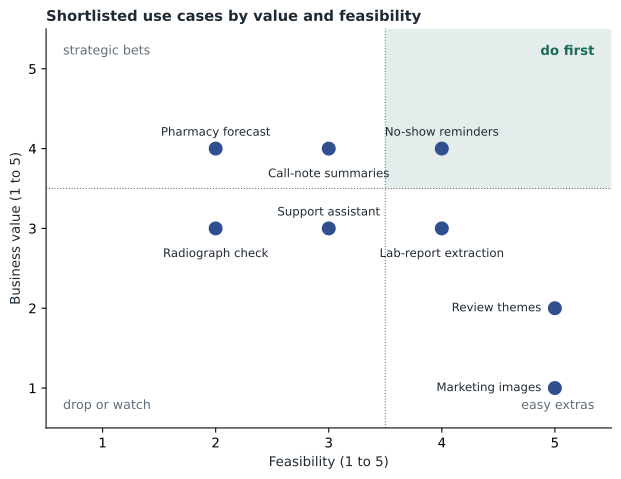
Reading the value and feasibility chart
Many teams plot ideas on two axes, value up the side and feasibility along the bottom, to see the shape of a portfolio at a glance. The four regions of the chart suggest different treatment:
- High value, high feasibility: do these first. The no-show reminders sat here.
- High value, low feasibility: strategic bets that need groundwork, often in data. The pharmacy forecast was valuable, but the supply data was spread across three systems with inconsistent product codes. The first step was a data project, not a model.
- Low value, high feasibility: easy wins that may be worth doing if they are cheap, but should not crowd out important work. Review-comment themes could be done quickly with a managed language service.
- Low value, low feasibility: usually not worth pursuing now. The radiograph quality check stayed on a watch list.
The chart hides the risk and alignment scores, so it is a companion to the table, not a replacement.
Scale, pause or terminate
Prioritization is not a one-time ranking. The exam guide expects a strategist to decide, at intervals, whether each initiative should scale, pause or terminate. These decisions apply to ideas already under way as much as to new ones, and they are the hardest to make, because people and budgets are attached.
| Decision | When it fits | Example |
|---|---|---|
| Scale | Evidence shows the benefit at the expected level, risks are controlled, and the organization can absorb the change | If the no-show pilot meets its targets, extend it from four clinics to all eleven |
| Pause | The idea is still promising, but a dependency is missing or circumstances have changed | Pause the pharmacy forecast until product codes are cleaned up |
| Terminate | Evidence shows the benefit will not arrive, the risk cannot be controlled, or a better option exists | Stop the marketing image idea; stock photography and a designer meet the need |
| Pivot | The core idea works, but for a different use or user than planned | A summarizer built for call notes might serve discharge instructions better |
Terminating an initiative is not a failure if it happens early and for good reasons. The failure is continuing to spend on an idea after the evidence has turned against it, often because stopping feels like admitting a mistake. Lorraine called this the "sunk cost trap": money already spent cannot be recovered, so it should not influence whether to spend more. Setting stop conditions in advance, as part of each initiative's plan, makes these decisions easier. Lesson 9 shows how.
A balanced portfolio
Andre noticed that the top of the ranking was full of small, safe ideas. That is a common pattern, and it can be a problem. If an organization funds only quick wins, it may never build the data and skills that bigger opportunities need. If it funds only ambitious bets, it may spend two years without visible results and lose the board's support.
Noor suggested thinking about the portfolio as a whole. A rough split she had seen work in mid-sized organizations was a majority of the budget on well-understood initiatives with near-term value, a meaningful share on foundations such as data quality that make later work possible, and a small share on experiments that might fail. The exact split matters less than making it deliberate. For Cascade Ridge's first year, the board leaned toward near-term value, because the AI program needed to prove itself.
Prioritization in exam scenarios
Scenario questions on prioritization usually describe several initiatives with different mixes of value, feasibility, risk and alignment, and ask which to pursue first, or what to do with one that is struggling. The best answer is rarely the most exciting initiative. It is usually the one that serves a stated business objective, has data and skills available, carries risks that can be controlled, and can show measurable results soon. Watch for distractors that choose an initiative because a competitor has it, because a vendor offered it, or because it uses the newest technology.
Questions about initiatives already under way test the scale, pause or terminate decision. Look for the evidence the scenario gives: has the initiative met its targets, is a dependency missing, has the business situation changed, or has a better option appeared? Answers that keep funding an initiative only because money has already been spent, or that scale an initiative before its risks are controlled, are usually wrong. Answers that tie the decision to criteria agreed in advance are usually right.
Common mistakes
MistakeChoosing weights after seeing the scores.
InsteadAgree criteria and weights before scoring, so they are not bent toward favorite ideas.
MistakeTreating small differences in weighted scores as meaningful.
InsteadGroup ideas into bands and decide within a band by judgment and discussion.
MistakeLetting the most enthusiastic sponsor decide.
InsteadScore independently, then discuss large disagreements; the people closest to the risks often see what others miss.
MistakeNever stopping an initiative once it has started.
InsteadSet stop conditions in advance and review regularly whether to scale, pause, terminate or pivot.
Summary and key terms
- Use cases come from objectives, front-line pain points, available data, the customer journey and the industry.
- A one-page canvas makes ideas comparable.
- Prioritization weighs business value, feasibility, risk, strategic alignment and sustainability using weights agreed in advance.
- Weighted scores support discussion but small differences are not meaningful.
- A value and feasibility chart shows quick wins, strategic bets, easy extras and ideas to drop.
- Strategists regularly decide whether each initiative should scale, pause, terminate or pivot, and they keep a deliberate balance between near-term value, foundations and experiments.
- Use case canvas
- A one-page description of an AI idea: problem, objective, capability, users, measures, data, risks and rough size.
- Weighted score
- The sum of each criterion score multiplied by its agreed weight.
- Feasibility
- Whether the organization has the data, skills, systems and time to deliver an idea.
- Sustainability
- Whether a solution can be run and paid for over time, including its energy use.
- Sunk cost
- Money already spent, which should not decide whether to spend more.
- Pivot
- Redirecting an initiative to a different use or user where it works better.
Practice problems
Work each problem on paper first, then reveal the answer to check.
An idea scores value 5, feasibility 1, risk 4, alignment 5, sustainability 3. What is its weighted score with this lesson's weights?
Show answer
5 × 0.35 + 1 × 0.25 + 4 × 0.15 + 5 × 0.15 + 3 × 0.10 = 1.75 + 0.25 + 0.60 + 0.75 + 0.30 = 3.65.
Where on the value and feasibility chart is a strategic bet?
Show answer
High value but low feasibility; it usually needs groundwork such as data work before a model.
Why set stop conditions before an initiative starts?
Show answer
They make it easier to terminate or pause on evidence rather than continuing because of sunk costs.
Lesson quiz · 5 questions
Score 60% or more to complete this lesson.
Create a free account to save your progress, take quizzes and earn a certificate.