
AWS-121 · Lesson 1 of 12 · 20 min
Where AI creates business value
▶ Video coming soon A video version of this lesson is on the way.
In the second week of November, Andre Leclerc, operations manager for the eleven clinics of Cascade Ridge Veterinary Partners, was handed a job nobody had held before. The board had watched the autumn AI assessment with interest and some alarm. It now had a list of more than a dozen AI ideas, a handful of enthusiastic vendors, and no way to tell which ideas were worth money. It asked Andre to bring back an AI roadmap by the end of the first quarter of 2027: which ideas to fund, in what order, with what budget, and how the group would know whether they were working.
Andre was not a data scientist. He ran schedules, staffing, supplies and the daily problems of eleven busy clinics. That was exactly why the board chose him. "We have people who can build models," Lorraine Beaudry, the CFO, told him. "We need someone who can tell us which models are worth building." Andre decided to study for the AWS Certified AI Business Strategist exam (AIB-C01) along the way, and he planned to sit it in May 2027.
Noor Siddiqui, the data scientist running the group's AI assessment, agreed to coach him. Their Thursday-morning strategy sessions are the thread of this course. Noor brought the technical judgment; Lorraine joined for anything involving money; Dr. Simone Kaur, the medical director, joined whenever an idea came near clinical work; and Hannah Weiss, the privacy and security lead, joined whenever client data was involved, which was often.
This course and the exam
The AIB-C01 exam is aimed at business leaders, consultants, program managers and others who decide where AI is used and are accountable for its results. It does not test coding or hands-on AWS configuration. Its questions are scenario based, in two formats: multiple choice, with one correct answer out of four, and multiple response, with two or more correct answers out of five or more options. The exam guide divides the content into four domains:
| Domain | Weight (out of 100 scored points) | Where it is covered |
|---|---|---|
| 1. AI Fundamentals and Literacy | 24 | Background from the AI Practitioner courses; reviewed in the exam readiness course |
| 2. AI Strategy and Business Value Creation | 28 | This course |
| 3. AI Governance and Responsible AI Leadership | 24 | The responsible AI course and the transformation course |
| 4. Business Readiness, Leadership, and AI Transformation | 24 | The transformation course |
Domain 2 has three tasks. The first is developing AI strategies that line up with business objectives: finding high-impact use cases, deciding whether to build, buy or partner, prioritizing initiatives, recognizing when AI is the wrong answer, and preparing for transitions. The second is measuring and demonstrating value: key performance indicators, baselines, return on investment, leading indicators and cost control. The third is positioning AI for competitive advantage: reading the competitive landscape, spotting business model opportunities, understanding which advantages last, and setting the right level of investment. Each lesson in this course takes up part of that list, and the last lesson pulls it together into Andre's roadmap.
Results are reported on a scaled score from 100 to 1,000, with 700 needed to pass. Scoring is compensatory: you pass on the overall score, not on each domain separately. Unanswered questions count as wrong and there is no penalty for guessing. The exam readiness course covers format, timing and strategy in detail.
Value starts with the business, not the technology
Noor began the first session by turning Andre's list upside down. The board's list was organized by technology: a chatbot, a forecasting model, an image tool, a summarizer. "Every one of these is a solution looking for a problem," she said. "Start from the other end. What does Cascade Ridge need to get better at? Then ask which of those needs AI can help with."
This is the most important habit in AI strategy. Business value is a measurable improvement in something the organization cares about: more revenue, lower cost, lower risk, better experience for clients or staff, or faster and better decisions. A technology that produces impressive demonstrations but does not move one of those measures has not created business value, however clever it is. A strategy therefore begins with business objectives and works toward capabilities, not the reverse.
Cascade Ridge's objectives for 2027 were already written down in the board's annual plan. Andre copied them onto the whiteboard:
- Grow revenue per clinic without adding exam rooms, mainly by filling more of the appointment slots the clinics already have.
- Keep the emergency hospital safe and well staffed overnight, where technician turnover had been high.
- Reduce the administrative load on veterinarians and technicians, which staff surveys named as the main cause of burnout.
- Keep client trust high, measured by review scores and the share of clients who return within eighteen months.
- Hold the growth in operating costs below the growth in revenue.
"Good," Noor said. "Now every AI idea has to point at one of those lines, or it doesn't get a slot on the roadmap."
The levers AI can pull
It helps to name the ways AI creates value, because each lever is measured differently. Most AI benefits fall under five broad levers.
| Lever | What AI does | Typical measures | A Cascade Ridge example |
|---|---|---|---|
| Revenue growth | Wins, keeps or serves more customers, or raises value per customer | Revenue, conversion rate, retention, average revenue per client | Filling slots that would otherwise be lost to no-shows |
| Cost reduction | Does work with less time, material or rework | Cost per transaction, hours per task, error and rework rates | Typing lab results into records automatically instead of by hand |
| Risk reduction | Catches problems earlier or reduces errors and losses | Incident counts, losses avoided, compliance findings | Flagging a blurry radiograph before the patient goes home |
| Experience | Makes interactions faster, easier or more personal for clients or staff | Satisfaction scores, wait times, staff survey results | Answering after-hours questions about opening times and refills |
| Decision quality and speed | Gives people better information sooner | Forecast accuracy, time to decision, outcomes of decisions | Forecasting pharmacy demand so orders are right the first time |
Two cautions came up straight away. First, one idea can pull several levers at once. The no-show model helps revenue (filled slots) and experience (clients who need a reminder get one), and it may cut staff time spent on phoning. A good business case names the main lever and treats the others as additional benefits rather than adding them all up uncritically. Second, some levers are easier to measure than others. Cost reductions and revenue appear in the accounts; experience and decision quality often show up only indirectly. Lesson 5 deals with measuring both kinds.
Mapping capabilities to outcomes
The exam guide asks you to identify high-impact AI use cases across business functions and to map AI capabilities to specific business outcomes. It names customer operations, sales and marketing, research and development, and software development as examples. A capability is what a type of AI can do: classify, predict a number, find patterns, extract information from documents, understand and generate language, recognize images, or plan and act through tools as an agent. An outcome is the business result you want. Strategy work is largely the work of joining the two with a believable chain of cause and effect.
| Business function | AI capabilities often used | Outcomes they can serve |
|---|---|---|
| Customer operations | Language understanding and generation, search over documents, classification of requests, speech to text | Shorter waits, more questions answered without a person, consistent answers, lower cost per contact |
| Sales and marketing | Prediction of churn or response, recommendation, content generation, segmentation | Higher conversion and retention, better-targeted spending, faster campaign production |
| Research and development | Pattern finding in data, summarizing literature, simulation, image analysis | Faster discovery, fewer failed experiments, better products |
| Software development | Code generation and explanation, test generation, documentation | Faster delivery, fewer defects, easier modernization of old systems |
| Back office and operations | Document extraction, forecasting, anomaly detection, scheduling optimization | Less manual entry, fewer errors, lower inventory, better staffing |
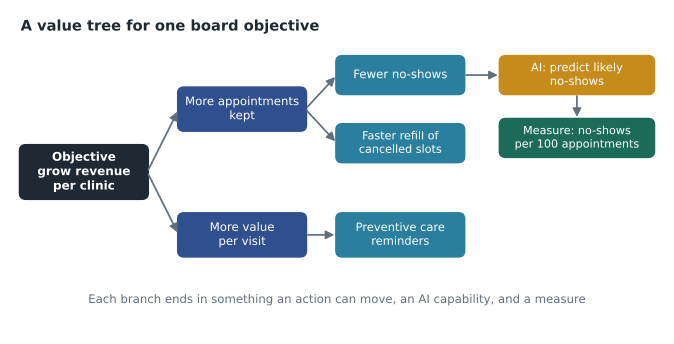
Noor drew the chain as a value tree. At the left is an objective, such as growing revenue per clinic. It splits into drivers: more appointments kept, and more value per visit. Each driver splits again, until a branch is specific enough that an action can move it: fewer no-shows, for example. Only at that point does an AI capability appear, such as predicting which bookings are likely to be missed so staff can send an extra reminder or offer the slot to a waitlist. Next to the capability goes the measure that will show whether it worked: no-shows per 100 appointments.
A value tree does three useful things. It forces the chain of cause and effect to be stated, so weak links are visible: if extra reminders do not actually change client behavior, the whole branch fails. It shows where AI is only one part of the answer, because the reminder process, the waitlist and the reception staff matter as much as the model. And it gives each initiative a measure before anyone builds anything, which is the start of the baseline work in lesson 5.
Competitive advantage, briefly
The third task in Domain 2 asks how AI can give an organization an advantage over its competitors. Lesson 11 treats this properly, but the main idea belongs here. Many AI tools are available to everyone: any clinic group can buy the same scheduling software with the same built-in assistant. Those tools may be worth having, but they rarely set an organization apart, because competitors can match them quickly. Advantage that lasts usually comes from things competitors cannot copy easily: proprietary data, such as Cascade Ridge's three years of appointment history and 95,000 pet records; processes redesigned around AI rather than AI bolted onto old processes; skills and habits built up through practice; and the trust of clients who have seen the organization use AI carefully.
Andre found this reassuring. "So we don't have to be first," he said. "We have to be good at using what we have." Noor agreed, with a warning: being too slow has a cost too, if competitors use AI to offer clients something Cascade Ridge cannot.
Value that is real, not apparent
Before ending the session, Lorraine raised the question that would return in almost every later lesson. Vendors had shown her impressive figures: hours saved per week, tickets deflected, productivity up. "How much of that is real money?" she asked.
The honest answer is: it depends what happens next. If an AI tool saves each technician twenty minutes a night, that time has value only if it is used for something that matters: more patient care, fewer overtime hours, less burnout and turnover. If the twenty minutes simply disappear into the shift, the saving is real for the technician but invisible in the accounts. Strategists distinguish realized value, which shows up in a measure the business tracks, from potential value, which would show up if the organization changed something to capture it. A good plan says how potential value will be turned into realized value, for example by reducing overtime budgets, or by tracking staff turnover as a target measure.
Noor's rule of thumb for the board was simple: a benefit counts in the business case if it has a named owner, a measure, a baseline and a plan for capturing it. Anything else goes in a separate column labeled "other benefits", where it can support a decision but not carry it.
Worked problem
Building a value tree for after-hours work
Dr. Kaur wants to use AI for the overnight call notes at the emergency hospital. Build a short value tree from one of the board's objectives, and name the capability and the measure.
Show solution
- Choose the objective it serves: keeping the emergency hospital safe and well staffed overnight.
- Name a driver: less administrative load per shift, which staff link to burnout and turnover.
- Make the driver specific: less time spent writing up phone calls, which currently takes about 6 minutes per call.
- Attach the capability: summarizing a call transcript into a draft note with fixed headings, reviewed and approved by a veterinarian or technician.
- Attach the measure and a guardrail: minutes per call note (target) and clinically important details missed in an audit sample (must not rise).
Answer: Objective: safe, well-staffed overnight care. Driver: less write-up time per call. Capability: draft summaries of call transcripts, reviewed by clinical staff. Measures: minutes per note, with an audit of missed details as a guardrail. The tree also shows that the value is realized only if the time saved goes into patient care or reduces overtime.
Common mistakes
MistakeStarting from a technology and looking for a place to use it.
InsteadStart from business objectives, work down to specific drivers, and only then ask which AI capability could move them.
MistakeAdding up every benefit an idea might have.
InsteadName the main lever and its measure; treat other benefits as supporting, and avoid counting the same gain twice.
MistakeCounting hours saved as money saved.
InsteadTime saved becomes realized value only when the organization captures it, for example through lower overtime or more work done.
MistakeAssuming any AI tool brings competitive advantage.
InsteadTools everyone can buy rarely set an organization apart; lasting advantage usually comes from data, redesigned processes, skills and trust.
Summary and key terms
- Business value is a measurable improvement in something the organization cares about: revenue, cost, risk, experience or decision quality.
- AI strategy starts with business objectives and works down to drivers, capabilities and measures, often drawn as a value tree.
- The exam guide expects you to map AI capabilities to outcomes across functions such as customer operations, sales and marketing, research and development, and software development.
- Potential value becomes realized value only when someone owns it, measures it against a baseline and changes something to capture it.
- Lasting competitive advantage tends to come from proprietary data, redesigned processes, skills and trust rather than tools anyone can buy.
- Business value
- A measurable improvement in revenue, cost, risk, experience or decision quality.
- Value lever
- A broad way AI creates value, such as revenue growth or cost reduction.
- Value tree
- A diagram linking an objective to drivers, an AI capability and a measure.
- Capability
- What a type of AI can do, such as classify, predict, extract or generate.
- Realized value
- Benefit that appears in a measure the business tracks.
- Potential value
- Benefit that would appear only if the organization changes something to capture it.
Practice problems
Work each problem on paper first, then reveal the answer to check.
Name the four AIB-C01 domains and the weight of Domain 2.
Show answer
AI Fundamentals and Literacy; AI Strategy and Business Value Creation (28 out of 100); AI Governance and Responsible AI Leadership; Business Readiness, Leadership, and AI Transformation.
What is the difference between a capability and an outcome?
Show answer
A capability is what the AI can do, such as predicting no-shows; an outcome is the business result, such as more appointments kept.
A tool saves each receptionist 15 minutes a day. Is that business value?
Show answer
It is potential value. It becomes realized value if the time is captured, for example by handling more calls, reducing overtime, or improving a tracked measure.
Lesson quiz · 5 questions
Score 60% or more to complete this lesson.
Create a free account to save your progress, take quizzes and earn a certificate.