
AWS-119 · Lesson 7 of 12 · 21 min
Domain 4 review: responsible AI
▶ Video coming soon A video version of this lesson is on the way.
Domain 4 carries 14 of every 100 scored points, about seven questions. It has two task statements: developing AI systems responsibly, and recognizing why transparent and explainable models matter. For Jonah this domain is personal. The group's rule that every clinical decision stays with a veterinarian or credentialed technician came from a long meeting in October with Dr. Simone Kaur, the medical director, who refused to approve the no-show pilot until she understood exactly what the model could and could not do. Noor's notes say: "Domain 4 questions often look like common sense. They are, but the exam expects the precise term and the matching AWS tool."
Task 4.1: features of responsible AI
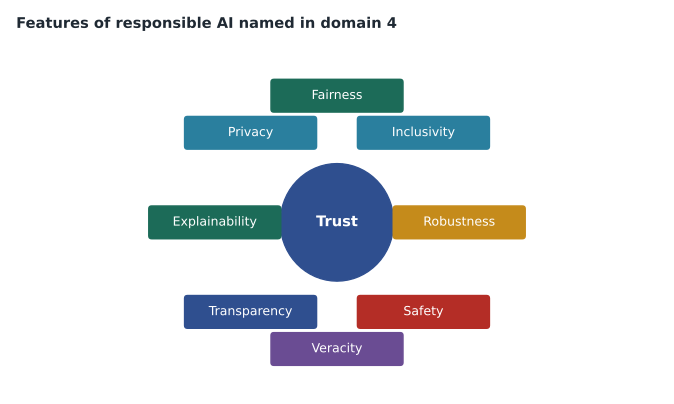
The guide names features of responsible AI, including bias, fairness, inclusivity, robustness, safety and veracity. Fairness means a system does not produce unjustly different outcomes for different groups. Inclusivity means it works for the full range of people it serves, including those with different languages, abilities or circumstances. Robustness means it behaves reliably when inputs are unusual, noisy or adversarial. Safety means it avoids outputs that cause harm. Veracity means its outputs are truthful and accurate. AWS's broader responsible AI framework also emphasizes privacy and security, explainability, transparency, controllability and governance, so expect those words in options too.
The guide asks you to know tools that help. Amazon Bedrock Guardrails lets you define policies that apply to both prompts and responses: denied topics, content filters for categories such as hate, insults, sexual content, violence and misconduct, word filters, filters for sensitive information such as personal details, and contextual grounding checks that flag responses not supported by the source material. Guardrails can also detect prompt attacks. Amazon SageMaker Clarify detects bias in data and models and explains predictions by showing how much each feature contributed. Amazon Augmented AI, often called A2I, adds human review workflows to machine learning predictions, for example sending low-confidence results to a person.
Choosing models responsibly
Responsible model selection goes beyond accuracy. The guide mentions environmental considerations and sustainability: larger models and more training consume more energy, so choosing the smallest model that meets the need, reusing pre-trained models rather than training new ones, and running workloads efficiently are responsible choices as well as cheaper ones. It also includes checking a model's documentation, license and intended use. A model card, discussed below, records exactly that information.
Legal risks of generative AI
The guide lists legal risks: intellectual property infringement claims, biased model outputs, loss of customer trust, risks to end users and hallucinations. Intellectual property risk arises when a model's output reproduces protected material or when training data was used without the right to do so. Biased outputs can create discrimination claims. Hallucinations can mislead customers, which has led to real disputes where organizations were held responsible for what their chatbots said. On the exam, the response to these risks is usually a combination of governance, human review, grounding in trusted sources and clear communication to users that they are dealing with AI.
The policy setting differs between countries, and Noor added a note for Jonah. In the United States there is no single federal AI law; a December 2025 executive order sought a national framework and challenged state AI rules, and Colorado replaced its broad 2024 AI act with a narrower law that takes effect on January 1, 2027, so the group follows Colorado's privacy law and watches the new rules. The exam does not test national law, but understanding the setting helps you see why governance questions matter.
Data sets, bias and variance
The guide lists characteristics of good data sets: inclusivity, diversity, curated data sources and balance. A data set is balanced when the groups and outcomes it contains are represented in sensible proportions; an unbalanced data set can lead a model to ignore minority cases. For the no-show model, Noor checked whether the data covered all eleven clinics, rural and urban, and every appointment type, because a model trained mostly on the busy Denver hospital might perform badly in small clinics.
Bias and variance describe two different kinds of error. A model with high bias is too simple and underfits: it misses real patterns and performs poorly even on its training data. A model with high variance is too complex and overfits: it memorizes the training data, including noise, and performs poorly on new data. The guide connects these to effects on demographic groups and inaccuracy. Do not confuse this statistical sense of bias with unfair treatment of groups, although both can appear in the same question. Tools to detect and monitor bias and truthfulness include analyzing label quality, human audits and subgroup analysis, which means checking performance separately for each group rather than only overall.
| Problem | What you see | Typical remedy |
|---|---|---|
| Underfitting (high bias) | Poor results on training and new data | A more capable model or better features |
| Overfitting (high variance) | Great on training data, poor on new data | More data, simpler model, regularization |
| Unbalanced data | A group or outcome is poorly predicted | Rebalance or collect more examples |
| Poor label quality | Inconsistent or wrong answers learned | Review and relabel |
| Unequal performance | Good overall, poor for one group | Subgroup analysis, then fix data or model |
Practice items for domain 4
First: a recruiting tool rates candidates from one university much higher than equally qualified candidates from others. Which responsible AI feature is at stake, and which tool helps investigate? Fairness; SageMaker Clarify can measure bias in the data and model. Second: a chatbot must never discuss medication doses with pet owners. Which feature enforces that? A denied topic in Amazon Bedrock Guardrails. Third: a model's answers are correct on clean test data but fail on typed notes full of abbreviations and spelling mistakes. Which feature is weak? Robustness. Fourth: an image model was trained on a public data set whose license forbids commercial use. Which legal risk does this raise? Intellectual property infringement. Fifth: a team wants low-confidence predictions sent to a person before they are used. Which service fits? Amazon Augmented AI.
Human oversight in practice
Human oversight is a theme across domain 4, and the exam favors answers that place people where errors are costly. There are several patterns. Human-in-the-loop means a person approves each output before it takes effect, as with the group's rule that a veterinarian reviews every discharge draft. Human-on-the-loop means people monitor the system and can intervene, as with staff reviewing the no-show flags each morning and marking wrong ones. Human review can also be selective, sending only low-confidence or high-risk cases to a person, which is what A2I supports. The right pattern depends on the stakes: the higher the cost of an error, the closer a person should be to each decision.
Oversight only works if the people involved understand what the AI does. That is why the group trained reception staff on what a no-show flag means and does not mean, and why each flag shows a short reason. A flag is a prompt to send a reminder, never a judgment about a client. Training requirements also appear in domain 5 as part of governance, so this idea links the two domains.
Human review is only as good as the conditions the reviewers work in. If reviewers see hundreds of items an hour, or only ever see items the model has already approved, they start to agree with it out of habit, a pattern called automation bias. Good designs send a sample of confident predictions to people as well as the uncertain ones, track how often reviewers overturn the model, and give reviewers the time and context to disagree. On the exam, a scenario that adds people to the loop without these conditions is weaker than one that also measures their decisions.
Sustainability as a responsible choice
The guide's mention of environmental considerations reflects a simple fact: training and running large models uses a lot of energy. Responsible practices include reusing pre-trained models instead of training new ones, choosing the smallest model that meets the requirement, using managed services that run on shared, efficiently used infrastructure, scheduling batch work sensibly, and turning off endpoints that are not in use. These choices usually reduce cost too, which is why sustainability answers on the exam often coincide with cost-effective answers. When an option proposes training a large model from scratch for a task an existing model could handle, it fails on cost and sustainability at once.
Transparency to users completes the picture. People should know when they are dealing with an AI system, what it is for and how to reach a person. For the group's planned booking assistant, the opening message will say that it is an automated assistant, that it cannot give medical advice, and how to call the clinic. Those three sentences address veracity, safety and trust in a way any client can understand.
Explainability and transparency also have a practical limit worth naming for the exam. For a large foundation model, a full explanation of why it produced a sentence is not available, so explainability shifts toward the system around the model: citations to retrieved sources, clear statements of what the tool is for, model cards that document known weaknesses, and logs that show what was asked and answered. When an option promises complete interpretability of a large language model, treat it with suspicion; when it offers source citations and documentation, it is usually closer to what AWS expects.
Responsible AI is also continuous. A model that is fair at launch can become unfair as the population it serves changes, and a chatbot that is safe today can be pushed into unsafe answers by new kinds of misuse. That is why monitoring, periodic subgroup analysis, guardrail reviews and user feedback appear across domains 4 and 5. On the exam, an answer that checks once at launch is usually weaker than one that builds checking into ongoing operations.
Worked problem
Subgroup analysis on the no-show model
The no-show model's recall is 0.62 overall. When Noor checks by clinic, recall is 0.66 at the city clinics but only 0.41 at the two rural clinics, where many clients drive long distances and weather causes cancellations. What should the team do?
Show solution
- The overall figure hides a large gap between groups.
- The rural clinics are underrepresented and have different reasons for missed appointments.
- The team should add rural examples and relevant features, such as travel distance and weather, then re-evaluate by clinic.
- Until the gap closes, staff at the rural clinics should know the model misses more of their no-shows.
Answer: Treat it as a representativeness problem: improve the data, re-run subgroup analysis and be transparent about the gap.
Task 4.2: transparency and explainability
A transparent model is one whose workings and documentation are open to inspection: how it was trained, on what data and with what limits. An explainable model is one whose individual outputs can be explained in terms a person can understand, such as which features drove a prediction. Simple models like decision trees or linear regression are naturally easier to explain; large neural networks and foundation models are harder, which is why tools and documentation matter. The guide lists tools that help: Amazon SageMaker Model Cards, which record a model's intended use, training details, evaluation results and risk assessment; Amazon Bedrock Model Evaluations; and openness of models, data and licensing, since open models allow more inspection.
The guide also asks you to recognize trade-offs between safety and transparency, and between interpretability and performance. A more interpretable model may be less accurate, and publishing every detail of a model's safety filters could help people get around them. Finally, it names principles of human-centered design for explainable AI: give users ways to give feedback, and make AI decisions transparent, so people know when AI is involved and can understand and challenge its output. For the no-show pilot, staff see a short reason with each flag, such as "two missed appointments in the last year", and can mark a flag as wrong, which feeds Noor's monitoring.
Common mistakes
MistakeTreating high accuracy overall as proof of fairness.
InsteadCheck performance for each subgroup; a good average can hide a bad group.
MistakeConfusing overfitting with underfitting.
InsteadOverfitting is high variance and fails on new data; underfitting is high bias and fails everywhere.
MistakeUsing SageMaker Clarify to block harmful chatbot replies.
InsteadClarify detects bias and explains predictions; Bedrock Guardrails filters prompts and responses.
MistakeAssuming the biggest model is the responsible choice.
InsteadThe smallest model that meets the need uses less energy and costs less.
MistakeHiding that a decision used AI.
InsteadHuman-centered design makes AI involvement transparent and gives users a way to give feedback.
Summary and key terms
- Responsible AI features include fairness, inclusivity, robustness, safety and veracity.
- Bedrock Guardrails filters prompts and responses; SageMaker Clarify detects bias and explains predictions; A2I adds human review.
- Legal risks include intellectual property claims, biased outputs, lost trust, end-user harm and hallucinations.
- Good data sets are inclusive, diverse, curated and balanced; check subgroups, not just averages.
- High bias underfits; high variance overfits.
- Model cards document intended use, training, evaluation and risks; explainable design shows users when and why AI acts.
- Fairness
- Avoiding unjustly different outcomes for different groups.
- Robustness
- Reliable behavior on unusual, noisy or adversarial input.
- Veracity
- Truthfulness and accuracy of outputs.
- Overfitting
- Learning the training data too closely, so the model fails on new data.
- Subgroup analysis
- Measuring performance separately for each group.
- Model card
- A document recording a model's purpose, training, evaluation and risks.
Practice problems
Work each problem on paper first, then reveal the answer to check.
Which AWS service detects bias and explains model predictions?
Show answer
Amazon SageMaker Clarify.
Which feature filters harmful content in prompts and responses?
Show answer
Amazon Bedrock Guardrails.
What does high variance usually indicate?
Show answer
Overfitting.
Name two legal risks of generative AI from the guide.
Show answer
Any two of IP infringement claims, biased outputs, loss of trust, end-user risk and hallucinations.
What does a model card record?
Show answer
Intended use, training details, evaluation results and risks.
Which service adds human review workflows to predictions?
Show answer
Amazon Augmented AI (A2I).
Lesson quiz · 5 questions
Score 60% or more to complete this lesson.
Create a free account to save your progress, take quizzes and earn a certificate.