
AWS-119 · Lesson 2 of 12 · 21 min
Question types: ordering, matching and case studies
▶ Video coming soon A video version of this lesson is on the way.
Most people preparing for an AWS exam expect multiple-choice questions, and AIF-C01 has plenty of them. But the AI Practitioner exam was one of the first AWS exams to use newer question types as well. When AWS announced them in July 2024, it named ordering, matching and case study questions and said the AI Practitioner and Machine Learning Engineer – Associate exams would be the first to include them. Noor's second page of notes for Jonah is about these formats. "You do not want to meet a matching question for the first time with the clock running," she wrote. "The knowledge is the same; the way you show it is different."
The five formats
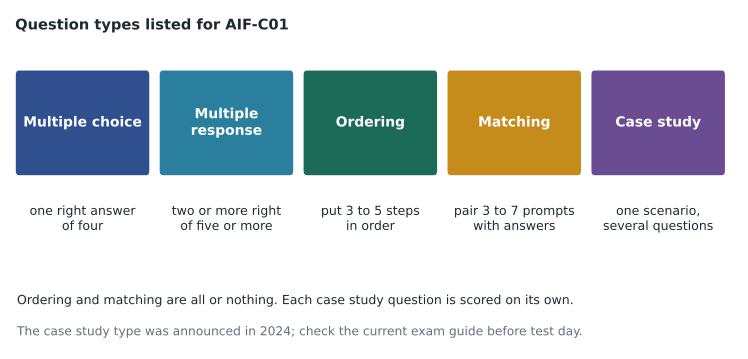
The current AIF-C01 exam guide lists four question types and describes each precisely. A multiple-choice question has one correct response and three incorrect responses. A multiple-response question has two or more correct responses out of five or more options, and you must select all the correct responses to get credit; choosing three of four correct answers earns nothing. An ordering question gives a list of three to five responses and asks you to select the correct ones and place them in the correct order to complete a task. A matching question gives a list of responses to match with three to seven prompts, and you must match all the pairs correctly to earn credit.
The fifth format, the case study, appeared in the July 2024 announcement. AWS described it as one scenario followed by two or more questions about that scenario, each evaluated separately, so each correct answer earns its own credit. The current exam guide page that lists the question types does not mention case studies, so you may or may not meet one. Treat it as a possibility rather than a certainty, and check the guide again in the weeks before your exam. The announcement also said that the total number of questions and the time allowed did not change when the new types were introduced, and that each new question carries the same value as a multiple-choice or multiple-response question.
| Type | How it looks | How it is scored | Main risk |
|---|---|---|---|
| Multiple choice | Four options, one correct | Right or wrong | A plausible distractor |
| Multiple response | Five or more options, two or more correct | All correct choices needed | Choosing one too many or too few |
| Ordering | Three to five items to arrange | All in the right order | One swapped pair costs the whole question |
| Matching | Three to seven prompts to pair | Every pair right | Two similar services swapped |
| Case study | One scenario, several questions | Each question separately | Rereading the long scenario every time |
Multiple response: count, then choose
Multiple-response questions tell you how many answers to choose, for example "Select TWO." The most common mistake is not a lack of knowledge but a failure of discipline: picking the two most familiar options without testing each against the stem. Noor's method is to judge every option on its own as true or false for this scenario, then check that the number of true options matches the number requested. If you have three that seem true and the question asks for two, one of your three is weaker; look for the word in the stem that rules it out. If you have only one, reread the options you dismissed quickly.
Here is a practice item in the style of the exam, written for this course. A clinic group wants to reduce the risk that its generative AI assistant reveals client phone numbers in its answers. Which two measures help? Select TWO. The options might be: configure sensitive information filters in Amazon Bedrock Guardrails; increase the model's temperature; restrict the assistant's IAM role so it can read only the documents it needs; switch to a larger model; and add more examples to the prompt. Judged one by one, guardrail filters that detect and mask personal information help, least-privilege access to source documents helps, while temperature, model size and extra examples do not address data exposure. The answer is the guardrail filters and the restricted role.
Ordering: build the sequence from the ends
Ordering questions test whether you understand a process, not whether you have memorized a list. They appear naturally for the machine learning lifecycle, the steps of retrieval augmented generation, the stages of fine-tuning, or the order of responsible steps when launching an AI feature. Because the whole question is wrong if any item is out of place, Noor teaches a method that reduces errors: fix the first and last steps before you place the middle ones. Most processes have an obvious start, such as defining the business goal or collecting data, and an obvious end, such as monitoring or gathering feedback. With the ends fixed, the middle usually has only one sensible arrangement.
Some ordering questions include more items than the sequence needs, and you must leave out the ones that do not belong. AWS's announcement said that some ordering questions use all the options and others use only some. So do not assume every item is part of the answer. If an item belongs to a different process, such as "provision a GPU cluster" in a list of prompt-engineering steps, it is probably a distractor.
Practicing the formats without real questions
The best way to get used to the formats is to write your own items. After each review lesson, Jonah writes one ordering item and one matching item from the material, then swaps them with Kwame Asante, the developer who wrote BookVet and who is studying for the same exam. Writing an item forces you to know the process or the pairs precisely, and answering someone else's item shows you how a stem can hide its constraint. Official practice material from AWS Skill Builder includes the newer formats, and it is worth using once you have finished your review, because it shows exactly how the exam interface presents them.
Worked problem
An ordering item about retrieval augmented generation
Put these steps in the order they happen when a staff member asks the after-hours assistant a question and it answers from the hospital's protocols: (a) the model generates an answer that cites the passages; (b) the question is converted into an embedding; (c) the most similar passages are retrieved from the vector store; (d) the retrieved passages are added to the prompt with the question.
Show solution
- The first step must turn the question into something that can be compared with stored passages: the embedding, (b).
- The comparison happens next: retrieval of the most similar passages, (c).
- The passages are then combined with the question in the prompt, (d).
- Only then can the model generate a grounded answer, (a).
Answer: b, c, d, a. Fixing the first step (embedding the question) and the last (generating the answer) makes the middle obvious.
Matching: use what you are sure of to narrow the rest
Matching questions pair a set of prompts, such as business needs, with a set of responses, such as AWS services. The trap is that the responses are often neighbors: Amazon Transcribe and Amazon Polly, Amazon Comprehend and Amazon Textract, Amazon SageMaker Clarify and Amazon SageMaker Model Monitor. Start with the pairs you are certain of, then use elimination on the rest. Remember that a response may be used once, more than once or not at all, according to the 2024 announcement, so do not assume the last remaining option must fit the last prompt. Check each pair on its merits.
A good way to practice is to build your own matching sets from the commonly confused pairs in lesson 9. Write each service on a card with a one-line need on the back, shuffle them and match them under a time limit. Jonah made a set of fourteen cards for the managed AI services alone, from Amazon Rekognition to Amazon Personalize, and found that two pairs caused nearly all his mistakes.
Case studies: read once, answer many
If you meet a case study, you will see one scenario followed by several questions. The scenario may be longer than a normal stem, describing an organization, its data, its constraints and its goals. Each question then asks about one aspect of it. Because each question is scored separately, a mistake on the first does not sink the others. The skill here is efficient reading. Read the scenario once carefully, noting the constraints on scrap paper or the whiteboard: the data involved, any privacy or residency requirement, budget or latency limits, and who must approve decisions. Then answer each question by going back only to the part of the scenario it concerns.
Noor wrote a short practice case for Jonah based on the group itself, with every detail invented for the exercise. A veterinary group wants a tool that drafts discharge instructions for pet owners after surgery. The drafts must use the group's own aftercare protocols, must never include a diagnosis the veterinarian did not record, must be reviewed by a veterinarian before they are printed, and client records must stay in the United States. Question 1 asks which approach keeps the drafts consistent with current protocols without retraining a model: retrieval augmented generation over the protocol documents. Question 2 asks which control enforces the review: a human-in-the-loop step before printing. Question 3 asks which AWS feature helps keep the model from producing content outside the approved topics: Amazon Bedrock Guardrails with denied topics. Question 4 asks how to meet the residency requirement: choose a Region in the United States, such as us-west-2 for the data and the model endpoint.
Reading any stem: the constraint decides
Whatever the format, most AWS questions hinge on one constraint. Phrases such as "with the least operational overhead", "most cost-effective", "without managing servers", "without retraining the model", "with the most current information" or "to meet a regulatory requirement" each point toward a different kind of answer. Least operational overhead usually favors a fully managed service. Most cost-effective often favors prompt engineering or retrieval over fine-tuning, and fine-tuning over training from scratch. Most current information favors retrieval augmented generation, because a model's training data has a cut-off date. Regulatory requirements point toward governance services, encryption and Region choice.
Noor taught Jonah a four-step routine. First, read the last sentence of the stem, so you know what is being asked. Second, read the whole stem and underline the constraint. Third, read every option and cross out those that fail the constraint, even if they would technically work. Fourth, choose between the survivors, looking for the one that meets the need most directly. If two options still seem right, ask which one AWS would describe as the simplest managed way to meet the requirement. That is very often the intended answer on a foundational exam.
# Scoring illustration: one ordering question and three case study questions
ordering = ["embed question", "retrieve passages", "augment prompt", "generate answer"]
attempt  = ["embed question", "augment prompt", "retrieve passages", "generate answer"]
print("Ordering credit:", 1 if attempt == ordering else 0)
case_answers = [True, False, True]  # each case study question scored on its own
print("Case study credit:", sum(case_answers), "of", len(case_answers))Ordering credit: 0 Case study credit: 2 of 3
What this code does
It illustrates how two newer question types are scored. An ordering question compares the learner's sequence with the correct one and gives credit only if the whole order is right, so swapping two steps earns nothing. Each case study question is scored separately, so getting two of three right earns two points.
Common mistakes
MistakePicking the familiar options on a multiple-response question without testing each one.
InsteadJudge every option as true or false for this scenario, then check the count.
MistakeAssuming every item in an ordering question must be used.
InsteadSome ordering questions use only some of the options; leave out items from other processes.
MistakeAssuming each matching response is used exactly once.
InsteadResponses may be used once, more than once or not at all.
MistakeRereading a long case study for every question.
InsteadNote the constraints once, then return only to the relevant part.
MistakeChoosing an option that works but ignores the constraint.
InsteadThe constraint, such as least overhead or lowest cost, usually decides the answer.
Summary and key terms
- The guide lists multiple choice, multiple response, ordering and matching; case studies were announced in 2024.
- Multiple-response, ordering and matching questions need every part right to earn credit.
- Each case study question is scored separately.
- Build ordering answers from the ends; build matching answers from the pairs you are sure of.
- Underline the constraint in every stem; it usually decides between plausible options.
- Multiple response
- A question with two or more correct answers among five or more options.
- Ordering question
- A question asking you to place three to five responses in the correct sequence.
- Matching question
- A question asking you to pair three to seven prompts with responses.
- Case study
- One scenario followed by several questions, each scored separately.
- Constraint
- The requirement in a stem, such as lowest cost or least overhead, that rules options in or out.
Practice problems
Work each problem on paper first, then reveal the answer to check.
How many correct answers does a multiple-choice question have?
Show answer
One, with three distractors.
How many prompts can a matching question have, according to the guide?
Show answer
Three to seven.
How many items can an ordering question have?
Show answer
Three to five, according to the current guide.
If you get one pair wrong in a matching question, how much credit do you earn?
Show answer
None; all pairs must be correct.
Which constraint usually points to retrieval augmented generation?
Show answer
A need for the most current or company-specific information without retraining.
What is the first step of Noor's reading routine?
Show answer
Read the last sentence of the stem to see what is being asked.
Lesson quiz · 5 questions
Score 60% or more to complete this lesson.
Create a free account to save your progress, take quizzes and earn a certificate.