
AWS-119 · Lesson 12 of 12 · 21 min
Final review and exam-day strategy
▶ Video coming soon A video version of this lesson is on the way.
The last lesson brings the program together: what to do in the final week, how to manage the 90 minutes, what happens after the exam and how to keep the credential useful. Jonah's exam is planned for a weekday morning in April 2027 at a Pearson VUE testing center in Denver. Nothing in this lesson describes the exam itself as having happened; it describes Noor's plan for it, and the same plan works for any candidate. "By the last week you cannot learn much more," Noor wrote. "You can still lose points to fatigue, nerves and logistics. This lesson is about not losing them."
The final week
Noor's final week reduces volume and increases rest. Seven days out, Jonah sits his last full practice set, timed. Six days out, he analyzes it and updates his log. Five days out, he drills the confused pairs once more. Four days out, he does a light review of domain 3, the heaviest domain. Three days out, he reviews domains 4 and 5 using his one-sentence summaries. Two days out, he checks logistics: his identification, the confirmation email, the route and parking, and the center's arrival time. The day before, he rests: a short walk through his summary sheets at most, then nothing.
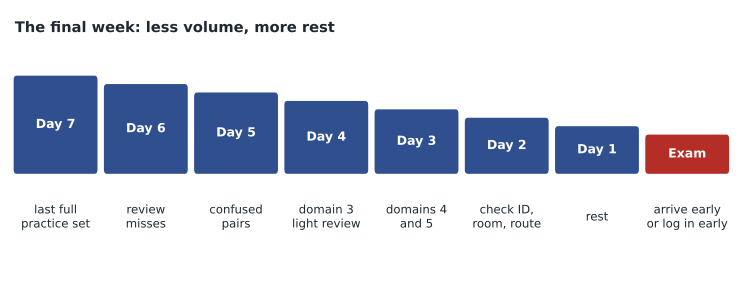
Cramming new material in the last days rarely helps on a scenario-based exam and often hurts, because it crowds out sleep and raises anxiety. Sleep matters more than one more practice set: memory consolidates during sleep, and a tired reader misses constraints. Noor also tells Jonah to stop taking practice sets three or four days before the exam, so that a bad result cannot shake his confidence when there is no time to act on it.
Logistics for each delivery option
At a testing center, arrive early, as the confirmation email advises, with identification that matches the name on your registration exactly. Personal items, including phones and watches, go into a locker. You may be given a whiteboard or note board, depending on the center. For online proctored exams, run the system test again on the day, close every application, clear the desk and room, and start the check-in early, because it involves photographing your identification and the room. Interruptions such as someone walking in can end an online session. The policies differ in detail and can change, so read the current instructions in your confirmation and on the AWS certification site rather than relying on memory or on this course.
| Check | Testing center | Online proctored |
|---|---|---|
| Identification | Exact name match, valid ID | Exact name match, valid ID |
| Arrival | Early, as the confirmation advises | Start check-in early |
| Equipment | Provided by the center | Your computer; system test passed |
| Room | Provided | Private, clear desk, no other people |
| Personal items | Stored in a locker | Removed from the room or out of reach |
Managing 90 minutes
Sixty-five questions in 90 minutes gives about 83 seconds per question. Most items take less, and a few long scenarios or case study questions take more. Noor's pacing rule uses checkpoints: about 24 questions answered by the 30-minute mark, about 49 by 60 minutes, and all 65 by 80 minutes, leaving ten minutes for review. That works out to about 74 seconds per question, a little faster than the raw average, which is what buys the review time. If a question is taking more than about two minutes, choose the best answer you have, flag it for review and move on. Answering before flagging matters: if time runs out, a flagged question with an answer can still earn credit, while a blank cannot.
total_min, questions, reserve = 90, 65, 10
per_q = (total_min - reserve) * 60 / questions
print("seconds per question with a review reserve:", round(per_q))
for minute in (30, 60, 80):
print("by minute", minute, "aim to have answered about", min(questions, round(minute * 60 / per_q)))seconds per question with a review reserve: 74 by minute 30 aim to have answered about 24 by minute 60 aim to have answered about 49 by minute 80 aim to have answered about 65
What this code does
It works out a pacing plan for 65 questions in 90 minutes, keeping 10 minutes in reserve for review, which gives about 74 seconds per question. It then prints how many questions should be answered by minutes 30, 60 and 80. Checking against these markers during the exam shows whether you need to speed up.
During review, revisit flagged items first. Change an answer only when you find a specific reason, such as a constraint you missed or a fact you now recall; research on test-taking suggests that changes made for a clear reason tend to be improvements, while changes made from vague doubt are not. On multiple-response items, check the count once more. On ordering and matching items, check that every position or pair is filled.
Reading under pressure
Nerves make people skim. The reading routine from lesson 2 is the antidote: read the last sentence of the stem first, then the whole stem, underline the constraint, eliminate options that fail it and choose the most direct fit. If two options still seem right on a foundational exam, ask which is the simpler managed way to meet the requirement. Watch for absolute words in options, such as always or never, which are often wrong, and for options that would work but ignore the stated constraint. If you feel anxious, a few slow breaths before starting the next question help more than pushing on.
A last pass through the domains
Noor's final summary sheet fits on one page. Domain 1: AI contains machine learning, which contains deep learning; match inference types to workloads; regression predicts numbers, classification categories, clustering groups; know Transcribe, Translate, Comprehend, Lex, Polly and Textract; choose metrics that reflect error costs. Domain 2: tokens, embeddings and vectors; hallucination and nondeterminism; Bedrock for managed foundation models, SageMaker AI for building models, Amazon Quick (formerly Amazon Q Business) as a ready-made assistant; on-demand versus provisioned throughput. Domain 3: model selection criteria; temperature; RAG with Knowledge Bases and vector stores; the cost ladder from prompting to pre-training; prompt techniques and risks; fine-tuning versus continued pre-training; ROUGE, BLEU, BERTScore and LLM-as-a-judge. Domain 4: fairness, robustness, veracity; Guardrails, Clarify, A2I and model cards; bias and variance; subgroup analysis. Domain 5: shared responsibility; IAM, KMS, PrivateLink, Macie; CloudTrail, Config, Inspector, Artifact, Trusted Advisor; the five scopes of the Scoping Matrix.
After the exam
The exit screen gives information about your result, and the final result appears in your AWS Certification account within five business days. If you pass, you receive a digital badge you can share, and the certification is valid for three years. Noor reminded Jonah that passing is a milestone for the group too: he will lead the business side of the no-show pilot planned for February 2027 and help evaluate the after-hours summaries with the emergency hospital.
If you do not pass, the score report shows your performance by domain, which is exactly the evidence lesson 11 teaches you to use. AWS requires you to wait 14 calendar days before retaking, and each attempt requires the full fee, with no limit on the number of attempts. Use the wait to analyze the report, rebuild a short plan around the weakest domains and the causes of misses, and book again when a fresh practice set shows the gaps have closed.
Keeping the credential current and choosing a next step
The certification lasts three years. AWS's recertification options for foundational certifications have included passing the current version of the exam or earning a higher-level certification; check the AWS recertification page for the options that apply to AI Practitioner when the time comes. The more useful question is what to learn next. For people who build machine learning solutions, the associate-level Machine Learning Engineer certification is a natural step. For people who work with data, the Data Engineer associate path fits. For people whose role, like Jonah's, is about using AI well in the business, the next step may be deeper work on governance, evaluation and change management rather than another exam. Noor's advice was to choose the next step by the work you want to do, not by the badge.
Handling a difficult start
Many candidates meet a hard question in the first few minutes and lose confidence. Remember that the exam includes 15 unscored questions, which are not marked, and some of them may be trial items that are unusually hard. A difficult early question tells you nothing about how the exam as a whole is going. Answer it as well as you can, flag it and move on; the next question is a fresh start. Noor told Jonah to expect at least a handful of questions he cannot answer with certainty. Passing does not require certainty on every item, only enough correct answers overall, which the compensatory model rewards.
If something goes wrong with the testing environment, such as a frozen screen at a center or a dropped connection online, tell the proctor or testing center staff immediately and follow their instructions. Do not try to fix the computer yourself or leave the room without permission. AWS and Pearson VUE have procedures for technical problems, and reporting at once is what protects your attempt.
Using the whiteboard or note board
If your testing setting provides a whiteboard or note board, use it for two things. At the start, if allowed, jot down a few memory aids you might need, such as the domain weights or a quick reminder of precision and recall. During the exam, use it for case studies, writing the scenario's constraints once so you do not have to reread the whole passage for each question. Keep notes brief; the board is a tool, not a second exam. Rules about what you may write before the exam begins vary, so follow the proctor's instructions.
A final word from Noor
Noor's last note in the study guide was not about AWS at all. She reminded Jonah why the group invested in the certification: so that the person who understands the clinics, the booking system and the clients also understands what AI can and cannot do, and can speak up when a proposal goes too far or not far enough. The exam is a check that the understanding is there. The real test will come in February 2027, when the no-show pilot starts and reception staff ask him what a flag means, and later when the emergency hospital decides whether the after-hours summaries earn a permanent place. If he can explain those clearly, the certificate will have done its job.
When the exam ends, take a moment before reading the result screen. Whatever it shows, you prepared with a plan, evidence and honest analysis, and that method will serve you in the next exam and in the next AI project at work.
Taken together, the twelve lessons of this course give you a method you can reuse for any AWS exam: learn the structure, review against the official guide, separate the neighbors, plan from evidence, analyze practice honestly and protect your energy for the day itself. The domains will change from exam to exam; the method will not.
Worked problem
Answering, flagging and reviewing
Suppose that at the 60-minute mark Jonah has answered 43 questions and flagged six. His checkpoint target is about 49. What should he do?
Show solution
- He is about six questions behind the checkpoint.
- The remaining 22 questions need about 27 minutes at 74 seconds each, leaving only about three minutes for review.
- He should speed up slightly, answering and flagging any item that passes two minutes.
- Flagged items already have answers, so he loses nothing if review time runs short.
Answer: Pick up the pace a little, keep answering before flagging, and use whatever review time remains on the flagged items.
Common mistakes
MistakeLearning new material the night before.
InsteadRest; review only your summary sheet.
MistakeFlagging a question without answering it.
InsteadAnswer first, then flag, so a blank never costs you a point.
MistakeChanging answers from vague doubt.
InsteadChange an answer only for a specific reason you can name.
MistakeAssuming online and center rules are the same as last time.
InsteadRead the current instructions in your confirmation.
MistakeRetaking immediately after a fail without analysis.
InsteadUse the 14-day wait to analyze the domain report and plan.
Summary and key terms
- The final week reduces volume: last practice set, review of misses, confused pairs, light domain review, logistics, then rest.
- Bring matching identification; for online exams, pass the system test and prepare the room.
- Pace with checkpoints, answer before flagging and keep ten minutes for review.
- Change answers only for a specific reason; check counts on multiple-response items.
- Results appear within five business days; a retake requires a 14-day wait and a new fee.
- The certification lasts three years; choose a next step by the work you want to do.
- Checkpoint
- A planned number of questions to have answered by a given time.
- Flag for review
- Marking a question to revisit later, after answering it.
- Taper
- Reducing study volume before an exam to arrive rested.
- Recertification
- Renewing a certification before it expires.
- Digital badge
- An online credential you can share after passing.
Practice problems
Work each problem on paper first, then reveal the answer to check.
About how many seconds per question does a ten-minute review reserve leave?
Show answer
About 74 seconds.
What should you do before flagging a question?
Show answer
Choose an answer.
How long must you wait to retake after a fail?
Show answer
Fourteen calendar days.
When do final results appear in your account?
Show answer
Within five business days.
How long is the certification valid?
Show answer
Three years.
What should the day before the exam look like?
Show answer
Rest, with at most a brief look at the summary sheet.
Lesson quiz · 5 questions
Score 60% or more to complete this lesson.
Create a free account to save your progress, take quizzes and earn a certificate.