
AWS-111 · Lesson 12 of 12 · 18 min
Case study: choosing an AI approach for a business problem
▶ Video coming soon A video version of this lesson is on the way.
On November 10, 2026, Noor and Jonah presented the first results of the AI assessment to the Cascade Ridge leadership team: Lorraine Beaudry, Dr. Simone Kaur, Andre Leclerc, Hannah Weiss and Gwen Halvorsen. The question in front of them was concrete. Missed appointments were costing the clinics empty slots every day. Should the company use machine learning to reduce them, and if so, how? This lesson follows the recommendation from problem to pilot plan, using every idea from the course.
Step 1: the business problem and its measure
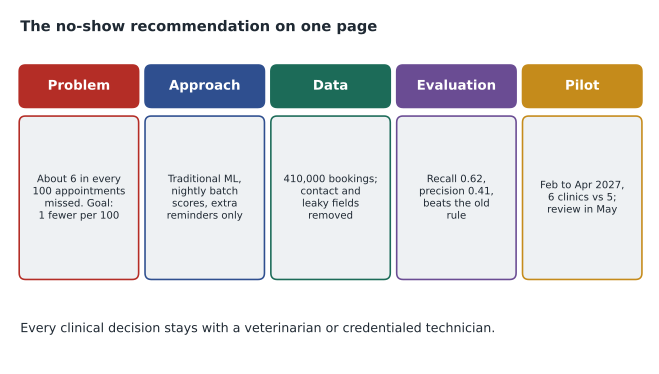
Jonah opened with the numbers. Over the six months to September 2026, 6 of every 100 appointments were missed, about 160 a day across the group. Each empty slot is lost revenue and a staff member waiting. The goal was to reduce misses by at least 1 in every 100 appointments within six months of the pilot, without refusing, charging or otherwise penalizing any client. Stating the goal this way gave the team a measure of success and a constraint before any model was discussed.
Step 2: is AI the right tool?
Noor ran the idea through the screen from lesson 11. There is no fixed rule that decides who will miss an appointment; the old rule of thumb caught only about 1 in 3 misses. A probabilistic answer is acceptable, because the action is a friendly extra reminder, not a decision about care or access. There are three years of labeled history, about 410,000 appointments. The value of rescued slots should exceed the cost of reminders, as the lesson 5 calculation suggested. And the risk of harm is low, provided the score is never used to refuse or downgrade a booking. The idea passed every question.
Step 3: which kind of AI?
The data is structured and tabular, the target is a clear yes or no, the front desk needs a short reason with each flag, and the scores must be cheap, fast and consistent every night. Each of those points to traditional supervised ML, specifically binary classification, rather than a foundation model. Noor also considered whether a managed AI service could do the job; none predicts no-shows from a company's own booking data, so a custom model trained on Cascade Ridge's history was needed. She had prototyped it in SageMaker Canvas, then rebuilt the best configuration as a repeatable SageMaker AI training job: a gradient-boosted tree with depth limited to avoid overfitting.
Step 4: the data
The training data combined BookVet and VetLedger records. Hannah's privacy rules were applied first: names, phone numbers, addresses and payment details were removed, booking numbers were replaced with random identifiers, and postal code was left out as a possible proxy for income. Fields filled in only after an appointment, such as checkout time and invoice total, were removed to prevent leakage. Missing reminder-confirmation values became an explicit "unknown". The data was split by time: 25 months for training, 5 for validation and the 6 most recent months as the test set.
Step 5: evaluation
On the test set of 60,000 appointments, the model caught 62 of every 100 misses (recall 0.62), and about 41 of every 100 flagged bookings were real misses (precision 0.41). Its AUC was 0.81. Accuracy was reported only beside the majority-class baseline, to show why it was not the measure that mattered. Training and validation recall differed by only 0.04, so the model was not overfitting. Recall by clinic ranged from 0.55 to 0.68; the lowest clinic's gap traced to incomplete reminder records, which Andre agreed to fix. Clarify showed the three strongest features were past miss count, days booked ahead and reminder confirmation, which matched the front-desk staff's own experience.
Step 6: how the model will be used
Every evening at 6 p.m., a batch job scores the next day's bookings and writes a list for each clinic. Staff send flagged clients an extra text or a call, voiced by Amazon Polly for clients who prefer calls, and offer slots that clients release to the waitlist. The list shows a short reason, such as "booked 5 weeks ahead; reminder not confirmed". Staff can ignore any flag. The score is never shown to clients and never used to refuse, double-book or charge.
Step 7: operations and governance
Gwen's production-readiness note from lesson 8 covered the rest. The pipeline is defined in SageMaker Pipelines and kept in source control. The approved version is recorded in the Model Registry, with a model card describing its intended use, data, evaluation and limits. Model Monitor checks input drift weekly, and recall and precision are recomputed weekly once outcomes are known. Input checks stop the job on bad data, and the old three-week rule runs as a fallback if scoring fails. All resources sit in the ML account in us-west-2, with least-privilege roles, KMS encryption and CloudTrail logging. Noor owns the model until June 2027; after that, Jonah does, with Gwen's team supporting the infrastructure.
Step 8: the pilot plan
The weakest number in the business case was how many caught misses a reminder actually rescues. Rather than guess, the team designed the pilot to measure it. From February to April 2027, six clinics will use the model's list; the other five will continue with the old rule. Clinics were assigned so that both groups include a mix of large and small, urban and rural. In May 2027, the team will compare the change in no-show rates between the two groups and decide whether to roll out, adjust or stop. Everything after November 10, 2026 is a plan, and the board approved it on that basis.
# Sizing the pilot: how many appointments, and what change could we hope to see?
pilot_clinics_per_day = 1450        # bookings per day at the six pilot clinics (illustrative)
days = 89                            # February to April 2027
baseline_rate = 0.06                 # 6 misses in every 100 appointments
recall = 0.62                        # share of misses the model flags
rescued_share = 0.25                 # assumption to be measured: flagged misses rescued

appointments = pilot_clinics_per_day * days
expected_misses = appointments * baseline_rate
rescued = expected_misses * recall * rescued_share
new_rate = (expected_misses - rescued) / appointments
print("pilot appointments:", appointments)
print("misses expected without change:", round(expected_misses))
print("misses rescued if the assumption holds:", round(rescued))
print("no-show rate would fall from", baseline_rate, "to", round(new_rate, 4))
print("reduction per 100 appointments:", round((baseline_rate - new_rate) * 100, 2))pilot appointments: 129050 misses expected without change: 7743 misses rescued if the assumption holds: 1200 no-show rate would fall from 0.06 to 0.0507 reduction per 100 appointments: 0.93
What this code does
It sizes a pilot by multiplying daily bookings by the number of pilot days to get the total appointments, then applying the 6 in 100 baseline no-show rate to estimate expected misses. It assumes the model flags 62 in 100 misses and that a quarter of flagged misses are rescued, and calculates how many would be saved. The result shows the no-show rate would fall by just under 1 per 100 appointments, which sets a realistic target to measure.
If one in four flagged misses is rescued, the no-show rate would fall from 6.0 to about 5.1 per 100 appointments, close to the goal of 1 fewer in every 100. If the rescued share turns out lower, the goal will not be met, which is exactly why the pilot measures it rather than assuming it. Lorraine liked that the decision in May would rest on evidence from Cascade Ridge's own clinics.
The other ideas
The leadership team also agreed the next steps for the rest of the list. After-hours call summaries, a generative AI task, would be explored in a separate project with Dr. Kaur reviewing every summary, the subject of AWS-112 and AWS-113. Survey themes would use Amazon Comprehend immediately, since no custom model is needed. The radiograph-quality idea would wait until technicians had labeled a sample with Ground Truth. Vaccine due dates, invoice calculation and new-clinic prediction were closed as not suitable for ML. A governance plan for all AI work, covering fairness, oversight, security and regulation, would follow, which AWS-114 develops.
Common mistakes
MistakeRecommending a model without a pilot.
InsteadTest the riskiest assumption in a controlled pilot with a comparison group before rolling out.
MistakePresenting accuracy as the headline result.
InsteadReport recall, precision and the business measure, with the baseline for comparison.
MistakeLeaving the use of the score undefined.
InsteadState exactly what staff do with each flag and what the score must never be used for.
MistakePlanning the model but not its owner.
InsteadName an owner for monitoring and retraining, and a date when ownership passes on.
What the case teaches about the exam
Jonah noticed that almost every step of the meeting matched a task statement in Domain 1 of the AIF-C01 exam guide. Defining AI, ML and deep learning, and placing generative and agentic AI among them, came from lessons 1 and 2. Recognizing data types, preparing data, splitting it and choosing an inference type came from lessons 3 and 4. Choosing metrics, both technical and business, and diagnosing fit came from lessons 5 and 6. The lifecycle, the sources of models, managed versus self-hosted use and MLOps came from lessons 7 and 8. Matching tasks to SageMaker AI capabilities and managed services came from lessons 9 and 10. And deciding when ML is the wrong tool, and when traditional ML beats a foundation model, came from lesson 11. Exam questions in this domain are often small versions of this meeting: a short scenario, then a question about which technique, metric, inference type or service fits. Reading each scenario for the business goal, the kind of data and the cost of each error usually points to the answer.
What success and failure would look like
Before the pilot starts, the team wrote down how it would read the results, so that nobody could reinterpret them afterwards. Success means the no-show rate at the pilot clinics falls by at least 1 in every 100 appointments more than at the comparison clinics, with no rise in client complaints and no front desk reporting that the list is unmanageable. A partial result, a smaller fall, would lead to adjusting the threshold or the reminder method and running a second period. Failure, no measurable difference, would mean keeping the old rule and recording what was learned. Writing these criteria in advance is a simple guard against seeing what one hopes to see.
Jonah, who will own the model after June 2027, added one more line to the plan: a check every quarter, even if nothing seems wrong, that the list is still used, the reasons still make sense to staff, and the rate of misses is still being reduced. Models rarely fail dramatically; they fade quietly when nobody is looking.
The meeting ended with a short list of actions, each with an owner and a date: Andre to fix reminder recording at the lowest-recall clinic by the end of November; Kwame and Mateo to build the nightly job and the front-desk list in December and January; Hannah to update the privacy notice wording and approve access; Noor to finalize the model card and monitoring; and Jonah to prepare the comparison report template for May. Everything on the list is a plan as of November 10, 2026.
Worked problem
Answering the board's questions
At the end of the meeting, a board member asks three questions: (1) Why not use a large language model, since everyone else is? (2) Could the model be used to charge a fee to likely no-shows? (3) What happens if the model stops working one night?
Show solution
- (1) The data is structured, the target is a yes or no, and the scores must be fast, cheap, consistent and explainable every night; a traditional model meets all four needs better than a foundation model.
- (2) No. The agreed use is extra reminders and waitlist offers only. Using a probabilistic score to penalize clients would be unfair to the 59 of every 100 flagged clients who would have attended, and would need a separate legal and policy review.
- (3) Input checks stop the job, an alert goes to the owner, and the old three-week rule produces the reminder list as a fallback until the model is fixed or rolled back to the previous approved version.
Answer: Traditional ML fits the data and the operational needs; the score is for reminders only; there is a tested fallback and rollback.
Summary and key terms
- The case study applied the whole course to one decision.
- The team stated a business goal with a measure and a constraint, then checked that AI was appropriate: no fixed rule, a probabilistic answer acceptable, enough labeled data, value above cost and low risk of harm.
- Structured data, a clear target and a need for explanation, speed and consistency pointed to traditional supervised ML built with SageMaker Canvas and SageMaker AI.
- The data was minimized, cleaned of leaky fields and split by time.
- Evaluation used recall, precision, AUC and per-clinic checks against a baseline.
- A nightly batch job feeds extra reminders, never penalties.
- Pipelines, the Model Registry, model cards, Model Monitor, fallbacks and named owners cover operations.
- A controlled pilot with a comparison group will measure the riskiest assumption before rollout.
- Business goal
- The outcome a project must achieve, stated with a measure and constraints.
- Pilot
- A limited trial used to test a solution and its assumptions before full rollout.
- Comparison group
- Units that continue as before, so the effect of a change can be measured.
- Fallback
- The process used when the model is unavailable or fails.
- Model card
- Documentation of a model's intended use, data, evaluation and limits.
- Intended use
- The specific purpose for which a model has been approved.
- Riskiest assumption
- The uncertain belief that most affects whether a project succeeds.
- Rollback
- Returning to a previous approved model version.
Practice problems
Work each problem on paper first, then reveal the answer to check.
Why does the pilot use a comparison group?
Show answer
To measure how much the model, rather than other changes, reduces no-shows.
Why was a traditional ML model chosen over a foundation model?
Show answer
Structured data, a clear target and needs for speed, low cost, consistency and explanation.
What happens if the nightly job fails?
Show answer
An alert goes to the owner and the old three-week rule runs as a fallback.
Lesson quiz · 5 questions
Score 60% or more to complete this lesson.
Create a free account to save your progress, take quizzes and earn a certificate.