
AWS-111 · Lesson 11 of 12 · 18 min
When machine learning is the wrong tool
▶ Video coming soon A video version of this lesson is on the way.
At the November 3 AI hour, Lorraine Beaudry arrived with a list from the board: twelve ideas, each beginning "Could AI...". Noor read it aloud and, to Lorraine's surprise, crossed out four. "Saying no to the wrong ideas," she said, "is the most valuable thing an AI assessment does. It saves the money for the right ones."
The exam guide asks candidates to recognize when AI and ML are not appropriate and when a traditional ML model is a better choice than a foundation model. This lesson covers both: the situations where ML adds cost and risk without benefit, and the factors, such as regulation, explainability and operating limits, that decide between kinds of AI.
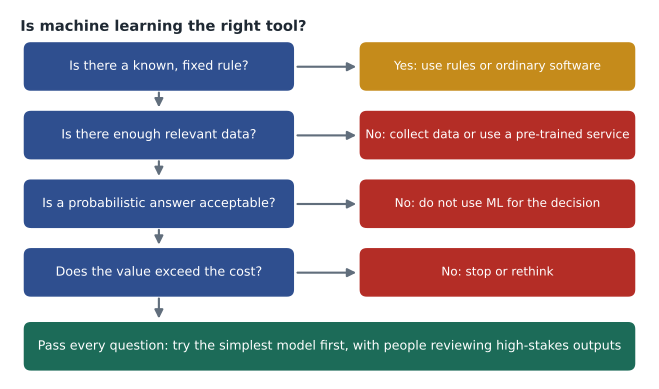
When a rule already exists
If the correct answer can be written down as a fixed rule, a rule is cheaper, faster, fully explainable and always right. Vaccine due dates at Cascade Ridge follow manufacturer and professional guidelines; a reminder that fires 12 months after a rabies vaccination is a few lines of ordinary code. Training a model to predict the due date would only add the chance of being wrong. The same applies to tax calculations, eligibility rules set by policy and anything else defined by regulation or contract.
When a specific outcome is needed instead of a prediction
Machine learning produces probabilistic outputs: likely answers with some chance of error. Some decisions need a deterministic answer, the same correct result every time. Calculating an invoice, checking that a controlled drug count balances, or applying a refund policy should never be "probably right". If a wrong answer would be unacceptable and a definite answer can be computed, use conventional software. ML can still help around the edges, for example by flagging unusual invoices for a person to check, but it should not produce the invoice.
When there is not enough good data
ML learns from examples. If there are too few, if they do not represent the situations the model will face, or if nobody can label them reliably, a model will be unreliable. Andre suggested predicting which new clinics the company should open. Cascade Ridge has opened four clinics in ten years, which is four examples: far too few to learn from. That question belongs to market research and judgment, perhaps supported by data analysis, not a predictive model.
When the cost outweighs the benefit
Every ML system has costs beyond training: data preparation, integration, monitoring, retraining, security review and staff time. A cost-benefit analysis compares those with the value the model creates. The board's idea of predicting which clients will buy premium pet food scored poorly: the potential extra revenue was small, the data was thin, and a simple promotion to clients with large-breed dogs would capture most of the value. Lesson 5's business metrics, cost per prediction and return on investment, make these comparisons concrete.
When the risk of harm is too high
Some uses carry risks that outweigh any benefit, at least without strong safeguards. The board's idea of an "AI diagnosis" chatbot that tells clients whether their pet needs to come in was rejected by Dr. Kaur. A wrong answer could delay care for a sick animal, liability would fall on the practice, and veterinary regulators expect a professional to make clinical judgments. The agreed principle for all AI work at Cascade Ridge is that AI may assist, but every clinical decision stays with a veterinarian or a credentialed veterinary technician. AWS-114 covers human oversight in depth.
Traditional ML or a foundation model?
When AI does fit, there is still a choice between a traditional ML model, such as a gradient-boosted tree trained on your own tabular data, and a foundation model, such as a large language model used through Amazon Bedrock. The exam guide names three factors that often decide it.
- Regulatory concerns. Regulated decisions may require documented data sources, consistent behavior and the ability to show how an outcome was reached. A traditional model trained on known data is easier to document and audit than a very large model trained by someone else on data you cannot inspect.
- Explainability requirements. If people must understand why the system produced an answer, simpler models are easier to explain. A decision tree or a model with clear feature importances, checked with SageMaker Clarify, can show that past misses and days booked ahead drove a score. A large language model's reasoning is much harder to trace.
- Operational constraints. Foundation models can be slower, more expensive per request and less predictable in their output. A nightly score for 2,600 bookings needs speed, low cost and identical results for identical inputs, which suits a small traditional model. Tasks involving open-ended language, such as summarizing a call or drafting a letter, suit foundation models, because no small model trained on Cascade Ridge's data could do them.
The rough rule: structured data with a clear target and a need for explanation points to traditional ML; unstructured language or images, open-ended generation and tasks where no labeled data exists point to foundation models or managed AI services.
| Idea from the board | Verdict | Reason |
|---|---|---|
| Predict vaccine due dates | Not ML | A fixed protocol rule is exact and explainable |
| Calculate invoices automatically | Not ML | A deterministic answer is required |
| Predict where to open new clinics | Not ML (for now) | Only four past examples; use research and judgment |
| AI diagnosis chatbot for clients | Rejected | Clinical and liability risk; decisions stay with vets |
| Predict appointment no-shows | Traditional ML | Labeled tabular data, clear target, explanation needed |
| Summarize after-hours call notes | Foundation model | Open-ended language task; vet reviews every summary |
| Find themes in survey comments | Managed AI service | Amazon Comprehend already does this |
| Flag low-quality radiographs | Explore later | Needs labeled images; diagnosis stays with vets |
# A tiny screening function for AI ideas, following the decision path.
def screen(idea):
    if idea["fixed_rule"]:
        return "use rules or ordinary software"
    if idea["must_be_exact"]:
        return "do not use ML for the decision"
    if idea["examples"] < 1000 and not idea["pretrained_service"]:
        return "collect data first, or use a pre-trained service"
    if idea["value"] <= idea["cost"]:
        return "not worth it yet"
    return "try the simplest model first, with human review where stakes are high"

ideas = {
    "vaccine due dates": dict(fixed_rule=True, must_be_exact=True, examples=0, pretrained_service=False, value=0, cost=0),
    "new clinic sites": dict(fixed_rule=False, must_be_exact=False, examples=4, pretrained_service=False, value=50, cost=40),
    "no-show prediction": dict(fixed_rule=False, must_be_exact=False, examples=410000, pretrained_service=False, value=90, cost=25),
}
for name, idea in ideas.items():
print(name, "->", screen(idea))vaccine due dates -> use rules or ordinary software new clinic sites -> collect data first, or use a pre-trained service no-show prediction -> try the simplest model first, with human review where stakes are high
What this code does
A short set of questions screens each AI idea in order: whether a fixed rule would do, whether the answer must be exact, whether there is enough data, and whether the value outweighs the cost. The first question that applies decides the advice. The three sample ideas end up with three different answers, from using ordinary software to trying a simple model with human review.
The screen is deliberately crude, and the thresholds are made up for illustration, but it captures the order of the questions Noor asks: is there a rule, must the answer be exact, is there data, is it worth it? Only ideas that pass every question reach the modeling stage.
Common mistakes
MistakeUsing ML because it is fashionable.
InsteadStart from the problem; use rules or ordinary software when they give exact answers.
MistakeLetting a model produce a result that must be exactly right.
InsteadUse deterministic code for invoices, balances and policy rules; ML can flag exceptions for review.
MistakeAssuming a foundation model is always the most capable choice.
InsteadFor structured data needing speed, low cost and explanation, a traditional model is often better.
MistakeBuilding a model from a handful of examples.
InsteadToo little representative data makes models unreliable; collect data or use judgment.
Hidden costs and the simplest thing that works
Noor kept a list of costs that ideas often forget. People must label data, review flagged cases and handle complaints when a model is wrong. Integration means changing the software and screens staff already use, and training staff to trust or question a new signal. Security and privacy review takes time, and some data cannot be used at all. Monitoring and retraining continue for as long as the model is in use. Finally there is opportunity cost: the team's time spent on one idea is time not spent on another.
Her counter to these costs is to try the simplest approach first and measure it. Before the no-show model, Andre's old rule, an extra reminder for anyone booked more than three weeks ahead, already caught about 1 in 3 misses. The model had to beat that rule by enough to pay for itself, and it did, reaching about 6 in 10. If it had only matched the rule, the right decision would have been to keep the rule. A baseline is not just a statistical check; it is a business question about whether the extra complexity buys anything.
Using AI to assist rather than decide
Many ideas that fail as automated decisions succeed as assistance. The rejected diagnosis chatbot became a different, much safer idea: an assistant that helps clients describe their pet's symptoms in a structured way before a call, so the triage technician starts with better information and still makes every decision. The rejected premium-food prediction became a plain report of which clients have large-breed dogs. Reframing an idea so that a person stays in charge, and the AI saves them time or surfaces information, often keeps most of the value while removing most of the risk. Noor recorded each rejected idea with its reframed version, so the board could see that saying no to one design was not saying no to the underlying need.
Questions to ask before any AI project
Noor gave the leadership team a one-page list of questions to ask of every future idea, whether it comes from staff, a vendor or the board. What decision or task will this change, and who does it today? What happens when the AI is wrong, and who notices? Is there a rule or a simpler tool that would do? What data does it need, and are we allowed to use it that way? Who will own it once it is running, and what will it cost each year, not just to build? How will we know, within three months, whether it is working? An idea that cannot answer these questions is not ready for a pilot. Lorraine said the list would also help her evaluate the AI features vendors were starting to add to the practice-management software, where the same questions apply even if no model is built in-house.
Lorraine left the session with the board's list reduced from twelve ideas to five worth pursuing, three that would be handled without AI at all, and four reframed so that a person stays in charge. She said that was the most useful hour of the assessment so far, because it turned a vague wish to "use AI" into a short list of decisions she could fund and measure.
Worked problem
Screening a new request
Kwame suggests using a large language model to decide, for each online booking, whether the requested visit type is allowed at that clinic, based on a list of which clinics offer which services. Is this a good use of AI?
Show solution
- Is there a fixed rule? Yes: the list of services per clinic defines exactly what is allowed.
- Must the answer be exact? Yes: allowing a booking for a service the clinic does not offer causes real problems.
- A language model would add cost and the chance of a wrong answer for a question a database lookup answers perfectly.
- A better design is an ordinary lookup in BookVet. An AI assistant might help clients describe what they need in their own words, then hand off to the lookup to check what is allowed.
Answer: Not a good use of a model for the decision itself: use a deterministic lookup, and keep AI, if any, for understanding the client's request.
Summary and key terms
- Machine learning is the wrong tool when a fixed rule already gives the answer, when a definite rather than probabilistic outcome is required, when there is too little representative data, when the cost outweighs the value, or when the risk of harm is too high without strong safeguards.
- A cost-benefit analysis should include the full costs of data, integration, monitoring and review.
- When AI does fit, choose between traditional ML and foundation models using regulatory concerns, explainability requirements and operational constraints such as speed, cost and consistency.
- Structured data with a clear target suits traditional ML; open-ended language and images suit foundation models and managed AI services.
- Deterministic
- Always producing the same, exactly correct result for the same input.
- Probabilistic
- Producing a likely answer with some chance of error.
- Cost-benefit analysis
- Comparing the full costs of a solution with the value it creates.
- Rules-based system
- Software whose logic is written explicitly by people.
- Traditional ML model
- A model such as a tree or regression trained on your own data for a specific task.
- Explainability
- The ability to show why a model produced a particular output.
- Operational constraints
- Limits such as latency, cost per request and consistency that a solution must meet.
- Human oversight
- A person reviewing or making the final decision on AI-assisted outputs.
Practice problems
Work each problem on paper first, then reveal the answer to check.
Should a model calculate customer invoices?
Show answer
No; invoices need a deterministic answer from ordinary software.
Name the three factors the exam guide lists for choosing traditional ML or a foundation model.
Show answer
Regulatory concerns, explainability requirements and operational constraints.
Why was predicting new clinic sites rejected as an ML project?
Show answer
There were only four past examples to learn from.
Lesson quiz · 5 questions
Score 60% or more to complete this lesson.
Create a free account to save your progress, take quizzes and earn a certificate.