
AUTO-330 · Lesson 8 of 12 · 20 min
Current probes and relative compression
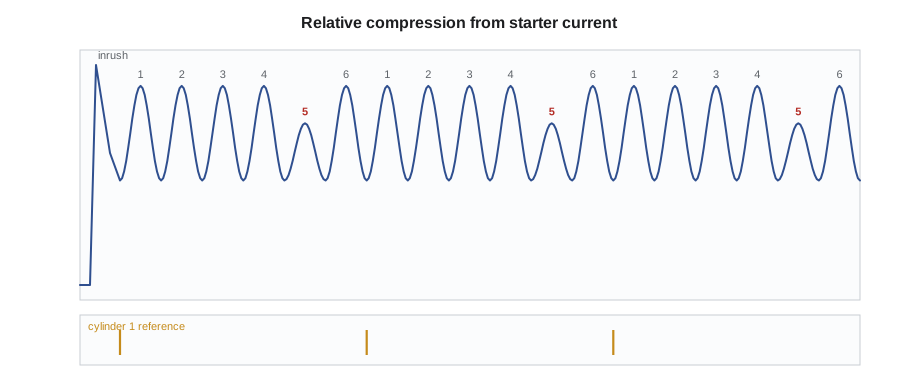
Van 1 is back on the hoist with one theory left: low compression in cylinder 5. Kiran could pull all six spark plugs and run a compression test, which on this engine means removing the intake plenum to reach the rear bank's coils, an hour of labor before the first reading. Marty shows her a faster first look. He clamps a large current probe around the battery cable, disables the fuel injectors with the scan tool, and cranks the engine for five seconds. The scope draws a row of humps. "Each hump is a cylinder squeezing its charge against the starter," he says. "A weak cylinder is easier to push. You'll see it before you touch a plug."
This lesson explains current probes and how to use them: how they work, how to choose and zero them, and the tests that make them indispensable for driveability work. The main tests are relative compression from starter current, fuel pump current analysis and actuator current checks. It finishes the van's diagnosis with the mechanical tests that prove the cause.
How current probes work
A current probe, or amp clamp, measures the current in a wire without breaking the circuit. Most automotive current probes use a Hall-effect sensor in the jaws: current in the wire creates a magnetic field around it, the sensor measures the field, and the probe outputs a voltage proportional to the current, such as 1 millivolt per ampere or 100 millivolts per ampere, which the scope reads and scales. Because Hall probes respond to direct current as well as alternating current, they are the type used on vehicles.
Probes come in ranges. A high-current probe, rated for hundreds or even a thousand amperes, measures starter, alternator and battery currents. A low-current probe, accurate to a few milliamperes, measures injector, coil, solenoid and parasitic draw currents. Before each use, the probe must be zeroed with its jaws closed and away from any wire, because its sensor drifts with temperature and nearby magnetic fields. The probe's arrow must point in the direction of conventional current, from positive toward negative; clamped the wrong way round, it shows the current as negative. Clamping around more than one wire measures their sum, which is useful sometimes and misleading often.
# Converting a current probe's output to amperes, and the effect of not zeroing it
mv_per_amp = 100
offset_mv = 18                       # reading with jaws closed and no wire: should be zeroed out
readings_mv = [118.0, 78.0, 20.0]
for mv in readings_mv:
    raw = mv / mv_per_amp
    corrected = (mv - offset_mv) / mv_per_amp
print(f"scope reads {mv:6.1f} mV: {raw:6.2f} A without zeroing, {corrected:6.2f} A after zeroing")scope reads 118.0 mV: 1.18 A without zeroing, 1.00 A after zeroing scope reads 78.0 mV: 0.78 A without zeroing, 0.60 A after zeroing scope reads 20.0 mV: 0.20 A without zeroing, 0.02 A after zeroing
An offset that looks small is not small on a low-current measurement. On the injector range, 18 millivolts of drift is nearly a fifth of an ampere, a large error on a reading of one ampere and an enormous one on a parasitic draw measured in milliamperes. Kiran zeroes the probe each time she moves it.
Relative compression: the principle
When the starter cranks the engine, it has to push each piston up against the air trapped in its cylinder on the compression stroke. The harder a cylinder resists, the more current the starter draws at that moment. A cylinder with good compression makes a tall current peak; a cylinder that leaks makes a smaller one. A current probe on the battery cable and a scope capture a peak for every compression stroke, in firing order. Comparing the peaks shows each cylinder's compression relative to the others, without removing anything.
Three things make the test work well. The injectors must be disabled, or the engine may start, which also floods the cylinders. The throttle should be held open if the procedure calls for it, so each cylinder fills the same way. And the battery must be fully charged, so the starter's speed is steady. The test does not give a compression pressure, only a comparison, so a cylinder at 80 percent of the others needs a proper compression and leak-down test to find out why. To know which peak is which cylinder, a second channel captures a synchronization signal: the cylinder 1 injector or coil command, or the camshaft sensor signal, with the module's injector command still running for the reference even though fuel is disabled, depending on the system.
Analyzing the capture
Kiran exports the capture and runs the shop's relative compression script. It finds the current peaks after the inrush, groups them by the cylinder 1 reference, assigns each peak to a cylinder by the firing order, and reports each cylinder's average peak as a percentage of the best one. The van's 3.5 liter V6 fires 1-2-3-4-5-6.
# Relative compression from starter current peaks (amperes above the baseline), grouped by the cylinder 1 reference
firing_order = [1, 2, 3, 4, 5, 6]
peaks = [182, 180, 184, 181, 147, 183,    # cycle 1, starting at cylinder 1
         181, 179, 183, 182, 146, 182,    # cycle 2
         180, 181, 182, 180, 148, 181]    # cycle 3
base = 95                                   # starter current between compression strokes
by_cyl = {c: [] for c in firing_order}
for i, p in enumerate(peaks):
    by_cyl[firing_order[i % 6]].append(p - base)
avg = {c: sum(v) / len(v) for c, v in by_cyl.items()}
best = max(avg.values())
for c in sorted(avg):
    pct = avg[c] / best * 100
print(f"cylinder {c}: {avg[c]:5.1f} A above baseline, {pct:5.1f} percent{' <- low' if pct < 85 else ''}")cylinder 1: 86.0 A above baseline, 97.7 percent cylinder 2: 85.0 A above baseline, 96.6 percent cylinder 3: 88.0 A above baseline, 100.0 percent cylinder 4: 86.0 A above baseline, 97.7 percent cylinder 5: 52.0 A above baseline, 59.1 percent <- low cylinder 6: 87.0 A above baseline, 98.9 percent
Cylinder 5 is about 40 percent below the others, three cycles in a row, which is far outside the normal spread of a few percent. The firing order and the reference place the low hump at cylinder 5, which matches the Mode 06 misfire counts from Lesson 3. The current probe has confirmed the theory in ten minutes, and the plenum only has to come off once, for the tests that tell Kiran why.
A test that shows all cylinders low and equal, with a high, steady cranking current, points at something common to every cylinder, such as retarded camshaft timing from a jumped chain; one that shows two adjacent cylinders low points at a head gasket between them. Relative compression is a screen, not a final answer, but it tells the technician where to look.
Proving why: compression and leak-down
With the plenum and coils removed and all six plugs out, Kiran runs a cranking compression test with the throttle held open. Five cylinders read about 160 psi; cylinder 5 reads 93 psi. A few milliliters of oil squirted into cylinder 5 barely raise the reading, which suggests the leak is not past the piston rings, since oil would seal worn rings temporarily. She then runs a leak-down test, as the engine course taught her, with the piston at the top of its compression stroke. Cylinder 5 leaks 34 percent, and the air hisses from the tailpipe and the exhaust manifold's test port. The other cylinders leak 6 to 9 percent.
# Compression and leak-down results: separate valve, ring and gasket leaks
comp = {1: 160, 2: 161, 3: 158, 4: 160, 5: 93, 6: 160}
wet5 = 99
leak = {1: 7, 2: 6, 3: 8, 4: 7, 5: 34, 6: 9}
others = [v for c, v in comp.items() if c != 5]
avg = sum(others) / len(others)
print(f"cylinder 5: {comp[5]} psi, {comp[5] / avg:.0%} of the others' average of {avg:.0f} psi")
print(f"cylinder 5 wet test rises only {wet5 - comp[5]} psi: rings are not the main leak")
for c, pct in leak.items():
print(f"cylinder {c}: leak-down {pct:2} percent{' <- air heard at the exhaust: exhaust valve' if pct > 20 else ''}")cylinder 5: 93 psi, 58% of the others' average of 160 psi cylinder 5 wet test rises only 6 psi: rings are not the main leak cylinder 1: leak-down 7 percent cylinder 2: leak-down 6 percent cylinder 3: leak-down 8 percent cylinder 4: leak-down 7 percent cylinder 5: leak-down 34 percent <- air heard at the exhaust: exhaust valve cylinder 6: leak-down 9 percent
The evidence is consistent from three directions: Mode 06 misfire counts, relative compression and a leak-down test with air escaping into the exhaust. Cylinder 5 has a leaking exhaust valve. It explains every symptom: the roughness on cold mornings, when a leaking valve seals worst, and the shudder under heavy load, when the cylinder cannot hold its charge. Fuel trims were normal because the leak is downstream of the combustion, not an unmetered air leak upstream. A borescope through the plug hole shows a dark, eroded patch on the edge of the exhaust valve face.
The repair is a cylinder head job, the work the engine course covered: remove the head, have the valve and seat machined or replaced, check the other valves, and reassemble with new gaskets and bolts torqued and angled to specification. Bev quotes Hal the repair alongside the cost of the van's mileage and condition, because a fleet owner decides on numbers. Hal approves the head job; the van is worth keeping. After the repair, Kiran repeats the relative compression test as part of the verification. All six humps match within 3 percent.
Fuel pump current analysis
The same probe, on its lower range and clamped around the fuel pump's power wire, shows the pump's health. An electric fuel pump's motor draws a current with a small ripple for each commutator segment as the brushes pass over it. Counting the ripples gives the pump's speed, and their shape shows the commutator's condition: a worn or burnt segment makes a ripple that is missing or much smaller, repeating once per revolution. The average current shows how hard the pump is working: high current with low pressure means a restriction or a worn pump, low current with low pressure often means a poor supply voltage or ground.
# Fuel pump current: speed from the commutator ripple, and a check for a weak segment
segments = 8
ripple_hz = 760.0                        # ripples per second measured on the scope
rpm = ripple_hz / segments * 60
print(f"pump speed: {rpm:,.0f} rpm")
# ripple heights over two pump revolutions (amperes peak-to-peak), from the capture
heights = [0.62, 0.60, 0.61, 0.63, 0.18, 0.62, 0.61, 0.60,
           0.61, 0.62, 0.60, 0.62, 0.17, 0.61, 0.62, 0.60]
avg = sum(heights) / len(heights)
weak = [i % segments for i, h in enumerate(heights) if h < 0.5 * avg]
print(f"average ripple {avg:.2f} A; weak ripple at segment position(s) {sorted(set(weak))}, once per revolution")
print("a repeating weak ripple means a worn or dead commutator segment: the pump can stall at that point")pump speed: 5,700 rpm average ripple 0.56 A; weak ripple at segment position(s) [4], once per revolution a repeating weak ripple means a worn or dead commutator segment: the pump can stall at that point
This capture is from the training board's old pump, saved in the shop's reference folder, not from van 1, whose pump is fine. A pump with a dead segment may run normally most of the time but stall when it stops with the brushes on that segment, or deliver less fuel when hot. Kiran will meet a related fault in the capstone. Pump current is also the quickest way to compare a new pump with an old one: the same current and ripple pattern at the same pressure means the new one is working as the old one should have.
Other current tests
Many more tests use the current probe. Ignition coil primary ramps were Lesson 7. Injector currents, with the low-current probe, show the pintle notch. Cooling fan and blower motors show their brush ripples and their running current, as Kiran saw on van 3's failing fan in the climate course. Electronic throttle motors show their current while moving and holding. Alternator output and ripple, battery charge and discharge, and parasitic draws were the electrical course. In each case, the current probe measures the circuit's work without opening it, and a comparison with a known-good reference or the other cylinders finds the odd one out.
| Test | Probe range | What it shows |
|---|---|---|
| Relative compression | High current, around the battery cable | Each cylinder's compression relative to the others |
| Fuel pump current | Low to medium current | Pump speed, commutator condition, working load |
| Coil primary ramp | Low to medium current | Coil inductance and resistance, dwell, current limit |
| Injector current | Low current | Coil condition and pintle movement |
| Fan, blower or throttle motor | Low to medium current | Brush ripple, friction, stalls |
| Parasitic draw | Low current, zeroed carefully | Which circuit keeps the vehicle awake |
Worked problem
Reading a relative compression capture
A four-cylinder engine fires 1-3-4-2. The capture's peaks above baseline, starting at cylinder 1, are 82, 84, 61, 83 amperes. Which cylinder is low, and by how much?
Show solution
- The peaks are in firing order: 82 is cylinder 1, 84 is cylinder 3, 61 is cylinder 4, 83 is cylinder 2.
- The best is 84 amperes.
- Cylinder 4 is 61 ÷ 84 = 73 percent of the best.
Answer: Cylinder 4, at about 73 percent of the best cylinder: follow up with compression and leak-down tests.
Common mistakes
MistakeForgetting to zero the current probe.
InsteadZero it with the jaws closed away from wires before each measurement.
MistakeRunning relative compression with the injectors enabled.
InsteadDisable fuel so the engine cannot start or flood.
MistakeAssigning peaks to cylinders without a reference.
InsteadUse a cylinder 1 reference and the firing order.
MistakeTreating relative compression as a pressure reading.
InsteadIt is a comparison; confirm with compression and leak-down tests.
MistakeClamping around more than one wire by mistake.
InsteadThe probe reads the sum of all wires in its jaws.
Summary and key terms
- A Hall-effect current probe measures DC and AC current without opening the circuit.
- Choose the right range, zero the probe and point its arrow with conventional current.
- Relative compression compares the starter current peak for each cylinder's compression stroke.
- A reference signal and the firing order identify each peak's cylinder.
- Compression and leak-down tests prove why a cylinder is low; where the air escapes shows which part leaks.
- Fuel pump current shows pump speed, commutator condition and working load.
- Comparison with other cylinders or a known-good reference finds the odd one out.
- Current probe
- A clamp that measures current from the magnetic field around a wire.
- Zeroing
- Removing a current probe's offset with its jaws closed and away from any wire.
- Relative compression
- A comparison of cylinders' compression from the starter's current peaks.
- Firing order
- The sequence in which the cylinders fire.
- Leak-down test
- A test that pressurizes a cylinder at top dead center and measures how fast air escapes, and where.
- Commutator
- The segmented ring on a DC motor's armature through which the brushes supply current.
- Borescope
- A small camera on a flexible probe for looking inside a cylinder or passage.
Practice problems
Work each problem on paper first, then reveal the answer to check.
Why does a cylinder with low compression make a lower current peak?
Show answer
It resists the starter less on its compression stroke.
How did Kiran know which peak was cylinder 5?
Show answer
From a cylinder 1 reference signal and the firing order.
What did air escaping at the exhaust during the leak-down test show?
Show answer
A leaking exhaust valve.
What does a weak commutator ripple repeating once per revolution show?
Show answer
A worn or dead segment on the fuel pump motor.
Lesson quiz · 5 questions
Score 60% or more to complete this lesson.
Create a free account to save your progress, take quizzes and earn a certificate.