
AUTO-330 · Lesson 2 of 12 · 23 min
Service information, TSBs and pattern failures
Theo Banks, Ridgeline's lube and tire technician, brings his own compact car in on a cold Monday with the check engine light on. The car has a code for intake camshaft timing over-advanced, and Theo already has a theory: "It's the cam phaser. Everybody online says this engine eats phasers." Marty hands the job to Kiran with a question instead of an answer: "Everybody online is not service information. Show me what the manufacturer says, what other shops have seen, and what this car is telling you, and then tell me whether Theo needs a phaser."
This lesson is about information: where it comes from, how reliable it is, and how to use it without letting it replace testing. It covers manufacturer service information and its parts, technical service bulletins and recalls, how independent shops get access in Canada and the United States, aftermarket information systems, pattern failures and professional networks, and how to search efficiently. Theo's car is the case that runs through it.
Manufacturer service information
Every vehicle manufacturer publishes service information for its vehicles: the procedures, specifications, wiring diagrams, diagnostic trouble code descriptions and diagnostic routines its own dealer technicians use. Most of it is published on a subscription website for each brand, sold by the day, month or year. A shop that works on many brands either subscribes to the brands it sees most, buys short-term access when a job needs it, or uses an aftermarket system that licenses and repackages the information from many manufacturers.
Service information is organized by system and by vehicle. For a driveability job, the sections Kiran uses most are: the description and operation of the system, which explains how it is supposed to work; the diagnostic trouble code charts, which give each code's setting conditions and a test procedure; symptom charts for faults without codes; component locations and connector views; wiring diagrams; specifications; and removal and installation procedures. Lesson 5 of the electrical course showed her how to read a wiring diagram; here she reads the words around it.
The most important part of a code description is the setting conditions, sometimes called the enabling criteria. They say exactly what the module measured, under which conditions, for how long, before it set the code. For Theo's car, the code sets when the intake camshaft's actual position is more advanced than the desired position by more than a set number of degrees for a set time while the engine is running above a certain oil temperature. Reading that tells Kiran that the module saw the camshaft go somewhere it did not command, and that the problem is real movement, not a lost signal: a signal fault would set a different code.
Diagnostic routines and why they are written the way they are
A manufacturer's diagnostic routine is a sequence of tests that leads from a code to a cause. It is written to be safe and to work on any vehicle of that type, so it often starts with simple checks and ends with replacing a module. A good technician follows the routine but also understands it. Each step tests one part of the system; knowing what each step proves lets the technician skip ahead when earlier evidence has already answered a question, or go back when a result does not fit.
Routines also assume a fault that has already happened. They can miss a fault caused by something outside the system, such as wrong engine oil in a camshaft timing system, or a wiring repair done badly by someone else. That is one reason the strategy in Lesson 1 puts gathering information and checking basics before following any routine.
Technical service bulletins and recalls
A technical service bulletin is a document a manufacturer publishes when it learns of a problem on a group of vehicles and has a recommended repair. Bulletins cover everything from a rattle to a software update for a driveability complaint. They list the affected models, years, engines and sometimes build dates or software versions; the symptom; the cause; and the correction, with part numbers and labor time. A bulletin is not a recall, and the repair it describes is normally paid for by the owner unless the vehicle is still under warranty or the manufacturer extends coverage.
A recall is different. It is issued when a defect affects safety or fails to meet a safety or emissions standard, and the repair is free to the owner. In Canada, safety recalls are made under the Motor Vehicle Safety Act and published by Transport Canada; in the United States, they are made under the federal safety law and published by the National Highway Traffic Safety Administration, which has a public lookup by vehicle identification number. Recall repairs are normally done by franchised dealers. Ridgeline checks for open recalls on every vehicle that comes in and tells the customer, because a recall repair may affect the job.
Marty adds a caution. "A bulletin tells you what the manufacturer has seen. It doesn't tell you what this car has. Use it to rank your theories, then prove it." Kiran searches by Theo's vehicle identification number and finds two bulletins for the camshaft code on his engine. One calls for checking the engine oil type and level and cleaning a small screen in the oil feed to the camshaft actuator solenoid, then updating the engine software. The other, for later build dates, calls for replacing the camshaft actuator itself. Theo's car was built before the second bulletin's range.
# Match bulletins against the vehicle: model year, engine, build date, code and symptom words
vehicle = {"year": 2016, "engine": "1.8L", "build": "2015-11", "code": "P0011", "symptom": "cold start rough idle check engine light"}
bulletins = [
    {"id": "TSB A", "years": (2014, 2017), "engine": "1.8L", "build": ("2013-06", "2016-04"), "codes": ["P0011", "P0014"],
     "words": ["cold", "rattle", "check engine"], "fix": "check oil, clean actuator solenoid screen, update software"},
    {"id": "TSB B", "years": (2016, 2019), "engine": "1.8L", "build": ("2016-05", "2018-12"), "codes": ["P0011"],
     "words": ["cold", "rattle"], "fix": "replace intake camshaft actuator"},
    {"id": "TSB C", "years": (2014, 2019), "engine": "2.0L", "build": ("2013-06", "2018-12"), "codes": ["P0011"],
     "words": ["idle"], "fix": "replace timing chain tensioner"},
]
for b in bulletins:
    applies = (b["years"][0] <= vehicle["year"] <= b["years"][1] and b["engine"] == vehicle["engine"]
               and b["build"][0] <= vehicle["build"] <= b["build"][1])
    code_hit = vehicle["code"] in b["codes"]
    word_hits = sum(1 for w in b["words"] if w in vehicle["symptom"])
    status = "applies" if applies and code_hit else "does not apply"
print(f"{b['id']}: {status:<14} symptom words matched {word_hits}/{len(b['words'])} -> {b['fix']}")TSB A: applies symptom words matched 2/3 -> check oil, clean actuator solenoid screen, update software TSB B: does not apply symptom words matched 1/2 -> replace intake camshaft actuator TSB C: does not apply symptom words matched 1/1 -> replace timing chain tensioner
Build dates are written year-month so that comparing them as text puts them in the right order. A bulletin that matches the code and the symptom but not the build range or engine does not apply, however tempting it looks. TSB C in the code is for a different engine; TSB B is for later cars. Only TSB A applies.
Access to information for independent shops
Independent shops depend on manufacturers sharing the same information their dealers get. In Canada this is covered by a voluntary agreement, the Canadian Automotive Service Information Standard, signed in 2009 by the vehicle manufacturers' associations and the aftermarket and service trade associations. Under it, manufacturers make service and repair information, training and diagnostic tools available to independent repairers on terms equivalent to those offered to their dealers. Aftermarket groups have argued for years that a voluntary agreement is not enough as vehicles become more connected, and they continue to call for federal legislation. In 2024 Canada also amended its Copyright Act so that getting around a digital lock for the purpose of diagnosis, maintenance or repair is no longer an infringement in itself.
In the United States, manufacturers and aftermarket groups signed a national memorandum of understanding in 2014, following a Massachusetts law, under which manufacturers provide service information and diagnostic tools to independent shops on the same terms as dealers. A federal bill, the REPAIR Act, was introduced to make access to vehicle data, tools and parts a legal requirement. In 2026 a House committee approved a narrowed version that would put the 2014 agreement into federal law and send the question of wireless vehicle data to a study; it still needs votes in both houses of Congress before it could become law. Several states have their own laws.
For Kiran the practical result is the same in both countries: the information exists, it is normally sold by subscription, and the shop must pay for it and know where to look. Ridgeline subscribes to an aftermarket system for everyday work and buys short-term manufacturer access when it needs the factory procedure, a bulletin's full text or software, as in Lesson 11. Security-related information, such as immobilizer and key programming procedures, is controlled more tightly and requires a registered security professional; that is also Lesson 11.
Aftermarket information, pattern failures and professional networks
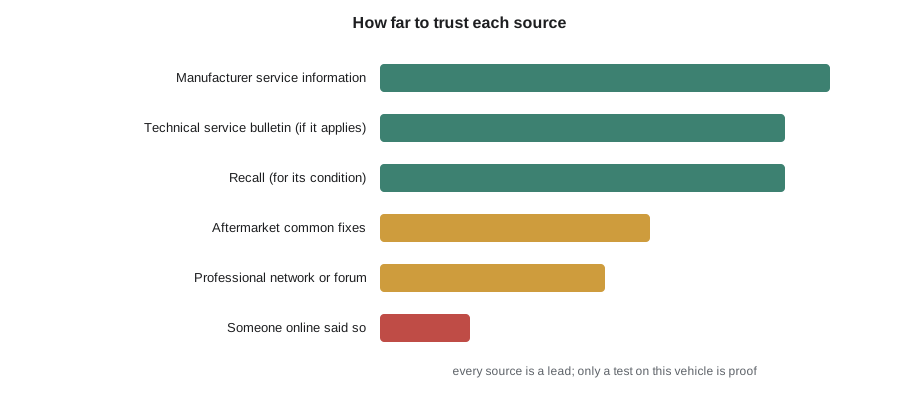
Aftermarket information systems repackage manufacturer information and add their own material: common fixes reported by thousands of shops, labor time guides, and known-good waveforms and data. A pattern failure is a fault that occurs again and again on a particular model, engine or part, often for the same reason. Pattern failures are valuable leads: they tell the technician where to look first. They are also dangerous, because a technician who knows the pattern may stop testing too early.
Professional technician networks and forums, where technicians post cases and answers, are another source. They are often faster and more practical than the manufacturer's material, but the information is only as good as the person who posted it. Marty's rule: anything from a forum or a common-fix database is a theory to test, never a reason to order a part. Theo's "everybody online" is the forum version of a pattern failure. It may be right for many cars, but it says nothing yet about his.
| Source | Strength | Limit |
|---|---|---|
| Manufacturer service information | Exact procedures, specifications and setting conditions | Assumes the fault is inside the system it describes |
| Technical service bulletin | Known problem and tested repair for a defined group of vehicles | Applies only within its stated range; still needs proof |
| Recall | Safety or emissions defect repaired free by a dealer | Covers only the recall condition |
| Aftermarket common fixes | What thousands of shops have actually replaced | Shows what was replaced, not always what fixed it |
| Professional network or forum | Fast, practical experience on hard cases | Quality varies; always a theory to test |
Searching efficiently
Information is only useful if it can be found quickly. Kiran's search order is: open recalls and campaigns by vehicle identification number; bulletins by vehicle identification number and code; the code's description and setting conditions; the system's description and operation; then common fixes and the network. She searches with the code first and the symptom second, and reads the setting conditions before the test procedure. She also writes the search results on the repair order, including what she found that did not apply, so the next person does not repeat the search.
Software matters more every year. Many bulletins for driveability complaints call for a software update rather than a part, because the manufacturer has changed how the module controls the engine. Kiran checks the module's calibration identification against the bulletin before deciding whether an update applies. If the module already has the latest calibration, the bulletin's software step is already done and the fault is elsewhere.
Back to Theo's car
With the information in hand, Kiran checks the basics the bulletin points at. The oil level is a liter low. The oil on the dipstick is thin and dark, and the oil change sticker shows the last change was well over the interval, at a quick-lube shop Theo used while on holiday. The owner's manual calls for a low-viscosity synthetic oil meeting the manufacturer's own specification; the receipt in the glovebox shows a heavier conventional oil. A camshaft phaser is moved by oil pressure controlled by a solenoid valve, so oil that is the wrong viscosity, low or dirty can make it move slowly or stick, especially when cold.
The scan tool data shows the evidence directly. At a cold start, the module commands the intake camshaft to its parked position, and the actual position should follow within a fraction of a second. Kiran records desired and actual camshaft position during a cold start and a few gentle accelerations, then compares them.
# Desired versus actual intake camshaft position during a cold start (degrees of advance, scan data)
samples = [(0.0, 0, 0), (0.5, 0, 4), (1.0, 0, 9), (1.5, 0, 12), (2.0, 0, 13), (2.5, 0, 11), (3.0, 0, 6),
           (3.5, 0, 2), (4.0, 0, 0), (6.0, 15, 3), (6.5, 15, 8), (7.0, 15, 12), (7.5, 15, 14), (8.0, 15, 15)]
limit = 10          # degrees of error the module allows before counting toward the code (illustrative)
worst = max(samples, key=lambda s: abs(s[2] - s[1]))
over = [t for t, d, a in samples if a - d > limit]
print(f"largest error {worst[2] - worst[1]} degrees at {worst[0]} s (desired {worst[1]}, actual {worst[2]})")
print(f"over-advanced by more than {limit} degrees at: {over} s")
lag = next(t for t, d, a in samples if d == 15 and a >= 14) - 6.0
print(f"when 15 degrees were commanded at 6.0 s, the camshaft reached it {lag:.1f} s later")largest error 13 degrees at 2.0 s (desired 0, actual 13) over-advanced by more than 10 degrees at: [1.5, 2.0, 2.5] s when 15 degrees were commanded at 6.0 s, the camshaft reached it 1.5 s later
The camshaft drifts up to 13 degrees advanced for about two seconds after a cold start while the module wants it parked at zero, then settles; when advance is commanded later, it gets there slowly but does arrive. Kiran recorded this on a mild morning; Theo says the light only comes on when it is well below freezing, when the oil is thickest and the drift must last much longer. The pattern fits sluggish oil control, not a broken phaser, which would usually fail to hold position at all or rattle loudly. Following the bulletin, Kiran removes the actuator solenoid and finds its inlet screen partly blocked with sludge. She cleans the screen, fits a new solenoid seal, changes the oil and filter with the specified oil, and checks the software: the module has the old calibration, so the update is added to the order with Theo's approval. After two cold starts the next morning, the largest error is 2 degrees and the code does not return.
Theo buys Kiran lunch and admits that the internet was half right. The engine does have a known camshaft problem, but on his car it was caused by oil, and a phaser would have cost him several hundred dollars and failed again on the same oil. Kiran's three Cs record the oil type found, the screen's condition, the before and after camshaft error, and the software calibration numbers.
Worked problem
Reading setting conditions
A code's setting conditions say: engine running more than 60 seconds, oil temperature above 68 °F, actual camshaft position more than 10 degrees from desired for more than 5 seconds. A car sets the code only on the coldest mornings, about two minutes after starting. What does that tell you?
Show solution
- The engine must have run for 60 seconds before the module checks, so an error in the first few seconds is not counted.
- The code sets after about two minutes, so on those mornings the camshaft must still be more than 10 degrees out after the first minute, much longer than the two seconds Kiran recorded on a milder morning.
- Cold-only behavior points at oil viscosity or flow, which change most with temperature.
Answer: The camshaft is still out of position after a minute on cold mornings; check the oil and the oil control path before condemning the phaser.
Common mistakes
MistakeOrdering the part a forum or common-fix list names.
InsteadTreat it as a theory, then test it on this vehicle.
MistakeApplying a bulletin that matches the code but not the build range.
InsteadCheck every condition: model, year, engine, build date and software version.
MistakeReading the test procedure before the setting conditions.
InsteadThe setting conditions say what the module actually saw.
MistakeAssuming a recall and a bulletin are the same.
InsteadA recall is a free safety or emissions repair by a dealer; a bulletin is a recommended repair.
MistakeSkipping the software check.
InsteadCompare the calibration identification with the bulletin before deciding an update applies.
Summary and key terms
- Manufacturer service information gives procedures, specifications, setting conditions and diagnostic routines.
- Setting conditions tell you exactly what the module measured before it set a code.
- Bulletins describe known problems for a defined group of vehicles; recalls are free safety or emissions repairs.
- Canada relies on a voluntary information-sharing agreement; the US relies on a 2014 agreement and state laws, with a federal bill still in progress.
- Pattern failures and forums are leads to test, not diagnoses.
- Search recalls, bulletins, code descriptions, then common fixes, and record what you found.
- Many driveability bulletins call for software updates; check the calibration first.
- Service information
- The manufacturer's published procedures, specifications, diagrams and diagnostic routines.
- Setting conditions
- The conditions and limits under which a module sets a diagnostic trouble code.
- Recall
- A free repair of a safety or emissions defect, normally done by a dealer.
- Pattern failure
- A fault that occurs repeatedly on a particular model, engine or part.
- Calibration identification
- The code that identifies which software version a module is running.
- Camshaft phaser
- A device driven by oil pressure that changes camshaft timing while the engine runs.
- Oil control solenoid
- A valve that directs oil pressure to a camshaft phaser on the module's command.
Practice problems
Work each problem on paper first, then reveal the answer to check.
What is the difference between a bulletin and a recall?
Show answer
A recall fixes a safety or emissions defect free of charge; a bulletin is a recommended repair, usually paid by the owner outside warranty.
Why did TSB B not apply to Theo's car?
Show answer
His car was built before the bulletin's build-date range.
What did the camshaft data show about the phaser?
Show answer
It moved slowly and drifted when cold but reached and held its target, which pointed at oil control rather than a failed phaser.
Why check the calibration identification before performing a bulletin's software update?
Show answer
If the module already has the newer calibration, the update is not the fix.
Lesson quiz · 5 questions
Score 60% or more to complete this lesson.
Create a free account to save your progress, take quizzes and earn a certificate.