
AUTO-210 · Lesson 9 of 12 · 23 min
Wheels, balancing and vibration diagnosis
Hal Osei has two vibration complaints this week, and Marcus Bell describes his in detail. Since the summer tires went back on, van 2's steering wheel shakes from side to side between about 55 and 70 mph, and settles down above that. And van 1, the van with the new rear springs, has a buzz that Marcus feels through the seat and the floor at highway speed, getting stronger the faster he goes. “Two vans, two shakes,” Marty says. “Different feel, different speeds. That tells us a lot before we touch either one.”
This lesson covers wheels, how they are fitted and fastened, how tire and wheel assemblies are balanced and measured for runout and road force, and how vibrations are diagnosed by measuring their frequency and matching it to the parts that turn at that rate. It follows both vans to their repairs.
Wheels
Wheels are made of pressed steel or of cast or forged aluminum alloy. Steel wheels are cheap, strong and easy to repair, and are common on work vehicles and as winter wheels; alloy wheels are lighter, which reduces unsprung mass, and dissipate brake heat better. A wheel's size is given by its rim diameter and width in inches, and its fitment by its bolt pattern, the number of studs and the diameter of the circle they sit on, its center bore, and its offset.
Offset is the distance from the wheel's mounting face to the center line of the rim, positive when the face is toward the outside of the wheel. Most front-wheel-drive cars use large positive offsets. A wheel with the wrong offset changes the scrub radius, described in Lesson 10, and the loads on the wheel bearings, and may rub on the suspension or the fender. Backspacing, the distance from the mounting face to the inner edge of the rim, is used by some truck wheel makers to describe the same thing.
Wheels are centered on the hub in one of two ways. Hub-centric wheels have a center bore that fits snugly over a machined pilot on the hub, which carries the wheel's weight and centers it; the lug nuts only clamp it. Lug-centric wheels are centered by the tapered seats of the lug nuts. Aftermarket wheels with oversized center bores need hub-centric rings to fill the gap, or the wheel may be clamped slightly off center and cause a vibration. Lug nuts must match the wheel's seat: conical, spherical or flat with a washer. The wrong nut seat contacts the wheel only at a ring or a point and can work loose.
Fastening wheels
Wheels are tightened to the manufacturer's torque in a star pattern, crossing from each nut to the one opposite, in two or more stages, so that the wheel is pulled flat against the hub. Impact wrenches are used only to run the nuts down, never for final tightening, unless they are fitted with a torque-limiting extension and the nuts are then checked with a torque wrench. AUTO-130 showed what over-tightening does: the uneven clamping on Ines Moreau's hybrid distorted its rotors and caused pulsation. Under-tightened nuts can loosen, and a wheel can come off. Ridgeline retorques the nuts on aluminum wheels after the first 60 miles when the service information recommends it and writes that on the invoice. Contact faces must be clean of rust and dirt, which compress over time and let the clamp load fall.
# Star tightening sequence for a wheel with n studs, and the torque stages
def star(n):
    if n == 4:
        return [1, 3, 2, 4]
    if n == 5:
        return [1, 3, 5, 2, 4]
    if n == 6:
        return [1, 4, 5, 2, 3, 6]
    if n == 8:
        return [1, 5, 3, 7, 2, 6, 4, 8]
    raise ValueError("unsupported stud count")
for n, final in [(5, 76), (6, 140), (8, 150)]:
    stages = [round(final * f) for f in (0.5, 1.0)]
print(f"{n} studs: order {star(n)}, first pass {stages[0]} lb ft, final pass {stages[1]} lb ft")5 studs: order [1, 3, 5, 2, 4], first pass 38 lb ft, final pass 76 lb ft 6 studs: order [1, 4, 5, 2, 3, 6], first pass 70 lb ft, final pass 140 lb ft 8 studs: order [1, 5, 3, 7, 2, 6, 4, 8], first pass 75 lb ft, final pass 150 lb ft
Imbalance
A tire and wheel assembly is never perfectly uniform. If one part of it is heavier than the opposite part, it is out of balance, and as it spins, the heavy spot pulls outward with a force that grows with the square of the speed. At highway speed a small heavy spot produces a surprisingly large force, and because it rotates once per wheel revolution, it shakes the wheel up and down or side to side at the wheel's rotation rate.
Here F is the force, m the unbalanced mass, r its distance from the axis and omega the angular speed in radians per second. The code calculates the force from a 1 oz unbalance on van 2's wheels.
# Force from an unbalanced mass on a spinning wheel
import math
UNITS = "US"
m = 0.030                     # kg of unbalance (about 1 oz)
r = 0.21                      # m, radius of the rim where weights go
tire_d = 0.74                 # m, overall tire diameter
for kmh in (50, 80, 100, 120):
    v = kmh / 3.6
    omega = v / (tire_d / 2)              # rad/s
    f = m * r * omega ** 2                # newtons
    hz = omega / (2 * math.pi)
    if UNITS == "metric":
        print(f"{kmh:3d} km/h: wheel turns {hz:4.1f} times a second, force {f:5.0f} N (about {f / 9.81:4.1f} kg)")
    else:
print(f"{kmh / 1.609:3.0f} mph: wheel turns {hz:4.1f} times a second, force {f / 4.448:4.0f} lbf")31 mph: wheel turns 6.0 times a second, force 2 lbf 50 mph: wheel turns 9.6 times a second, force 5 lbf 62 mph: wheel turns 11.9 times a second, force 8 lbf 75 mph: wheel turns 14.3 times a second, force 11 lbf
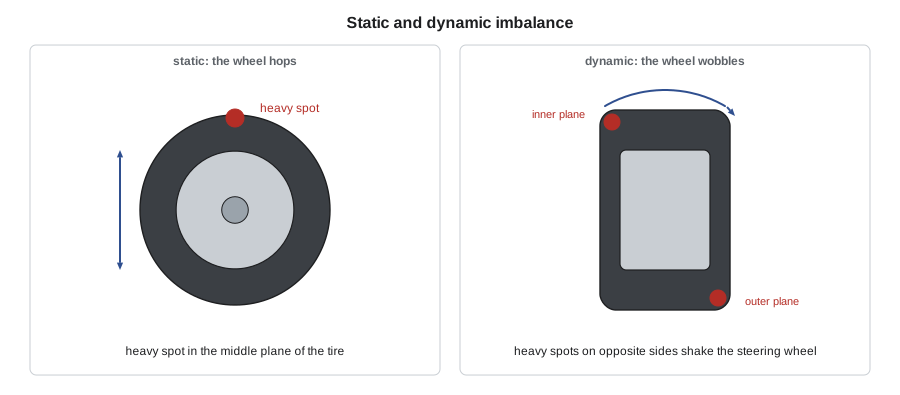
Static imbalance is a heavy spot in the center plane of the wheel; it makes the wheel hop up and down. Dynamic imbalance is a heavy spot on one side of the center plane, matched or not by one on the other side; it makes the wheel wobble from side to side, which the driver feels as a shimmy in the steering wheel. A wheel can be in perfect static balance and still have dynamic imbalance, which is why every modern balancer measures both and calls for weights on both the inner and outer planes of the rim.
Balancing
A wheel balancer spins the assembly on a shaft and measures the forces at the shaft's bearings, then shows how much weight to add and where on each plane. The assembly must be mounted correctly: centered on its center bore with the right cone, or on a lug-centric adapter for lug-centric wheels, because a wheel mounted off center on the balancer will be balanced off center. Weights are clip-on, hammered onto the rim flange, or adhesive, stuck to a clean inner surface of the rim on alloy wheels where clip-on weights would show or damage the finish. Most balancers have modes for placing adhesive weights hidden behind the spokes. Weights are now made of steel or zinc rather than lead, which is banned or being phased out in many places.
Before balancing, Theo removes stones from the tread, cleans mud and ice from inside the rim, and removes old weights, because each of those is itself an imbalance. After balancing, the assembly is spun again to confirm that it reads zero or within the balancer's tolerance. If it needs a lot of weight, more than about 2 to 3 oz on a plane, the tire may be mounted with its heavy spot at the wheel's heavy spot; rotating the tire on the rim, called match mounting, can halve the weight needed.
Runout and road force
Some vibrations are not caused by weight at all. Radial runout is the amount the tread's surface rises and falls as the wheel turns, an out-of-round tire or wheel; lateral runout is the amount it wobbles from side to side. Both are measured with a dial indicator on the tread or the rim with the assembly spinning slowly on the balancer or the vehicle. A tire with radial runout acts like a wheel with a high spot: it lifts the vehicle once per revolution, a vibration that balancing cannot cure.
A tire can also vary in stiffness around its circumference, so that even a perfectly round, perfectly balanced tire pushes harder against the road at one point than another. A road force balancer measures that variation by pressing a roller against the spinning tire with a set force, like the weight of the vehicle, and reading how much the tire pushes back. It then tells the technician how to rotate the tire on the wheel to place the tire's stiffest point at the wheel's lowest point, which cancels much of the variation. A tire whose variation is still too high after matching is defective.
# Radial runout from dial indicator readings taken at eight points around the tread
UNITS = "US"
readings = [0.000, 0.012, 0.028, 0.044, 0.051, 0.037, 0.019, 0.005]          # indicator readings at 45-degree steps
runout = max(readings) - min(readings)
high = readings.index(max(readings)) * 45
limit = 0.040
print(f"radial runout {runout:.3f} in with the high spot at {high} degrees from the valve stem")
print("within the limit" if runout <= limit else "over the limit: match mount, then check the wheel alone")radial runout 0.051 in with the high spot at 180 degrees from the valve stem over the limit: match mount, then check the wheel alone
Vibration diagnosis: frequency is the clue
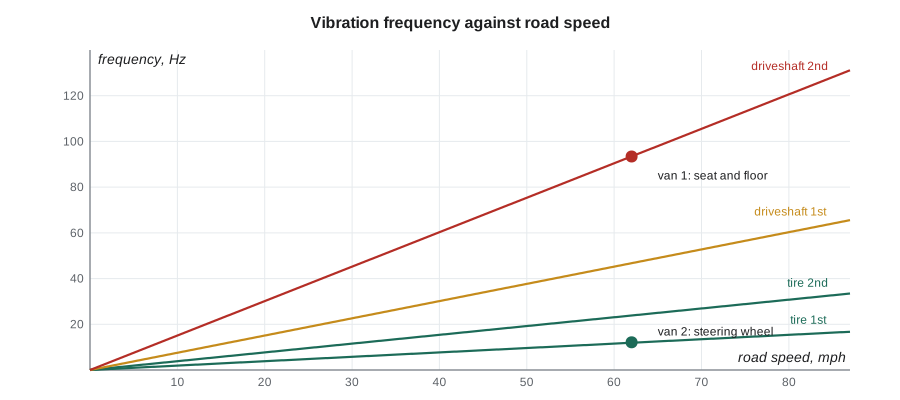
Every vibration is caused by something turning or moving at a definite rate, and the rate of the vibration matches the rate of its cause. That is the key to finding it. A tire and wheel turns about once every 7.6 feet on a typical car, so at 60 mph it turns about 12 to 13 times a second, 12 to 13 hertz. The vehicle's driveshaft turns faster than the wheels by the axle ratio, and the engine turns at its own rate, shown on the tachometer. A vibration that occurs once per revolution of a part is called first order for that part; one that occurs twice per revolution, such as from a worn universal joint or a driveshaft working at an angle, is second order.
Technicians measure vibration frequency with an electronic vibration analyzer, a sensor placed on the seat or steering column with a display or a phone app that shows the frequency and strength of the vibration while the vehicle is driven. Without one, the road test still gives strong clues. A vibration that depends on road speed, regardless of gear or engine speed, comes from the tires, wheels, axles or driveshaft. One that depends on engine speed, appearing at the same engine speed in different gears or when the engine is revved in park, comes from the engine or its accessories. A shake felt in the steering wheel usually comes from the front wheels; one felt in the seat and floor usually comes from the rear wheels or the driveline.
# Identify a vibration's source by comparing its frequency with the turning parts (first and second order)
import math
UNITS = "US"
speed_kmh = 62 * 1.609              # road speed during the measurement
tire_d = 0.74                    # m, overall tire diameter
axle_ratio = 3.92                # rear axle ratio, driveshaft turns per wheel turn
engine_rpm = 2150                # tachometer reading at that speed in top gear
measured = [12.1, 93.4]          # hertz measured on the steering column (van 2) and seat (van 1)
wheel = speed_kmh / 3.6 / (math.pi * tire_d)
sources = {"tire and wheel, 1st order": wheel, "tire and wheel, 2nd order": 2 * wheel,
           "driveshaft, 1st order": wheel * axle_ratio, "driveshaft, 2nd order": 2 * wheel * axle_ratio,
           "engine, 1st order": engine_rpm / 60, "engine, 3rd order (V6 firing)": 3 * engine_rpm / 60}
for name, hz in sources.items():
    print(f"{name:<30} {hz:5.1f} Hz")
for m in measured:
    best = min(sources, key=lambda k: abs(sources[k] - m))
print(f"measured {m:4.1f} Hz is closest to: {best}")tire and wheel, 1st order 11.9 Hz tire and wheel, 2nd order 23.8 Hz driveshaft, 1st order 46.7 Hz driveshaft, 2nd order 93.5 Hz engine, 1st order 35.8 Hz engine, 3rd order (V6 firing) 107.5 Hz measured 12.1 Hz is closest to: tire and wheel, 1st order measured 93.4 Hz is closest to: driveshaft, 2nd order
Van 2: a steering wheel shimmy
Van 2's shake is in the steering wheel, appears only in a speed band and depends on road speed alone. The analyzer reads 12.1 hertz at 62 mph, matching the tire and wheel first order. That points at a front wheel. On the balancer, the right front reads 2 oz out on the outer plane: one of its clip-on weights is missing, leaving a clean mark on the rim where it used to be. A shimmy that comes and goes in a speed band is typical of imbalance, because the suspension resonates at a particular wheel speed and the shake is strongest there. Theo rebalances all four, finds the others close, and the road test is smooth.
Van 1: a buzz in the seat
Van 1's buzz is in the seat and floor, rises steadily with speed, and is not in a band. The analyzer reads 93.4 hertz at 62 mph, which is about twice the driveshaft's rotation rate: a driveshaft second-order vibration. Second-order driveline vibrations come from universal joints working at unequal angles. A universal joint does not turn its output shaft at a perfectly steady speed when it runs at an angle; the output speeds up and slows down twice per revolution. A driveshaft is designed with its two joints at equal and opposite angles so that the second joint cancels the first joint's speed changes.
Van 1's new rear springs were the clue. Marty measures the driveshaft and pinion angles with a digital angle gauge and finds that the rear axle's pinion now points about two degrees higher than before. The new springs are correct, but one of the tapered shims that sat between the old springs and the axle to set the pinion angle was left out during reassembly; the old one is still in the parts bin. Kiran refits the shims with new U-bolts, rechecks the angles, and the buzz is gone. “The van told us where to look,” Marty says. “We just had to listen to the frequency.”
Wheel bearing or tire noise?
A hum or growl that rises with road speed may come from a worn wheel bearing or from a tire with an uneven wear pattern, such as cupping or heel-and-toe wear. Two road tests help. A bearing's noise usually changes when the vehicle swerves gently left and right, getting louder when the load moves onto the bad bearing, so a noise that grows in a gentle right turn points to a left-side bearing. Tire noise changes with the road surface and often stops changing when the tires are rotated or swapped. On the hoist, a worn bearing may feel rough when the wheel is spun by hand, or show play when the tire is rocked, and a stethoscope or a set of electronic chassis ears clamped near each bearing can find it on a road test.
Worked problem
How much speed does the van gain from a smaller tire?
Van 1's driver is told his speedometer reads correctly with tires of 29.1 in diameter. A fleet tire of 28.4 in is fitted on the rear. When the speedometer reads 60 mph, what is the true speed?
Show solution
- The wheel turns at the same rate for the same indicated speed.
- True speed is proportional to the tire diameter.
- 60 × 28.4 / 29.1 ≈ 58.6 mph.
- The van is going a little slower than indicated, and the anti-lock and stability systems see a speed difference between the axles.
Answer: About 58.6 mph; mixed diameters front and rear also confuse the wheel speed systems.
Common mistakes
MistakeFinal-tightening lug nuts with an impact wrench.
InsteadRun them down, then torque in a star pattern with a torque wrench.
MistakeMounting a wheel off center on the balancer.
InsteadUse the correct cone or lug-centric adapter so the wheel is balanced on its true center.
MistakeBalancing a wheel packed with mud or ice.
InsteadClean it and remove old weights first.
MistakeRebalancing over and over to cure a vibration.
InsteadCheck radial runout and road force; balancing cannot fix an out-of-round or stiff-spotted tire.
MistakeReplacing parts for a vibration without measuring its frequency.
InsteadMatch the frequency to the turning parts first.
Summary and key terms
- Wheels are fitted by bolt pattern, center bore and offset, and are hub-centric or lug-centric.
- Lug nuts must match the wheel's seat and be torqued in a star pattern with a torque wrench.
- Imbalance force grows with the square of speed; static imbalance hops, dynamic imbalance wobbles.
- Balancers measure both planes; runout and road force variation cause vibrations balancing cannot fix.
- A vibration's frequency matches the part that causes it: tire and wheel, driveshaft or engine.
- Steering wheel shakes usually come from the front wheels; seat and floor vibrations from the rear or driveline.
- Unequal universal joint angles cause second-order driveshaft vibrations.
- Offset
- The distance from the wheel's mounting face to the center line of the rim.
- Hub-centric
- A wheel centered by its center bore on a pilot on the hub.
- Dynamic imbalance
- Imbalance on one side of the wheel's center plane that makes it wobble.
- Radial runout
- The rise and fall of the tread surface as the wheel turns.
- Road force variation
- The change in a tire's push against the road around its circumference.
- First order
- A vibration occurring once per revolution of a part.
- Match mounting
- Rotating a tire on its wheel to cancel heavy or stiff spots against the wheel's.
Practice problems
Work each problem on paper first, then reveal the answer to check.
A vibration appears at the same engine speed in every gear. Where is it likely to come from?
Show answer
The engine or its accessories.
Why can a wheel be in static balance and still cause a shimmy?
Show answer
It can still have dynamic imbalance, a couple between its inner and outer planes.
A tire reads 0.055 in of radial runout. What is done next?
Show answer
Match mount the tire on the wheel, then check the wheel's runout alone; replace whichever is out.
At 60 mph a wheel turns 12 times a second. What is its second-order frequency?
Show answer
24 Hz.
Lesson quiz · 5 questions
Score 60% or more to complete this lesson.
Create a free account to save your progress, take quizzes and earn a certificate.