
AUTO-210 · Lesson 10 of 12 · 22 min
Wheel alignment angles
By the end of April the alignment rack in bay 3 is booked solid. Pothole damage, new tires, struts and tie rods all end with an alignment, and Marty decides it is time for Kiran to learn to run the machine herself. Before she touches it, he takes her into the training room with a whiteboard, a model knuckle and a printout from Dr. Singh's car. “The machine will give you a screen full of numbers,” he says. “If you don't know what every one of them means and what it does to the car, you'll just be turning bolts until the numbers go green.”
This lesson defines the wheel alignment angles: camber, caster and toe, which are adjusted on most vehicles, and the diagnostic angles, steering axis inclination, included angle, scrub radius, setback, thrust angle and toe-out on turns, which reveal bent or worn parts. It explains what each angle does to tire wear, steering and handling, how pulls are predicted from the differences between the two sides, and how toe is converted between angle and distance. Lesson 11 then puts it into practice on the rack.
Reference lines and signs
Alignment angles are measured against reference lines. Seen from the front of the vehicle, the reference is the true vertical. Seen from above, the front wheel angles are measured against the thrust line from Lesson 4, or against the vehicle's geometric centerline on older two-wheel alignments. Seen from the side, the reference is again the vertical. Small angles are given in degrees and decimal degrees, and sometimes in degrees and minutes, where 60 minutes make one degree. Every angle has a sign, positive or negative, and the sign matters as much as the size.
Camber
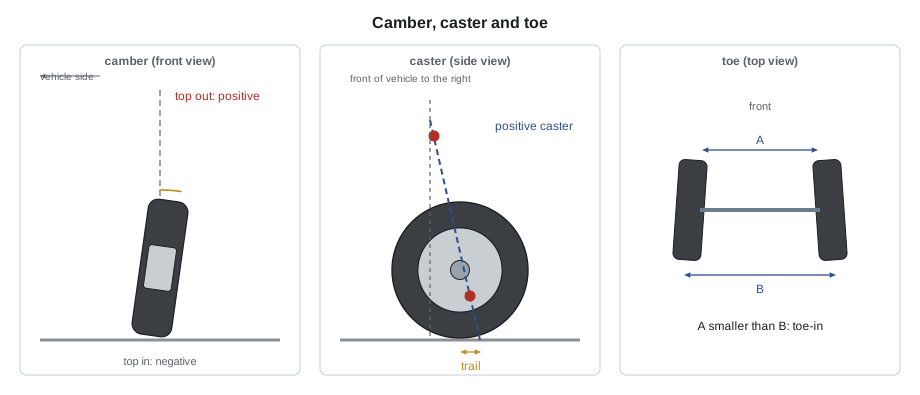
Camber is the tilt of the wheel in or out at the top, seen from the front. It is positive when the top of the wheel leans outward, away from the vehicle, and negative when the top leans inward. Most modern cars have a small negative camber, often between about zero and minus one degree at the front and a little more at the rear, because a little negative camber keeps the outside tire flatter on the road as the body rolls in a turn, as Lesson 3 explained. Trucks with solid front axles or heavy loads may have a little positive camber at curb height that becomes close to zero when loaded.
Too much camber in either direction loads one edge of the tread and wears that edge, the one-edge wear of Lesson 8: positive camber wears the outer edge, negative camber the inner edge. A difference in camber between the left and right wheels, called cross-camber, makes the vehicle pull. A tilted wheel acts like a cone, which rolls in a curve toward its narrow end, so the vehicle pulls toward the side with more positive camber. On most cars a cross-camber of about half a degree is enough to cause a noticeable pull. Camber is affected by ride height, worn ball joints and bushings, bent struts and knuckles, and shifted subframes.
Caster
Caster is the tilt of the steering axis forward or rearward, seen from the side. It is positive when the top of the steering axis is tilted toward the rear of the vehicle, which places the point where the steering axis meets the ground ahead of the tire's contact patch. That makes the tire trail behind its pivot, like the wheel of a shopping cart, and the trailing tire wants to line up straight ahead. Positive caster gives directional stability at speed and makes the steering wheel return to center after a turn. Most modern cars and trucks have several degrees of positive caster, often three to seven degrees, and electric power steering lets engineers use a lot of it without making the steering heavy.
Caster does not wear tires directly, because it does not tilt the wheel when it is pointed straight ahead. But it affects steering. Too little positive caster makes a vehicle wander and makes the wheel slow to return after a turn; too much makes the steering heavy and can cause a shimmy at low speed. A difference between the sides, cross-caster, makes the vehicle pull toward the side with less positive caster. Engineers sometimes build in a little cross-caster, more on the right in countries that drive on the right, to offset the pull to the right caused by the crown of the road, which slopes down toward the shoulder for drainage. A bent strut, a bent lower control arm or a shifted cradle changes caster.
Toe
Toe is whether the wheels point in or out at the front, seen from above. When the fronts of the two wheels on an axle are closer together than their backs, the axle has toe-in; when they are farther apart, toe-out. Toe can be given for each wheel against the thrust line or centerline, individual toe, or as the sum of both, total toe. It is measured either as an angle or as a distance: the difference between the distances across the front and the back of the tires at a set diameter. Converting between the two needs that diameter, as the code shows.
Toe has the largest effect on tire wear of any alignment angle. A wheel that is not pointed in the direction of travel is dragged slightly sideways as it rolls, scrubbing the tread and leaving the feathered edges described in Lesson 8. A small toe error wears tires faster than a large camber error. Toe settings allow for the forces of driving: on a rear-wheel-drive vehicle, the rolling resistance of the front tires pushes them back and outward on their bushings, so a little static toe-in makes them run straight; on a front-wheel-drive car, the drive force pulls the front wheels forward and inward, so zero or a little toe-out may be specified. Toe also sets the steering wheel's position: if the two front wheels' individual toe values are unequal, the steering wheel will be off center when the vehicle drives straight.
In this conversion, x is the toe distance across the tire for one wheel, D the reference diameter, usually the tire's overall diameter or a stated rim diameter, and theta the toe angle. Because the distance depends on the diameter chosen, a toe specification in millimeters or inches is only meaningful with its reference diameter.
# Convert toe between degrees and distance at a reference diameter
import math
UNITS = "US"
D = 27.5                          # reference diameter (tire overall diameter)
def to_distance(deg):
    return D * math.tan(math.radians(deg))
def to_degrees(dist):
    return math.degrees(math.atan(dist / D))
for deg in (0.05, 0.10, 0.20):
    print(f"{deg:4.2f} deg of toe per wheel = {to_distance(deg):5.3f} in at a {D} in diameter")
x = 0.125
print(f"total toe of {x} in = {to_degrees(x):4.2f} deg total, {to_degrees(x) / 2:4.2f} deg per wheel")0.05 deg of toe per wheel = 0.024 in at a 27.5 in diameter 0.10 deg of toe per wheel = 0.048 in at a 27.5 in diameter 0.20 deg of toe per wheel = 0.096 in at a 27.5 in diameter total toe of 0.125 in = 0.26 deg total, 0.13 deg per wheel
Steering axis inclination and included angle
Steering axis inclination, SAI, also called kingpin inclination, is the tilt of the steering axis inward at the top, seen from the front. It brings the steering axis's ground point close to the center of the tire's contact patch, which reduces steering effort and kickback. Because of SAI, a wheel turned away from straight ahead swings slightly downward, lifting the front of the vehicle, and the vehicle's weight pushes it back to center; that is a second self-centering effect alongside caster. SAI is not adjustable. It is set by the parts, so a change in SAI from one side to the other means a bent part.
The included angle is the SAI plus the camber, the angle between the steering axis and the wheel's own center line. Because both depend on the knuckle and the struts or arms, comparing the angles from side to side tells the technician what is bent. If SAI is wrong but the included angle is correct, the problem is in the body or the parts that locate the steering axis, such as a strut tower or a lower control arm; if the included angle is wrong, the knuckle or the strut, the parts between the steering axis and the wheel, is bent. Lesson 12 uses that reasoning.
# Diagnosing bent parts from SAI, camber and included angle (left and right, degrees)
readings = {"left": {"sai": 13.2, "camber": -0.2}, "right": {"sai": 12.5, "camber": 0.5}}
spec_sai = 13.2
for side, r in readings.items():
    included = r["sai"] + r["camber"]
    r["included"] = included
    print(f"{side:<5} SAI {r['sai']:5.1f}, camber {r['camber']:+5.1f}, included angle {included:5.1f}")
d_sai = readings["left"]["sai"] - readings["right"]["sai"]
d_inc = readings["left"]["included"] - readings["right"]["included"]
print(f"SAI differs by {d_sai:.1f} deg; included angle differs by {d_inc:.1f} deg")
if abs(d_inc) < 0.5 and abs(d_sai) >= 0.5:
    print("SAI wrong, included angle correct: look at the strut tower, lower arm or subframe on the low side")
elif abs(d_inc) >= 0.5:
print("included angle wrong: look at the knuckle or strut on that side")left SAI 13.2, camber -0.2, included angle 13.0 right SAI 12.5, camber +0.5, included angle 13.0 SAI differs by 0.7 deg; included angle differs by 0.0 deg SAI wrong, included angle correct: look at the strut tower, lower arm or subframe on the low side
Scrub radius, setback and the thrust angle
Scrub radius is the distance, at the ground, between the center of the contact patch and the point where the steering axis meets the ground, seen from the front. Most front-wheel-drive cars use a small negative scrub radius, with the steering axis meeting the ground outside the patch's center, because it tends to keep the vehicle straight if one brake pulls harder or one tire blows out. Wheels with the wrong offset or spacers change the scrub radius, which is one reason they can make a vehicle pull under braking or feel nervous over bumps.
Setback is the amount one front wheel is set back from the other, measured as a difference in wheelbase from side to side or as an angle. A small factory setback exists on some vehicles, but a change in setback after a collision or a curb strike shows a shifted cradle, a bent arm or a damaged frame. A setback causes a slight pull toward the side with the shorter wheelbase.
The thrust angle, from Lesson 4, is the direction the rear wheels point relative to the vehicle's centerline. A four-wheel alignment first sets the rear toe so that the thrust angle is close to zero, then sets the front toe relative to the thrust line, so that the steering wheel is centered when the vehicle drives straight. If the rear toe cannot be adjusted, as on a twist beam or a solid axle, the front toe is set to the thrust line anyway, which centers the steering wheel even though the vehicle tracks slightly crab-wise.
Predicting a pull
Many pulls can be predicted from the alignment readings before a road test. The rules are simple: the vehicle tends to pull toward the side with more positive camber, toward the side with less positive caster, and toward the side with the shorter wheelbase from setback. Their effects add, so a positive cross-camber and a positive cross-caster can cancel each other. Other causes of pull are not alignment angles: a tire with a built-in tendency to roll sideways, called conicity, a dragging brake, uneven tire pressures or a road crown. The code estimates the combined effect of cross-camber and cross-caster with simple weights; real vehicles differ, but the direction of the prediction is reliable.
# Predicting a pull from cross-camber and cross-caster (left minus right, degrees)
def predict(camber_l, camber_r, caster_l, caster_r):
    cross_camber = camber_l - camber_r          # positive: left has more positive camber, pulls left
    cross_caster = caster_l - caster_r          # positive: left has more caster, pulls right
    score = cross_camber * 1.0 - cross_caster * 0.5    # rough weights: camber has about twice the effect
    side = "left" if score > 0.25 else "right" if score < -0.25 else "no noticeable pull"
    return cross_camber, cross_caster, side
cases = [
    ("Lindqvist minivan as found", -0.2, 0.5, 3.8, 3.1),
    ("Dr. Singh's EV front", -0.5, -0.5, 6.2, 6.6),
    ("factory crown offset", -0.4, -0.4, 4.0, 4.4),
]
for name, cl, cr, kl, kr in cases:
    cc, ck, side = predict(cl, cr, kl, kr)
print(f"{name:<28} cross-camber {cc:+.1f}, cross-caster {ck:+.1f}: {side}")Lindqvist minivan as found cross-camber -0.7, cross-caster +0.7: right Dr. Singh's EV front cross-camber +0.0, cross-caster -0.4: no noticeable pull factory crown offset cross-camber +0.0, cross-caster -0.4: no noticeable pull
The first case shows a vehicle with the right wheel's camber well more positive than the left's, and with less caster on the right as well: both effects point right, and the minivan in Lesson 12 does indeed pull right. The other two cases show settings within normal tolerances, where a small cross-caster of the kind built in to offset the road crown makes no noticeable pull of its own.
Toe-out on turns and the full list
Toe-out on turns, from Lesson 6, is measured on the alignment rack by turning the wheels to a set angle, usually 20 degrees for the outside wheel, and reading the inside wheel's angle. Some machines also measure maximum steering lock, the full turn to each side. A toe-out on turns that differs from side to side, or from the specification, points to a bent steering arm.
| Angle | What it is | Adjustable? | Main effects when wrong |
|---|---|---|---|
| Camber | Tilt of the wheel in or out at the top | Often | One-edge tire wear; pull toward more positive side |
| Caster | Tilt of the steering axis fore and aft | Sometimes | Wander, heavy steering; pull toward less positive side |
| Toe | Wheels pointing in or out | Yes, front and often rear | Fast feathered wear; off-center steering wheel |
| Steering axis inclination | Inward tilt of the steering axis | No | Shows bent parts |
| Included angle | SAI plus camber | No | Separates a bent knuckle or strut from a bent arm or body |
| Scrub radius | Steering axis to patch center at the ground | No | Pull under braking, sensitivity over bumps |
| Setback | One front wheel behind the other | No | Slight pull; shows collision or curb damage |
| Thrust angle | Rear wheels' pointing direction | Through rear toe | Crab-wise tracking, off-center steering wheel |
| Toe-out on turns | Inside wheel turning more in a turn | No | Tire squeal and scrub in turns; bent steering arm |
Worked problem
Will this toe wear the tires?
Dr. Singh's front total toe reads +0.16 in at a reference diameter of 27.5 in against a specification of +0.04 in ± 0.04 in. How large is the error in degrees per wheel, and does it matter?
Show solution
- The error in total toe is 0.16 − 0.04 = 0.12 in.
- Per wheel, that is 0.06 in.
- In degrees, atan(0.06 / 27.5) ≈ 0.13 degrees per wheel.
- Each wheel is dragged sideways about 12 feet every mile it travels, enough to feather the tread within a few thousand kilometers.
Answer: About an eighth of a degree per wheel, small on paper but enough to wear the tires quickly.
Common mistakes
MistakeThinking caster wears tires.
InsteadCaster affects stability and pull; camber and toe wear tires.
MistakeGiving a toe specification in millimeters or inches without its diameter.
InsteadToe distance depends on the reference diameter; check what the specification uses.
MistakeTrying to adjust SAI.
InsteadSAI is fixed by the parts; a wrong SAI means a bent or shifted part.
MistakeCentering a steering wheel by turning it on its splines.
InsteadSet the individual front toe so the wheel is centered on the thrust line.
MistakeBlaming every pull on the alignment.
InsteadCheck tire pressures, tire conicity and brake drag too.
Summary and key terms
- Camber tilts the wheel in or out; too much wears one edge, and cross-camber pulls toward the more positive side.
- Positive caster gives stability and return; cross-caster pulls toward the less positive side.
- Toe is the largest cause of alignment-related tire wear and sets the steering wheel's position.
- SAI and the included angle are not adjustable and reveal bent parts.
- Scrub radius and setback affect pull and show damage.
- The rear toe sets the thrust line, and the front toe is set to it.
- Pulls can be predicted from cross-camber, cross-caster and setback, but tires and brakes can pull too.
- Camber
- The tilt of a wheel in or out at the top, seen from the front.
- Caster
- The tilt of the steering axis forward or rearward, seen from the side.
- Toe
- Whether the wheels point in or out at the front, seen from above.
- Steering axis inclination
- The inward tilt of the steering axis, seen from the front.
- Included angle
- The sum of steering axis inclination and camber.
- Scrub radius
- The distance at the ground between the steering axis and the center of the contact patch.
- Setback
- The amount one front wheel is set back from the other.
Practice problems
Work each problem on paper first, then reveal the answer to check.
The left wheel has −0.8° camber and the right +0.2°. Which way does the vehicle tend to pull?
Show answer
Right, toward the side with more positive camber.
Left caster 5.5°, right caster 4.0°. Which way does it tend to pull?
Show answer
Right, toward the side with less positive caster.
At a 27.5 in diameter, what is 0.10° of toe as a distance?
Show answer
27.5 × tan 0.10° ≈ 0.048 in.
SAI is low on the left but the included angle matches the right. What is bent?
Show answer
Something locating the steering axis: the strut tower, lower arm or subframe, not the knuckle.
Lesson quiz · 5 questions
Score 60% or more to complete this lesson.
Create a free account to save your progress, take quizzes and earn a certificate.