
AUTO-210 · Lesson 3 of 12 · 23 min
Front suspension designs
Gord Haney's pickup is up on the rack in bay 3 with its new stabilizer bar links and bushings on the bench beside it. Before Kiran picks up a wrench, Marty wants her to understand the whole front suspension the parts belong to, because the same morning's schedule holds two more front-end jobs: Ines Moreau's hybrid has a knock and a creak when she turns into her driveway, and a used compact SUV that Theo bought for his partner needs a pre-purchase inspection.
This lesson describes the front suspension designs used on cars and light trucks: the MacPherson strut, the short-and-long-arm or double-wishbone design, multilink designs and the solid front axle of heavy four-wheel-drive trucks. It explains ball joints, bushings and stabilizer bars, how each is checked for wear, and how Kiran repairs Gord's truck and Ines's car.
What a front suspension has to do
A front suspension must do everything a rear suspension does and two things more. It must let the wheels steer, turning about a steering axis while still moving up and down, and on front-wheel-drive and four-wheel-drive vehicles it must make room for a drive shaft passing through the middle of the knuckle. The knuckle, sometimes called the spindle or upright, is the part that carries the wheel bearing and hub, the brake caliper and the steering arm. Everything else in the front suspension exists to hold the knuckle in the right place and let it move in the right way.
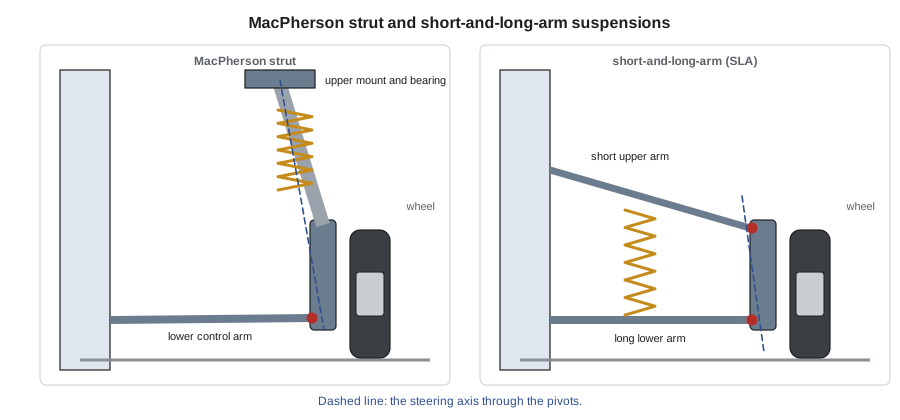
The steering axis is an imaginary line through the upper and lower pivots of the knuckle: the upper and lower ball joints on a double-wishbone suspension, or the upper strut mount and the lower ball joint on a strut. Its tilt, seen from the front and from the side, gives two of the alignment angles covered in Lesson 10, steering axis inclination and caster.
The MacPherson strut
The MacPherson strut, named after the engineer who developed it in the 1940s, is the most common front suspension on cars and small SUVs. A strut is a damper whose body is bolted rigidly to the knuckle, so that it acts as the upper locating link. The coil spring sits around the strut, between a seat on the strut body and an upper mount bolted into the body's strut tower. A single lower control arm, usually an L-shaped or A-shaped arm with two bushings at the body and a ball joint at the knuckle, locates the bottom of the knuckle.
Because the strut turns with the wheel when the vehicle is steered, the upper mount contains a bearing that lets the strut and spring rotate under load. That bearing is a common source of noise: a creak, a groan or a binding feel when the steering wheel is turned with the vehicle stopped or moving slowly, sometimes with a spring that winds up and then lets go with a clunk. The strut design is compact, cheap and light, and it leaves room for the engine and drive shafts of front-wheel-drive cars. Its drawbacks are that the strut tower is tall, the camber changes less usefully as the wheel moves, and the strut's seal and rod carry side loads that a plain damper does not.
Short-and-long-arm and double-wishbone suspensions
The short-and-long-arm suspension, or SLA, uses two control arms, an upper one that is shorter than the lower one. Each arm pivots on bushings at the frame and connects to the knuckle through a ball joint. When both arms are triangle-shaped they are often called wishbones, and the design a double-wishbone suspension. Gord's pickup, like most full-size trucks and many larger cars, uses an SLA.
The unequal arm lengths are deliberate. As the wheel rises over a bump or as the body rolls in a turn, the short upper arm swings through a tighter arc than the long lower arm, pulling the top of the wheel inward. That gain in negative camber keeps the outside tire flatter on the road as the body leans, which improves grip in turns and reduces the change in track width that would scrub the tires sideways. The price is more parts, more pivots and more space.
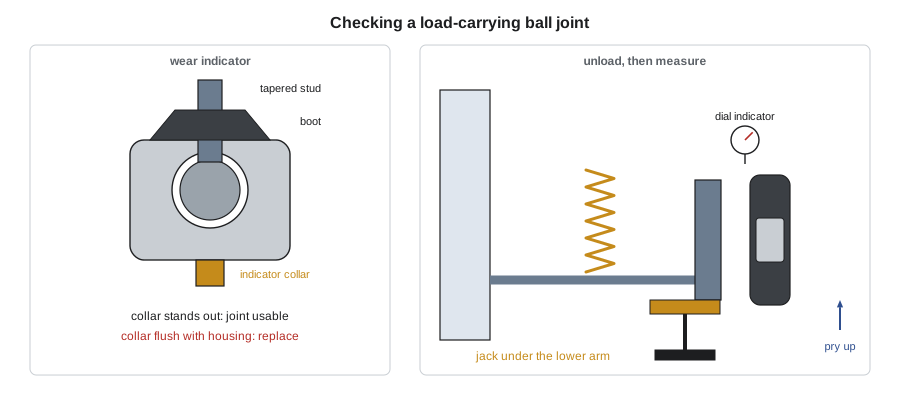
Where the spring sits matters for service. On many trucks the coil spring, or the strut-and-spring assembly, sits on the lower arm, so the lower ball joint carries the vehicle's weight and is called the load-carrying ball joint; the upper joint is a follower that only locates the knuckle. On some older designs the spring sits on the upper arm, and then the upper joint carries the load. On torsion bar trucks, the bar attaches to the lower arm. Knowing which joint carries the load tells the technician where to place the jack when checking for wear.
Multilink and solid front axles
Multilink front suspensions replace one or both control arms with two separate links, each with its own ball joint or bushing at the knuckle. The extra links let engineers control the steering axis and the wheel's motion more precisely, and many premium cars use them. They are checked joint by joint, like any other suspension, but have more joints to check and more alignment interactions.
Heavy-duty four-wheel-drive pickups and some off-road vehicles still use a solid front drive axle, with the knuckles turning on ball joints or kingpins at each end of the axle housing and the axle located by radius arms or leaf springs and a track bar, a diagonal link that keeps the axle centered under the frame. A worn track bar or its bushings can let the axle shift sideways, and on some trucks it is one cause of the violent shaking after a bump known as death wobble. Those trucks are less common in Ridgeline's bays, but Kiran will meet them.
Ball joints
A ball joint is a ball-and-socket pivot. A hardened steel ball on a tapered stud sits in a socket lined with a bearing material, and a rubber boot keeps out water and grit and holds in the grease. The joint lets the knuckle pivot up and down and turn for steering at the same time. The tapered stud fits a matching tapered hole in the knuckle and is pulled tight by a nut, so that the taper locks, and a cotter pin or a self-locking nut keeps the nut from turning.
Ball joints wear as the ball and its liner wear, letting the ball move up and down in the socket, axial play, or side to side, radial play. Worn ball joints cause clunks over bumps, wandering, uneven tire wear and, in the worst case, separation, in which the ball pulls out of its socket and the wheel folds under the vehicle. A torn boot lets in water and salt and ruins a joint quickly, so a torn boot on a sealed joint means the joint is replaced.
Many load-carrying ball joints have a wear indicator: the grease fitting sits on a collar that sticks out of the bottom of the joint, and as the joint wears, the collar sinks until it is flush with the housing. When the collar can no longer be moved or no longer stands proud of the housing, the joint is worn out. For joints without an indicator, the joint is unloaded and its movement measured with a dial indicator or a pry bar, and compared with the manufacturer's specification. Many manufacturers now specify zero allowable play for follower joints and for most car ball joints.
# Ball joint check: measured play against the service limit
UNITS = "US"
limit_axial = 0.030        # service limit for the load-carrying lower joint
joints = [
    ("left lower (load carrying)", "axial", 0.015),
    ("right lower (load carrying)", "axial", 0.020),
    ("left upper (follower)", "radial", 0.0),
    ("right upper (follower)", "radial", 0.0),
]
for name, kind, play in joints:
    lim = limit_axial if kind == "axial" else 0.0      # follower joints: no play allowed
    ok = play <= lim
print(f"{name:<28} {kind:<6} play {play:5.3f} in, limit {lim:5.3f} in: {'pass' if ok else 'replace'}")left lower (load carrying) axial play 0.015 in, limit 0.030 in: pass right lower (load carrying) axial play 0.020 in, limit 0.030 in: pass left upper (follower) radial play 0.000 in, limit 0.000 in: pass right upper (follower) radial play 0.000 in, limit 0.000 in: pass
The figures above are Gord's, with an illustrative service limit; the truck's own service information gives the real one. Both lower joints are within their limit, and both upper joints are tight. The lower joints' wear indicators still stand clear of their housings. Kiran writes the readings on the inspection sheet so that next year's technician can see how fast they are wearing.
Bushings
Control arms and links pivot on bushings: rubber sleeves bonded between an inner steel tube, which the bolt passes through, and an outer shell pressed into the arm. The rubber twists as the arm moves instead of sliding, so it needs no lubrication, absorbs vibration and noise, and lets the arm move slightly under load. Because the rubber twists, the bolt through a rubber bushing must be tightened with the suspension at its normal ride height. If it is tightened with the arm hanging, the rubber is already twisted when the vehicle is lowered, and it tears early.
Worn bushings crack, split, separate from their sleeves or let the inner tube move off center. They cause clunks when the vehicle brakes or accelerates, wander, a shimmy over bumps, and changes in the alignment as the vehicle brakes. Some bushings are filled with fluid to absorb vibration better, and a leaking fluid-filled bushing shows as a wet, oily patch on the arm. Polyurethane bushings, sold as performance parts, are stiffer and last longer but transmit more noise and, because they slide instead of twisting, need lubrication.
Stabilizer bars and links
A stabilizer bar is a U-shaped steel bar that runs across the vehicle. Its middle section is held to the frame or subframe in two rubber bushings, and its ends are connected to the left and right control arms or struts by short end links. When both wheels move up together, over a speed bump, the bar simply rotates in its bushings and does nothing. When one wheel moves up and the other down, as the body rolls in a turn, the bar is twisted, and its resistance to twisting pushes the inside wheel down and the outside wheel up, reducing roll. A stiffer bar reduces roll but also transmits more of a one-sided bump from one wheel to the other.
The bar's stiffness rises with the fourth power of its diameter, like a coil spring, so a bar only slightly thicker is much stiffer. The code shows the effect for Gord's truck.
# Stabilizer bar: twisting stiffness of the center section, J = pi d^4 / 32
import math
UNITS = "US"
G = 79000.0                         # N/mm2 for spring steel
length = 900.0                      # mm, length of the twisted center section
arm = 250.0                         # mm, lever arm from the bar's center to the end link
for d in (30.0, 32.0, 34.0):
    J = math.pi * d ** 4 / 32       # mm4
    torsion = G * J / length        # N mm per radian
    at_link = torsion / arm ** 2    # N/mm at the end link, one side up and one side down
    if UNITS == "metric":
        print(f"bar diameter {d:4.1f} mm: about {at_link:5.1f} N/mm at each link")
    else:
print(f"bar diameter {d / 25.4:5.3f} in: about {at_link * 5.71:4.0f} lb/in at each link")bar diameter 1.181 in: about 638 lb/in at each link bar diameter 1.260 in: about 826 lb/in at each link bar diameter 1.339 in: about 1052 lb/in at each link
End links take a beating. They have a ball joint or a pair of rubber bushings at each end, and because they connect the bar to the arm, every bump and every turn works them. Worn links rattle and clunk over small bumps, especially at low speed on rough roads. Bar bushings dry out, crack and squeak; once they are loose the bar can shift and hammer the links, which is what happened to Gord's truck. On the hoist, a link is checked by grabbing it and twisting; any play in its joints, or a link that rotates freely when it should be stiff, means it is worn.
Repairing Gord's truck
Kiran follows the service information. With the truck on the rack and the front suspension at ride height, so that the bar is not twisted, she removes the end link nuts, holding the link studs with a hex key in their ends so the ball does not spin. The old right link's lower bushing is mashed flat. She unbolts the two bar bushing brackets from the frame, cleans the bar where the bushings sit, which is rusted and pitted, and fits the new bushings with the light coat of the approved grease the instructions call for. New links go in, and all the nuts are torqued to specification with the weight on the wheels. A road test over the speed bumps in the back lane is silent. Marty points out that the bushings declined last spring would have cost Gord less than a third of today's bill.
Ines's hybrid: a strut mount
Ines Moreau's car has a different noise: a creak and a light clunk from the left front when she turns the steering wheel slowly while parking. Kiran turns the wheel lock to lock with the car on the ground and her hand on the top of the left strut, under the hood, and feels a notchy grinding through her fingers. The strut mount bearing has corroded after a salty winter. The repair means removing the strut, compressing the spring in the shop's wall-mounted strut compressor, and replacing the mount and bearing. With 186,000 kilometers on the car and the strut itself showing a misty but dry body, Marty suggests replacing both front struts with complete assemblies, called loaded or quick struts, that come with a new spring, seat and mount already assembled. That avoids the spring compressor altogether and renews everything in the corner. Ines agrees. After the struts are replaced, the camber and toe will have moved, so an alignment is part of the job; Lesson 11 follows it.
Worked problem
Is a thicker stabilizer bar worth it?
Theo is thinking of fitting his partner's SUV with an aftermarket rear stabilizer bar of 0.94 in instead of the original 0.83 in. Roughly how much stiffer is it, if its shape and length are the same?
Show solution
- Bar stiffness rises with the fourth power of diameter.
- The ratio is (24 / 21)⁴ (or (0.94 / 0.83)⁴).
- That is about 1.71, so the bar is about 70 percent stiffer.
- That much extra rear roll stiffness changes the vehicle's balance in turns and makes one-sided bumps harsher; it is a change to the design, not a repair.
Answer: About 70 percent stiffer. Kiran tells Theo that a bar that much stiffer is a design change, not a repair.
Common mistakes
MistakeChecking a load-carrying ball joint with the vehicle's weight on it.
InsteadJack under the arm that carries the spring so the joint is unloaded, then measure.
MistakeAllowing some play in a follower ball joint.
InsteadMost manufacturers specify no play for follower joints; check the service information.
MistakeReusing a ball joint with a torn boot.
InsteadWater and grit ruin the joint; replace it.
MistakeTorquing control arm bushing bolts with the wheels hanging.
InsteadTorque them at ride height so the rubber is not pre-twisted.
MistakeSpinning a link stud with an impact wrench.
InsteadHold the stud with a hex key or the flats provided and use a hand wrench.
Summary and key terms
- The knuckle carries the hub, brake and steering arm; the suspension holds it in place and lets it steer and move.
- A MacPherson strut uses a structural damper as the upper link and turns on a bearing in its upper mount.
- A short-and-long-arm suspension gains negative camber as the wheel rises, keeping the outside tire flatter in turns.
- The ball joint on the arm that carries the spring is the load-carrying joint and must be unloaded to check it.
- Rubber bushings twist rather than slide and must be torqued at ride height.
- A stabilizer bar resists roll only when the two wheels move differently; its links and bushings wear and knock.
- Knuckle
- The part that carries the wheel bearing, hub, brake and steering arm.
- MacPherson strut
- A suspension in which a structural damper locates the top of the knuckle.
- Short-and-long-arm suspension
- A design with a short upper and a long lower control arm.
- Load-carrying ball joint
- The ball joint on the arm that carries the spring force.
- Follower ball joint
- A ball joint that locates the knuckle but carries no spring load.
- Bushing
- A rubber or other flexible sleeve on which a suspension arm pivots.
- End link
- A short link connecting a stabilizer bar to a control arm or strut.
Practice problems
Work each problem on paper first, then reveal the answer to check.
Why does the short upper arm of an SLA suspension improve grip in turns?
Show answer
It pulls the top of the wheel inward as the wheel rises, keeping the outside tire flatter as the body rolls.
A truck's coil springs sit on its lower arms. Where is the jack placed to check the lower ball joints?
Show answer
Under the lower arm, close to the ball joint, so the spring is held compressed and the joint is unloaded.
What noise suggests a worn strut mount bearing?
Show answer
A creak, groan or notchy feel when the steering is turned slowly, sometimes with a clunk as the spring winds up.
A 1.18 in bar is replaced with a 1.30 in bar. About how much stiffer is it?
Show answer
(1.30 / 1.18)⁴ ≈ 1.47, about 47 percent stiffer.
Lesson quiz · 5 questions
Score 60% or more to complete this lesson.
Create a free account to save your progress, take quizzes and earn a certificate.