
AUTO-210 · Lesson 7 of 12 · 23 min
Hydraulic and electric power steering
A week after his stabilizer bar repair, Gord Haney's truck is back with a new noise: a whine from the engine bay whenever he turns the wheel, loudest on cold mornings, and a steering wheel that feels heavy for the first few minutes. The same afternoon Dr. Singh calls about her electric hatchback. On the coldest morning of the week the dash showed a steering assist warning, the steering went heavy in her driveway, and then everything was normal again after a few minutes of driving. Two power steering systems, two very different technologies, one day.
This lesson explains why power assist is needed and how hydraulic power steering, electrically driven hydraulic pumps and electric power steering provide it. It covers how each one senses the driver's effort, how its faults are diagnosed, and why electric power steering has become part of the vehicle's network of driver assistance systems, with calibrations that follow alignments and steering repairs.
Why assist is needed
Turning the front wheels of a stationary vehicle takes a great deal of force. The tires' contact patches must twist on the pavement, and the steering axis geometry described in Lesson 10 lifts the front of the vehicle slightly as the wheels turn. On a heavy pickup or a front-wheel-drive car with most of its weight over the front wheels, the force needed at the steering wheel rim to turn the wheels while parked could be more than most drivers can manage without a very slow steering ratio. Power steering adds force so that the ratio can stay quick and the effort light, and well-designed systems add less force at speed, where steering loads are lower and a light, twitchy wheel would feel unsafe.
Hydraulic power steering
In a hydraulic system, an engine-driven pump supplies fluid under pressure to the steering gear. The pump is usually a vane pump: a slotted rotor turns inside an oval cam ring, and vanes sliding in the slots sweep fluid from the inlet to the outlet. Because the pump turns with the engine, it delivers far more fluid than needed at highway speed, so a flow control valve in the pump bypasses the excess back to the inlet, and a pressure relief valve limits the maximum pressure, typically around 1,200 to 1,500 psi, which the system reaches when the steering is held against a lock. A reservoir, sometimes remote and sometimes on the pump, holds the fluid; a high-pressure hose carries it to the gear, and a low-pressure return line, often with a cooler loop, brings it back.
In a hydraulic rack, the rack carries a piston inside a cylinder formed by the rack housing, with seals on the piston and at each end of the cylinder. A rotary control valve on the pinion shaft decides which side of the piston gets pressure. The valve is built around a torsion bar, a slim steel bar that connects the input shaft from the steering wheel to the pinion. When the driver turns the wheel, the torsion bar twists slightly before the pinion moves, and that twist turns an inner valve spool relative to an outer sleeve, opening passages that send pressure to one side of the piston and connect the other side to the return. The harder the driver turns, the more the bar twists and the more pressure reaches the piston. When the driver lets go, the bar centers the valve and pressure equalizes. Recirculating-ball gears use the same valve with a piston on the ball nut.
# Assist force from hydraulic pressure on the rack piston
import math
UNITS = "US"
bore = 40.0              # mm, cylinder bore
rod = 24.0               # mm, rack diameter through the piston (it reduces the working area)
area = math.pi / 4 * (bore ** 2 - rod ** 2)       # mm2
for kpa in (500, 2000, 6000, 9000):
    force = kpa / 1000 * area        # kPa / 1000 = N/mm2
    if UNITS == "metric":
        print(f"{kpa:5d} kPa on {area:5.0f} mm2 gives {force / 1000:4.1f} kN of assist at the rack")
    else:
        print(f"{kpa * 0.145:5.0f} psi on {area / 645.2:4.2f} in2 gives {force / 4.448:5.0f} lbf of assist at the rack")
print("parking needs the high pressures; highway steering needs only a little")72 psi on 1.25 in2 gives 90 lbf of assist at the rack 290 psi on 1.25 in2 gives 362 lbf of assist at the rack 870 psi on 1.25 in2 gives 1085 lbf of assist at the rack 1305 psi on 1.25 in2 gives 1627 lbf of assist at the rack parking needs the high pressures; highway steering needs only a little
Fluids and hoses
Power steering systems use the fluid the manufacturer specifies: some use a dedicated power steering fluid, some an automatic transmission fluid, and some a synthetic fluid that must not be mixed with anything else. The wrong fluid can swell or harden the seals. Fluid breaks down with heat and picks up wear particles from the pump and rack, so it darkens and can smell burnt. The level is checked with the engine at the temperature the cap or service information states; many reservoirs have separate hot and cold marks.
High-pressure hoses are made of reinforced rubber with crimped steel fittings and are rated for the system's pressure; a leaking or bulging hose is replaced, never clamped. Return hoses carry low pressure and are often clamped onto metal lines, which corrode in road salt. A leak at the return side is messy; a burst high-pressure hose can spray hot fluid onto the exhaust.
Diagnosing hydraulic systems
Kiran checks Gord's reservoir first. The level is at the cold mark, but the fluid is foamy and light brown, full of tiny air bubbles. Air in the fluid makes the pump whine as the bubbles collapse under pressure, and aerated fluid compresses, so the assist feels uneven. Air gets in through a leak on the suction side, where the system is below atmospheric pressure, so the leak may draw air in without dripping fluid out. She finds the cause where the return line joins the reservoir: the clamp has rusted loose and the hose is cracked at its end. A whine that is worst when the fluid is cold and thick is classic for a suction-side air leak or a restricted reservoir screen.
Other symptoms point to other parts. A groan when the steering is held at full lock is normal, because the relief valve is open. Hard steering in both directions with a quiet pump points to low pump output, a slipping belt or a restricted hose; hard steering in one direction only points to the rack's valve or piston seals. Steering that is heavy only when cold and improves as it warms, called morning sickness, is usually worn rack seals that leak internally until the fluid warms and the seals swell. A pump that whines with fluid that is full and clear may be worn.
The definitive test is a pressure and flow test. A tester with a gauge, a flow meter and a shut-off valve is installed in the high-pressure line between the pump and the gear. With the engine at idle and the fluid at operating temperature, the technician reads the flow and the pressure with the valve open, then briefly closes the valve, for no more than a few seconds, to read the pump's maximum relief pressure, then turns the steering to each lock to see whether the gear holds pressure. Comparing the readings with the specification separates a weak pump from a leaking gear.
# Power steering pressure and flow test: compare readings with specification (illustrative values)
UNITS = "US"
spec = {"flow at idle": 2.0, "relief pressure": 1500, "pressure at each lock": 1500}
readings = {"flow at idle": 1.95, "relief pressure": 1465, "pressure at each lock": 1450}
for test, s in spec.items():
    r = readings[test]
    ratio = r / s
    verdict = "ok" if ratio >= 0.90 else "low"
    print(f"{test:<22} spec {s:7.2f}, reading {r:7.2f} ({ratio * 100:3.0f} %) {verdict}")
print("weak pump: flow and relief pressure both low; leaking gear: pump good but lock pressure low")flow at idle spec 2.00, reading 1.95 ( 98 %) ok relief pressure spec 1500.00, reading 1465.00 ( 98 %) ok pressure at each lock spec 1500.00, reading 1450.00 ( 97 %) ok weak pump: flow and relief pressure both low; leaking gear: pump good but lock pressure low
Gord's pump passes the test once the air is out. Kiran replaces the return hose and clamp, flushes the old, aerated fluid with the specified fluid, and bleeds the system the way the service information describes: with the front wheels off the ground, turning the wheel slowly lock to lock with the engine off, then with the engine running, topping up as the bubbles rise, and sometimes with a vacuum cap on the reservoir to pull the air out. The whine is gone.
Electrically driven hydraulic pumps
Some vehicles keep a hydraulic rack but drive the pump with an electric motor instead of the engine. This electro-hydraulic power steering, or EHPS, saves fuel because the pump runs only as fast as needed, and it keeps working when an engine with stop-start shuts off at a light. The pump's module varies its speed using vehicle speed and steering rate signals. It is diagnosed like a hydraulic system for leaks and fluid condition, and like an electrical system for power, ground and module faults.
Electric power steering
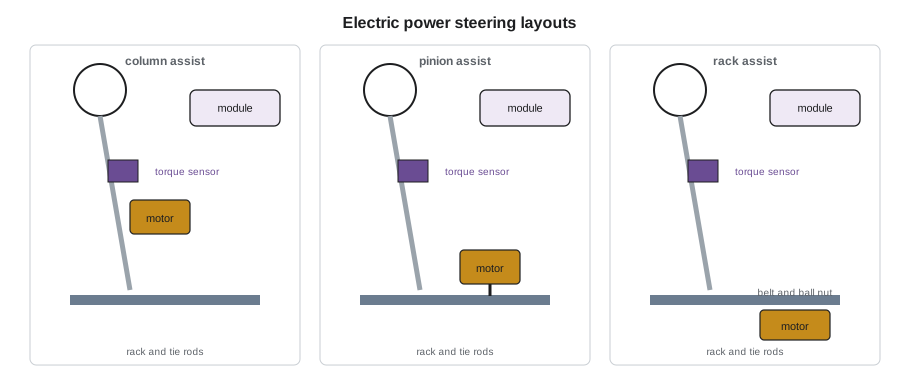
Most new cars and light trucks use electric power steering, EPS, with no hydraulic parts at all. An electric motor adds torque to the steering through a gear. The motor can be mounted on the column, driving the steering shaft through a worm gear; on the pinion, driving the rack through a second pinion; or on the rack itself, driving a ball nut on a threaded section of the rack through a belt. Column-mounted units suit small cars; rack-mounted units deliver the most force and suit heavier vehicles such as trucks and electric SUVs.
The key sensor is the torque sensor, which measures how hard the driver is turning the wheel. Like the hydraulic valve, it uses a torsion bar between the input shaft and the output; the sensor, usually a non-contact magnetic or Hall-effect sensor, measures the bar's twist. A steering angle sensor, on the column or inside the EPS unit, measures where the wheel is pointed and how fast it is turning. The EPS module combines those signals with vehicle speed and decides how much motor torque to add, using an assist map: a lot of assist at parking speeds, little at highway speeds.
# A simple EPS assist map: more assist at low speed and for higher driver torque (illustrative)
UNITS = "US"
def assist(driver_nm, speed_kmh):
    gain = 4.0 if speed_kmh < 10 else 2.5 if speed_kmh < 50 else 1.0     # speed-dependent gain
    deadband = 0.5                                                      # Nm before any assist
    a = max(0.0, abs(driver_nm) - deadband) * gain
    return min(a, 12.0)                                                 # limit of the motor, Nm at the column
for speed in (5, 40, 100):
    row = []
    for driver in (1, 2, 3, 4):
        if UNITS == "metric":
            row.append(f"{driver} Nm -> {assist(driver, speed):4.1f} Nm")
        else:
            row.append(f"{driver * 0.7376:3.1f} lb ft -> {assist(driver, speed) * 0.7376:4.1f} lb ft")
    label = f"{speed} km/h" if UNITS == "metric" else f"{speed / 1.609:3.0f} mph"
print(f"{label:>8}: " + ", ".join(row))3 mph: 0.7 lb ft -> 1.5 lb ft, 1.5 lb ft -> 4.4 lb ft, 2.2 lb ft -> 7.4 lb ft, 3.0 lb ft -> 8.9 lb ft 25 mph: 0.7 lb ft -> 0.9 lb ft, 1.5 lb ft -> 2.8 lb ft, 2.2 lb ft -> 4.6 lb ft, 3.0 lb ft -> 6.5 lb ft 62 mph: 0.7 lb ft -> 0.4 lb ft, 1.5 lb ft -> 1.1 lb ft, 2.2 lb ft -> 1.8 lb ft, 3.0 lb ft -> 2.6 lb ft
Because a computer decides how much torque the motor adds, EPS can do things a hydraulic system cannot. It can add a small torque to bring the wheel back to center after a turn, damp out kickback from bumps, compensate for a slight pull from a crowned road or a crosswind, and steer the vehicle itself for parking assist and lane centering, as directed by the driver assistance modules over the vehicle network. It uses energy only when it adds torque, which saves fuel, or battery range in an electric vehicle.
Diagnosing electric power steering
EPS faults are found mostly with a scan tool. The module stores trouble codes and shows live data: driver torque, motor current, steering angle, vehicle speed, the module's temperature and its supply voltage. Most systems have a fail-safe strategy. If a sensor fails, the module may reduce assist gradually and turn on a warning lamp, so that the driver is not surprised by a sudden change. If the module overheats, after a long session of parking maneuvers, for example, it reduces assist until it cools, which can feel like a fault but is a protection.
EPS motors draw large currents, often 60 to 100 amperes when parking, so the system is very sensitive to supply voltage. A weak 12-volt battery, a loose terminal, a corroded ground or a high-resistance connection at the module can make the assist heavy or set a low-voltage code. Before replacing any EPS part, the technician tests the battery and charging system and does a voltage drop test on the module's power and ground circuits while it is working hard.
Dr. Singh's electric car has no alternator: its 12-volt battery, which runs the lights, modules and steering, is charged from the high-voltage battery through a DC-to-DC converter, and only while the car is on. Kiran finds two stored codes for low supply voltage at the EPS module, both set on the same frigid morning, and a 12-volt battery that tests at 41 percent of its rated cold cranking ability. With the car parked outside for several days in deep cold, the old battery's voltage sagged under the steering motor's load in the first minutes of driving, before the converter brought it back up. A new 12-volt battery cures it, and Kiran clears the codes and checks the module's live voltage while turning the wheel lock to lock at a standstill.
# EPS supply check: battery voltage at the module while parking, versus the low-voltage limit
UNITS = "US"
limit = 10.5                     # volts below which this module reduces assist (illustrative)
tests = [
    ("old battery, cold soaked, wheel held at lock", 12.1, 85, 0.021),
    ("new battery, same test", 12.7, 85, 0.008),
]
for name, battery_v, amps, circuit_ohms in tests:
    at_module = battery_v - amps * circuit_ohms - 0.9 * (1 if "old" in name else 0.2)   # 0.9 V sag in a weak battery
print(f"{name:<44} {at_module:5.2f} V at the module: {'assist reduced' if at_module < limit else 'normal'}")old battery, cold soaked, wheel held at lock 9.41 V at the module: assist reduced new battery, same test 11.84 V at the module: normal
Calibration after alignment and repairs
The steering angle sensor tells the EPS module, the stability control module and the driver assistance systems where straight ahead is. After an alignment that changes the toe, after replacing a steering gear, column or intermediate shaft, or after replacing the sensor itself, its zero point may no longer match the vehicle's true straight ahead, and the service information usually requires a steering angle sensor reset or calibration with a scan tool. The EPS module itself may also need its center position, its end stops or its torque sensor offset learned. Driver assistance cameras that use the steering angle may need a calibration check as well; AUTO-420 covers that in detail.
Skipping these steps causes real problems: a stability control system that thinks the wheel is turned when it is not may brake a wheel unexpectedly, and a lane-keeping system may try to steer to correct a turn that is not happening. Marty's rule is simple: after any steering or alignment work, look up the calibration requirements, do them, and record them on the repair order.
Worked problem
How much assist does the rack need?
Gord's truck needs about 1,690 lbf at the rack to turn its wheels while parked on dry pavement. Its rack piston has a working area of about 1.24 in². What pressure must the pump provide if the driver supplies almost none of the force?
Show solution
- Pressure equals force divided by area.
- 1,690 / 1.24 ≈ 1,360 psi.
- That is about 1,360 psi.
- That is close to the pump's relief pressure, which is why parking is when a weak pump is most obvious.
Answer: About 1,360 psi, close to the relief valve setting.
Common mistakes
MistakeTopping up power steering fluid with whatever is on the shelf.
InsteadUse only the fluid the manufacturer specifies; the wrong fluid damages seals.
MistakeHolding the steering at full lock for a long time during testing.
InsteadThe relief valve is open and the fluid overheats; hold it only briefly.
MistakeReplacing a pump for a whine without checking for aerated fluid.
InsteadLook for a suction-side air leak or low fluid first.
MistakeReplacing an EPS rack for heavy steering without testing the battery and grounds.
InsteadEPS draws large currents; test supply voltage and voltage drops first.
MistakeSkipping the steering angle sensor reset after an alignment.
InsteadCheck the service information and calibrate as required.
Summary and key terms
- Power assist lets the steering ratio stay quick while keeping effort low, especially when parking.
- Hydraulic systems use an engine-driven vane pump, a rotary valve with a torsion bar and a piston in the gear.
- Air in the fluid makes the pump whine; a pressure and flow test separates a weak pump from a leaking gear.
- Electro-hydraulic systems drive the pump with an electric motor.
- Electric power steering uses a motor, a torque sensor, a steering angle sensor and a module with an assist map.
- EPS is sensitive to supply voltage and reduces assist to protect itself when hot or faulty.
- Steering angle sensor and EPS calibrations often follow alignments and steering repairs.
- Vane pump
- A pump in which vanes in a slotted rotor sweep fluid around an oval cam ring.
- Flow control valve
- A valve that bypasses excess pump flow back to the inlet.
- Rotary valve
- The valve on the input shaft that directs pressure to one side of the gear piston.
- Torsion bar
- A slim bar between the input shaft and pinion whose twist measures the driver's effort.
- Electric power steering
- A system in which an electric motor adds steering torque under module control.
- Torque sensor
- A sensor that measures the twist of the torsion bar to find the driver's steering effort.
- Steering angle sensor
- A sensor that reports the steering wheel position and rate of turn.
Practice problems
Work each problem on paper first, then reveal the answer to check.
What makes a hydraulic power steering pump whine when the fluid is cold and foamy?
Show answer
Air drawn in through a suction-side leak; the bubbles collapse under pressure.
Steering is heavy only when turning left. What is the likely cause?
Show answer
A leak in the gear's valve or piston seals on one side.
Why does an EPS system often reduce assist after a long session of parking?
Show answer
The module or motor has become hot and is protecting itself.
What must be checked before replacing an EPS unit for low assist?
Show answer
The battery, charging system and voltage drops on the module's power and ground.
Lesson quiz · 5 questions
Score 60% or more to complete this lesson.
Create a free account to save your progress, take quizzes and earn a certificate.