
AUTO-210 · Lesson 8 of 12 · 23 min
Tires: construction, ratings and wear patterns
By the first week of April the tire bay is the busiest place in the shop. Every customer who put winter tires on in the fall wants their summer or all-season tires back on, and Theo and Kiran swap sets from the storage racks from opening to closing. Marty uses the rush as a classroom. “Every tire that comes off a vehicle is a report card,” he tells Kiran. “It tells you how the vehicle was driven, how it was inflated and how its suspension and alignment are doing. You just have to learn to read it.”
AUTO-110 introduced tire sizes, tread depth and pressure checks. This lesson goes deeper: how tires are built, what every marking on the sidewall means, how load, speed and quality ratings are set, how winter tires are identified and where the law requires them, how tires for heavy electric vehicles differ, how to choose a correct replacement or plus size, and how to read wear patterns to find the faults that caused them.
How a radial tire is built
Almost every passenger and light truck tire is a radial tire. Its body is made of one or two plies of polyester or other cord, running across the tire from bead to bead at right angles to the direction of travel, like the lines of longitude on a globe. Those plies let the sidewall flex easily, which gives a comfortable ride and lets the tread stay flat on the road. Under the tread, two or more belts of steel cord run around the tire at a shallow angle, forming a stiff band that keeps the tread flat and resists punctures. Many tires add a cap ply of nylon wound around the belts, which holds them together at high speed.
The beads are hoops of high-strength steel wire wrapped in rubber at the inner edges of the sidewalls; they hold the tire on the wheel rim. An inner liner of air-tight butyl rubber replaces the inner tube. The sidewall rubber is formulated to flex millions of times without cracking and to resist ozone and sunlight, and the tread compound is chosen for grip, wear and rolling resistance. Older bias-ply tires, with plies running diagonally and crossing each other, survive on some trailers, farm equipment and classic cars; they ride and handle differently and are never mixed with radials on the same axle.
Reading the sidewall
The size code on a passenger tire, for example P265/70R17 115T, packs a great deal of information into a short string. The P means a passenger car tire built to the US standard; a size with no letter is a European metric tire, and LT means a light truck tire. The 265 is the section width in millimeters. The 70 is the aspect ratio, the sidewall height as a percentage of the width. The R means radial construction, and 17 is the rim diameter in inches. The 115 is the load index and the T is the speed rating, together called the service description.
The load index is a number that stands for the maximum load the tire can carry at its maximum inflation pressure, from a standard table: 91 means 1,356 lb, 100 means 1,764 lb, and 115 means 2,679 lb. An XL or Extra Load tire is built to carry more load at a higher pressure than a standard load tire of the same size. A newer category, marked HL for High Load, is made for heavy vehicles such as electric cars and SUVs and carries more again. LT tires use load ranges marked by letters, C, D and E, which correspond to their strength and maximum pressure, and often show two load indexes, one for single and one for dual mounting.
The speed rating is the highest speed at which the tire can carry its rated load for a sustained period under test conditions: S is 112 mph, T 118 mph, H 130 mph, V 149 mph, W 168 mph and Y 186 mph. It is not a recommendation to drive that fast; a higher rating usually means a tire built to run cooler and handle more precisely.
# Decode a tire size and service description, and look up the load and speed ratings
import re
UNITS = "US"
LOAD = {88: 560, 91: 615, 94: 670, 98: 750, 100: 800, 104: 900, 106: 950, 112: 1120, 115: 1215, 121: 1450}   # kg
SPEED = {"S": 180, "T": 190, "H": 210, "V": 240, "W": 270, "Y": 300}                                     # km/h
def decode(code):
    m = re.match(r"(P|LT)?(\d{3})/(\d{2})R(\d{2}) (\d{2,3})([A-Z])( XL)?", code)
    kind, width, aspect, rim, li, sr, xl = m.groups()
    li = int(li)
    load = LOAD[li]
    speed = SPEED[sr]
    if UNITS == "metric":
        loads, speeds = f"{load} kg", f"{speed} km/h"
    else:
        loads, speeds = f"{load * 2.205:.0f} lb", f"{speed / 1.609:.0f} mph"
    kinds = {"P": "passenger (P-metric)", "LT": "light truck", None: "metric (no prefix)"}
    print(f"{code}: {kinds[kind]}, {width} mm wide, sidewall {aspect} % of width, {rim} in rim,"
          f" load index {li} = {loads}{' (extra load)' if xl else ''}, speed {sr} = {speeds}")
for c in ["P265/70R17 115T", "205/55R16 91V", "215/50R18 98V XL"]:
decode(c)P265/70R17 115T: passenger (P-metric), 265 mm wide, sidewall 70 % of width, 17 in rim, load index 115 = 2679 lb, speed T = 118 mph 205/55R16 91V: metric (no prefix), 205 mm wide, sidewall 55 % of width, 16 in rim, load index 91 = 1356 lb, speed V = 149 mph 215/50R18 98V XL: metric (no prefix), 215 mm wide, sidewall 50 % of width, 18 in rim, load index 98 = 1654 lb (extra load), speed V = 149 mph
Other markings matter too. The maximum load and maximum inflation pressure are molded on the sidewall; the maximum pressure is a limit, not a recommendation. The pressure the vehicle needs is on its tire placard, usually on the driver's door pillar. The DOT code, the tire identification number, ends in four digits giving the week and year of manufacture: 1424 means the 14th week of 2024. Tires age even when they are not used, as the rubber oxidizes and hardens, and many vehicle and tire makers recommend replacing tires after a set number of years regardless of tread depth; Ridgeline points out any tire more than six years old.
Quality grades
Tires sold in the United States, and most tires sold in Canada, carry Uniform Tire Quality Grading marks. The treadwear grade compares the tire's wear on a government test course with a reference tire: a tire graded 400 wore twice as slowly as one graded 200 on that course. It is a comparison within one manufacturer's line more than a promise of distance. The traction grade, AA, A, B or C, comes from straight-line braking on wet asphalt and concrete with the wheels locked, AA being best. The temperature grade, A, B or C, shows how well the tire resists heat build-up at speed on a test drum. Winter tires and deep-tread tires are exempt from the grading, which is why many winter tires carry no grades.
Winter tires and the law
A winter tire's rubber stays soft at low temperatures, where a summer tire's compound hardens, and its tread has deep grooves and many sipes, small slits that give it biting edges on ice and help pack snow into the grooves, because snow grips snow. Tires that pass a standard snow traction test are marked with a pictogram of a mountain with three peaks and a snowflake, the three-peak mountain snowflake symbol. Many all-season tires carry only an M+S, mud and snow, marking, which is based on tread design and involves no traction test. A newer class of all-weather tire carries the three-peak symbol and can stay on all year.
Colorado has a traction law that, when it is in effect on mountain highways, requires adequate tires, such as tires with the three-peak symbol, M+S tires or four-wheel drive with adequate tread, or chains. Quebec, in Canada, requires winter tires with the three-peak symbol from December 1 to March 15. Ridgeline recommends winter tires to every customer who drives in the mountains.
Tires for electric vehicles
Electric vehicles are heavier than gasoline vehicles of the same size, because of their batteries, and their motors deliver full torque from a standstill. Both wear tires faster: owners of electric vehicles commonly report shorter tire life than they expected. Tires designed for electric vehicles often have a higher load index, sometimes the HL category, stiffer constructions, tread compounds that resist wear and have low rolling resistance for range, and a foam layer bonded inside the tread to reduce cabin noise, which matters in a car with no engine sound to mask it. When replacing an electric vehicle's tires, the load index and the manufacturer's recommendations matter even more than usual, and foam-lined tires need care when patching, because the foam must be cut back from the repair area.
Dr. Singh's summer tires are going back on this week. Because her rear tires wore fast on their inner edges last year, Marty has Theo check them carefully before mounting them. The rears are close to the replacement point on the inner edge, so she buys a new pair, with the same load index and the foam liner of the originals, and Lesson 11 follows the alignment that will stop it happening again.
Choosing a replacement or a plus size
The safest replacement is the size, load index and speed rating on the vehicle's placard. Customers sometimes want larger wheels with lower-profile tires, called plus sizing, for appearance or handling. A correct plus size keeps the tire's overall diameter within a few percent of the original, so the speedometer, odometer, anti-lock and stability systems still read correctly and the tire still clears the body and suspension through its full travel. It must also have a load index, at the correct pressure, at least as high as the original, which often means an XL tire, because a lower-profile tire holds less air. The code compares sizes for Theo's partner's SUV.
# Compare an original tire with a plus size: diameter, revolutions and speedometer error
import math
UNITS = "US"
def diameter_mm(width, aspect, rim_in):
    return rim_in * 25.4 + 2 * width * aspect / 100
orig = (225, 65, 17)
for size in [(225, 65, 17), (235, 55, 18), (235, 50, 19), (245, 45, 20)]:
    d = diameter_mm(*size)
    revs = (1000000 if UNITS == "metric" else 1609344) / (math.pi * d)    # per km or per mile
    err = (d / diameter_mm(*orig) - 1) * 100
    speedo = 100 / (1 + err / 100)
    w, a, r = size
    if UNITS == "metric":
        print(f"{w}/{a}R{r}: {d:5.0f} mm, {revs:4.0f} revs per km, {err:+4.1f} %, true speed at an indicated 100: {100 * d / diameter_mm(*orig):5.1f} km/h")
    else:
        print(f"{w}/{a}R{r}: {d / 25.4:5.1f} in, {revs:4.0f} revs per mile, {err:+4.1f} %, true speed at an indicated 60: {60 * d / diameter_mm(*orig):4.1f} mph")
print("keep the overall diameter within about 3 % of the original")225/65R17: 28.5 in, 707 revs per mile, +0.0 %, true speed at an indicated 60: 60.0 mph 235/55R18: 28.2 in, 716 revs per mile, -1.2 %, true speed at an indicated 60: 59.3 mph 235/50R19: 28.3 in, 714 revs per mile, -0.9 %, true speed at an indicated 60: 59.4 mph 245/45R20: 28.7 in, 703 revs per mile, +0.6 %, true speed at an indicated 60: 60.3 mph keep the overall diameter within about 3 % of the original
Rotation
Front and rear tires wear differently: on a front-wheel-drive car the fronts carry the steering, most of the braking and the drive, and wear faster and on their shoulders; on a rear-wheel-drive vehicle or an electric car with a rear motor, the rears may wear faster in the middle. Rotating the tires at the interval the manufacturer recommends, often every 5,000 to 7,500 miles, evens out the wear so that all four reach the end of their life together. The pattern depends on the vehicle and the tires: the rearward cross for front-wheel drive, the forward cross for rear-wheel and four-wheel drive, and straight front-to-rear swaps for directional tires, whose tread is designed to turn one way only, and for vehicles with different sizes front and rear. After rotation, the tire pressure monitoring system may need to relearn the sensor positions.
Tire pressure monitoring systems themselves differ by market. In the United States every light vehicle since the 2008 model year must have one that warns the driver when a tire is 25 percent or more below its placard pressure. Direct systems use a sensor in each wheel; indirect systems use the anti-lock wheel speed sensors to detect the faster rotation of a soft tire, and must be reset after pressures are set.
Reading wear patterns
The way a tire wears points to its cause. Kiran learns to measure tread depth at three places across every tire, inner, center and outer, and to run her hand across the tread in both directions, because some patterns are easier to feel than to see.
| Pattern | What it looks like | Most likely causes |
|---|---|---|
| Center wear | Tread worn down the middle, shoulders still deep | Overinflation; on drive wheels, hard acceleration |
| Both-shoulder wear | Both edges worn, center still deep | Underinflation, overloading, or many tight turns |
| One-edge wear | One shoulder worn smooth, smooth wear across the tread | Camber out of specification; bent or worn suspension parts |
| Feathering | Tread ribs worn to a sharp edge on one side; feels smooth one way, rough the other | Toe out of specification |
| Cupping or scalloping | Dips worn at intervals around the tire | Worn dampers, imbalance, or loose suspension or bearing parts |
| Heel-and-toe | Each tread block worn at an angle, front to back | Lack of rotation, often on non-drive axles |
| Flat spot | One worn patch across the tread | A locked-wheel skid or long storage |
| Diagonal wipe | A worn band running at an angle across the tread | Rear toe out of specification on front-wheel-drive cars |
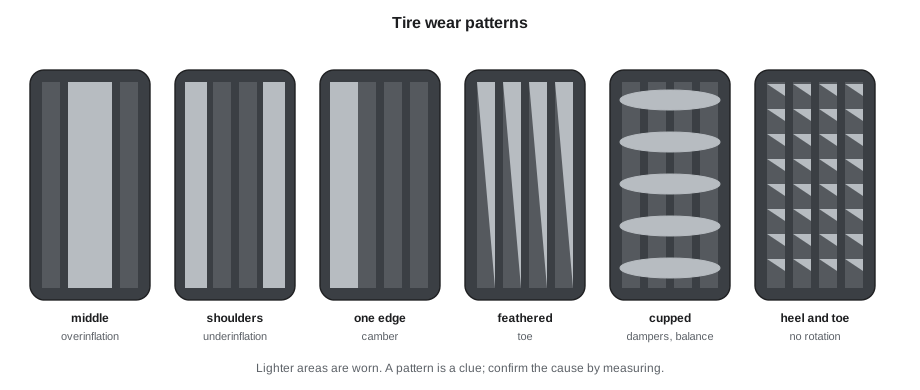
As each set comes off in the changeover rush, Kiran reads them. The Lindqvists' winter tires have heel-and-toe wear on the rears, because they were never rotated. One of Hal's vans has center wear: its drivers have been setting the pressures at the maximum on the sidewall instead of the placard. Gord's light truck winter tires are even, but they are eight years old and their sidewalls have fine cracks; Simone suggests replacing them before next winter. Every finding goes on the repair order, with tread depths, so customers can see what Ridgeline sees.
# How old is a tire? Read the last four digits of its identification number
import datetime
today = datetime.date(2027, 4, 6)
for name, code in [("Gord's winter LT", "0919"), ("Dr. Singh's summer rear", "4123"), ("van 2 front", "1225")]:
    week, year = int(code[:2]), 2000 + int(code[2:])
    made = datetime.date.fromisocalendar(year, week, 1)
    age = (today - made).days / 365.25
    flag = "point it out" if age >= 6 else "ok"
print(f"{name:<24} code {code}: made week {week} of {year}, {age:4.1f} years old, {flag}")Gord's winter LT code 0919: made week 9 of 2019, 8.1 years old, point it out Dr. Singh's summer rear code 4123: made week 41 of 2023, 3.5 years old, ok van 2 front code 1225: made week 12 of 2025, 2.1 years old, ok
Worked problem
Is this load index enough?
Jess's SUV has original tires of size 225/65R17 102H, and she wants 245/45R20 tires. The tire shop offers a standard-load tire with load index 99. The vehicle's heaviest axle load is 3,440 lb. Is the offered tire acceptable?
Show solution
- Each tire on that axle carries half: 1,720 lb.
- Load index 102 is 1,874 lb and 99 is 1,709 lb.
- The offered tire is rated below the original and below the actual load of 1,720 lb.
- A replacement must have at least the original load index at the correct pressure; an XL tire of that size with index 102 or higher is needed.
Answer: No. The offered tire's load index is too low; Kiran recommends an XL tire with a load index of at least 102.
Common mistakes
MistakeInflating to the maximum pressure on the sidewall.
InsteadUse the pressure on the vehicle's placard; the sidewall figure is a limit.
MistakeFitting a plus size with a lower load index.
InsteadMatch or exceed the original load index at the correct pressure, often with an XL tire.
MistakeTreating M+S as a winter tire marking.
InsteadOnly the three-peak mountain snowflake symbol shows a tested winter tire.
MistakeIgnoring a tire's age because the tread is deep.
InsteadRead the date code and point out tires more than about six years old.
MistakeRotating directional tires side to side.
InsteadDirectional tires move front to rear on the same side only.
Summary and key terms
- Radial tires have body plies running bead to bead and steel belts under the tread.
- The size code gives the type, width, aspect ratio, construction, rim size, load index and speed rating.
- Load index sets the maximum load; XL and HL tires carry more; speed rating is a tested limit.
- The identification number's last four digits give the week and year of manufacture.
- The three-peak mountain snowflake marks a tested winter tire; some places require winter tires by law.
- Plus sizes must keep the overall diameter within a few percent and the load index at least as high.
- Wear patterns point to inflation, alignment, damper and rotation faults.
- Radial tire
- A tire whose body plies run from bead to bead at right angles to the direction of travel.
- Aspect ratio
- The sidewall height as a percentage of the section width.
- Load index
- A number standing for the maximum load a tire can carry at its maximum pressure.
- Speed rating
- A letter standing for the speed at which a tire can carry its rated load under test.
- Three-peak mountain snowflake
- The symbol for a tire that has passed a standard snow traction test.
- Plus sizing
- Fitting larger wheels with lower-profile tires of nearly the same overall diameter.
- Feathering
- Tread ribs worn to a sharp edge on one side, usually caused by incorrect toe.
Practice problems
Work each problem on paper first, then reveal the answer to check.
What does the 55 in 205/55R16 mean?
Show answer
The sidewall height is 55 percent of the 205 mm section width.
A tire's code ends in 3721. When was it made?
Show answer
In the 37th week of 2021.
A front tire is worn smooth on its outer edge only. What is the likely cause?
Show answer
Too much positive camber, or a bent or worn suspension part.
Why do electric vehicles often need tires with a higher load index?
Show answer
Their batteries make them heavier than similar gasoline vehicles.
Lesson quiz · 5 questions
Score 60% or more to complete this lesson.
Create a free account to save your progress, take quizzes and earn a certificate.